Breaking News
Breaking News
from Washington and beyond

Florida GOP Bill Would Require Bloggers Who Write About Ron DeSantis to Register With the State

First Amendment or nah?

Ron DeSantis smiles
Paul Hennessy/SOPA Images/LightRocket/Getty Images
Ron DeSantis

A Florida Republican lawmaker has introduced a bill that would require paid bloggers who write about elected officials to register with the state.

The bill, which was introduced Tuesday, applies to bloggers covering Governor Ron DeSantis, his Cabinet, and the state legislature. The bloggers would have to register with the state government and then self-report every time they write a story about lawmakers, as well as how much they were paid for the posts and who paid them.

If the bloggers fail to report their stories within five days of publication, they will face fines of $25 a day, up to $2,500.

“Paid bloggers are lobbyists who write instead of talk,” state Senator Jason Brodeur, the bill’s sponsor, said. “They are both professional electioneers. If lobbyists have to register and report, why shouldn’t paid bloggers?”

Creating a registry of political writers and independent journalists would only allow for increased surveillance, and smacks of authoritarianism. DeSantis has remained a constant in headlines as of late for cracking down on human rights in his state, particularly for people of color and women and gender minorities. The Republican, seen as a front-runner for the Republican 2024 presidential nomination, has declared war on all things “woke” and is clearly making good on his promise.

Brodeur too is no stranger to controversy. He was elected in 2020 with just 50.3 percent of the vote, and there have been accusations that a “ghost candidate”—someone recruited to help sway the election results—siphoned thousands of votes away from Brodeur’s Democratic opponent.

His new bill is highly unconstitutional and unlikely to survive if challenged in court, according to New York–based First Amendment lawyer Ron Kuby.

“It’s hard to imagine a proposal that would be more violative of the First Amendment,” Kuby told NBC. “We don’t register journalists. People who write cannot be forced to register.”

Democrats Blast Joe Biden for Siding With Republicans to Overturn D.C. Laws

Does Washington, D.C. deserve rights or not?

Biden and Bowser sit at a table.
Chip Somodevilla/Getty Images
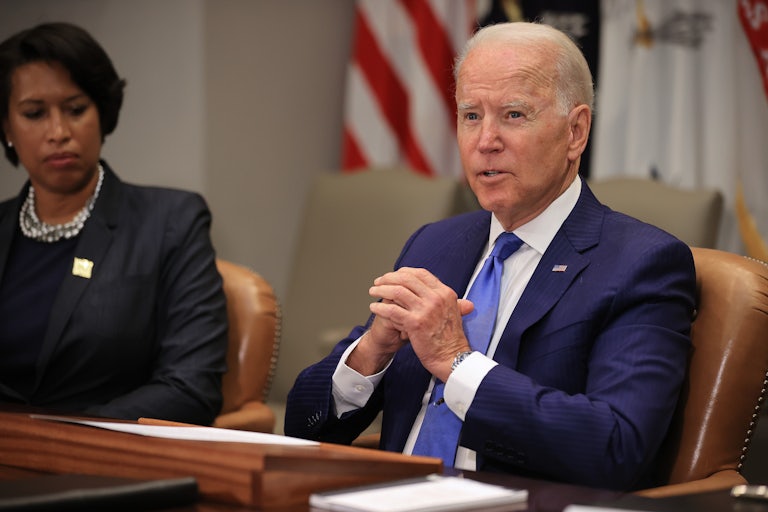
President Joe Biden hosts a meeting with Washington, D.C., Mayor Muriel Bowser, in July 2022.

On April 20, 2021, the Biden administration called the “denial of self-governance” in Washington, D.C., “an affront to the democratic values on which our Nation was founded,” wholeheartedly endorsing efforts to give D.C. statehood. But now President Biden is supporting a congressional effort to actively deny D.C.’s “self-governance.”

After the D.C. City Council voted unanimously in support of a criminal code reform bill—and voted 12–1 to override Mayor Muriel Bowser’s veto of it—Republicans pounced on the bill last month, vying to subvert local democratic processes and obstruct the reforms (Republicans interfering in democracy; who would’ve imagined?). But more astonishing was that many moderate Democrats joined the charade and voted to overturn the D.C. law too. And on Thursday, Biden announced he’d join them.

Democrats in and outside of D.C. are furious, noting that the administration either supports D.C. statehood, or it doesn’t. “The White House f***** this up royally,” one House Democrat texted The Hill. “F****** AMATEUR HOUR. HEADS SHOULD ROLL OVER AT THE WHITE HOUSE OVER THIS.” They added that numerous other members were “EXTREMELY PISSED.”

The House voted last month to block both D.C.’s proposed criminal code reform, which would eliminate most mandatory sentencing and reduce penalties for certain crimes, and another bill that would extend voting rights to noncitizens. An estimated 7 percent of D.C. residents are noncitizens of some form. It is likely to clear the Senate as well, and now with Biden’s announcement, a local government overseeing 700,000 residents will find its rule wholly subverted by the federal government.

An array of D.C. officials denounced the move. D.C. Delegate Eleanor Norton called the moment “a sad day for D.C. home rule and D.C. residents’ right to self-governance.”

Mayor Bowser—who, again, vetoed the criminal code reform—has not publicly commented since Biden’s decision, but last week, she wrote a letter to Senate leaders Chuck Schumer and Mitch McConnell beseeching Congress not to block the measures. “The insult of limited Home Rule is that the 700,000 DC residents and taxpaying Americans, and their duly elected officials, must endure the review and oversight of our laws by officials not elected to represent our interests or values,” Bowser wrote. “I call on all senators who share a commitment to the basic democratic principles of self-determination and local control to vote ‘NO’ on any disapproval resolutions involving duly elected laws of the District of Columbia.”

Democratic members of Congress echoed the concerns. “Plenty of places pass laws the President may disagree with. He should respect the people’s gov of DC just as he does elsewhere,” Representative Alexandria Ocasio-Cortez wrote on Twitter.

Number three House Democrat Pete Aguilar called the move “disappointing,” saying “I’m a former mayor of a city of 70,000 and I wouldn’t want the federal government coming in and telling me what city ordinances to pass.”

Republican Senator Lindsey Graham called Biden’s move “smart politics,” adding that, “you don’t want to get left of the D.C. mayor.” As if any consequential number of the more than 250 million potential voters in this country will make their decision based on Biden’s stance on D.C. criminal justice policies.

And even aside from the political miscalculation, the rhetorical misstep is almost just as confounding. Opponents of D.C. statehood are now using this as yet another feather in their tattered caps against stopping taxation without representation.

For an administration that purports to care about D.C. statehood, it’s silly for it now to support overruling D.C.’s own local processes. But it’s also a move that has no substantial political benefits—which may make one question whether the administration actually ever wanted D.C. statehood at all.

A Texas GOP Bill Wants to Stop Credit Card Companies From Processing Your Abortion Pill Payment

Texas Republicans are introducing bill after bill to make it harder to get an abortion.

MARK FELIX/AFP/Getty Images
An abortion rights demonstrator holds a sign outside the Harris County Courthouse during the Women’s Wave march in Houston, on October 8.

A Texas Republican lawmaker has introduced a bill that would ban credit card companies from processing transactions for abortion pills, the state’s latest attempt to dramatically curb safe access to the medical procedure.

The bill, which Representative Drew Springer proposed Thursday night, would classify processing credit card transactions for “the provision of an abortion-inducing drug by courier, delivery, or mail service” as a felony. The legislation would also allow individuals to sue credit card companies that allow such transactions to go through.

Springer’s bill did not say how the state would monitor credit card purchases for abortion pills, nor how civilians would know which card companies continue to process the transactions.

Since Roe v. Wade was overturned, Texas has banned abortion after six weeks, before many people even know they are pregnant. There are no exceptions for rape or incest, and only a few to save the life of the pregnant person. Individuals are also allowed to sue anyone who provides abortion care or helps someone get an abortion, in what’s known as the state’s chilling vigilante law.

Apparently not satisfied with those restrictions, Texas has continued to try to limit access to other forms of reproductive health. Last week, another Republican lawmaker introduced a bill that would compel internet providers in the state to block websites that sell or provide information on how to obtain abortion pills.

Under the Women and Child Safety Act, abortion funds and their staffers could face criminal penalties for helping someone get an abortion even if they travel out of state, as could individuals who manufacture and distribute abortion pills in Texas or who provide information on how to get the drugs. The bill would also allow individuals to bring civil lawsuits against the people who maintain such sites, another extension of the state’s vigilante law. All of these restrictions, however, run counter to what Texans actually want: A study by the Public Religion Research Institute found that 57 percent of state residents think abortion should be legal in all or most cases.

Medication abortions, which consist of taking the two drugs mifepristone and misoprostol, make up more than half of all abortions in the United States, according to the Guttmacher Institute. The pills are considered a crucial resource in maintaining widespread access to safe abortions. Restricting the means to medication abortions will hit people of color and lower-income people the hardest.

Mississippi Republicans Want to Ban Ballot Initiatives on Abortion

Fun new attack on democracy

Posters outside the pink abortion clinic read things like "This clinic is a refuge" and "Pink House, thank you for being here. These people, this place, has saved my life."
ANDY HUFFAKER/AFP/Getty Images
The Jackson Women’s Health Organization, Mississippi’s last abortion clinic, on July 7, 2022. The clinic is now closed.

Mississippi lawmakers have introduced a bill that would give citizens back the right to vote on ballot initiatives—except on laws about abortion access.

State residents were stripped of their right to introduce citizen-led ballot initiatives in 2021. This new bill, introduced Tuesday, would allow them to propose changes to laws but not constitutional amendments. They would also not be allowed to “propose any new law or amend or repeal any existing law relating to abortion.”

The U.S. Supreme Court ruled in Dobbs v. Jackson Women’s Health Organization last summer to roll back the nationwide right to an abortion. The case concerned the constitutionality of Mississippi’s law banning abortion after 15 weeks. After the ruling, Mississippi’s trigger law went into effect, and abortion is now illegal in the state except in cases of rape or incest or to save the pregnant person’s life.

Opinion regarding abortion in Mississippi is almost evenly split. A recent study by the Public Religion Research Institute found that 49 percent of state residents believe the procedure should be legal in all or most cases. In July 2022, a month after the Dobbs ruling, a poll conducted by Blueprint Polling for the ACLU of Mississippi found that 51 percent of state residents disagreed with the Supreme Court’s decision.

Mississippi residents also rejected a previous ballot initiative aimed at curbing abortion access. In 2011, anti-abortion groups put the Personhood Amendment on the ballot. The amendment would have defined the word “person” in the state constitution to include fertilized human eggs. An overwhelming majority of voters, 58 percent, rejected the initiative.

Lawmakers in Mississippi have a history of using the right to ballot initiatives as a punitive tool. It has been taken away twice, once in 1922 and again in 2021, because officials disagreed with the results of citizen-led ballot initiatives.

If the measure passes the state legislature, it would be just another instance of lawmakers creating loopholes to continue restricting abortion, instead of letting the people decide what they want for themselves. This has also happened in Kentucky, where a Republican lawmaker introduced a bill to prosecute people who get illegal abortions for criminal homicide, despite state residents voting in the 2022 midterms against an amendment that would have said abortion is not a protected right in the state.

The most egregious example is Kansas, where residents voted overwhelmingly in August to keep abortion protections in the state constitution. Lawmakers responded by introducing a bill that would let individual cities and counties restrict abortion, directly circumventing the will of the people.

Texas GOP Bill Would Give Major Tax Cut to Straight, Never-Divorced Parents

If you make it to kid number 10, there’s an extra reward for you.

Brandon Bell/Getty Images

Conservatives are always seeking ways to (a) defund the government and its services and (b) push their own cultural values onto others. One Texas state representative found a way to try doing both.

Representative Bryan Slaton has filed a bill to roll back 100 percent of property taxes for heterosexual married couples with 10 children.

The legislation calls for property tax relief by increments of 10 percent for each child, starting with married couples with four “qualifying children” receiving a 40 percent credit, those with five receiving a 50 percent credit, and so on. (Couples with three children or fewer do not qualify for the credit.)

If a “qualifying married couple” has 10 or more “qualifying children,” they would receive a 100 percent credit off their property taxes.

Language in the bill defines a “qualifying child” to be a “natural child of both spouses of a qualifying married couple born after the date on which the qualifying married couple married,” or an adopted child of one or both spouses, adopted after the couple was married.

And what constitutes a “qualifying married couple,” you may ask? Well, it “means a man and a woman who are legally married to each other, neither of whom have ever been divorced.”

“With this bill, Texas will start saying to couples: ‘Get married, stay married, and be fruitful and multiply,’” Slaton said in a statement.

The bill may not be surprising coming from Slaton. The Houston Press reports that the Texas representative, a former minister, has proposed banning minors from all drag events and has also dedicated much of his time in government to trying to attach various anti-LGBTQ amendments to completely unrelated legislative packages.

Slaton’s former intern Jake Neidert is a self-described Christian nationalist who has menacingly called for trans people to be “publicly executed.” The vicious figure went on to work as legislative director for Representative Tony Tinderholt, Slaton’s ally in many of his anti-LGBTQ crusades.

So, whether or not this specific bill gets awfully far, rest assured its author is heavily active in working to advance a radical fundamentalist agenda on Texans.