Life in a Warming World
A weekly reckoning with our heated planet—and the fight to save it

Why Harris Is Backpedaling on Fracking

Fracking and corn-based ethanol have a lot in common.

Kamala Harris talks to reporters on a tarmac.
Erin Schaff/Pool/AFP/Getty Images
Vice President Kamala Harris arrives in Atlanta for a campaign event on July 30.

Shortly after the Iowa caucuses—a moment that feels almost unfathomably long ago in this presidential race—Tom Philpott wrote about the peculiar role that corn-based ethanol plays in national politics. Because ethanol is important to Iowa, and the Iowa caucuses are important in the primaries because of their early date, candidates from both parties tend to declare their allegiance to federal ethanol subsidies.

But ethanol subsidies are a pretty inefficient way to encourage energy production. Solar panels generate 100 times as much energy as corn per acre, Tom wrote. Installing them in place of cornfields would open up more land for growing actual food, while reducing pesticide and fertilizer runoff into waterways and reducing the destruction of Iowa’s soil layer. But the tangled history of Iowa corn, federal subsidies, and the primary schedule go back so far at this point that it’s very hard to start a serious political discussion about what better policies might look like.

I thought back to Tom’s piece this week, as news emerged that Kamala Harris was walking back her prior opposition to fracking. As California attorney general, she sued the Obama administration over its fracking approvals off the state’s coast, and in the 2019 Democratic primaries she promised to ban the practice, but her campaign is now telling the press that she would not in fact ban it.

Fracking is somewhat similar to ethanol, actually, in terms of its place in American political narratives. Fracking pollutes groundwater, has fueled a huge spike of planet-warming methane, and isn’t very profitable: The expensive practice is a “sorry bet for job creation,” TNR’s Kate Aronoff wrote in 2019. But much like ethanol in Iowa, for almost two decades fracking has played an outsize role in states that play an outsize role in the presidential election—specifically, Ohio and Pennsylvania.

Ohio, which Trump has twice won comfortably, probably won’t decide the 2024 election. Pennsylvania, on the other hand, very well might. “Many strategists in both parties believe Pennsylvania and its 19 electoral votes could wind up being the decisive state,” Axios reported in May. And so far, the polling in Pennsylvania has suggested the race is neck and neck. So it’s not particularly surprising that Harris is backpedaling on her fracking opposition, presumably aiming to win Pennsylvania voters.

As with ethanol, though, there’s something a bit tragic about this political pandering. While Pennsylvanians are the ones Harris hopes to win by backing fracking, they’re also the people most likely to be harmed by fracking. As Colin Jerolmack has repeatedly written for TNR, even landowners who have made money leasing their land to drillers have sometimes come to regret it—either because they regret losing control over their own properties or because of the effect on local groundwater. (In one community, he wrote, “private water wells became laced with carcinogenic chemicals and contained methane concentrations so high that running faucets could be set on fire.”) Grist’s Jake Bolster reported last week on the industry’s troubling habit of dumping fracked wastewater—which has been found to contain toxic compounds—on Pennsylvania roads, with the cooperation of some state authorities. As of 2021, the last time a major poll was conducted, not only did a majority of Pennsylvanians want to see more regulation of the fracking industry, but a majority actually wanted to “end” fracking in the state (25 percent wanted it done “as soon as possible,” and 30 percent favored a gradual transition).

So why is Harris reversing her position on fracking if Pennsylvanians want it gone? One reason may be that many of the voters who oppose fracking (for example: the 79 percent of Democrats who want fracking to end) will vote for her either way. The people the party is anxious about winning, on the other hand, might be the ones who’d be turned off by a proposed ban. For example, 43 percent of independents in the 2021 poll said fracking should not end or be phased out.

At the end of the day, ethanol and fracking—which defy any rational cost-benefit calculation—persist for the same reason: American democracy isn’t particularly democratic.

Good News/Bad News


There’s a growing consensus that carbon capture doesn’t work very well—and, per Amy Westervelt’s analysis of internal documents, that fossil fuel companies probably knew that to begin with. That’s bad news in one sense, but the growing consensus also builds the foundation for better ideas and policies going forward.


Wildfires like the Park Fire now threatening four counties in California can also contaminate the water supply beyond the immediate burn range in several ways. A new multimedia report in The Washington Postexplains how.

Stat of the Week
73%

That’s how much of the world’s coral is now bleaching due to heat, according to The Guardian’s latest report on the ongoing mass bleaching event.

What I’m Reading

Do bigger highways actually help reduce traffic?

The answer is “no.” MIT Mobility Initiative fellow David Zipper explains why widening highways doesn’t solve the problem these proposals are hoping to solve:

These projections have a fatal blind spot: They fail to consider how humans respond to changing conditions like new vehicle lanes. When people see cars traveling freely over a recently expanded highway, they will recalibrate their travel decisions. Some will choose to drive at rush hour when they would have otherwise driven at a non-peak time, taken public transit, or perhaps not traveled at all. When a roadway is widened, Marshall said, “You might have less congestion at first, but it quickly goes away.”

Such behavioral adjustments will continue until traffic is as thick as it was before, when the roadway was narrower. The only difference is now there will be more cars stuck in traffic, emitting even more pollution.

This phenomenon is known as induced demand.

Read David Zipper’s full story at Vox.

This article first appeared in Life in a Warming World, a weekly TNR newsletter authored by deputy editor Heather Souvaine Horn. Sign up here.
What Kind of Climate Candidate Will Kamala Harris Be?

Some clues suggest her approach to climate policy might differ subtly from President Biden’s.

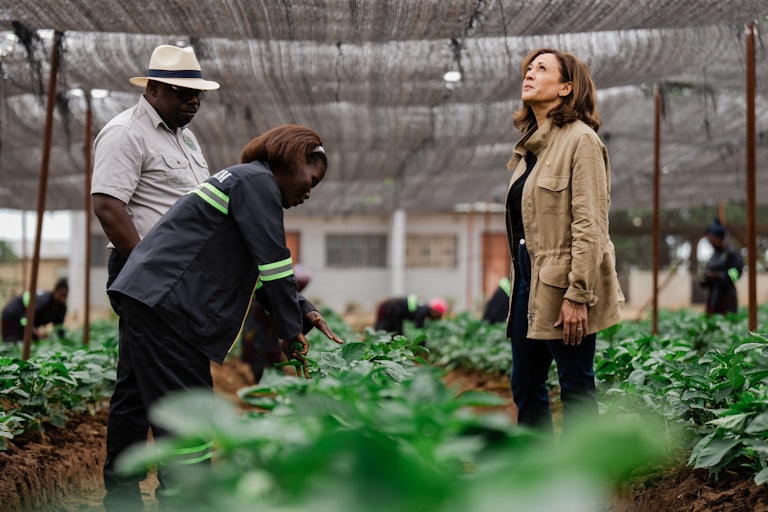
Kamala Harris looks up toward a light-filtering cloth shading the rows of crops she stands among. Two others show her the crops.
Kent Nishimura/Los Angeles Times/Getty Images
Vice President Harris vists Panuka Farm in Lusaka, Zambia, on a trip highlighting climate-smart agriculture and food security.

Earlier this month, TNR’s Kate Aronoff argued that perhaps the best gift President Biden and his team could give the planet would be to step aside. “The Biden administration has almost certainly done more to reduce greenhouse gas emissions than any of its predecessors,” she wrote. But sticking with a “struggling” candidate unlikely to win in November would be a “catastrophe”—not just because it might hand the White House to Donald Trump, who has already promised to reverse Biden’s climate policies, but because Democrats would trash their credibility with younger voters, making it harder to pass robust climate policy for years to come.

Now Biden has stepped aside, passing the torch to Vice President Kamala Harris. That Harris would be a more pro-climate president than Trump is pretty clear—even to senior Republicans and Trump alums. But just how pro-climate would she be?

Several outlets have already tried to answer this question by looking at her history. As vice president, in addition to promoting the administration’s signature Inflation Reduction Act, “Harris argued for the allocation of $20 billion for the EPA’s Greenhouse Gas Reduction Fund, aimed at aiding disadvantaged communities facing climate impacts,” Grist’s Zoya Teirstein writes, and “was the highest-ranking U.S. official to attend the international climate talks at COP28 in Dubai last year,” where she announced new U.S. pledges for green energy and climate adaptation funds for poorer countries. But that, as Teirstein points out, doesn’t indicate much, as it goes along with the V.P. role.

One could also look to Harris’s platform for the 2019 primaries. That’s not the best indicator, either: 2019 was “pretty near peak-Greta,” observes writer and environmentalist Bill McKibben, referring to climate activist Greta Thunberg, and Harris was pitching herself specifically to Democrats. But that said, Harris did differ from Biden in backing a fracking ban. And there’s some reason to believe she meant it. The New York Times noted this week that in 2016, as California attorney general, Harris sued the Obama-Biden administration over fracking approvals off the state’s coast.

This wasn’t the only environmental case Harris pursued as attorney general, or as San Francisco district attorney before that. While the environmental justice unit she created in San Francisco “only filed a handful of lawsuits,” and not particularly significant ones, Teirstein writes, Harris did found the unit. She also secured several settlements for environmental cases against Chevron, BP, and Volkswagen and investigated whether ExxonMobil lied to shareholders about the risks from climate change.

Ultimately, it might be Harris’s time as senator that proves most tantalizing to those dedicated to the fine political art of tea-leaf scrutiny. Harris supported numerous pieces of environmental legislation during her time in the Senate—the Los Angeles Times points to the Clean School Bus Act of 2019, the Water Justice Act of 2019, and her support for limiting PFAS and lead exposure, among others. She was also one of the original co-sponsors of the Green New Deal.

While the Biden administration has pursued policies aligned with the Green New Deal, Biden himself has typically refrained from letting those three words pass his lips, much as he’s often retreated into euphemism when it comes to abortion. There’s clearly a difference of some degree between Harris and Biden when it comes to language and rhetoric. Only time will tell what difference there might be in substance.

Good News/Bad News

Water use in California’s urban areas is down 9 percent since the last drought emergency, the Los Angeles Times reports. A caveat: This falls short of Governor Newsom’s goal of a 15 percent cut in urban water use. A much bigger caveat: Urban water use is, itself, a bit of a red herring. The amount of water consumed by agriculture is roughly four times higher than that for urban residential needs, and that’s a much tougher nut to crack, politically. While shifting away from thirsty crops like alfalfa (for cattle), almonds, and fruit could cut water consumption by 93 percent, researchers recently found, replacement crops wouldn’t be as profitable.

As news broke that the world’s average temperature for a single day had climbed to the highest ever recorded on Sunday and then smashed that record again on Monday, research firm Rhodium Group released a report finding that, even with the Inflation Recovery Act’s infusion of cash into green energy and energy efficiency, the U.S. is falling short of its pledge to cut emissions 50 percent relative to 2005 levels by 2030.

Stat of the Week
40%

That’s how many active ingredients in U.S. pesticides are actually PFAS, according to new research contradicting Environmental Protection Agency claims. PFAS are extremely long-lasting chemicals that have been linked to liver damage, immune system disruption, hormonal disruption, obesity, and some forms of cancer, to name a few possible health effects. “The researchers also obtained documents,” The Guardian
reports, “that suggest the EPA hid some findings that show PFAS in pesticides.”

What I’m Reading

To Help Stop Malaria’s Spread, CDC Researchers Create a Test to Find a Mosquito That Is Flourishing Thanks to Climate Change

Global warming is opening up new habitat for mosquitoes and the diseases they transmit. And one particular species is now threatening Africa:

A mosquito native to Asia has found a new home on the planet’s second-largest continent—and, as a prime carrier of the parasite that causes malaria, poses an increased public health threat to nearly 130 million people.

The mosquito—the notorious Anopheles stephensi—is not only adaptable, but it also bears a striking resemblance to most other insects in its genus, making it difficult for researchers, government officials and just about anyone else to determine which bug is which.

That is, until earlier this year. Researchers at the Centers for Disease Control and Prevention recently announced that they have developed a new test that allows for the rapid identification of the disease-transmitting insect, giving communities where the mosquito is migrating a chance to move quickly to eradicate it and address potential malaria infections.

Read Victoria St. Martin’s full report at Inside Climate News.

This article first appeared in Life in a Warming World, a weekly TNR newsletter authored by deputy editor Heather Souvaine Horn. Sign up here.
Will Heat Waves Become a Voting Issue?

More people recognize that climate change is driving deadly heat waves than believe either Trump or Biden would make a good president.

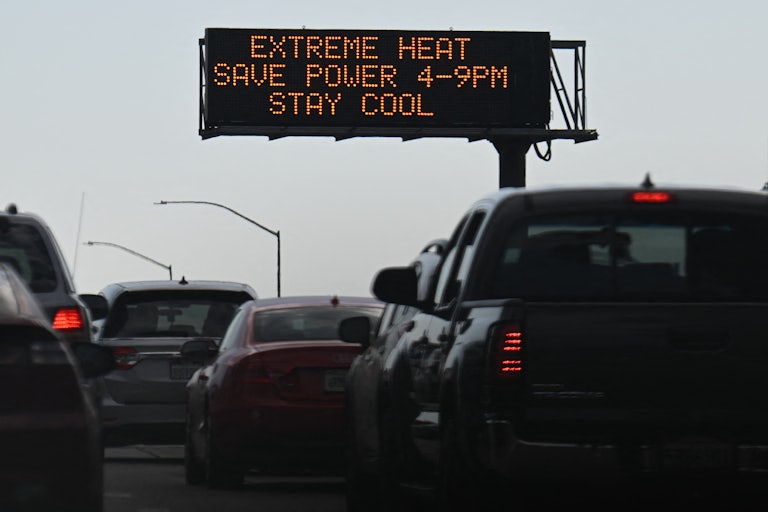
Cars sit in bumper-to-bumper traffic beneath a sign saying "Extreme Heat Save Power 4-9 PM Stay Cool."
PATRICK T. FALLON/AFP/Getty Images
A highway sign during a heat wave in Los Angeles in 2022

In the first two weeks of July, extreme heat killed at least 37 people across the United States, and 19 in one California county alone, according to conservative estimates reported by CNN. Last week, Las Vegas set a new record of five consecutive days with temperatures over 115 degrees, while Washington, D.C., hit 104 degrees on Tuesday amid what is so far the city’s hottest summer ever.

It’s not just the U.S. In April, heat waves hammered East Asia, breaking records in Vietnam, Laos, and Myanmar. At least 1,300 are estimated to have died from extreme temperatures during this year’s Hajj in Saudi Arabia in June.

Headlines from the U.S. presidential race—a shocking debate, a possible brokered convention, an assassination attempt, and more—have overwhelmed these stories in recent weeks. But extreme heat may prove in retrospect to be one of the most important stories of the summer.

And three-quarters of Americans accept the science behind this fatal heat. Seventy-four percent of people in the U.S. now believe that global warming is affecting extreme heat in the nation, according to a large survey released this week by the Yale Program on Climate Change Communication and George Mason University’s Center for Climate Change Communication.

Let’s put that number into perspective: 74 percent is not only higher than the percentage of respondents in a March 2024 Gallup poll who think Trump would make a good president (35 percent), and higher than the percentage who say Biden would make a good president (30 percent)—it’s higher than both of those numbers added together. More people in the U.S. believe climate change is driving extreme heat than think either party’s candidate would do a decent job in the White House.

Personal beliefs are complicated, and so are poll numbers. That 74 percent figure doesn’t mean that 74 percent of Americans are motivated to act right now (or in November) to limit climate change. The same Yale/George Mason survey found, bizarrely, that only 50 percent of Americans think they have “personally experienced the effects of global warming,” and only 47 percent think people in the country are being harmed “right now” by global warming.

But the survey also found that 67 percent of Americans say global warming is “personally” important to them, to varying degrees, and 62 percent feel some level of personal responsibility to help reduce it.

Liza Featherstone previously wrote at TNR about a group called the Environmental Voter Project, whose leaders believe that climate change—and the environment more broadly—may be a vast, currently untapped force in this country’s elections. While many voters don’t consider climate change their top priority, many people who currently don’t vote (and therefore aren’t necessarily captured in historical election data, “likely voter” polls, or even Democratic or Republican voter-turnout efforts) say climate change is their top political priority.

Some experts, accordingly, are starting to believe disaffection and climate concern may go hand in hand, in ways that could lead to huge swings if people who care about climate change suddenly show up at the polls. That’s an intriguing theory this summer, as so many people and op-eds are expressing dissatisfaction, or even panic, at the candidates taking the stage at the Republican and Democratic conventions.

As deadly heat waves continue, and increase, it will become harder and harder for people to believe that they personally haven’t experienced the effects of climate change. And as Americans’ disenchantment with their political options grows, party leaders may well wonder whether the answer to their electoral woes—putting climate change front and center in their campaigns and policy platforms—has been staring them in the face all along.

Good News/Bad News

A project in Borneo, The New York Times reports, is providing proof of concept that community-run reforestation can boost biodiversity and wildlife while helping villages get the services they need.

Google’s recent retreat from net-zero goals, thanks to the energy demands from artificial intelligence, isn’t the only sign of Big Tech struggling to keep its carbon neutrality promises. As MIT Technology Review explains this week, Amazon’s claims of meeting its targets also deserve scrutiny: The company is relying heavily on renewable energy credits and carbon credits, and it’s far from clear that those actually reduce emissions.

Stat of the Week
1.3 milliseconds per century

That’s the increased rate at which the planet’s rotation is slowing (it was previously slowing by only 0.3 to 1 milliseconds per century), due to the melting of the polar ice caps, The Guardian reports.

What I’m Reading

Scientists plan climate engineering experiment in ocean off Cape Cod

Many worry that geoengineering—tinkering with the world’s natural systems, like the circulation of water in the air and ground, in an attempt to reduce climate change—is both risky and represents time and money better spent just halting fossil fuel emissions. But scientists at the Woods Hole Oceanographic Institution in Massachusetts are about to experiment with it:

The scientists want to disperse 6,600 gallons of sodium hydroxide—a strong base—into the ocean about 10 miles south of Martha’s Vineyard. The process, called ocean alkalinity enhancement or OAE, should temporarily increase that patch of water’s ability to absorb carbon dioxide from the air. This first phase of the project, targeted for early fall, will test chemical changes to the seawater, diffusion of the chemical and effects on the ecosystem.

If successful, the team plans to conduct a larger trial next year in the Gulf of Maine.

Dan McCorkle, co-principal investigator of the project and a recently retired Woods Hole researcher, said the team chose a part of [the] ocean that would minimize impact on marine life, and that they will stop the release of sodium hydroxide if marine mammals are present. The chemical will likely be detectable in an area a couple miles in diameter and should dissipate within five days.

Read Barbara Moran’s report at WBUR.

This article first appeared in Life in a Warming World, a weekly TNR newsletter authored by deputy editor Heather Souvaine Horn. Sign up here.
Being Against Poop in Rivers Is Now “Un-American”

Oklahoma Governor Kevin Stitt has an unusual interpretation of Oklahoma v. Tyson.

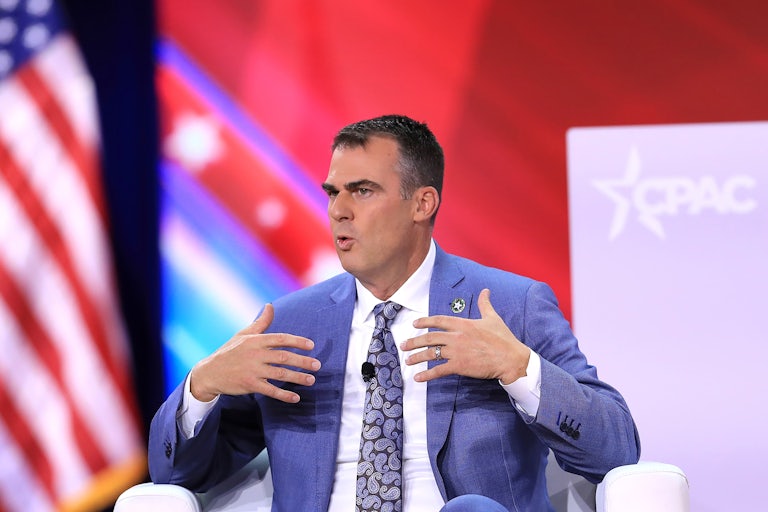
Kevin Stitt gesticulates while seated onstage.
Dylan Hollingsworth/Bloomberg/Getty Images
Kevin Stitt, governor of Oklahoma, speaks during the Conservative Political Action Conference in Dallas, in 2022.

If a company fills a river with bird poop to the point that fish in nearby lakes asphyxiate, is it “un-American” to sue them? Oklahoma Republican Governor Kevin Stitt thinks so. Last week, he signed a law that makes it impossible to sue a poultry company for pollution as long as it has a “Nutrient Management Plan” that complies with state requirements.

“You can’t have a business have a permit, doing what they’re supposed to do, and then come in and let a frivolous lawsuit take place and somehow put them out of business. That’s un-American. It’s not going to happen in Oklahoma,” local news channel KFOR reported Stitt saying. “We had a former Attorney General that sued the chicken industry even though they were following all the rules at the time, saying they should have done something different.”

You may be wondering what all this is about. Stitt was referring to a case that began almost two decades ago: Oklahoma v. Tyson Foods. Not everyone would agree with Stitt’s description of what happened there.

In 2005, then–Oklahoma Attorney General Drew Edmondson, a Democrat, sued 11 companies over the pollution of the Illinois River. The companies, the case alleged, were spreading large amounts of chicken waste and bedding over cropland in the Illinois River Watershed, which covers parts of eastern Oklahoma and northwest Arkansas. While using chicken waste as fertilizer is allowed in some situations, this quantity of chicken waste, the state argued, led to high amounts of phosphorus runoff that polluted local waterways and, in turn, led to an overgrowth of algae and lower dissolved oxygen levels. Fish died, the Illinois River looked and smelled gross, the quality of the drinking water produced by the watershed suffered, and populations of fish and other wildlife in Lake Tenkiller declined.

“Frivolous” (Stitt’s word above) is an odd adjective to describe that lawsuit. Thirteen years after the trial ended in 2009, U.S. District Judge Gregory Frizzell finally ruled in 2023 that the state was right about almost everything. While the state couldn’t prove the bit about the quality of the drinking water, he said, the phosphorus levels, algae levels, wildlife death, and aesthetic degradation were clear, and Frizzell didn’t find the companies’ argument that they were following the law very compelling.

“Historically, defendants have done little—if anything—to provide for or ensure appropriate handling or management of the poultry waste,” he wrote. They “knew or should have known no later than the late 1990s that their growers’ land application of litter was a primary source of the excess phosphorus in the waters,” at which point they were obligated to take action or else fall afoul of state and federal public nuisance law, which stipulates that you’re not allowed to interfere with the public’s use and enjoyment of these waterways. And Oklahoma state law makes it clear, the judge added, that even if companies are following a strict pounds-per-acre regimen for chicken litter, “litter must be applied in a manner that will prevent pollution of State waters.”

Implying, as Governor Stitt did last week, that these sorts of lawsuits are putting law-abiding mom-and-pop shops out of business is also a little odd. Four of the companies named were either Tyson Foods or its subsidiaries. Tyson is the second-largest food company in the nation, right behind PepsiCo, and among the top 10 largest food companies in the world. Another two were Cargill and its subsidiary Cargill Turkey Production. Cargill is the largest privately held company in the country, with an estimated value of around $60 billion. Then there’s Cal-Maine Foods, with revenue above $1.3 billion, which was among those found liable in 2023 for conspiring with other companies to raise egg prices. And George’s Inc and George’s Foods LLC, which cut a $5.8 million deal with the Department of Justice last May as part of the department’s inquiry into poultry companies (including Cargill, which settled for $15 million) conspiring to suppress workers’ wages. Peterson Farms and Simmons Foods admittedly don’t have quite this sort of profile, although obviously no company that can recall 13 tons of TGI Friday’s boneless chicken bites, as Simmons did in December, is small.

The companies in question are now upset that they’re being told to pay to fix something that happened a long time ago—an objection that sort of cuts both ways, since the people affected by their actions are probably mad that it took this long too. The tribal governments of the Cherokee, Chickasaw, Choctaw, Muscogee (Creek), and Seminole Nations have denounced the new law giving the poultry industry immunity from these sorts of lawsuits. This is the background to Stitt’s remarks declaring these suits “un-American.”

The Oklahoma case is part of a bigger picture. Protecting lakes, rivers, and drinking water is actually extremely popular. Polls typically find higher support for that than for fighting climate change. But as TNR’s Kate Aronoff and others have repeatedly observed, the legal system is typically much more favorable to corporations than to their victims—human or animal.

Oklahoma has now made that system even more favorable to corporations. It’s one in a series of recent news events indicating that even the most clear-cut, commonsense moves to protect the public are going to be fought tooth and nail. On Monday, industry groups sued the federal government over a new standard to keep PFAS—chemicals “associated with developmental delays in children, decreased fertility in women and increased risk of some cancers,” per The New York Times—out of drinking water. I previously wrote about companies’ loud objections to being told they could no longer decaffeinate coffee using a chemical so dangerous that it’s been banned for paint stripping since 2019.

Voters say these issues matter to them. But if that’s the case, they’re going to have to show that at the polls. Relying on administrators and courts to protect them is getting riskier by the day.

Good News/Bad News

Bill McKibben sees hope in a new report suggesting that clean energy adoption is accelerating. Read his analysis at his newsletter, The Crucial Years.

Runoff from a large landfill, possibly including PFAS, may be contaminating waterways and even organic compost in the genteel winery-and-tourist-filled Napa Valley, The Guardian reports.

Stat of the Week
1.5 billion

That’s the number of people around the globe who experienced dangerous heat where they live between January and May of this year, according to The Washington Post.

What I’m Reading

Why a new method of growing food on Mars matters more on Earth

Brazilian astrobiologist Rebeca Gonçalves and her colleagues think an ancient Mayan farming technique could work well for growing food on Mars. And that also means it could work well in some of the increasingly arid, unpredictable climates on Earth:

Intercropping, or growing different crops in close proximity to one another to increase the size and nutritional value of yields, requires less land and water than monocropping, or the practice of continuously planting just one thing. Although common among small farmers, particularly across Latin America, Africa, and China, intercropping remains a novelty in much of the world. This is partly because of the complexity of managing such systems and largely unfounded concerns about yield loss and pest susceptibility. Modern plant breeding programs also tend to focus on individual species and a general trend toward less diversity in the field.

This is a missed opportunity, according to Gonçalves. Evidence suggests intercropping can combat the impacts of climate change and unsustainable farming practices on yields in degraded soils, which comprise as much as 40 percent of the world’s agricultural land. “The potential of intercropping really is very high for solving some of the climate change issues,” she said.

Read Ayurella Horn-Muller’s full report at Grist.

This article first appeared in Life in a Warming World, a weekly TNR newsletter authored by deputy editor Heather Souvaine Horn. Sign up here.

You’d Be Amazed How Many People Want Big Oil Charged With Homicide

A new poll shows overwhelming support for holding oil and gas companies accountable via the courts.

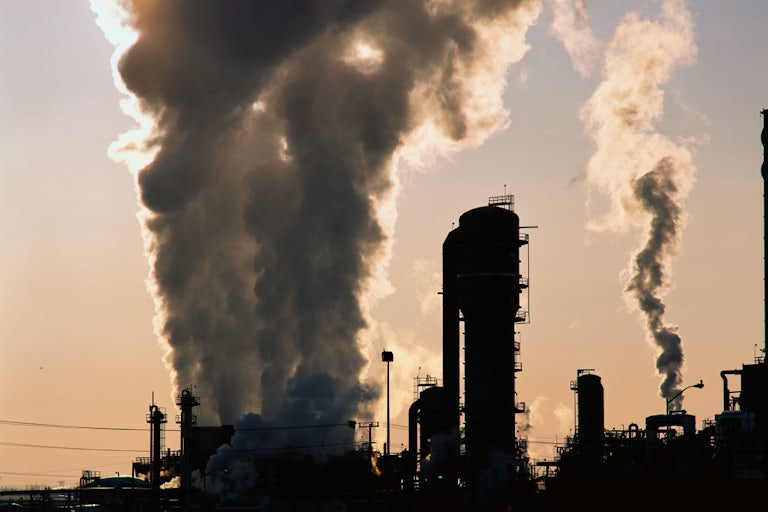
Smokestacks release giant plumes of smoke into the sky.
Joe Sohm/Visions of America/Getty Images
Smokestacks at a petroleum processing plant

Sixty-two percent of likely voters think oil and gas companies “should be held legally accountable for their contributions to climate change,” according to a new poll published this week. Not only do 84 percent of Democrats think that but also 59 percent of independents and even 40 percent of Republicans.

These are striking numbers. As I wrote in this newsletter last month, all too often pollsters ask people vague questions about whether people support “steps” to address climate change, without specifying what those steps are. That didn’t happen with this poll, which was conducted by the progressive think tank Data for Progress and consumer rights advocacy group Public Citizen. This was the exact question: “Do you think that oil and gas companies should be held legally accountable for their contributions to climate change, including their impacts on extreme weather events and public health?” In addition to the aforementioned political divides, women said “yes” more often than men, young people more often than old people, and Black or Latino people more often than white people—but that still adds up to a striking degree of support for accountability for fossil fuel companies.

Nor did the poll stop there. It also asked whether people supported not just civil lawsuits but criminal prosecutions for “reckless or negligent homicide.” This is a relatively new idea, and a somewhat edgy one for a lot of people. But 49 percent of respondents said they supported this too, compared to only 39 percent who said they’d oppose.

The New Republic has been covering legal approaches to climate accountability for years now: both the civil suits and more recent approaches. Public Citizen’s Aaron Regunberg and David Arkush made the case for criminal prosecutions, and specifically homicide charges, in March. “In criminal law, homicide means causing a death with a culpable mental state,” they reasoned. “If someone substantially contributes to or accelerates a death, that counts as ‘causing’ it. If they did so intentionally, knowingly, or recklessly, that counts as ‘culpable mental state.’ So the basic questions in a climate homicide trial are as follows: Did fossil fuel companies substantially contribute to or accelerate deaths, and did they do so at least recklessly, if not knowingly or intentionally?”

Criminal charges can do things that civil lawsuits can’t. “In today’s thinking,” Regunberg and Arkush wrote, “tort law—the law of civil wrongs—seeks economically efficient outcomes: The question is about whether one party should give another some money. Criminal law, by contrast, is concerned with society’s fundamental values—with morality.” And that’s reflected in the effects of these types of law: “Where tort law prices misconduct, criminal law prohibits it.”

Regunberg and law professor Donald Braman subsequently proposed another novel legal approach: civil asset forfeiture. That’s a tool that’s typically used by cops to confiscate property they suspect of being used for committing crimes—a system that disproportionately penalizes poor people and minorities, and in which it’s often very hard to recover the seized assets even if no crime is ever proven. But it was originally intended, Regunberg and Braman wrote, to be used against “large-scale criminal enterprises.” Since legal experts are now arguing that fossil fuel companies’ activities “could fall under the category of criminal violations such as reckless endangerment, criminal mischief, conspiracy and racketeering, and homicide,” Regunberg and Braman wrote, it stands to reason that the “pipelines, refining plants, and oil reserves” that are “recklessly endangering entire communities” could be confiscated by the police.

And then there’s Kate Aronoff’s latest. Given that fossil fuel companies have manufactured and promoted plastics for decades—even misleading the public about plastics recycling—there really ought to be a way, she argued, to hold them accountable at the international level for microplastics, which have now been found not only in “food, water, blood, and placenta” but also in human testicles. “In a recent book,” she wrote, “Spanish economist and environmental adviser David Lizoain makes the case for bringing fossil fuel executives in front of the International Criminal Court, and understanding rising temperatures—and the resulting mass deaths—as climate genocide.”

The international legal system is, on the whole, much more favorable to companies than it is to their potential victims, Kate argued. And that’s arguably true in the domestic arena as well. Which brings us back to the recent poll: If this many people favor legal accountability, perhaps that may be about to change.

Good News/Bad News

Bill McKibben writes in The New Yorker about a photography exhibit he found particularly effective at communicating the urgency of the climate crisis. The Asia Society’s “Coal + Ice” exhibit contains “perhaps the single most powerful rendering of the climate crisis I’ve ever seen,” he writes—specifically, photographer Gideon Mendel’s depiction of people all over the world standing in flood waters. “Mendel’s videos,” McKibben continues, “invoke change over physical space: the same foreign and scary thing is happening around the globe, simultaneously.” (If that doesn’t sound like good news, recall that effective policy depends first upon awareness and communication.)

Former Environmental Protection Agency employees with the nonprofit Public Employees for Environmental Responsibility have accused the EPA of incorrectly reporting the results of PFAS testing in pesticides, falsely telling the public that these long-lasting, potentially damaging chemicals had not been found in samples when, in fact, they had been.

Stat of the Week

26 days

On average, people experienced 26 more excessively hot days in the past year than they would have without climate change. Read The New York Times’ report here.

What I’m Reading

In a warmer world, tornado behavior is changing—this is how we can prepare

At least 24 people were killed last weekend in severe thunderstorms and tornadoes in multiple states. Tornado intensity and frequency are famously much, much harder to tie to climate change than hurricanes or atmospheric rivers are. But peak months seem to be shifting earlier in the season, and the pattern of touchdowns seems to be shifting eastward, the BBC’s Cinnamon Janzer reports.

“We have way more people living in the mid-south and east of the Mississippi River than we do in the Great Plains,” [meteorology professor Victor] Gensini says. The higher population densities of the states seeing an increase in storms means that they have the potential to do more damage.

As tornado seasons and locations change, one thing remains the same—the importance of preparation.… Trudy Thompson Shumaker, a volunteer and national spokesperson for the American Red Cross, says that education is key to preparing for tornadoes. “Know what to do and how to stay safe,” she says. This starts with identifying the safest room in your home—an interior, windowless space. Bathrooms sometimes meet these requirements, but a closet can also work, as can an emergency stairwell in larger buildings.

She also suggests assembling an emergency kit that contains the supplies necessary for sheltering in place for two weeks. “You’ll need water because the water supply may be unsafe. You’ll need a battery-powered radio and phone chargers,” says Thompson Shumaker. Before a tornado strikes, “go through your phone and write down the important numbers you’ll need if your phone goes dead.”

Read Cinnamon Janzer’s full report at the BBC.

This article first appeared in Life in a Warming World, a weekly TNR newsletter authored by deputy editor Heather Souvaine Horn. Sign up here.