Breaking News
Breaking News
from Washington and beyond

Cortez Masto Reelected Nevada Senator, Winning Key Seat for Democrats

Catherine Cortez Masto’s victory gives Democrats control of the Senate.

Profile view of Cortez Masto, as she smiles on stage.
Anna Moneymaker/Getty Images

Democrat Catherine Cortez Masto was reelected Nevada senator on Tuesday in a tight race against MAGA Republican Adam Laxalt, according to a projection from NBC News.

Cortez Masto leads Laxalt 48.7 percent to 48.2 percent, with 96 percent reporting.

With Cortez Masto’s victory in Nevada, Democrats will have 50 seats and maintain control in the Senate, as Vice President Kamala Harris can cast the tie-breaking vote.

Nevada is a swing state that went for Hillary Clinton in the 2016 presidential election and Joe Biden in 2020. But analysts have been warning for weeks that Democrats have taken the state’s Latino vote for granted and risked losing the crucial demographic during the midterms.

Cortez Masto, who in 2016 became the first Latina elected to Senate, specifically targeted Latina voters during her campaign. She focused on issues such as abortion access, affordable housing, and childcare.

She also sought to reach out to Latino small-business owners, to ensure they did not feel forgotten by Washington lawmakers.

Laxalt, however, was confident that he could draw the Latino vote away from the Democrats.

A descendant of Washington institution Republicans—his grandfather was once called Ronald Reagan’s “first friend”—Laxalt has veered sharply right from his family tree.

A former Nevada attorney general, Laxalt co-chaired Donald Trump’s campaign in the state and is now positioned to take up the former president’s ideological mantle.

He has complained against “wokeness” and pushed multiple conspiracy theories, including the Big Lie that the 2020 presidential election was stolen. After announcing his Senate campaign in late 2021, Laxalt pushed for an audit of the 2020 results in Douglas County, a rural county in Nevada’s northwest.

In October, 14 of his relatives endorsed Cortez Masto, though Laxalt pointed out that most of them were already registered Democrats.

This article has been updated.

More on the 2022 Election

Democrat Adrian Fontes Wins Arizona Secretary of State, Defeats MAGA Republican Mark Finchem

His victory means that a conspiracy theorist and election denier will not oversee voting rights in Arizona.

Christian Petersen/Getty Images

Mega-conspiracy theorist and MAGA Republican Mark Finchem lost the race for Arizona secretary of state, according to a projection from the Associated Press.

Democratic Adrian Fontes leads Finchem 52.8 percent to 47.2 percent, with 83 percent of votes counted. The former Maricopa County recorder and U.S. Marine will control the certification of election results in a crucial swing state.

Finchem ran an unusual campaign, with almost no paid advertising, public events, or media appearances, and with only one aide. Instead, he opted to ride the popularity of other more prominent right-wingers such as Arizona gubernatorial candidate Kari Lake. The Republican, whose signature look includes a cowboy hat, campaigned under the slogan “Just Follow the Law”—but he seemed pretty intent on breaking it.

A 2020 election denier, Finchem was photographed in the mob outside the Capitol on January 6. He has denied going into the building but says he would not have certified the results that year and has hinted he might reject Democratic victories in the future. He had expressed deep distrust of vote-counting machines and could force counties to count the votes by hand, which experts say is slower and less accurate. He can also change rules on where to set up voting booths and work with the state government to restrict early and mail-in voting.

Finchem also expressed support for the groups of people who showed up, sometimes armed, at early voting stations in Arizona. They said they were watching for voter fraud, but many accused them of voter intimidation, as they would take photos of people dropping off their ballots and sometimes follow voters.

As if that weren’t dangerous enough, Finchem has embraced some conspiracy theories that even his fellow MAGA Republicans won’t touch. He has said he is a member of the Oath Keepers and has accused former Vice President Mike Pence of plotting both a coup to topple Trump and to steal the presidency in 2024.

Mark Kelly Defeats MAGA Candidate Blake Masters in Arizona Senate Race

With Arizona in the bag, Democrats need either a win in Nevada or the upcoming Georgia runoff to maintain control of the Senate.

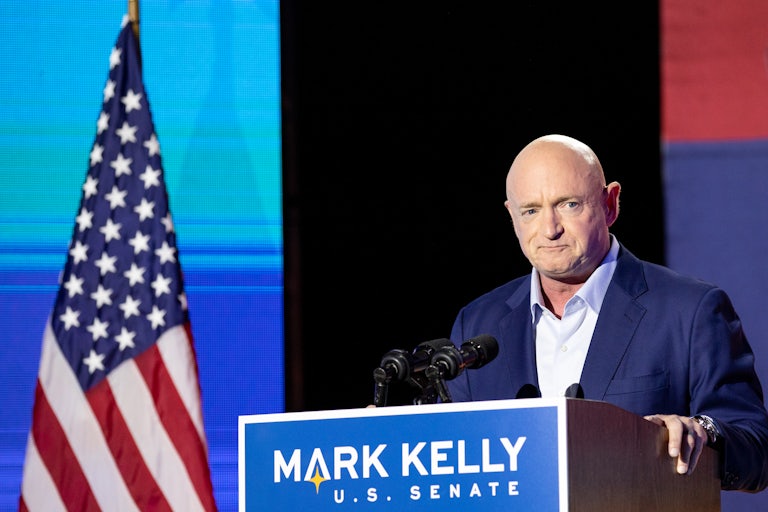
Mark Kelly speaks to supporters at a podium that reads “Mark Kelly for U.S. Senate”
Courtney Pedroza/Getty Images

Democratic incumbent Mark Kelly has defeated Republican challenger Blake Masters in the hotly contested Arizona Senate race. The race was called late Friday night by the Associated Press; with 83 percent of votes in, Kelly was leading by a margin of 51.8 to 46.1 percent. At the time the race was called, Masters was running slightly behind his fellow Republican, Kari Lake, who is running for governor in the state. (When the Senate race was called, Lake trailed Democratic candidate Katie Hobbs by a 50.7 t0 49.3 margin.)  

Arizona was seen as one of the races crucial to Democrats maintaining their hair-thin hold on the Senate. By securing re-election, Kelly brings the Democrats within one seat of keeping control of the Senate (should Democrats notch 50 seats, Vice President Kamala Harris will cast the tie-breaking vote). 

Kelly, a former astronaut and husband of former Representative Gabby Giffords, supports codifying abortion access into law and overhauling the U.S. immigration system. He also backs increased gun regulation and runs a nonprofit dedicated to the issue with his wife, who retired from politics after surviving an assassination attempt.

Arizona went for President Joe Biden during the 2020 presidential election, in a major upset.

But Republicans made steady inroads over the following two years, in part due to runaway inflation that they blamed on Biden.

Masters was seen as a long-shot candidate, but he gained steadily on Kelly in the last few weeks of the race. He was endorsed by former President Donald Trump and got a huge popularity boost through support from a MAGA PAC and his former boss, far-right billionaire Peter Thiel, who was a major donor to Masters’ campaign.

Masters initially supported a fetal personhood law but soon backed off that extreme stance in favor of a federal 15-week abortion ban. Both his initial abortion stance and his (false) claims that the 2020 election was rigged were scrubbed from his campaign website. He also supports finishing the expensive and ineffective U.S.-Mexico border wall started by Trump.

Attention now shifts to the Nevada Senate race, where Republican Adam Laxalt, at the time of this writing, had a 821 vote lead over incumbent Democrat Catherine Cortez Masto. However, Nevada politics reporter John Ralston, who has forgotten more about the Silver State’s political scene than most of the rest of us will ever know, favors Cortez Masto based on where the remaining votes are. 

 Should Democrats manage to secure the Senate ahead of the Georgia run-off, it could scramble the conventional wisdom of how voters might turn out to vote in that contest. The New Republic’s Grace Segers has some timely analysis of how that contest might shake out should Democrats win in Nevada.    

Kevin McCarthy Is in Trouble

As the GOP’s margin of victory in the House dwindles in the direction of single digits, so too go his chances of becoming speaker.

Chip Somodevilla/Getty Images

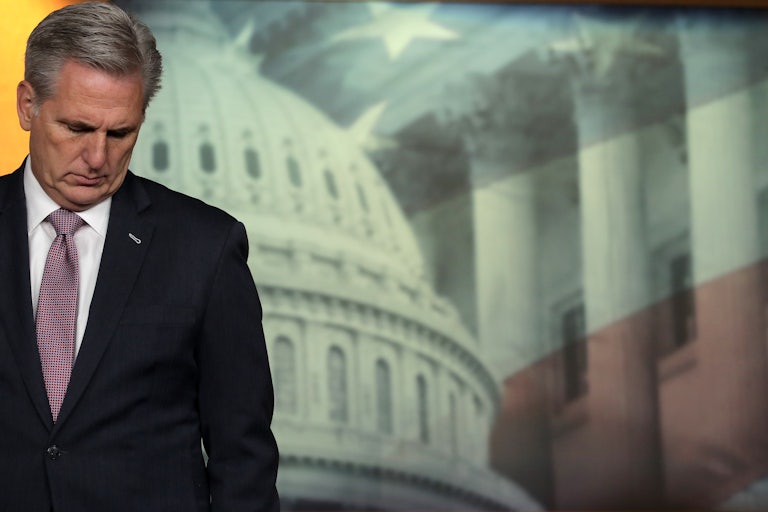
It is said that no plan survives first contact with the enemy. For Kevin McCarthy, who had a lot riding on his party claiming a historic midterm victory that would restore a substantial Republican majority in the House, his most formidable adversary turns out to be the American electorate, who turned out in numbers sufficient to blunt the vaunted “red wave” and keep Democratic losses to a minimum. Many House races remain uncalled; it’s possible that when all is done and dusted, McCarthy might be left with a majority large enough to be spit-shined into respectability. But fresh reporting from NBC News suggests that the vultures are already circling.

NBC’s report—published Thursday, and authored by Scott Wong, Kyle Stewart, and Kate Santaliz—is worth a full read. But the long and the short of it is that McCarthy is going to likely need the support of the entire caucus to obtain the gavel, and his historic troubles keeping the House Freedom Caucus in his corner may prove to be his undoing. Per NBC News:

“No one currently has 218” votes, said Rep. Chip Roy, R-Texas, as he emerged from a private Freedom Caucus meeting near the Capitol where members were discussing their strategy. Roy previously told NBC News he has not decided who he is backing for speaker.

“I have personally stated that Kevin McCarthy has not done anything to earn my vote,” added another Freedom Caucus member, Rep. Bob Good, R-Va.

Russ Vought, an influential conservative activist who went on to serve as Trump’s White House budget director, also warned against a McCarthy speakership in a statement Thursday.

“Kevin McCarthy’s speakership is in deep trouble. Members will have to go home and explain to constituents why they are voting for a leader who is not committed to waging war against a woke and weaponized government,” said Vought, now president of the conservative Center for Renewing America.

Back in August, The New Republic’s Grace Segers and Daniel Strauss published their magnum opus on McCarthy’s outsize ambitions, and even at a time when Republicans could still dream of a big midterm victory, there were signs that McCarthy’s hold on his caucus was incredibly fragile. Per Segers and Strauss:

But a few months before the November elections, some congressional Republicans are privately unsure if McCarthy even has the votes to become speaker. There’s almost always some last-minute alternative candidate who emerges in defiance of the front-runner. It’s likely a long shot will throw his or her hat in the ring, but congressional Republicans interviewed for this article also suggested that a more serious candidate like House Minority Whip Steve Scalise, McCarthy’s longtime deputy and occasional rival, would make a play for the speakership. Others have mentioned House Republican Conference Chair Elise Stefanik, who has spent the past year burnishing her credentials with the MAGA crowd.…

Some House Republicans have dismissed reporters’ questions about leadership as inside baseball, but even a sidestep can be telling. “I think we have a clear objective here as a conference: Go win seats and go create a majority to go stand up against Biden. And we need to have a conversation about what that’s going to look like, and then we’ll figure out our leadership structure,” said Representative Chip Roy of Texas. “Kevin’s a friend. I have a lot of friends in the conference. Let’s just keep marching forward and win in November.”

So far, Steve Scalise, who was thought to be the likeliest to challenge for the speakership, has publicly maintained his support for McCarthy, even as he prepares to launch a bid to become the majority leader in the House. Stefanik, meanwhile, rather pointedly endorsed former President Donald Trump on Friday. Her support, at a time when so many have plumped for Florida Governor Ron DeSantis to seize the mantle, may serve her in good stead should Trump withdraw his own (tenuous) support for McCarthy.

Finally, if you need further indication that the red wave’s failure to materialize is going to be roiling Republicans on Capitol Hill, it appears that Senate Minority Leader Mitch McConnell is in a spot of bother as well: Florida Senator Marco Rubio took to Twitter on Friday to call for postponing the Senate leadership vote next week. (And yes, we took the time to be extra sure that this was, in fact, the real Marco Rubio, and not one of Elon Musk’s newly minted blue-check impersonators. What a world!)

Colorado Legalizes Magic Mushrooms

It becomes the second state after Oregon to give the OK to psychedelics.

James MacDonald/Getty Images

Proposition 122, the initiative seeking to legalize the use of “natural medicine,” has narrowly passed, with 52.3 percent in support and 47.7 percent against it, with 92 percent of votes reporting. The measure allows people 21 and older to grow and consume psychedelic mushrooms. It also allows the creation of state-regulated centers where people can make appointments to consume psilocybin, the compound derived from psychedelic mushrooms.

The passage of this measure comes more than four years after Denver became the first city in the United States to decriminalize psychedelics. Now the entire state becomes the second state after Oregon to fully legalize the use of “magic” mushrooms.

The measure specifically legalizes psilocybin and psilocin, two compounds found in psychedelic mushrooms. While the proposition does not include an option for retail sales, it further decriminalizes the personal growing and use of what the initiative defines as “natural medicine”—besides psilocybin and psilocin, this would include ibogaine, mescaline, and dimethyltryptamine, or DMT—for adults 21 or older.

As it eliminates penalties for psychedelic use, the proposition also lays out plans for establishing supervised administration of the “natural medicine” at licensed “healing centers.” By 2024, state agencies will be required to begin accepting applications for healing center licenses.

After June 1, 2026, these centers could be authorized to expand their services to include DMT, ibogaine, and mescaline, subject to an advisory board’s recommendation. Beyond the new “healing centers,” existing mental health and substance abuse centers could seek licenses to offer psychedelic treatments.

Additionally, anyone who completed a sentence for a conviction related to an act now legal under the initiative will be able to petition the courts to seal records related to that conviction.

Colorado’s passage follows an effort by certain members of Congress to open up research into psychedelic therapies. Three years ago, Representative Alexandria Ocasio-Cortez introduced an amendment to expand research but was shut down by a majority of Democrats and nearly all Republicans.

Earlier this year, Ocasio-Cortez was joined by an unlikely ally in Representative Dan Crenshaw as they attached amendments to the annual military spending bill to increase access of psychedelic treatments to veterans and active service members, as well as expanding research into psychedelic substances. The U.S. Department of Veterans’ Affairs has, since June, been involved in a number of clinical trials involving psychedelic drugs, which have shown promise in the treatment of post-traumatic stress disorder.