Breaking News
Breaking News
from Washington and beyond

Colorado Legalizes Magic Mushrooms

It becomes the second state after Oregon to give the OK to psychedelics.

James MacDonald/Getty Images

Proposition 122, the initiative seeking to legalize the use of “natural medicine,” has narrowly passed, with 52.3 percent in support and 47.7 percent against it, with 92 percent of votes reporting. The measure allows people 21 and older to grow and consume psychedelic mushrooms. It also allows the creation of state-regulated centers where people can make appointments to consume psilocybin, the compound derived from psychedelic mushrooms.

The passage of this measure comes more than four years after Denver became the first city in the United States to decriminalize psychedelics. Now the entire state becomes the second state after Oregon to fully legalize the use of “magic” mushrooms.

The measure specifically legalizes psilocybin and psilocin, two compounds found in psychedelic mushrooms. While the proposition does not include an option for retail sales, it further decriminalizes the personal growing and use of what the initiative defines as “natural medicine”—besides psilocybin and psilocin, this would include ibogaine, mescaline, and dimethyltryptamine, or DMT—for adults 21 or older.

As it eliminates penalties for psychedelic use, the proposition also lays out plans for establishing supervised administration of the “natural medicine” at licensed “healing centers.” By 2024, state agencies will be required to begin accepting applications for healing center licenses.

After June 1, 2026, these centers could be authorized to expand their services to include DMT, ibogaine, and mescaline, subject to an advisory board’s recommendation. Beyond the new “healing centers,” existing mental health and substance abuse centers could seek licenses to offer psychedelic treatments.

Additionally, anyone who completed a sentence for a conviction related to an act now legal under the initiative will be able to petition the courts to seal records related to that conviction.

Colorado’s passage follows an effort by certain members of Congress to open up research into psychedelic therapies. Three years ago, Representative Alexandria Ocasio-Cortez introduced an amendment to expand research but was shut down by a majority of Democrats and nearly all Republicans.

Earlier this year, Ocasio-Cortez was joined by an unlikely ally in Representative Dan Crenshaw as they attached amendments to the annual military spending bill to increase access of psychedelic treatments to veterans and active service members, as well as expanding research into psychedelic substances. The U.S. Department of Veterans’ Affairs has, since June, been involved in a number of clinical trials involving psychedelic drugs, which have shown promise in the treatment of post-traumatic stress disorder.
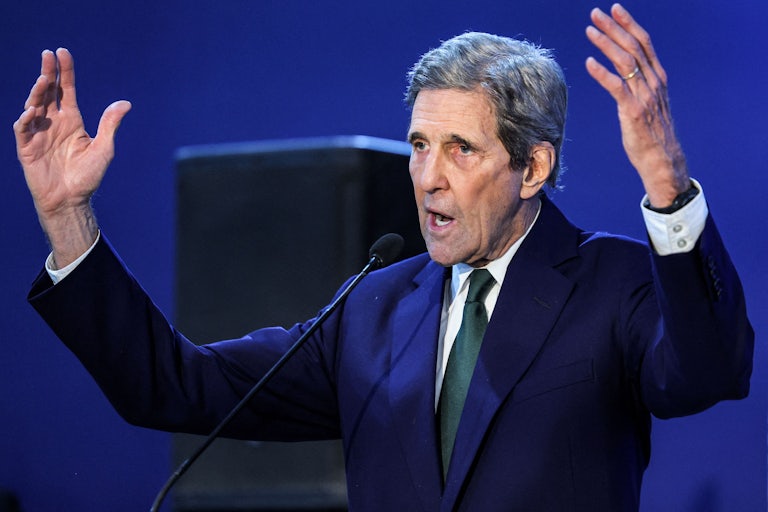
We Have New Details About the U.S. Carbon Trading Plan (and It’s Still Confusing)

File under: Answers that only raise more questions.

Ahmad Gharabli/Getty Images

Earlier this week I wrote about a carbon trading scheme floated by international climate envoy John Kerry for financing renewable energy development in developing countries. As we learned on Wednesday, it’s going to be called the Energy Transition Accelerator, or ETA—not to be confused with the Energy Transition Accelerator Financing Platform, or ETAF, launched last year at COP26 by the International Renewable Energy Agency, the United Arab Emirates, and the Abu Dhabi Fund for Development.

Details are still very much being worked out, but new ones furnished on Wednesday haven’t added much more clarity. The ETA is to be a public-private partnership between the U.S. government, the Rockefeller Foundation, and the Bezos Earth Fund, which intends “to catalyze private capital to accelerate the clean energy transition in developing countries” through at least 2030. Per an official announcement:

Chile and Nigeria are among the developing countries expressing early interest in exploring the ETA’s potential benefits. Bank of America, Microsoft, PepsiCo, and Standard Chartered Bank have also expressed interest in informing the ETA’s development, with decisions on whether to formally participate pending the completion of its design. The ETA will also be open to sovereign government investments and engagement.

National and subnational governments (regions, cities, etc.) can package their renewable energy and climate resilience plans into credits to be bought by major corporations. As in similar carbon trading schemes, the ETA would allow credit buyers to offset their own emissions by financing reductions elsewhere. Officials also argue it’ll help unlock even more private-sector financing. “By providing jurisdictions with fixed-price advance purchase commitments for verified emission reductions, the ETA will create a predictable finance stream that can unlock upfront private finance at more favorable rates,” the announcement continues. Participating jurisdictions “will include social safeguards and benefits to local economies, including support for job creation and training.”

There are more than a few well-documented problems with offsetting schemes: For one, they’re fertile ground for scams. The system for validating which credits actually correspond to real emissions reductions in the voluntary carbon market is still something of a regulatory Wild West, ruled by a small handful of private actors.

The ETA could also be courting its own unique set of challenges. Renewable energy projects are often developed by third-party companies that are contracted out by for-profit or public utilities. The result could be a kind of Rube Goldberg contraption for financing clean energy development: Big companies in wealthy countries will buy up credits for projects to count toward their climate goals developed by some third-party contractor abroad. Fossil fuel companies won’t be allowed to participate—at least for now.

Among the organizations to be consulted is the Science-Based Targets Initiative, a Bezos Earth Fund donation recipient that recently came under fire over governance and transparency issues, including its practice of collecting fees from companies to verify that their net-zero plans are legit.

Needless to say, climate justice advocates who’ve been asking the U.S. to put up actual money toward climate finance weren’t exactly thrilled by Kerry’s innovation/rehashing of a 40-year-old idea with a patchy (at best) track record. Even the U.N. secretary-general’s staff and some European nations were reportedly cool to the idea.

Can’t win ’em all!

Actually, Democrats Put Plenty of Focus on “Pocketbook Issues”

A new analysis shows how the party might have done so well on election night, and what it should keep in mind.

Brandon Bell/Getty Images
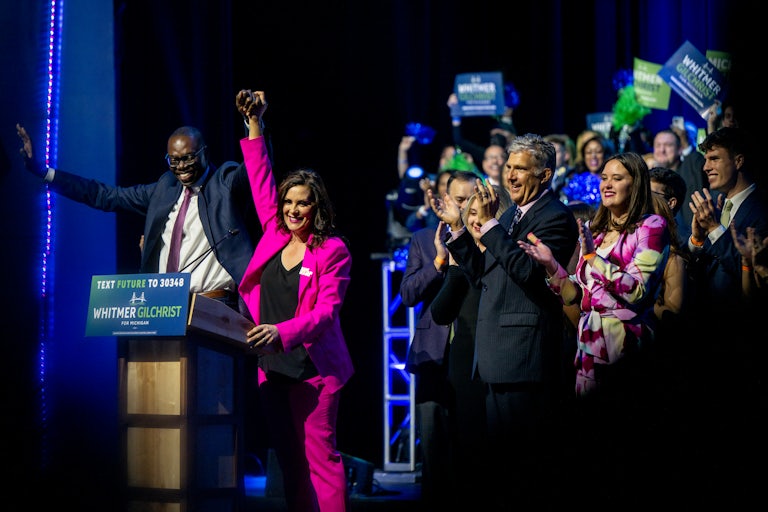
Lieutenant Governor Garlin Gilchrist II and Governor Gretchen Whitmer celebrate big wins for Michigan Democrats on election night.

Apparently, Democrats actually focused more on so-called pocketbook issues than Republicans in the final months of campaign.

Analysis from the Winning Jobs Narrative Project shows that, across nine “pocketbook” topics—including health care, prescription drugs, and Social Security—Democrats aired 200,000 more advertisement spots than Republicans.

These figures contradict a media narrative that arose during the lead-up to election night, which held that Democrats’ messaging was substantially out of touch with voters’ economic concerns. This conventional wisdom contributed to the premature consensus that Democrats were set to drown in a red wave. The thinking went like this: Republicans were hitting the Democrats on inflation; Democrats were focused too much on democracy or “social issues;” the energy around abortion peaked too soon; student debt cancellation was a mistake.

And then the red wave fizzled into a red ripple.

Democrats held seats they were defending and won elections on which they’d pinned their hopes—from Pennsylvania’s Senate seat and governorship to Michigan’s governorship and state legislature—all while staving off a number of Republican challengers who were thought to be in the ascendance. While some elections, like Arizona’s Senate and governor’s races, are still undeclared, Democrats overperformed expectations in sum.

The analysis did show Republicans having an advantage over Democrats in focusing on taxes, the economy, and energy. But that might have been for naught: As the researchers behind the study reported, “The data suggest that Republicans’ generalized criticisms of the economy may have fallen short against Democrats’ communication advantage on key, specific pocketbook concerns.”

In other words, Republicans amorphously blithering about inflation (let alone about some nondescript necessity to cut taxes for the rich) may not have been enough to overcome Democratic messaging on items such as health care or drug prices or manufacturing—issues that tend to localize the “economy” to voters. This becomes all the more powerful when Democrats counter Republicans’ indiscriminate gripes about inflation with explanations that offer price gouging as an alternative.

This dynamic surely may not be universal, and is not the only factor that contributed to the election results. Massive turnout spurred by benefactors of student debt cancellation, as well as those concerned about losing the right to an abortion or the impending threat of climate change also factored into the exit polling—especially among young people and women. If Democrats want to replicate such success in the future, they ought to reflect on how speaking to “social issues” and “pocketbook issues” are not mutually exclusive—and that attention given to both issue categories is a winning combination.

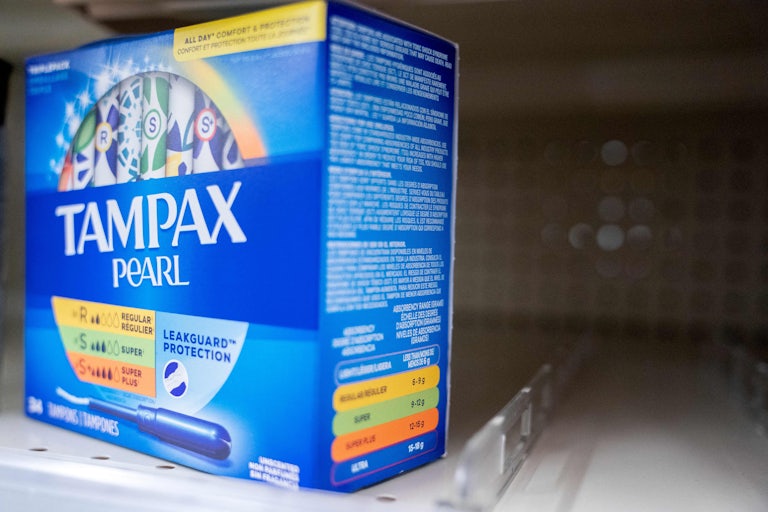
Period-Havers Have the Last Laugh Over the “Red Wave”

As one jokester put it, “More like light spotting.”

Stefani Reynolds/Getty Images

Turns out there was a “red wave” on Election Day after all, just not the ones that Republicans hoped for. Women, particularly women of color, voted overwhelmingly Democratic during the 2022 midterms, exit polls found. Inevitably, some found the joke that was … just sitting there.

The midterm elections saw record-high voter turnout, both early and in person, and according to the exit polls, access to abortion was one of the top issues at the ballot box. Additionally, five states had abortion rights issues on the ballot, and all five states voted to either increase or maintain access to the procedure.

Republicans had been promising a tsunami-like sweep in the midterms but ended up stunned to see major losses across the board. Although many of the marquee national races remain tight, Democrats pulled off upset wins and flipped state legislatures. In Michigan, the state government went Democratic, and abortion was the primary driver.

Right-wing media outlets and commentators have freaked out, trying to explain why their red wave slowed to a trickle. They have tried to blame everything from Donald Trump to voters being too young. They can’t seem to grasp—or won’t admit—that people vote for issues that matter to them.

But Washington Post writer Monica Hesse explained, “Buddy, it was right in front of you. The red wave rolled in with Aunt Flo on a longboard.”

Many others have been quick to mock the so-called red wave, noting it both sounds like a euphemism for a period and symbolizes how period-havers turned out in droves to vote against the Republicans.

“So, contrary to all these major media outlets, the red wave coming is my period on Friday,” tweeted professor Uju Anya.

Podcaster Allison Gill joked that “the ‘red wave’ is more like light spotting.”

Writer Akilah Hughes sympathized: “I get it, sometimes I think it’s a red wave but then my period hasn’t actually shown up.” But, she hastened to add, “It’s just that I’m not on TV affecting anyone’s life with that miscalculation.”

Republicans Are So Mad at the Huge Youth Turnout They Want to Increase the Voting Age

Gen Z came out in huge numbers this election. Now Republicans are trying to decide what the new voting age should be.

Thomas Simonetti/Washington Post/Getty Images
A view inside the campaign headquarters of Maxwell Frost, who was recently elected to the House of Representative from Florida’s 10th congressional district.

Young voters turned out in record numbers for Election Day and overwhelmingly voted Democratic—sending Republicans into a moralistic panic over the voting age.

About a third of voters under age 30 participated in the midterm elections, according to a study by Tufts University’s Center for Information & Research on Civil Learning and Engagement.

There was 27 percent turnout overall, and 31 percent turnout in battleground states. In fact, young voters—who favored Democrats by about a 2-to-1 margin—helped tip the scale left in several crucial races, including Pennsylvania and Michigan.

As a result, not only was there no much-promised “red wave” on election night, but many states swung in the opposite direction, although the national races remain tight. Democrats took control of state legislatures in Pennsylvania, Michigan, and Minnesota.

By Thursday morning, conservatives were clamoring to raise the voting age, although they couldn’t seem to agree on what the new age should be: There were arguments for 21, 25, 30, or simply until voters had gotten “a lil life experience.”

The demand is, of course, as ridiculous as it is hypocritical. There is no talk of also raising the age for military enlistment or, say, consent. Instead, it shows that the right is rushing to preserve its power over Gen Z rather than appealing to them through legislation.

But while it’s easy to poke fun at Republicans, a call to raise the voting age is still a call to violate voter rights.

“The fact that there are republicans calling to raise the voting age to 21 because Gen-Z showed up in HEAVY Democratic numbers last night is both laughable and terrifying,” tweeted Olivia Julianna, from the nonprofit Gen-Z for Change.