Breaking News
Breaking News
from Washington and beyond

Led by Progressives, House Votes to Avert Rail Strike and Give Workers Sick Leave

Rail workers currently get zero sick days. The House voted to give them seven.

Stefani Reynolds/Getty Images

The House voted Wednesday to advance a deal aimed at averting a national rail strike—and also give rail workers needed paid sick leave.

Members voted 290–137 in support of a tentative labor agreement brokered by President Joe Biden. Subsequently, the House voted 221–207 to add seven paid sick leave days to said agreement. Rail workers currently have no paid sick days.

The additional paid sick leave measure comes after progressive House members, including Representatives Jamaal Bowman and Cori Bush, pushed for its addition.

Unless an agreement is met by December 9, tens of thousands of rail workers will go on strike, disrupting a large portion of the country’s economy.

The urgency of the matter—both the fate of the economy and, crucially, workers’ welfare—prompted Speaker Nancy Pelosi to promptly bring the two measures to the House floor for a vote.

“After hearing from our Members, we are in agreement that a nationwide rail strike must be prevented—and that more must be done to secure the paid sick leave that hard-working railroaders deserve,” Pelosi wrote in a memo to colleagues on Tuesday.

The measure helps make clear where members of Congress actually stand on advocating for workers. The bill now goes to the Senate for a vote on Thursday, where the fate of paid leave remains unclear. Senators Cruz, Rubio, and Hawley have expressed noncommittal support for rail workers, rooted mainly in opposition to Biden’s initial deal. Senator Bernie Sanders has led the charge on the Senate side to add paid sick leave days to the rail agreement.

With the passage of both measures in the House, the Senate now has to take up both the tentative agreement and paid sick leave provision. As a result, senators’ true stance on the welfare of workers will become clear soon.

House Democrats Elect Hakeem Jeffries as Party’s First Black Leader

Jeffries, along with Katherine Clark and Peter Aguilar, is part of a new generation of House Democratic leadership.

Anna Moneymaker/Getty Images

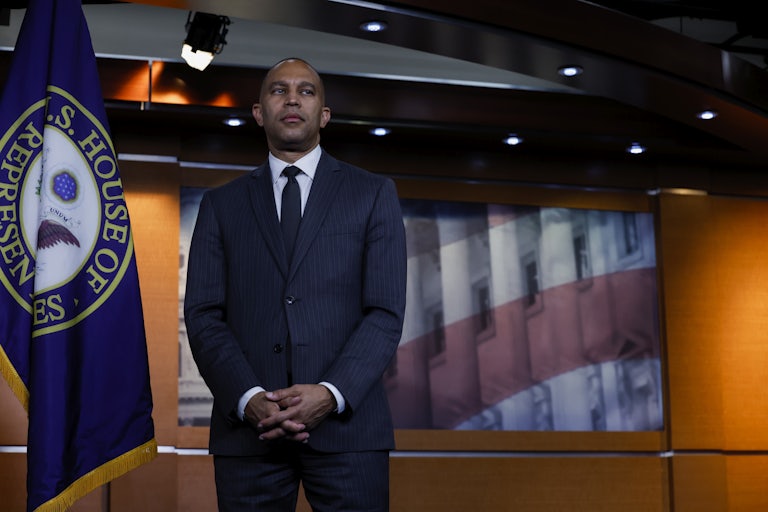
On Wednesday morning, House Democrats voted unanimously to elevate New York Congressman Hakeem Jeffries to lead the party. Jeffries becomes the first Black person to lead a major party in either the House or Senate. He will serve as minority leader in the upcoming Congress.

Jeffries, 52, ran unopposed, with Massachusetts’s Katherine Clark, 59, succeeding Jim Clyburn as whip and California’s Peter Aguilar, 43, succeeding Steny Hoyer as leader of the House Democratic caucus. The trio’s ascendance marks a stark generational change from their predecessors. House Speaker Nancy Pelosi and Clyburn are both 82; Hoyer is 83.

The elder leaders will continue serving as rank-and-file members of Congress—while still maintaining a touch of influence. On Tuesday, House Democrats voted unanimously in a committee to designate Pelosi as a “speaker emerita.” Clyburn will become an assistant leader.

Jeffries was born and raised in Brooklyn, near the district he now serves. Jeffries first began his career as a corporate lawyer. He then worked for Viacom and CBS before getting elected to the New York State Assembly, serving from 2007 to 2012.

In 2015, Jeffries introduced a bill to make the use of a chokehold illegal under federal law, after the NYPD’s killing of Eric Garner. In 2018, Jeffries’s co-authored First Step Act passed, prompting the development of education, vocational, and mental health counseling programming for formerly incarcerated individuals.

Jeffries has garnered some skepticism from the left. In 2016, he criticized a unanimous U.N. resolution denouncing Israel’s settlement activity as a “flagrant violation” of international law. Jeffries argued that President Obama should have gone against the 14 nations who voted in favor of it and vetoed the resolution instead of abstaining.

Jeffries has also collected hundreds of thousands from industry donors embedded in investment, real estate, and lobbying. He has received the support of pro-Israel groups, including AIPAC, which has deliberately worked to tank Democratic candidates and support election denialists.

Nevertheless, Jeffries takes the mantle as party leader with little internal opposition. Now he is tasked to honor that support and push forward a strong progressive agenda that respects those who elected not to challenge him.

Netanyahu Explicitly (Tepidly) Condemns Trump for Dinner With Antisemite Nick Fuentes

The Israeli prime minister–designate said Donald Trump’s dinner with Kanye West and Nicholas Fuentes was a “mistake.”

Israeli Prime Minister–designate Benjamin (Bibi) Netanyahu said Wednesday Donald Trump’s meeting with a white supremacist was a “mistake,” his harshest criticism of the former U.S. president to date.

It has been one week since Trump met with Nick Fuentes, a Holocaust denier and white supremacist, and rapper Kanye West, another outspoken antisemite. Bibi explicitly, and tepidly, condemned Trump for the meeting.

President Trump’s decision to dine with this person I think is wrong and misplaced. I think it’s a mistake. He shouldn’t do that,” Netanyahu said in a fawning interview with Bari Weiss.

“He has been a tremendous supporter of Israel, and I’m unabashedly appreciative of what he did for Israel,” he said, adding he thought Trump is “irreverent.”

The rest of the interview consisted mostly of Weiss giving Netanyahu a pass to say whatever he wanted. She did not press him on the atrocities committed in Gaza or elsewhere in Palestine, and she allowed him to distance himself from authoritarianism. She also felt it was important to ask him what his favorite book is and who his biblical hero is.

Trump boasted in October that “no President has done more for Israel than I have.” That post on Truth Social also contained a veiled threat: “U.S. Jews have to get their act together and appreciate what they have in Israel—Before it is too late!” he added.

While in office, Trump was the only modern president to visit Israel. He recognized Jerusalem as the capital and the Golan Heights as sovereign Israeli territory, the first U.S. president to do so and in violation of international law. His administration also helped orchestrate the Abraham Accords, which normalized ties between Israel and multiple nations in the Middle East and North Africa.

Likely because of this, Netanyahu has until now largely excused Trump’s support for domestic white supremacists, antisemites, and neo-Nazis.

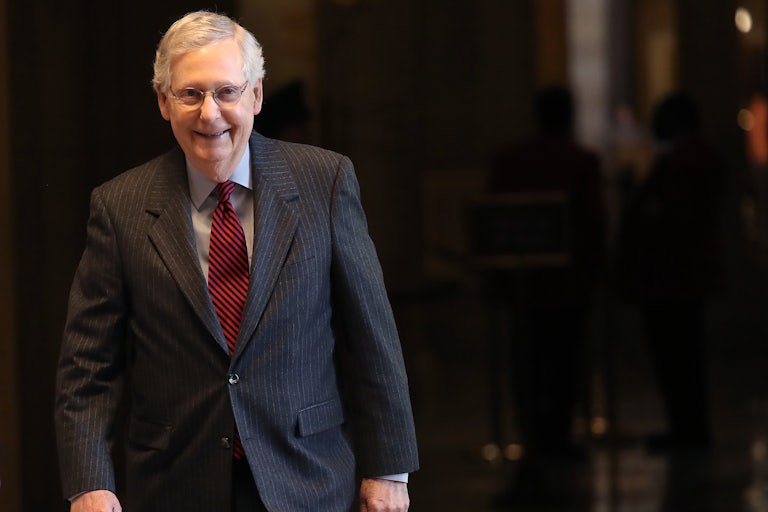
In the week since his meeting with Fuentes, Republicans have been loath to criticize Trump. GOP leaders Mitch McConnell and Kevin McCarthy offered weak rebukes, while those who have spoken out explicitly were already vocal Trump critics and not in leadership positions.

Full List of Republicans Who Voted Against Protecting Marriage Equality

Thirty-six Republicans voted against the Respect for Marriage Act. Here are their names.

Win McNamee/Getty Images

Here are the senators who voted Tuesday against enshrining marriage equality. All 36 are Republicans.

  • John Barrasso
  • Marsha Blackburn
  • John Boozman
  • Mike Braun
  • Bill Cassidy
  • John Cornyn
  • Tom Cotton
  • Kevin Cramer
  • Mike Crapo
  • Ted Cruz
  • Steve Daines
  • Deb Fischer
  • Lindsey Graham
  • Chuck Grassley
  • Bill Hagerty
  • Josh Hawley
  • John Hoeven
  • Cindy Hyde-Smith
  • Jim Inhofe
  • Ron Johnson
  • John Neely Kennedy
  • James Lankford
  • Mike Lee
  • Roger Marshall
  • Mitch McConnell
  • Jerry Moran
  • Rand Paul
  • Jim Risch
  • Mike Rounds
  • Marco Rubio
  • Rick Scott
  • Tim Scott
  • Richard Shelby
  • John Thune
  • Tommy Tuberville
  • Roger Wicker

Senate Passes Respect for Marriage Act Protecting Marriage Equality

The vote on the bill, which will protect same-sex marriage and interracial marriage, was 61–36.

Chip Somodevilla/Getty Images

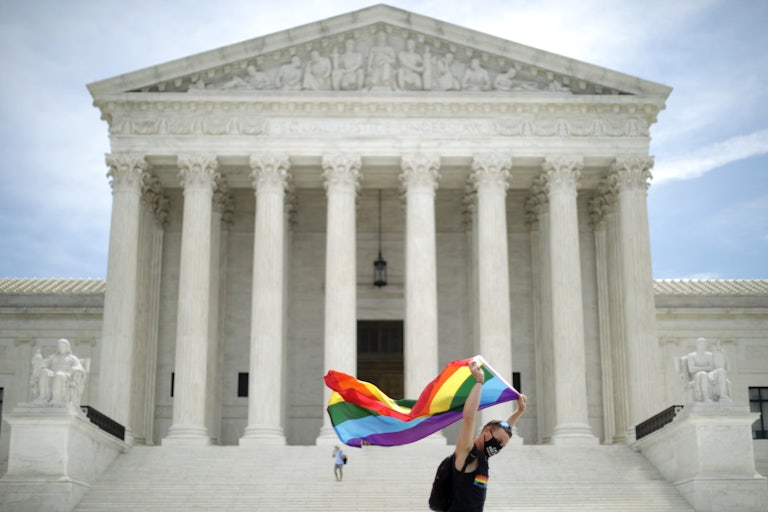
The Senate voted 61–36 Tuesday to approve a bill enshrining marriage equality.

The Respect for Marriage Act, which applies to both same-sex and interracial marriage, would require that two people be considered married so long as their marriage was legal in the state in which it was performed. The act also repeals a 1996 law defining marriage as between a man and a woman, which has remained on the books despite being declared unconstitutional by the Supreme Court in 2015.

Thirty-six Republican senators voted against the bill, including Mitch McConnell, who is in an interracial marriage.

Many civil rights activists have warned that after the Supreme Court overturned Roe v. Wade in June, same-sex marriage may be next on the chopping block.

The Senate voted 62-37 on November 16 to advance the bill to a final vote. The chamber had added an amendment to the bill clarifying certain protections for religious organizations.

It will now return to the House of Representatives before President Joe Biden can sign it into law.

The act already passed the House over the summer, although 156 voted against it—including a shockingly hypocritical nay vote from Representative Glenn Thompson, who attended his son’s same-sex wedding just a week later.

Critics of the bill say, though, that it does not go far enough with LGBTQ protections. Part of the amendment says that religious organizations do not have to marry same-sex couples, which would allow groups to continue to be homophobic, and the bill does not require all states to actually issue same-sex marriage license.