Breaking News
Breaking News
from Washington and beyond

Freedom-Loving Conservatives Are Mad that Brittney Griner Is No Longer in Russian Jail

WNBA star Brittney Griner has been released from Russian jail, and the far right is upset about it.

KIRILL KUDRYAVTSEV/AFP/Getty Images

Thursday morning, the Biden administration announced that Phoenix Mercury star Brittney Griner would be released from Russian detainment, in a one-for-one prisoner swap with former Russian military officer and arms dealer Viktor Bout.

Afterward, the right wing wasted no time inciting outrage about the freeing of an American detained in Russia for 294 days.

Some weren’t even trying to feign logic and were instead outright racist and homophobic:

Prisoner swaps do not lend themselves well to “ideal” scenarios. But there are basic facts here that these outrage-drivers simply have no interest in. They act as if Biden unhesitatingly made the deal and has not been trying to rescue other American detainees, like former U.S. Marine Paul Whelan. But according to a senior U.S. official, Whelan is being treated as an espionage case. The Russian government gave the U.S. a choice over who to free: “one [Griner] or none.”

Meanwhile, Paul Whelan’s family is sharing much more grace than the right-wingers fomenting outrage over their loved one, acknowledging both the good news of Griner’s release and still the urgency to free Whelan:

Griner’s wife,  Cherelle, said they both are committed to working to help free those left behind in Russian detention, including Whelan:

But right-wingers have no interest in nuance or the facts undergirding such a difficult situation.

In the meantime, Griner’s restored freedom warrants rejoicing. And an urge to support all who are imprisoned—especially those on inane charges like less than a gram of cannabis oil—ought to be maintained. As Dave Zirin wrote, “There is no politics more basic than solidarity with the imprisoned.”


House Passes Respect for Marriage Act Protecting Same-Sex Marriage

The House voted 258–169 to protect same-sex and interracial marriage.

Chip Somodevilla/Getty Images

The House of Representatives voted 258–169 Thursday to approve a historic bill enshrining the right to marriage equality.

The Respect for Marriage Act will now go to President Joe Biden to be signed into law. The bill, which applies to both same-sex and interracial marriage, would require that two people be considered married so long as their marriage was legal in the state in which it was performed. The act also repeals a 1996 law defining marriage as between a man and a woman, which has remained on the books despite being declared unconstitutional by the Supreme Court in 2015.

Many civil rights activists have warned that after the Supreme Court overturned Roe v. Wade in June, same-sex marriage may be next on the chopping block.

During debate beforehand, Republicans accused Democrats of overreacting, insisting that the 2015 Supreme Court ruling ensuring equal marriage would continue to stand. Two Republican representatives, Vicky Hartzler and Bob Good, went so far as to claim the bill discriminated against religious institutions—despite being backed by most major religious organizations—and threatened heterosexual marriage.

The Senate voted 61–36 last week to pass the bill.

The act had already passed the House over the summer, although 156 voted against it—including a shockingly hypocritical “nay” vote from Representative Glenn Thompson, who attended his son’s same-sex wedding just a week later. Thompson again voted no on Thursday.

Critics of the bill say, though, that it does not go far enough with LGBTQ protections. Part of the amendment says that religious organizations do not have to marry same-sex couples, which would allow groups to continue to be homophobic, and the bill does not require all states to actually issue same-sex marriage licenses.

Don’t Do Today’s Wordle

New York Times employees have embarked on a 24-hour walkout after the paper of record failed to meet union demands.

Jakub Porzycki/NurPhoto/Getty Images

Over one thousand New York Times employees have embarked on a 24-hour walkout, the first protest of its kind at the nation’s paper of record in more than four decades.

Members of the NewsGuild of New York had been negotiating with management for nearly two years. Finally, the union reached a tipping point, announcing last week that more than 1,100 union members would walk out at 12:01 a.m. Thursday morning, unless a deal was made. As can be seen, no agreement was reached.

While there has been no updated contract since March 2021, staff also have not received raises in more than two years. This, while inflation and rent have both rocketed.

Negotiations had been ongoing this week, with 12 hours of bargaining on Tuesday. On Wednesday, The New York Times union guild said management “backed off its attempt to kill our pension and agreed to expand fertility benefits,” but they still were short on other priorities, including pay increases and health care contributions.

The union has said some major desks will be short 90 percent of their workforce on Thursday, with some departments being essentially empty. Consequently, numerous desks will be run by managers—if at all—as employees picket outside the New York Times building.

Meanwhile, the company has directed members to work in advance of the strike in order to complete assignments.

Further, employees who walk out will not be paid. CNN retrieved an internal memo sent to employees by the Times’ human resources department, reading that striking employees “will not be paid by the company for the duration of the strike” and that they “cannot use vacation or personal days to account for this time” unless it was approved before last Friday. The union has  argued that this is a walkout, not a strike, since it is for limited duration.

New York Times spokesperson Danielle Rhoades Ha told the Associated Press that the Times had “solid plans in place” to continue business, including relying on international reporters and other nonunion journalists.

Thursday will reveal what a hollower New York Times looks like—and whether it really can continue business as usual, even for 24 hours.

WNBA Star Brittney Griner Released From Russian Prison

Griner was released by the Russian government and is coming home, 10 months after her arrest.

EVGENIA NOVOZHENINA/POOL/AFP/Getty Images

WNBA star Brittney Griner has been released by the Russian government and is coming home.

She was released Thursday in a one-for-one prisoner swap with Viktor Bout, a former Russian military officer who was serving a 25-year sentence in the United States for conspiring to kill Americans, exporting missiles, and conspiring to help a terrorist organization. The Russian government has sought his release for a decade, since his 2012 sentencing in New York.

Griner was arrested at a Moscow airport in February on drug-smuggling charges. She testified that she inadvertently packed cannabis oil in her luggage and in August was sentenced to nine years in prison.

President Biden spoke Thursday morning shortly after 8:30 a.m. from the White House in the company of Griner’s wife, Cherelle. From NBC’s Peter Alexander:

Cherelle said, “The most important emotion I have right now is sincere gratitude for President Biden and his entire administration.” Biden said: “Britney is an incomparable athlete. She endured mistreatment and a show trial in Russia with characteristic grit and integrity.” Biden said he’d been working for her release since July and mentioned Paul Whelan, a former U.S. Marine still detained in Russia on espionage charges. NBC’s Andrea Mitchell reported Thursday morning that the Biden administration pushed hard for Whelan’s release after four years in prison, but Russia wouldn’t budge.

Biden will surely take some heat from the right wing for releasing Bout, who had a long record of arms dealing and supporting terrorist groups like Colombia’s FARC before he was convicted. Preet Bharara, the U.S. attorney who prosecuted Bout, said at the time of his sentencing: “Viktor Bout has been international arms-trafficking enemy number one for many years, arming some of the most violent conflicts around the globe.”

But make no mistake. This is a great day—obviously for Brittney and Cherelle, for the Biden team, for the United States, and for justice.

Manchin’s Last-Ditch Attempt to Save His Pipeline Deal is Unlikely to Work

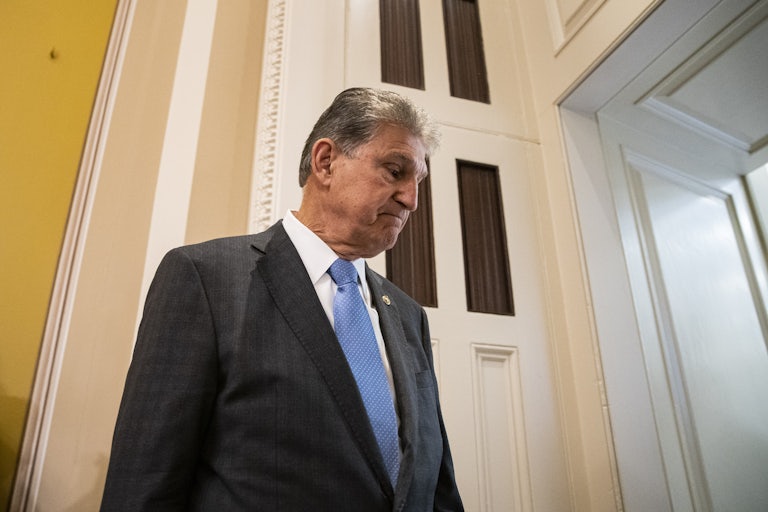
Senator Joe Manchin isn’t giving up on his fight for permitting reform, even after it was removed from the annual defense spending bill.

Al Drago/Bloomberg/Getty Images
Senator Joe Manchin

The final text of the 2023 National Defense Authorization Act, or NDAA, was released Tuesday, and absent was Senator Joe Manchin’s so-called “Dirty Deal,” a set of provisions he was promised in exchange for his support for the Inflation Reduction Act (a bill he massively watered down).

Now Manchin is trying yet again to include his provisions, this time as an amendment to the annual defense spending bill. Manchin released his amendment Wednesday, with various concessions to try to appeal to Republican support instead of members of his own party. Nevertheless, he seems unlikely to garner enough support.

The bill would weaken environmental review processes and fast-track the permitting process for energy projects, including pipelines and fossil fuel infrastructure.

Manchin’s bill seeks to clear the path for the Mountain Valley natural gas pipeline, a West Virginia project opposed by several community and environmental groups, facing lawsuits in state and federal courts, and even invalidated by an appeals court.

Federal agencies would be called to proceed in issuing permits and leases, superseding citizen challenges and clearing the path for the legally and communally opposed fossil fuel project.

But the effort failed for a second time Tuesday, after Manchin previously attempted to attach the bill to the September continuing resolution that avoided a government shutdown.

Manchin’s provisions were not all inherently bad. They sought to promote construction of new electrical transmission lines, which are urgently needed in order to reach net-zero emissions. And to be fair, opposition to energy infrastructure projects can be rooted in Nimby-esque rationales; expedited permitting can help push forward the construction of urgently needed green infrastructure.

But Manchin’s approach, foregrounded by his thirst for a natural gas pipeline, did not capture  those potential benefits. Democrats don’t have to trash the entire bill, but they also ought not leave the fight for permitting reform to the most conservative Democrat in Congress.