Breaking News
Breaking News
from Washington and beyond

The Weird Online Profile of the National Guardsman Arrested for Allegedly Leaking Intelligence Docs

Here’s what we know about the suspected leaker.

DANIEL SLIM/AFP/Getty Images
The Pentagon

Federal investigators on Thursday arrested an air national guardsman suspected of leaking classified intelligence documents about the war in Ukraine.

The man, a 21-year-old named Jack Teixeira, is a member of the Massachusetts Air National Guard’s intelligence wing. He is believed to have shared the documents on a Discord server in early March.

The documents were confirmed to be real, although some were doctored before being posted online. They include information on Russian and Ukrainian strategies and issues in the ongoing war, as well as intelligence on Canada, China, Israel, South Korea, the Indo-Pacific military theater, and the Middle East.

Teixeira shared the documents to a group he led. The other members, about 20-30 of them in total, were mostly young men and teenagers who had bonded during the height of the Covid-19 pandemic over their shared interest in guns, racist memes, and video games.

Four members of the group spoke to The New York Times and insisted that Teixeira, whom they didn’t name, wasn’t a whistleblower. He shared the documents to inform his friends. The leak only gained attention when other members of the group posted some of the documents to a public forum.

The leak is unusual in that it is not as broad in scope as previous ones, such as WikiLeaks or the one orchestrated by Edward Snowden. But the information in the documents is much more timely, which has concerned White House and defense officials.

Some of the documents are less than two months old, and they contain previously unknown details about the state of Ukraine’s army as it tries to fend off the Russian invasion. The documents also revealed new information about how the U.S. gathers intelligence on adversaries and allies alike.

It’s unclear how Teixeira was able to access such highly classified intelligence. A U.S. official, speaking anonymously to The Washington Post, explained that National Guard units sometimes perform support services for active-duty units, including intelligence support for the Joint Staff. If Teixeira performed such support service, he could have been able to get ahold of the documents.

This post has been updated.
Arkansas’s New Law to Save Kids From Social Media Doesn’t Apply to Most Social Media

The law technically makes it illegal for minors to use social media without parental consent, but there are a few big exceptions.

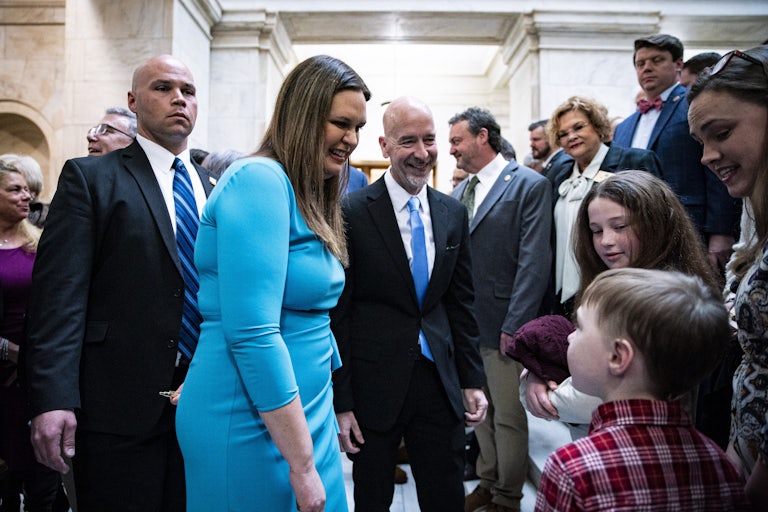
Al Drago/Bloomberg/Getty Images
Arizona Governor Sarah Huckabee Sanders

Sarah Huckabee Sanders just made it illegal for anyone in Arkansas under the age of 18 to use social media without consent from their parents. Except, it seems a lot of apps, like TikTok and Snapchat, are exempt.

The Arkansas governor signed the so-called Social Media Safety Act on Wednesday, amid her larger push to “save the children,” marked, for instance, by her bill making child labor easier.

“A social media company shall not permit an Arkansas user who is a minor to be an account holder on the social media company’s social media platform unless the minor has the express consent of a parent or legal guardian,” the bill reads.

Under the bill, which takes effect in September,  all users of a social media app must verify their age by submitting a “digitized” form of identification, like a driver’s license, to the company. If they are proven to be a minor, the company must confirm that the minor has a guardian’s consent.

If the company in question fails to perform proper age verification processes, they would be liable to a $2,500 fee per violation, plus any court costs or attorney’s fees and damages brought by the user and their family if they chose to pursue legal action.

It’s tough talk for a bill that doesn’t actually hold many companies to account, or seek to meaningfully improve young people’s relationship with the online world. Because while it’s difficult to imagine how exactly the bill would be enforced, what’s more difficult is to understand which companies will even be impacted.

The bill has numerous carve outs. Companies that offer “subscription content in which users follow or subscribe unilaterally” or “interacting gaming, virtual gaming, or an online service” (like Twitch or OnlyFans) are excluded. Companies that allow “a user to generate short video clips of dancing, voice overs, or other acts of entertainment” (like TikTok) are excluded. Companies that consist mainly of direct exchanges of messages, photos, or videos (like Snapchat) are exempted. And companies that offer services for K-12 schools or career development services to individuals (like LinkedIn) are excluded.

Moreover, the bill excludes companies that have generated less than $100 million, which would include any number of smaller websites, including far-right platforms like Parler and Truth Social.

Instagram, Facebook, and Twitter appear to be the most prominent websites seemingly not touched by the various exclusions. How exactly the state will work with these companies on an individual basis to set an identity verification process in motion is unclear.

There should be a concerted effort and intentional conversation surrounding the online world and our engagement with it—especially among young people. But Arkansas’s bill is mainly concerned with dictating what websites people under 18 can use without parental consent; there is little attempt to better people’s relationships with the internet more broadly.

In this way, the bill is almost a perfect embodiment of conservative governance: purporting to “empower” personal choice of children and families by instead limiting civil liberties—and then offering no material support to help either with, or after, that “personal choice.”

Trump’s Record of Failure and Lawbreaking Fails to Deter GOP Endorsements

Here is a list of every member of Congress and every governor who has endorsed the twice-impeached, criminally indicted former president.

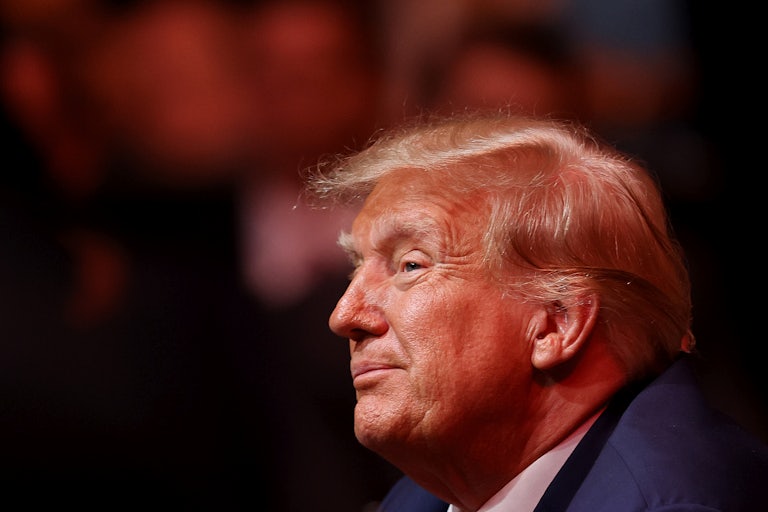
Donald Trump
Carmen Mandato/Getty Images

Donald Trump has been impeached twice. He has lost the popular vote twice. He has been found liable for sexual abuse and defamation. He is the first former president to be criminally indicted, and the first to be federally indicted. He is under at least two other criminal investigations.

And beyond every out-of-touch, offensive, or even blatantly wrong thing Trump has said, the former president’s legacy is also connected to many of the crises of our time. With disastrous train derailments coming one after another, we are reminded that Trump deregulated the railroad industry and defanged environmental protection agencies. Amid the crash of institutions like Silicon Valley Bank, we are reminded that Trump’s own rollback of Obama-era Dodd-Frank regulations helped widen the doors to such a collapse. And amid attacks on basic civil rights, we are reminded that Trump helped ratchet up such viciousness.

Nevertheless, despite all of this—the social disharmony, the material suffering, even just the fact that this all hurts Republicans electorally—scores of Republicans are already endorsing Trump’s third consecutive bid for the White House anyways. In basic terms, these Republicans are signing off on, and even encouraging, more of the above.

On Tuesday July 11, all six Michigan House Republicans came out to endorse Trump—members from a state Trump lost by nearly three points, and one that just re-elected a Democratic governor against a Trumpian candidate by nearly eleven points.

The six Michigan Republicans bring Trump’s endorsement count to 76.

Here is a list of every member of Congress or governor who has endorsed Trump’s 2024 bid for president:

Governor

  • Henry McMaster (SC)

Senate

  • Marsha Blackburn (TN)
  • Ted Budd (NC)
  • Steve Daines (MT)
  • Lindsey Graham (SC)
  • Bill Hagerty (TN)
  • Cindy Hyde-Smith (MS)
  • Markwayne Mullin (OK)
  • Eric Schmitt (MO)
  • Tommy Tuberville (AL)
  • J.D. Vance (OH)

House

  • Brian Babin (TX-36)
  • Jim Banks (IN-3)
  • Jack Bergman (MI-1)
  • Andy Biggs (AZ-5)
  • Mike Bost (IL-12)
  • Lauren Boebert (CO-3)
  • Josh Brecheen (OK-2)
  • Vern Buchanan (FL-16)
  • Michael Burgess (TX-26)
  • Mike Carey (OH-15)
  • John Carter (TX-31)
  • Andrew Clyde (GA-9)
  • Eli Crane (AZ-2)
  • Mike Collins (GA-10)
  • Byron Donalds (FL-19)
  • Pat Fallon (TX-4)
  • Chuck Fleischmann (TN-3)
  • Russell Fry (SC-7)
  • Matt Gaetz (FL-1)
  • Lance Gooden (TX-5)
  • Paul Gosar (AZ-9)
  • Tony Gonzales (TX-23)
  • Marjorie Taylor Greene (GA-14)
  • Harriet Hageman (WY)
  • Diana Harshbarger (TN-1)
  • Clay Higgins (LA-3)
  • Richard Hudson (NC-9)
  • Bill Huizenga (MI-4)
  • Wesley Hunt (TX-38)
  • Ronny Jackson (TX-13)
  • John James (MI-10)
  • Carlos Giménez (FL-28)
  • Jim Jordan (OH-4)
  • John Joyce (PA-13)
  • Mike Kelly (PA-16)
  • Anna Paulina Luna (FL-13)
  • Brian Mast (FL-21)
  • Lisa McClain (MI-9)
  • Dan Meuser (PA-9)
  • Mary Miller (IL-15)
  • Max Miller (OH-7)
  • Cory Mills (FL-7)
  • John Moolenaar (MI-2)
  • Alex Mooney (WV-2)
  • Barry Moore (AL-2)
  • Troy Nehls (TX-22)
  • Andy Ogles (TN-5)
  • Scott Perry (PA-10)
  • Guy Reschenthaler (PA-14)
  • John Rose (TN-6)
  • John Rutherford (FL-5)
  • George Santos (NY-3)
  • Pete Sessions (TX-17)
  • Elise Stefanik (NY-21)
  • Greg Steube (FL-17)
  • Dale Strong (AL-5)
  • William Timmons (SC-4)
  • Jeff Van Drew (NJ-2)
  • Beth Van Duyne (TX-24)
  • Tim Walberg (MI-5)
  • Michael Waltz (FL-6)
  • Randy Weber (TX-14)
  • Daniel Webster (FL-11)
  • Roger Williams (TX-25)
  • Joe Wilson (SC-2)

This story was last updated on July 11.

Trump-Appointed Judges Are Micromanaging Access to the Abortion Pill

The abortion pill is technically still available, but for now, it’s going to be much harder to get.

Chris Coduto/Getty Images/UltraViolet

Two Trump-appointed judges on the Fifth Circuit Court of Appeals decided late Wednesday that access to the abortion pill should be sharply curtailed, dealing a major blow to abortion access nationwide.

Last week, Texas federal Judge Matthew Kacsmaryk, also appointed by Donald Trump, ruled that mifepristone, one of the medications used to induce an abortion, had been improperly approved by the Food and Drug Administration and should be yanked from the U.S. market. Another judge in Washington state filed a dueling injunction the same day to keep the drug available. The Department of Justice asked the Fifth Circuit Court of Appeals Monday evening to stay the ruling while the case is appealed and the lawsuit plays out completely.

The Fifth Circuit only stayed the part of Kacsmaryk’s ruling, which was set to go into effect this Saturday, that referred to mifepristone’s initial FDA approval in 2000, saying the plaintiffs were too late to challenge that decision. In other words, the abortion pill is still available for now.

But two members of the three-judge panel, both appointed by Trump, upheld the rest of Kacsmaryk’s decision rolling back changes that had made mifepristone more easily accessible. The third judge, who was appointed by George W. Bush, wanted to stay the entire Texas ruling and keep the pill available without restrictions.

Under the appellate court ruling, mifepristone is now only available up to seven weeks of pregnancy, before many people even know they are pregnant, as opposed to 10 weeks. Retail pharmacies can no longer dispense the drug, and people cannot buy the pill online or via telemedicine. Instead, they will have to visit a physician. Nonphysicians are not allowed to prescribe or administer mifepristone.

The ruling also suspends FDA approval of the generic version of mifepristone, which would take a more affordable option off the market.

Medication abortions make up more than half of all abortions performed in the United States. These drugs can be ordered online and delivered via mail, making them a key resource for people who live in states that have cracked down on abortion access since Roe v. Wade was overturned last summer. The Fifth Circuit’s ruling is a huge blow to nationwide abortion access.

The appellate ruling also conflicts directly with the injunction out of Washington, which orders that mifepristone’s status and the means to acquire it must remain unchanged. The only way the FDA can comply with both rulings is by exercising enforcement discretion—a legal tool it can also use if the lawsuit ultimately is decided against mifepristone and abortion rights.

A bigger issue at play, though, is that nonelected judges who do not have medical backgrounds are making decisions about medication. As Rachel Rebouché, the dean of Temple University’s law school, previously told The New Republic, “The question for appellate courts is not just about abortion but about deference to a federal agency’s expertise.”

Kacsmaryk’s ruling “undermined” the FDA’s authority, she said. “To take seriously that it ignored risks, risks unsupported by any credible evidence, suggests questions as to what federal courts might decide about other federal agencies’ decisions.”

The Justice Department has said it will “seek relief in the Supreme Court if necessary.”

If Kacsmaryk’s complete ruling went into effect, it “would thwart FDA’s scientific judgment and severely harm women, particularly those for whom mifepristone is a medical or practical necessity,” department lawyers argued in the filing.

“This harm would be felt throughout the country, given that mifepristone has lawful uses in every State,” the filing said. “The order would undermine healthcare systems and the reliance interests of businesses and medical providers. In contrast, plaintiffs present no evidence that they will be injured at all, much less irreparably harmed, by maintaining the status quo they left unchallenged for years.”

Nebraska Republican Says Six-Week Abortion Ban Is Necessary Because White People Are Being Replaced

Fun little one-two punch of misogyny and racism

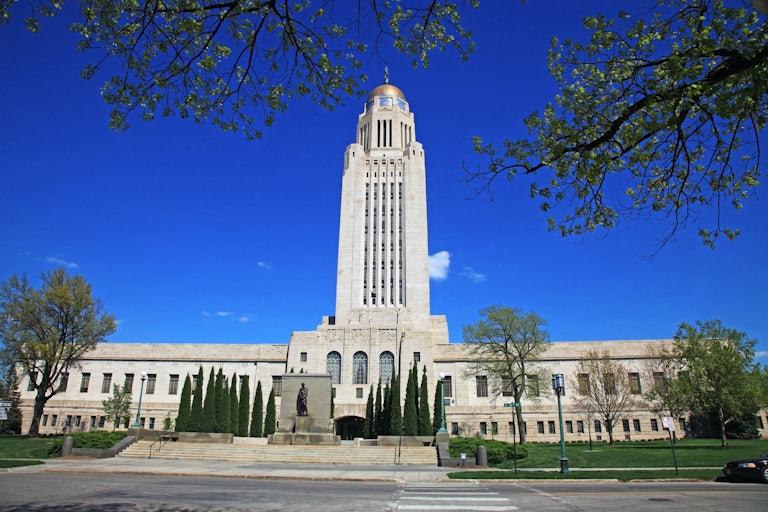
State capitol building in Lincoln, Nebraska
Education Images/Universal Images Group/Getty Images
The state Capitol building in Lincoln, Nebraska

A Nebraska Republican state senator argued Wednesday for a six-week abortion ban by claiming there are too many foreigners living in the state, invoking a racist conspiracy theory.

Since Roe v. Wade was overturned, abortion is allowed in Nebraska up to 21 weeks and six days of pregnancy. But on Wednesday, the Senate began debating a bill that would ban abortion after six weeks, before many people even know they are pregnant.

Senator Steve Erdman decided that the best argument in favor of the ban was the “great replacement theory,” which the Southern Poverty Law Center defines as a “racist conspiracy narrative [that] falsely asserts there is an active, ongoing, and covert effort to replace white populations in current white-majority countries.”

“Our state population has not grown except by those foreigners who have moved here or refugees who have been placed here,” Erdman told the chamber.

Erdman also said that all of the aborted fetuses “could be working and filling some of those positions that we have vacancies.”

Erdman’s argument delivers a nice one-two punch of racism and misogyny. First, he thinks that abortions should be banned to force more white people to have babies. But it’s actually people of color who are hardest hit by abortion restrictions. Not all states report the racial and ethnic data of people who get abortions, but those that do found a disproportionately high number of people of color seek the procedure.

The Centers for Disease Control and Prevention found that in 2020, in 29 states and Washington, D.C., 39.2 percent of people who got an abortion were Black. Hispanic people made up 21.1 percent of people who got an abortion, and other nonwhite ethnicities made up 7 percent.

What’s more, if Erdman is actually worried about increasing the labor force, he definitely shouldn’t be banning abortions. Abortion gives people better control over their own lives and allows them more opportunities to join the workforce and move upward economically. Treasury Secretary Janet Yellen warned the Senate Banking Committee in May last year, a month before the Dobbs ruling, that “eliminating the right of women to make decisions about when and whether to have children would have very damaging effects on the economy and would set women back decades.”

Six-week abortion bans are being considered across the country, including in Florida, which just passed such a bill on Thursday by a vote of 70-40, mainly along party lines. It now goes to Governor Ron DeSantis, who is expected to sign it into law.

This post has been updated.