Breaking News
Breaking News
from Washington and beyond

Ron DeSantis Is Now Attacking the Orlando Philharmonic Because It Once Hosted a Drag Show

In an administrative complaint, the Florida governor accused the Orlando Philharmonic Plaza Foundation of putting on a “sexually explicit show.”

Ron DeSantis speaks at a podium
Scott Olson/Getty Images

Florida Governor Ron DeSantis stripped the Orlando Philharmonic Plaza Foundation of its liquor license Friday for allowing children to attend a Christmas drag show.

DeSantis, who has been cracking down on LGBTQ rights, filed an administrative complaint through the state department of business and professional regulation accusing the Philharmonic’s foundation of putting on a “sexually explicit” show where minors would be present.

The governor had previously warned any venues that hosted the touring show A Drag Queen Christmas that his administration would seek legal action against them. He has also mentioned the possibility of having child protective services investigate parents who take their children to drag shows.

Civil rights attorney Alejandra Caraballo pointed out that DeSantis couched the administrative complaint in language about morality, at one point saying that businesses that host drag shows are a “nuisance,” which is defined as something that “becomes manifestly injurious to the morals or manners of the people.” By framing drag shows as a morality law issue, Caraballo said, DeSantis strips the performances of free speech protections.

DeSantis has gone to all-out war with anything he deems “woke,” and with LGBTQ rights in particular. He enacted the state’s now infamous Don’t Say Gay law, banned transgender women from playing women’s sports, and vowed to defund diversity, equity, and inclusion programs on college campuses. He also unconstitutionally forced out Andrew Warren, a state attorney who said he would not unilaterally criminalize cases involving personal medical issues, such as abortion or trans health care.

DeSantis is also part of a larger trend of Republicans demonizing drag queens and trans people, accusing them of being pedophiles as a way to fearmonger about the LGBTQ community. Drag shows, Medicaid funding for gender-affirmative care, and even children’s hospitals have all come under attack.
What Were the Miami Police Thinking With That “Black History Month” Cop Car?

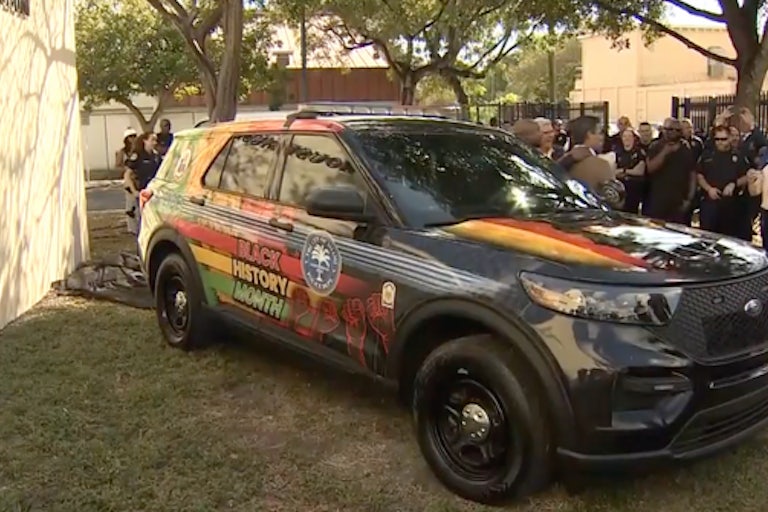
Miami police unveiled a new cop car emblazoned with the words “Black History Month” and covered in images of Africa and raised Black fists.

A black Miami police car painted in green, red, and yellow. On the side are the words "Black History Month" and several close fists raised in the air.
Screenshot/WISN TV

On Thursday, in the dawn of Black History Month and amid nationwide calls for police reform after another flashpoint of police brutality in the killing of Tyre Nichols, the Miami Police Department unveiled its latest expense: a Black History Month–inspired cop car.

The pan-African colored vehicle, adorned with images of Africa and raised Black fists, was in honor of the history and legacy of the Black police precinct—a separate station that closed in 1963—and the officers who served there, reported the Miami Herald.

Mayor Francis Suarez also used the occasion to boast a decrease in complaints made against officers in the past year.

“I’m very proud of the way our officers behave,” Suarez said, according to the Herald. “We embrace our history. We know where we came from.”

Meanwhile, Miamians are gathering on Saturday to protest the police killing of Antwon Cooper, a Black man. Officials, who have changed their story about whether Cooper was armed, shot the 34-year-old as he attempted to flee a traffic stop. Video does not indicate him carrying a weapon.

Miami’s police department, like every other’s, is rooted in a history not worth embracing. As Vice pointed out with a poignant example, in 1967, Miami Police Chief Walter Headley coined the phrase “When the looting starts, the shooting starts”—his standing orders to his officers should they face any “civil uprising.” Former President Donald Trump paid homage to that phrase in the aftermath of the murders of George Floyd and Breonna Taylor by the Minneapolis and Louisville police departments, respectively:

Indeed, one might hope that police departments everywhere would not “embrace” their history but rather shed themselves of it; after all, even if Suarez was referring specifically to the history of Black cops, the nation just witnessed five of them kill another.

Elon Musk Says Twitter Will Share Ad Revenue With People Who Pay Him

Musk announced that users will be able to share in some of the company’s ad revenue, but only if they subscribe to Twitter Blue.

Elon Musk
Justin Sullivan/Getty Images

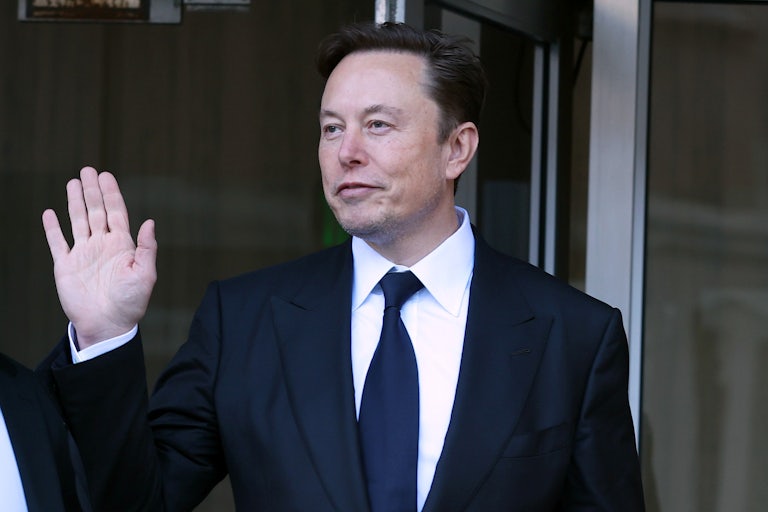
Elon Musk seems to be scrambling to make more money at Twitter, as the company this week unveiled a series of plans aimed to cut costs and increase ad revenue.

Musk announced Friday that Twitter will start showing ads in replies to tweets. If the original poster pays for the company’s controversial Twitter Blue subscription plan, they could share some of the ad revenue. Musk did not specify how much that share would be.

This decision came the day after Twitter announced it would get rid of its free application programming interface, or API, in favor of a “paid basic tier.” An API allows multiple separate computer systems to communicate. Twitter’s API, as explained by Wired, “allows third parties to retrieve and analyze public Twitter data, which can then be used to create programmable bots and separate applications that connect to the platform.”

Removing the free API would put a stop to bot-controlled accounts that share, say, hourly cute animal photos, but it would also end automated severe weather alerts, and throttle research and activism on the platform.

Musk also announced he would phase out Twitter’s “legacy Blue Verified” check marks. After the initial Twitter Blue rollout was flooded with disinformation, the company tried again in December with a series of color-coded checks to denote different statuses. Confusingly, both Twitter Blue subscribers and legacy verified accounts—significant accounts that had been verified pre-Musk—had blue checks.

All of these changes come just days after Twitter made its first interest payment on the $12.5 billion in debt that Musk took on when he bought the social media platform.

The Tesla CEO took the Twitter reins in late October for $44 billion, about a third of which he borrowed from a group of banks. Since taking over, he has aggressively slashed costs, including firing employees, auctioning off everything in Twitter’s San Francisco headquarters, and apparently just not paying rent.

But advertisers have also left the platform en masse, turned off by Musk’s lax approach to content moderation and apparent penchant for letting Nazis back online.

Matt Gaetz’s Brilliant Idea for the Debt Ceiling Crisis: Medicaid Work Requirements

The Florida representative wants to force people to work to get health care.

Drew Angerer/Getty Images

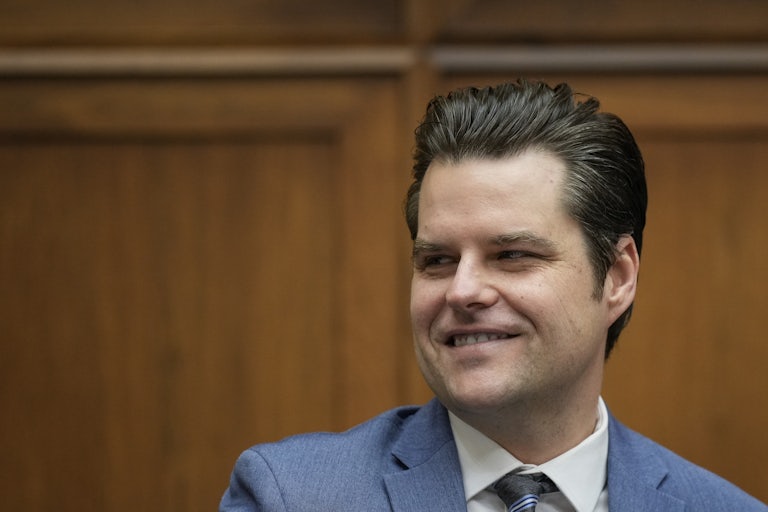
Matt Gaetz is apparently rallying his colleagues to force work requirements on people in order for them to get health care.

The Florida representative told Semafor that he’s been pitching the idea of tightening Medicaid eligibility on “able-bodied working age adults” as part of a potential deal to raise the debt ceiling. Semafor reported Gaetz has been garnering “a very positive reception” to his pitch, including from House Speaker Kevin McCarthy.

“Work requirements are proving to be a very unifying concept with my colleagues,” Gaetz said.

Gaetz doubled down on Friday and added to his pitch, tweeting that “work requirements on means-tested programs (like Medicaid & food stamps) will curtail inflationary government spending and increase labor participation.”

On its face, these reports are concerning, given how much Gaetz and his fellow far-right colleagues have already secured from McCarthy. After dragging out the speaker vote, they were able to force him to modify the House rules package and give them highly sought-after committee seats. For Gaetz’s proposal to gain “very positive” favor with other Republicans, including McCarthy, is not a good sign.

But, realistically, this is a project most, if not all, Republicans would happily sign onto. Work requirements for social services like Medicaid have long been part of the conservative project; Gaetz is just more publicly pushing for what most of the caucus wants anyway.

As of October 2022, over 84 million people were enrolled in Medicaid, many of whom are elderly, children, pregnant, and/or low-income. Six states have held ballot measures on whether to expand Medicaid coverage; all six voted to do so, five of them being red states.

Political popularity has not stopped Republicans from persisting before, however, so the real-life stakes should not be understated. Imposing work requirements on millions of people just so they can receive health care—or even put food on the table—is draconian.

Value judgments aside, the punitive logic does not even work: A 2019 study on Arkansas’ Medicaid work requirements found 18,000 people lost health care coverage before a judge put the policy on hold, but there was no notable increase in employment. And the more problems one has to deal with—like an inability to obtain health care or medicine—the less one is able to live fully, let alone work sufficiently. So not only is the policy undesirable morally, it is not even effective economically.

YouTube Contractors Lead First Strike in Google History

The YouTube Music contractors are protesting a forced return to the office, after most of them were hired remotely to begin with.

Justin Sullivan/Getty Images

On Friday, in Austin, Texas, over 40 YouTube Music contractors are striking in what is believed to be the first time a group of Google workers will go on strike.

The workers—who are technically employed by Cognizant, a subcontractor of Google’s parent company, Alphabet—are striking in response to an order to return to the office in Austin by February 6. They argue the mandate is an unfair labor practice as many of them cannot afford to pay for relocation (travel, childcare, and beyond) while they’re paid just $19 an hour. A majority of them were hired remotely, nearly a quarter not even based in the state.

The workers, responsible for managing music content for YouTube’s 2.1 billion monthly worldwide users, argue the forced return is an unfair labor practice and retaliation to their organizing. A supermajority of the YouTube Music workers, members of Alphabet Workers Union-CWA, filed for union recognition from the National Labor Relations Board in late October.

Workers are awaiting the NLRB to rule on their union recognition and on recognizing Alphabet and Cognizant as joint employers—forcing both companies to negotiate. The union sees the return to office order as a violation of labor law that mandates fair union voting conditions, and says workers would negotiate return to office policies after a successful union election.

As of now, the union says both companies scapegoat the other for policies like the return to work mandate, muddying the waters of which entity is actually pushing the mandate and where exactly workers can seek accountability. And while Alphabet still exercises control over companies like Cognizant, subcontracting enables them to treat workers worse.

“The result of this two-tiered system is that full-time Google employees receive dramatically higher pay benefits, while contractors are treated as second-class workers,” Music Generalist Sam Regan explained to The New Republic.

Workers attempted to express their objections on numerous occasions. They conducted a mass email campaign, collecting testimonials as to how the policy would negatively impact workers. On January 20, workers submitted a letter to Cognizant CEO Ravi Kumar, demanding that he honor his previous support for flexible work arrangements. Receiving no response, workers filed an unfair labor practice charge with the NLRB. And now they are striking.

The strike joins other action from the Alphabet Workers Union-CWA nationwide. On Thursday, workers rallied outside Google’s New York City office in response to Alphabet laying off 12,000 employees. On Wednesday, Google Raters—workers who train, test, and evaluate algorithms that drive Google’s reportedly 81 percent revenue-generating search function—delivered a petition demanding better working conditions. Namely, these workers are excluded from Alphabet-wide minimum standards ($15/hour, health care, tuition reimbursement, and more). The so-called “ghost workers” driving Google’s profits behind the scene are demanding to be compensated at least to the bare minimum.

While the workers are part of an ongoing story of tech companies mistreating their workers, this incident is unique as the workers are not exactly “tech” workers. “We’re actually all musicians and music industry workers. So our culture is really built around the love for music,” Regan explained. “For me, this is the most interesting and inspiring team that I’ve ever worked with at a job. And we think that over the past three years, since we began working remotely, our team metrics have been incredible. We’ve more than proven that we’re capable of delivering excellent work at the highest level.”

The workers are holding a press conference outside the Google Austin office at 12 p.m. E.T., which can be viewed here.