Breaking News
Breaking News
from Washington and beyond

Starbucks Is Closing All Stores in a Main Union Stronghold

The corporation’s union-busting efforts are escalating.

Thomas A. Ferrara/Newsday RM/Getty Images

Last year, Ithaca, New York, became the first town in the country where every Starbucks worker was unionized. Now, by the end of the month, Starbucks will have forcibly shut down all three of its unionized Ithaca locations.

The company announced its intention to close Ithaca’s two remaining stores (in a town in which a large chunk of the population is caffeinated college students) on Friday.

In a recent press release, the company said they “​​continue to open, close and evolve our stores as we assess, reposition and strengthen our store portfolio.” But given that all of Ithaca’s stores, all unionized, have been shut down within a year, the actions seem more than simply earnestly strategic.

Last June, Starbucks shut down a location near Cornell University, a handful of weeks after the location voted 19–1 to unionize. “The College Ave location may be the single most prime property in all of Upstate NY,” former Ithaca Mayor Svante Myrick wrote on Twitter. “Over 15,000 pedestrians cross it every day. There’s no way it isn’t profitable. This looks like union busting.”

Last week, emails were revealed to show that Starbucks higher-ups were actively concerned with bad press and the workers’ striking in the lead-up to their decision to shut down the campus location. Workers had complained of their hours being cut and stores being understaffed, seemingly in efforts to wear down the workers and consequently the stores themselves.

“The under-scheduling is genius on their part,” Stephanie Heslop, who worked at one of the two soon-to-be-closed locations, told Jacobin. “Customers and our pitiful paychecks punish us and Starbucks can claim that it’s about ‘business needs.’”

Such efforts to push out employees holds potential resonance, with another Starbucks store in Buffalo, New York—among the first locations to unionize—now filing to decertify from the union. Last April (the same month Ithaca’s campus location unionized), the Buffalo store voted 18–1 to unionize. Since then, it seems management has done whatever it could to turn back the clock.

“Almost every union leader at the store was fired or forced out because of the environment of intimidation and fear that Starbucks management created,” a spokesperson for Workers United told local TV outlet WGRZ. “In fact, the company is currently being prosecuted for the discriminatory treatment of workers at the Del-Chip store.”

It appears that if Starbucks can’t outright close locations down, it’s looking to simply wear out and replace the workers who unionized them. Such a notion is affirmed by the aforementioned emails, which reveal efforts from management to refuse time-off requests for student workers to go home for spring break and even double-schedule them, all in self-fulfilling anticipation of “expected turnover” for “10-14 partners in the next four weeks” (emphasis in the original email). That specific email was sent on March 4: four weeks before the store would hold its unionization vote.

With the closure of the college campus location, the two remaining locations in Ithaca logically would have only increased in foot traffic. Yet somehow, Starbucks purports that the closure of those two final locations—again, in a town whose population is significantly made up of students and faculty—is part of some ongoing detached-from-union-efforts business optimization scheme.

To be fair, Starbucks is not wholly dishonest in its logic of why it is forcibly closing stores. The closures are optimizing—just not for customer satisfaction, nor for basic worker protection and dignity, but simply for executive profits.

The revelations are not surprising. Just over a month ago, former Starbucks CEO Howard Schultz accidentally admitted that nonunion stores received better benefits than unionized stores, and he couldn’t even say “no” to the question of whether he has threatened workers for unionizing.
Trump Can’t Stop Lying About His Rape Trial

Even as the jury begins deliberations in the rape and defamation trial, Trump keeps shitposting on social media.

ANDY BUCHANAN/AFP via Getty Images

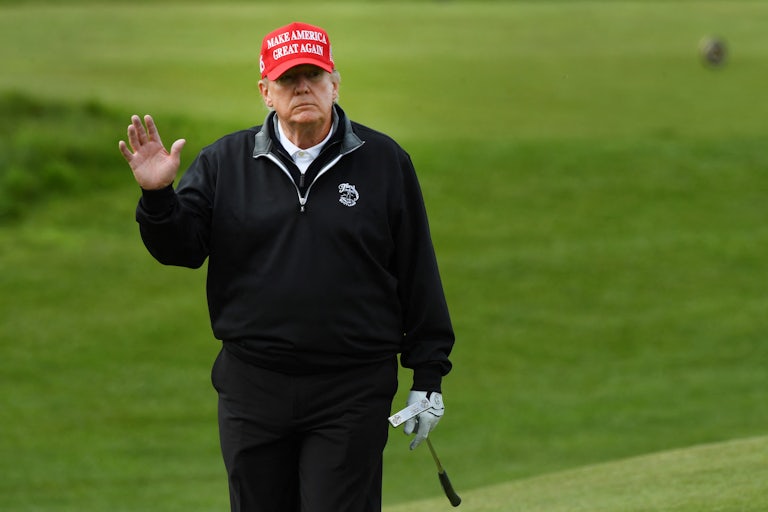
Donald Trump is patiently waiting with bated breath like the rest of us to see if a jury will find him guilty of raping a woman in the mid-1990s and of defaming her when she accused him of assault decades later.

Yeah, right!

A jury began deliberating Tuesday on whether the former president raped and defamed writer E. Jean Carroll, and Trump is already lying about it.

“Waiting for a jury decision on a False Accusation where I … am not allowed to speak or defend myself,” Trump wrote on Truth Social. In reality, Trump refused to testify during the trial (despite an offer from the judge presiding over the case that he could do exactly that). Instead, he has repeatedly posted about it on social media, leading the judge presiding over the case to reprimand both Trump and his lawyer.

I will therefore not speak until after the trial, but will appeal the Unconstitutional silencing of me, as a candidate, no matter the outcome!” Trump said, seemingly not seeing the irony of announcing his silence.

Carroll accused Trump in her 2019 memoir of raping her in the Manhattan Bergdorf Goodman department store in the mid-1990s. She has sued him twice for defamation: first in 2019, when he said she made up the rape allegation to promote her book, and again in November for posts he made about her on social media.

She is not the only woman to accuse him of sexual assault: At least 26 other women have done so, two of whom testified during the trial. But Carroll’s case is the first to make it to a courtroom.

Playing Hide and Seek Can Get You Shot in America

A Louisiana man has been charged for shooting a 14-year-old girl in the head as she played the game with her friends.

Bryan Tarnowski/Bloomberg/Getty Images

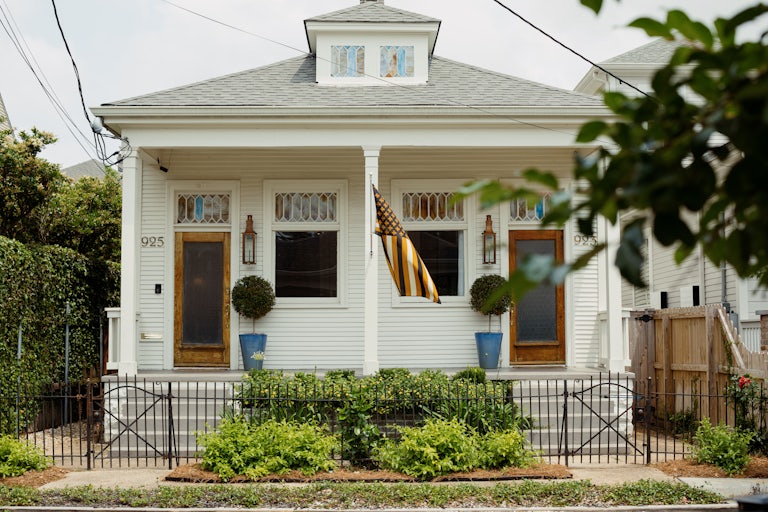
On Sunday, a Louisiana man shot a 14-year-old girl in the back of the head as she played hide and seek with a few friends outside his home.

Detectives say that the children were playing hide and seek outside the home of David Doyle, who told detectives that he saw shadows outside his home and then grabbed his gun. When he came back outside, he apparently saw people running away from his property and began haphazardly shooting at them. It is not clear whether Doyle even asked who was there.

The girl has been receiving treatment for non-life-threatening injuries.

Local outlet KPLC-TV reports that the shooting happened on a dead-end road on which the only three homes are owned by Doyle, the victim’s family, and a relative of the victim’s family. The man has been charged with aggravated assault, battery, and illegal discharge of a firearm, and his bond has been set at $300,000.

The shooting of a 14-year-old girl playing hide and seek follows a string of similarly appalling cases, like 16-year-old Ralph Yarl being shot after accidentally ringing the wrong doorbell, or 20-year-old Kaylin Gillis being shot and killed after her friend accidentally turned into the wrong driveway, or two teenage cheerleaders being shot after one of them accidentally pulled on the wrong car door handle.

Louisiana is among the states with a so-called “stand your ground” law that can be used to justify the use of deadly force in the context of self-defense. Such laws, spread even further after the murder of Trayvon Martin in Florida in 2012, have been linked to an 11 percent rise in gun homicides in America.

Angry, radicalizing figures have fomented social distrust in this country. That has sparked increasingly vicious instances of violent crime, seen just days ago in the mass shooting carried out in Allen, Texas, by a neo-Nazi inspired by the likes of Libs of TikTok and Nick Fuentes. And codified law has affirmed this social distrust, encouraging people to internalize it and allowing it to metastasize into murderous instincts.

An Entire Florida School District Has Banned a Kids’ Book on Segregation

The district pulled the book after one parent complained.

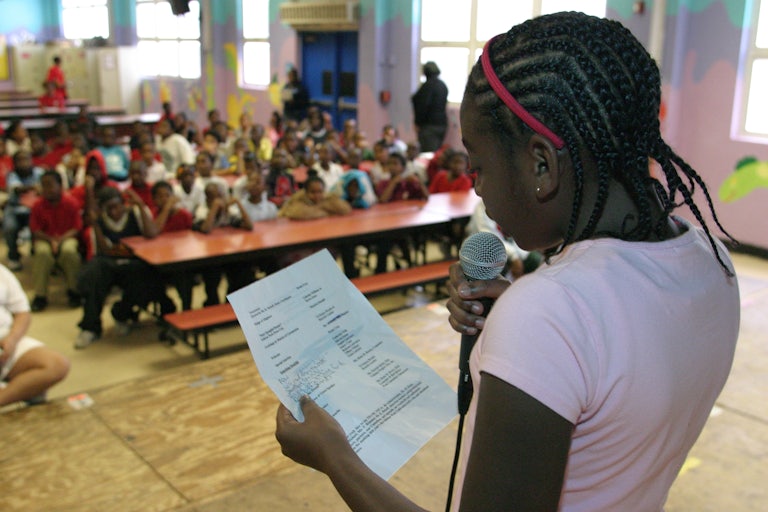
A Black girl in elementary school holds a mic and reads off a paper on stage.
Jeffrey Greenberg/Universal Images Group/Getty Images

A Florida school district has banned a book about segregation after one parent complained, part of a disturbing trend of state schools blocking discussions of racial justice.

The Wakulla County school district decided in October to remove the graphic novel Little Rock Nine from its libraries after reviewing a complaint from a parent. The school that initially banned the book did not give more details on why the parent complained but said it had decided that even though the book is historically accurate, its subject matter is “difficult for elementary students to comprehend.”

Florida schools begin teaching about segregation in fourth grade, but the book—which is written at a third-grade level—has been deemed “above the understanding” of all elementary students.

Instead, it will only be allowed in middle and high school libraries because “some students in middle or high school might be at a third grade reading level and could gather knowledge from the material,” the school principal and librarian said.

This book ban is the latest instance to come to light of Florida restricting what can be taught or even read in schools, usually on topics involving race, gender, and sexuality. In March, an elementary school in Pinellas County banned the movie Ruby Bridges after one parent complained that she didn’t like how it depicted race relations in 1960s America. Earlier this year, Pinellas County school officials also banned high school students from reading The Bluest Eye by Toni Morrison—again after just one parent complained.

Florida is increasingly restricting what can be taught in schools at all levels. Governor Ron DeSantis has declared war on “wokeism” and has promised to defund diversity, equity, and inclusion programs on college campuses. He has backed the Stop Woke Act, which restricts teaching about race in colleges, and announced plans to mandate Western civilization courses. His administration was also in close contact with the College Board as it gutted the A.P. African American Studies course.

But the book bans go a step further, as they aren’t even about changing the school curriculum but preventing students from reading the books at all. In public schools, one school district has banned 23 different books from school libraries. Teachers in other school districts have also been told to hide their classroom book collections until all the books have been vetted and approved. But the vetting process is opaque, and there is no policy clarifying how long a complaint review process should take. As a result, books and films are withheld from students for months on end.

“Why is it permissible to teach white scholars Black folks were enslaved but not permissible to teach them about African American contributions to America and the world and the struggles they encountered and continue to experience as citizens of the United States of America?” former St. Petersburg police chief Goliath Davis asked in an op-ed for The Weekly Challenger after Ruby Bridges was banned. “Black history, Native-American history and Hispanic history, though not always glamorous, are American history and cannot be denied.”

Here Is the Moment Cops Arrested a Journalist at the Jordan Neely Protest

Because what’s this story without a dash of police violence?

Selcuk Acar/Anadolu Agency/Getty Images
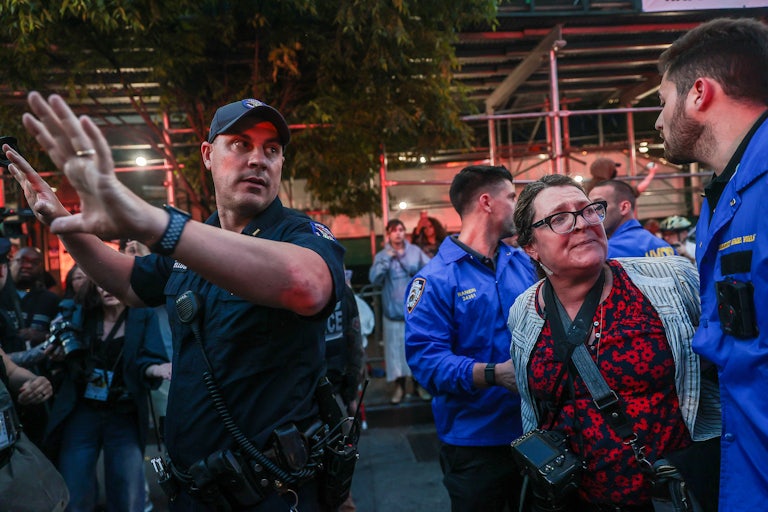
Photojournalist Stephanie Keith is arrested at a Jordan Neely vigil and protest in New York on May 8.

On Monday night, residents of New York City gathered in downtown Manhattan for a vigil and protest in honor of Jordan Neely, a homeless man choked to death by 24-year-old Daniel Penny on the city’s subway.

And of course, in a story already rife with injustice, the police had to make sure that their failings were front and center. Longtime photojournalist Stephanie Keith was among 11 people arrested at the protest.

At a press conference that night, New York Police Department Chiefs Jeffrey Maddrey and John Chell said those taken into custody had violated laws by using a loud microphone, blocking the street, or even because some apparently had “assaulted themselves.”

The police chiefs have not yet clarified what “assaulted themselves” exactly means.

Video shows Chell himself barking at his officers to “lock her up,” after Keith simply stepped into the sidewalk to take a photo.

In Keith’s case, Chell said at the conference, the photographer faces charges of disorderly conduct and interfering with three arrests. The New York Daily News reports that Keith was released and given a summons later in the night.

Keith’s own words, and video open for all of us to see, undermine the police’s account of what happened.

“I was trying to photograph what I thought was an arrest, but I never even got a chance to see since they grabbed me as soon as I tried to photograph,” she told the Daily News. “I said, ‘I’m press,’ and they said, ‘You’re not, you’re arrested.’”

It’s almost too perfect. Penny has yet to be charged for killing Neely—an incident documented clearly on video. The police instead questioned the murderer and released him back onto the streets with little ado. Meanwhile, also on video, one of the most powerful police officers in New York City ferociously commanded his subordinates to lock up a journalist who was simply documenting his officers responding with more force to protesters than to a murderer.

Indolent thinkers often call any number of things “Orwellian,” but if anything warrants the oft-used designation, it’s the lack of arrest of someone caught on film committing murder and the active arrest—also caught on film—of a photojournalist trying to record the police state violently repressing people who were protesting that injustice.