Breaking News
Breaking News
from Washington and beyond

There Is No Democrat’s Case for Ron DeSantis

A Orlando Sentinel op-ed falls into familiar traps in making the case for Florida’s governor.

Photo by Joe Raedle/Getty Images
Florida Governor Ron DeSantis

The case against Ron DeSantis from a Democrat’s perspective is straightforward and uncomplicated. For one thing, he’s a Republican. And not just any Republican: DeSantis has been one of the most odious and destructive governors in America since January 2019. He has been a vocal opponent not just of efforts to end the Covid-19 pandemic but of the vaccine that did more to control it than anything else; his anti-vaccine advocacy has also spurred on anti-vaccine activists’ assault on safe, protective measures to control diseases like mumps and polio. He has relentlessly attacked his state’s LGBTQ population, signing draconian bills into law that aid the false, dangerous idea that these people are “groomers.” His efforts in Florida have practically single-handedly brought back book banning to America, an extremely troubling development. On top of that, he is, on most issues, a bog-standard Republican: He wants to cut benefits for the poor and pass massive tax cuts for the rich. He is also, it almost goes without mentioning at this point, grotesque and charismaless, and a phenomenally unappealing figure. He has no juice.

Writing in The Orlando Sentinel on Monday, William Cooper—a Democrat and author of Stress Test: How Donald Trump Threatens American Democracy, a book with one of the most non–[citation needed] titles in the history of American publishing—made the case that none of that actually matters because DeSantis went to Harvard and Yale. Here’s Cooper:

But unlike Biden and Trump, DeSantis passes the litmus test. He’s very competent. A Yale- and Harvard-educated lawyer, DeSantis served in the Navy (including on a tour in Iraq) before entering Congress and then becoming Florida’s governor. And he’s effectively achieved his objectives in Florida—regarding both politics and policy.

DeSantis’ competence matters. Why? Because the most important quality to have in a U.S. president is competence. The biggest questions facing the country do not fall comfortably along some left-right axis but instead require prudent and empirically effective leadership to address. How should we approach our global rivalry with China? How should we regulate artificial intelligence? How should we participate in an international economy complicated by dysfunction and violence around the world? And so on.…

A simple question establishes the point. Which candidate would be better at the helm in a global crisis: an 80-year-old who can’t walk straight (Joe Biden); a 76-year-old with the emotional intelligence of a 10-year-old (Donald Trump); or a 44-year-old Harvard-law-trained Navy vet who skillfully runs his home state (Ron DeSantis)?

This is an argument that reduces politics to pure aesthetics—there is no mention of anything DeSantis could do that affects people’s lives in any way. Cooper produces no evidence that DeSantis is “skillfully” managing his home state; he addresses none of the policies that DeSantis has pursued in Florida. The office of the presidency is reduced to an almost symbolic one in which DeSantis is effective simply because he fits some sort of preordained model of what a president should look like (and also because, unlike Trump and Biden, he is not old). Similarly, there is no mention that Biden has skillfully managed an international crisis—Russia’s invasion of Ukraine. Ron DeSantis has spent most of the last two years losing a war against Disney. 

It gets worse: 

Indeed, domestic issues matter less and less the more interconnected the world gets—and it’s getting exponentially more interconnected as time marches on. This, in turn, decreases the relevance of a president’s political party and increases the importance of a president’s competence. Far better to get the culture wars wrong but get China right than vice versa. Same with taxation: Better to tilt the code a little more toward the rich if it means we also get smarter regulations protecting humanity from the downside of artificial intelligence. Appoint conservative judges all day long if it means America’s international effectiveness and leadership improves. America’s domestic squabbles just don’t mean as much as they used to. And it’s a sign of our national decadence and complacency that our political focus is nonetheless still insular and myopic. The world is a dangerous and complicated place and the president of the United States should be—above all else—very good at dealing with global challenges.

Setting aside the myopia of this argument—issues that don’t interest Cooper, like gay rights, are reduced to baubles to be cast aside so that we can “regulate artificial intelligence,” whatever he means by that—none of this actually applies to DeSantis. There is no evidence that he could manage foreign affairs any better than Biden or, for that matter, Trump. There is significant evidence that he would arguably make lives for vulnerable people—LGBTQ people and poor people, in particular—worse than Trump.  

DeSantis’s appeal has largely always been this abstract. He does seem more normal than Trump. There are no tweetstorms at three in the morning. There are no indictments about mishandling classified information. And yet, despite the fact that he’s young and possesses his faculties, DeSantis remains a damaging political force. All you have to do is look at what he’s actually doing and saying. 
More on the Interminable 2024 GOP Primary

Federal Judge Orders Trump to Shut Up About Classified Docs

The Department of Justice won its first salvo with Trump, but there will be many more to come.

Photo by JIM WATSON/AFP/Getty Images

Donald Trump is banned from talking on social media about evidence in the classified documents case, thanks to a protective order issued Monday.

Trump pleaded not guilty last week to 37 counts of keeping classified information without authorization, making false statements, and conspiring to obstruct justice. Federal prosecutors requested the protective order on Friday, arguing they needed to protect “sensitive and confidential” information.

Magistrate Judge Bruce Reinhart has acquiesced, issuing an order that significantly restricts the ways Trump can access evidence in the case and share it online. Unless he has permission from a judge, Trump is not allowed to share information about the evidence to anyone not involved with the case.

He also cannot see any of the prosecutors’ evidence unless he is in the presence of his lawyers, and he definitely cannot keep any copies of the evidence. If he violates any of these new rules, he could face criminal contempt charges.

Trump also had to sign a form promising, like Bart Simpson writing on the chalkboard, “I will not further disclose or disseminate the Discovery Materials.”

Given Trump’s penchant for just tweeting out important decisions or insider information, it’s unsurprising that Reinhart issued a protective order. This isn’t the first time Trump had to be disciplined before a trial even got underway: In May, the judge presiding over Trump’s Manhattan criminal case on the alleged payment of hush money to Stormy Daniels issued a protective order stating that the people involved in the lawsuit are not allowed to share evidence from the case on social media. Trump can still discuss the case publicly and is only restricted from sharing information about the evidence.

Prosecutors had argued Trump has a “long-standing history” of attacking people involved in his legal disputes. The judge also ordered Trump to attend a hearing specifically to be told to stop trying to intimidate witnesses.

Why Did the DOJ Resist Investigating Donald Trump’s Role in January 6?

A new Washington Post report suggests the Department of Justice did not want to seem “partisan” by investigating the former president’s attempt to overturn a legitimate election.

Photo by Brendan Smialowski/AFP/Getty Images
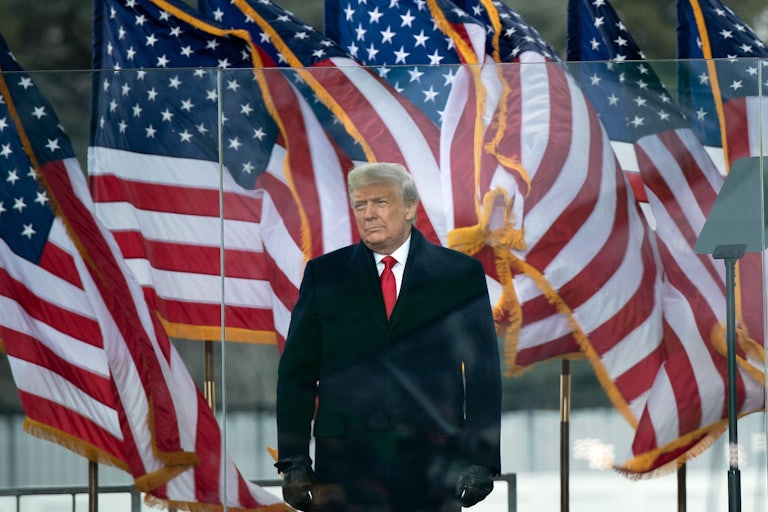
Donald Trump at a rally shortly before his supporters stormed the Capitol

The Department of Justice waited a year to investigate Donald Trump for his alleged role in the January 6 insurrection, The Washington Post reported Monday.

A new investigation by the Post found that the DOJ resisted looking into Trump or members of his inner circle, even as evidence of an organized scheme to overturn the 2020 election piled up. Instead, newly sworn-in Attorney General Merrick Garland and his team opted for a “bottom-up” strategy, focusing first on the rioters and working their way up. Garland and his team refrained from directly investigating the former president out of fear of looking politically partisan.

Just hours after he was sworn into office, Garland met with acting U.S. attorney for the District of Columbia Michael Sherman, who along with the FBI was responsible for prosecuting all crimes related to the January 6 attack. Sherman presented their work, which had resulted at the time in charges for nearly 300 rioters, with nearly 900 in  total identified.

Sherman had made waves when he said Trump could be considered guilty of the attack, but according to the Post’s investigation, his presentation made no mention of investigating Trump or his advisers. Investigators stayed away from Trump, even as more and more evidence appeared of numerous schemes intended to overturn a legitimate election.

More than a year later, in November 2022, Garland finally appointed special counsel Jack Smith to investigate Trump’s alleged mishandling of classified documents and his alleged role in the January 6 attack. The Post attributes this delay to “a wariness about appearing partisan, institutional caution, and clashes over how much evidence was sufficient to investigate the actions of Trump and those around him.”

Sherwin, senior Justice Department officials, and the deputy FBI director all opposed investigating Trump or his allies directly, arguing it was too early, the Post reported. But Garland then continued with this approach, giving Trump more time to spread lies about the 2020 election.

Trump pleaded not guilty last week to 37 counts of keeping classified information, some of it relating to national security, without authorization, making false statements, and conspiring to obstruct justice. He is still under investigation for his role in January 6 and under a separate investigation for his role in trying to overturn the results of the 2020 election in Georgia.

More on Trump's Lawlessness

Donald Trump’s Former Attorney General Thinks He’s a Child

The former president is also seen as a national security risk by many of the people who worked closest with him in his former administration.

Photo by Mark Wilson/Getty Images

Two of Donald Trump’s ex-advisers warned over the weekend that the former president poses a massive threat to national security, in light of his recent indictment for allegedly mishandling classified documents.

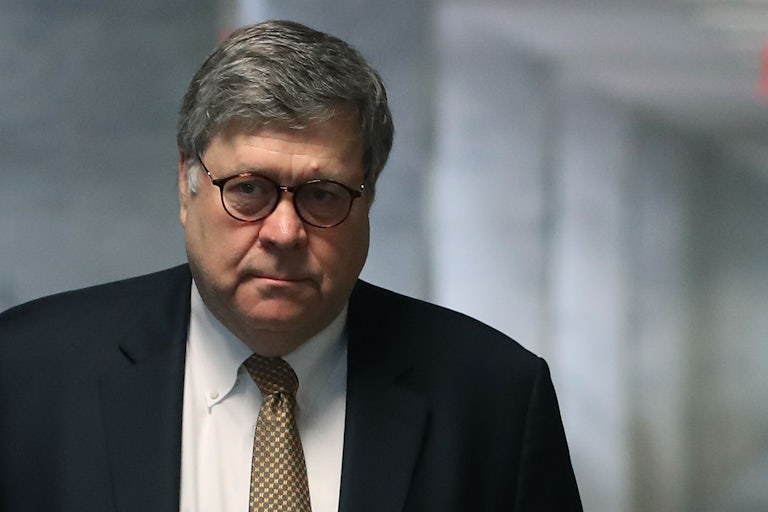
Former Attorney General Bill Barr called Trump’s conduct “indefensible” on Sunday. Although he defended some of his former boss’s behavior, Barr opposed Trump running for office again.

“Should we be putting someone like this forward as the leader of the country, leader of the free world?” Barr told CBS’s Face the Nation. “He will always put his own interests, and gratifying his own ego, ahead of everything else, including the country’s interest, there’s no question about it.”

“He’s like a … defiant 9-year-old kid who’s always pushing the glass toward the edge of the table, defying his parents to stop him from doing it,” Barr continued. “It’s a means of self assertion and exerting his dominance over other people. And he’s a very petty individual … but our country can’t be a therapy session for, you know, a troubled man like this.”

Also on Sunday, former Defense Secretary Mark Esper told CNN’s State of the Union that Trump’s alleged handling of classified material was “unauthorized, illegal, and dangerous.” He compared Trump’s actions to those of Jack Teixeira, the Massachusetts Air National Guard member accused of leaking sensitive military documents online.

When asked if he thought Trump could ever be trusted with national secrets again, Esper replied, “Based on his actions, again, if proven true under the indictment by the special counsel, no.”

“I mean, it’s just irresponsible action that places our service members at risk, places our nation’s security at risk. You cannot have these documents floating around.”

Trump was charged with a total of 37 counts for keeping classified information, some of it relating to national security, without authorization, making false statements, and conspiring to obstruct justice. Barr and Esper are the latest former Cabinet members to turn on Trump over the indictment.

Former national security adviser John Bolton said the indictment should end Trump’s political career, and former chief of staff John Kelly said Trump was “scared shitless” at the prospect of actually being held accountable for once.

It’s worth noting, though, that all of these men defended Trump during his time in office and continue to justify some of his behavior. Still, their comments underline just how serious the charges Trump faces are and how indefensible his actions were.

Don’t Debate Robert F. Kennedy Jr.

Elon Musk and Joe Rogan aren't interested in the "truth" about vaccines. They just want a circus.

Photo by Chesnot/Getty Images

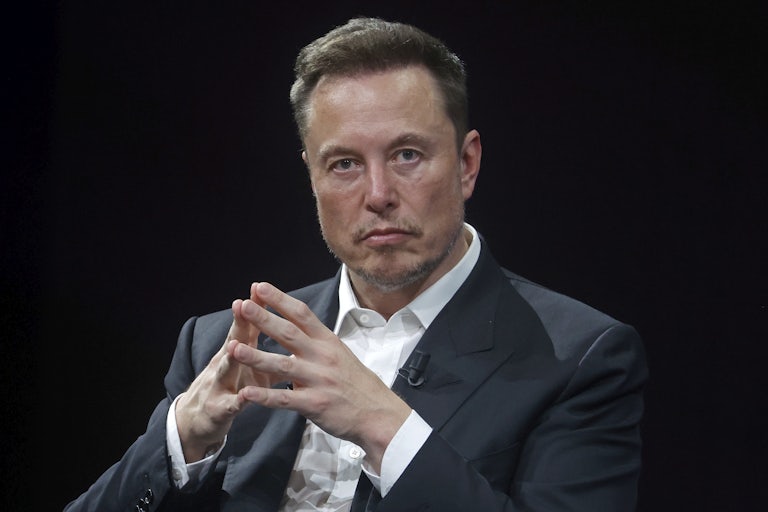
Dr. Peter Hotez is a respected vaccine scientist, dean of the National School of Tropical Medicine and professor of pediatrics and molecular virology and microbiology at Baylor College of Medicine, who has devoted his career to improving global public health. He is also the author of Vaccines Did Not Cause Rachel’s Autism: My Journey as a Vaccine Scientist, Pediatrician, and Autism Dad, a book that draws on his experience as a doctor and the father of an autistic daughter. Podcaster and conspiracy theorist Joe Rogan and profoundly unfunny Twitter CEO Elon Musk spent the weekend trying to bully him into debating Robert F. Kennedy Jr. on the efficacy of vaccines.

The saga started on Saturday, when Hotez shared a Vice article about how Spotify—which signed Rogan to a multiyear exclusive contract in 2021 that is rumored to be worth $200 million—has stopped “even trying to stem” the podcast host’s “vaccine misinformation,” which was focused on Rogan’s three-hour-long interview with Kennedy. “Peter, if you claim what RFKjr is saying is ‘misinformation’ I am offering you $100,000.00 to the charity of your choice if you’re willing to debate him on my show with no time limit,” Rogan tweeted. Musk quickly backed him up, writing, “He’s afraid of a public debate, because he knows he’s wrong.”

Hotez has offered to appear on Rogan’s podcast but has rightfully refused to debate Kennedy on the issue. Given the popularity and influence of Rogan’s show, there are persuasive arguments for appearing, if only to correct the wild statements that are frequently shared about not just the Covid-19 vaccine but all vaccines. But appearing with Robert F. Kennedy Jr. would likely only legitimize those views. Kennedy has spent more than a decade spouting conspiracy theories with no basis in fact about vaccines. As Hotez noted to MSNBC host Mehdi Hasan, “Anti-vaccine disinformation … is now a lethal force in the United States. I offered to go on Joe Rogan but not to turn it into the Jerry Springer show with having RFK Jr. on.”

The goal of the “debate” Rogan is trying to host is not to hash out the truth or to finally decide if vaccines are safe and effective or not. Vaccines are safe and effective: This is settled science. The goal is to sow doubt and confusion over both settled science and the value of expertise, both in medicine and in the wider world. Hotez is right to avoid it. But he is already paying a price: He says he was “stalked” on Sunday by anti-vax protesters who were waiting for him outside his Houston home.