Breaking News
Breaking News
from Washington and beyond

Montana’s New Anti-Drag Law Is So Vaguely Worded It Could Target Dolly Parton

The radical drag ban has officially been signed into law.

Dolly Parton
Theo Wargo/Getty Images

Governor Greg Gianforte has signed an extreme and vaguely worded bill that aims to ban drag performances in front of minors but actually goes much further than that.

The new law, which Gianforte signed on Monday, defines drag performers as “a male or female performer who adopts a flamboyant or parodic feminine persona with glamorous or exaggerated costumes and makeup.” When it was first introduced, journalist and transgender rights activist Erin Reed pointed out that the measure could affect glam rock, wrestling, and even performances by Dolly Parton. Queen Dolly herself has said she has exaggerated her appearance to be “flashy” and “flamboyant.”

The ban categorizes any business that serves alcohol and hosts a drag show as a “sexually oriented business.” The law bans these businesses from allowing minors to enter during a “sexually oriented performance,” and it also prohibits any kind of “sexually oriented activity” in a public space when a minor is present. Businesses could face a fine of up to $10,000 and even lose their liquor license if they repeatedly violate the law.

The law is also the first to specifically ban drag story hours, an event where drag queens read stories to children, which are not at all sexual in nature. Public schools or publicly funded institutions such as museums and libraries are prohibited from hosting drag performances. The institution would be fined $5,000 for hosting a show, and the staff member who approved it could lose their teaching or librarian certification.

“We have white [cisgender] individuals that have zero experience within the drag community providing a legally binding definition of what drag art is,” drag performer Anita Shadow told the Montana Free Press. “I think I speak for the community when I say that is hurtful, degrading, and it’s a misunderstanding.”

Several legal organizations have already spoken out against the law, arguing that it violates the First Amendment. Montana-based nonprofit law firm Upper Seven Law has already pledged to challenge the drag ban in court.

The Human Rights Campaign warned that the law will “further alienate members of Montana’s LGBTQ+ community.” “It’s a sad state of affairs when extremist politicians enact new laws that hurt their constituents instead of helping them,” legal director Sarah Warbelow said in a statement.

Montana is now the third state to ban drag performances, after Tennessee in March and Florida earlier this month. The Tennessee law was blocked by a judge for violating free speech rights, but Pride groups in Florida are already canceling events in light of the new legislation.

John Roberts Would Like You to Pretty Please Stop Heckling Supreme Court Justices

The chief justice says you don’t need to be worried about the Supreme Court’s ethics. They’ll handle it themselves.

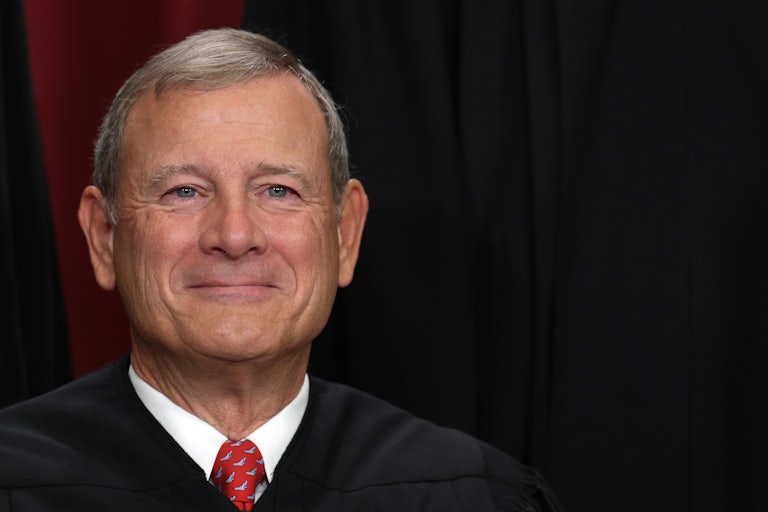
Chief Justice John Roberts
Alex Wong/Getty Images

On Tuesday, Chief Justice John Roberts complained about justices being heckled and said that the Supreme Court—of which nearly half its members have been found to be embroiled in suspicious activity—does not need to be held accountable by other branches of government.

Roberts shared the comments at the American Law Institute’s one hundredth anniversary dinner.

“I want to assure people that I am committed to making certain that we as a court adhere to the highest standards of conduct,” Roberts told the audience. “We are continuing to look at things we can do to give practical effect to that commitment. And I am confident there are ways to do that that are consistent with our status as an independent branch of government under the Constitution’s separation of powers.”

He gave no concrete examples of how the corrupt court will hold itself accountable.

Roberts also reminisced on the days of his mentor, conservative Court of Appeals Judge Henry Friendly, contrasting them to today. “There’s much in the legal arena that he would find abhorrent: [a] judge heckled and shouted down at a law school, protesters outside the homes of justices, to the extent that marshall protection is needed 24/7.”

The chief justice said that in the 18 years he has served on the highest court in America, “the hardest decision he had to make” was not related to the First Amendment, or the death penalty, or the separation of powers—but whether to erect fences and barricades around the Supreme Court.

While those fences were going up, Roberts said, he kept hearing the words of former secretary of state and Supreme Court Justice Charles Evans Hughes at the opening of the Supreme Court building. “The republic endures, and this is the symbol of its faith,” Roberts quoted.

That invocation is what makes Roberts’s comments so troubling. Trust in the Supreme Court is at its lowest in 50 years. The “republic” was very nearly upended two years ago, on January 6, and arguably has been numerous other times, for instance in 2000, at the hands of the legal system. The court has also been implicated in many other signals of an undemocratic society, like, for instance, overturning abortion rights.

Meanwhile, longtime Justice Clarence Thomas has received secret and lavish gifts for decades from the Nazi memorabilia–collecting billionaire and GOP donor Harlan Crow, including luxurious island-hopping excursions on superyachts, tuition payments for his grandnephew’s private schooling, and even a secret deal in which Crow bought Thomas family property and proceeded to upgrade it while Thomas’s mother still lived in it.

Justice Neil Gorsuch successfully sold a 40-acre property that he had been trying to sell for two years to an undisclosed buyer; the buyer of the nearly $2 million Colorado ranch was the CEO of a law firm that has since had 22 cases with business before the court.

Roberts’s own wife has allegedly been paid more than $10 million by an array of high-class law firms—at least one of which has argued before her husband in the Supreme Court.

And this doesn’t even scratch the surface of other issues, like Thomas and Brett Kavanaugh being alleged sexual abusers.

Indeed, if the court is a symbol of the republic, the republic is failing. And yet Roberts’s main concern is not with legitimizing the Supreme Court but with the people heckling justices for not doing so.

Fox News Is Now Praising Statutory Rape on Air

Fox host Greg Gutfeld celebrated a high school teacher who was arrested for having sex with her student.

Fox host Greg Gutfeld laughs
Steven Ferdman/Getty Images
Fox host Greg Gutfeld

Fox News host Greg Gutfeld praised statutory rape on air, saying that he would have loved for an older woman to have sex with him when he was a teenager.

During his show Monday, Gutfeld talked about a 38-year-old teacher in California who was arrested for allegedly having sex with her 16-year-old student. The age of consent in California is 18. Gutfeld began loudly praising the alleged assault, while the rest of his co-hosts sat in uncomfortable silence.

“Come on! Sixteen years old—I would have died for that!” Gutfeld shouted.

“A 16-year-old boy! Sixteen-year-old boy with like a hot teacher. I mean, what was the Van Halen song? ‘Hot for Teacher?’ That was written about this!”

His co-host Katherine Timpf then incredulously said, “You’re disgusting!”

Gutfeld’s actions are exactly why so many people don’t come forward about sexual assault. If they do, they are often mocked and—particularly if they’re male—told they should be into it. This case is particularly egregious because teachers are in positions of authority over their students, making it easier for them to exploit younger people.

In a sick twist, Gutfeld has previously referred to LGBTQ people and drag queens as “groomers.” He admitted that part of the reason why he uses the slur is because he’s tired of being called a racist and a bigot.

But now, here he is on air, praising someone accused of actual grooming.

South Carolina Passes Extreme Abortion Ban, Wiping Out Access Across the South

South Carolina was one of the last states in the South that allowed abortion.

Sean Rayford/SOPA Images/LightRocket/Getty Images
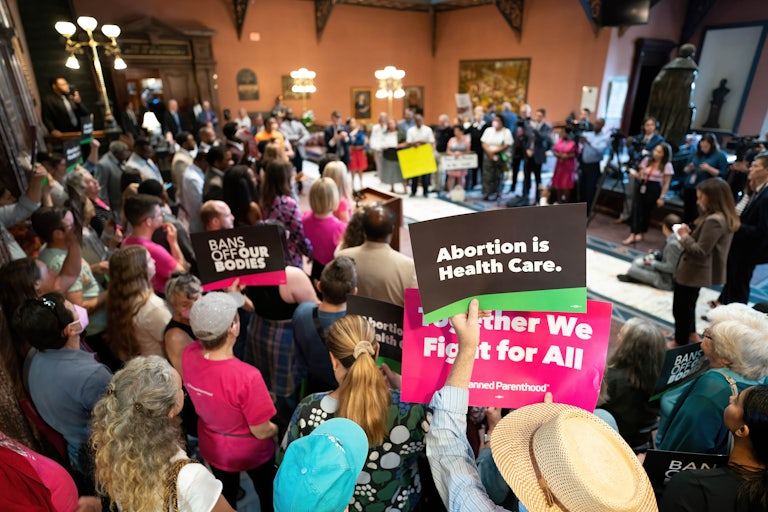
Demonstrators and lawmakers gather with signs and placards in the lobby of the South Carolina statehouse to oppose the six-week abortion ban, on May 16.

The South Carolina Senate passed a bill Tuesday banning abortion at six weeks, before many people even know they are pregnant, and wiping out abortion access in the final southeastern state.

A similar ban died in the legislature in late April after all of the female senators, who span the political spectrum, banded together to filibuster the measure. But Republican Governor Henry McMaster called the lawmakers back for a special session to consider multiple measures, including a new abortion ban. The bill passed by a vote of 27–19.

We are not God. We need to let people make decisions for themselves,” said Senator Katrina Shealy, a Republican.

Republican Sandy Senn pointed out that the Senate had heard “no medical testimony” about the bill and that if the ban becomes law, it will likely cause illegal abortions to increase.

She asked South Carolinians to remember in the future that when their children “are dying” from having to get illegal abortions, “it is our fault!”

House Democrats had filed 1,000 amendments to try to block the measure from reaching a final vote, but it wasn’t enough. The self-named “sister senators” tried to filibuster the measure, but they too were defeated. All three Republican men who voted against the initial ban switched sides and voted for the six-week ban.

Abortion is currently legal in South Carolina until 22 weeks, although the state had multiple restrictions, such as a mandatory 24-hour waiting period and biased counseling, aimed at running out the clock. If McMaster signs the new bill into law, then abortion access will be essentially wiped out for the entire southeastern United States.

After Florida and North Carolina codified new abortion restrictions in quick succession, South Carolina was one of the last states in the South to hold the line on access to the procedure. Now that it has fallen, it will be next to impossible for anyone in the region to get an abortion.

There is a slim chance the new law may not stick, though: After Roe v. Wade was overturned, South Carolina enacted a six-week trigger ban, which the state Supreme Court blocked in January. The new bill is an attempt to circumvent the ruling. If the new measure is challenged in court, it’s possible the state’s high court will block it once more.

Lauren Boebert Admits She Had Her Third Son Because Birth Control Was Too Expensive

Despite her experience, the Colorado congresswoman has made it a point to oppose contraception access.

Kevin Dietsch/Getty Images

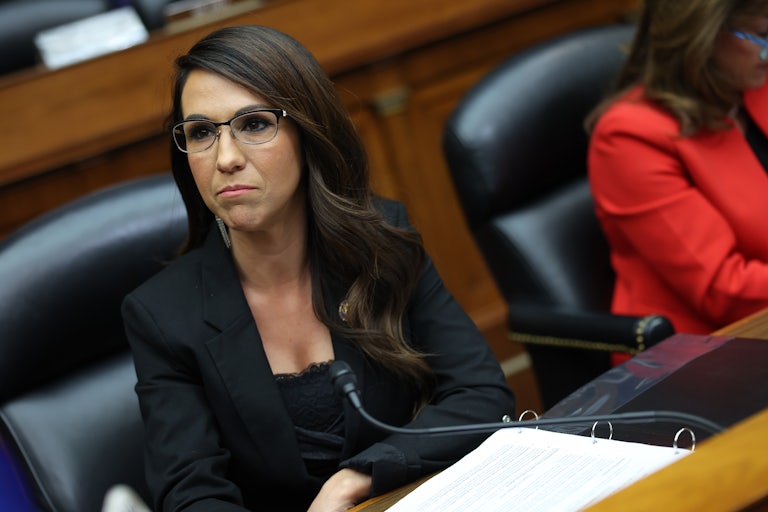
Representative Lauren Boebert admitted Tuesday that she only had her third son because birth control was too expensive.

But instead of using this life experience to work to make access to contraception easier or more affordable, the Colorado Republican has actively worked to make birth control harder to get.

During a hearing on prescription drug prices Tuesday, Boebert asked a pharmacy owner if he often sees people leave without their prescriptions because they can’t afford the medication.

“I left a prescription at a pharmacy once. I went to get birth control,” Boebert said, explaining that the price was so high she thought the medicine was for three or even six months. But it turns out she was only getting one month’s worth of birth control.

“I said, ‘It’s cheaper to have a kid.’ And I left it there, and now I have my third son,” Boebert said.

Boebert then said that not being able to afford her medication “turned out to be a really great thing” because it resulted in her son. But instead of making birth control easier to access for people, Boebert has decided to force everyone into the same predicament she was in.

Boebert has repeatedly moved to make contraception harder to get. Last summer, she voted against the Right to Contraception Act, which would have codified the right to access birth control. In January, she introduced the Defund Planned Parenthood Act, which would have prohibited federal funds from going to Planned Parenthood.

While Boebert said it was because of Planned Parenthood’s abortion services, the organization actually provides a wide range of sexual health care, from birth control to screenings for sexually transmitted infections. Cutting federal funding, which makes up a little less than half of Planned Parenthood’s budget, would have crippled its services. Boebert has also supported the repeal of the Affordable Care Act, which requires that insurance policies cover birth control.

Boebert took the wrong lesson away from not being able to afford her birth control, and now everyone else is having to suffer for it.