Breaking News
Breaking News
from Washington and beyond

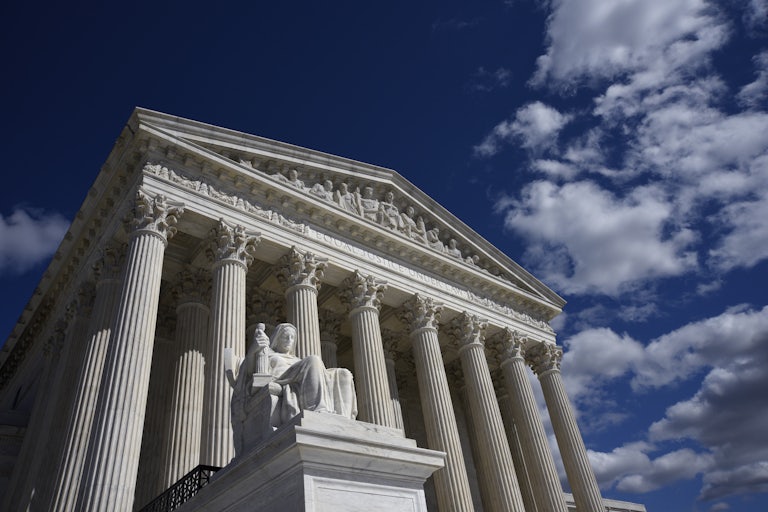
Supreme Court Strikes Down Right-Wing Theory That Would Have Upended Elections

The ruling on the “independent state legislature theory” is a blow to election deniers everywhere.

MANDEL NGAN/AFP/Getty Images

The Supreme Court on Tuesday struck down the controversial “independent state legislature theory,” in a serious win for democracy.

The court voted 6–3 in the case Moore v. Harper to knock down the fringe right-wing legal theory, which would have given state legislatures broad, virtually unchecked authority to oversee federal elections.

The Supreme Court had been asked in the case to decide whether North Carolina’s Supreme Court had the power to throw out the Republican-controlled legislature’s congressional maps.

Last year, the state Supreme Court deemed the maps an “egregious and intentional partisan gerrymander” meant to favor Republicans—and court-drawn maps were instead used for the 2022 election.

North Carolina Republicans argued that under the Constitution’s elections clause, the state legislature has the ultimate authority over election laws, not the courts, and they wanted their gerrymandered map reinstated.

But the Supreme Court handily rejected their argument, writing: “The Elections Clause does not vest exclusive and independent authority in state legislatures to set the rules regarding federal elections.”

Had the court ruled differently, election deniers throughout the country would likely be rejoicing. In its most extreme form, the independent state legislature theory could allow state legislatures to bypass state courts and governors’ vetoes when it comes to election law, giving them virtually unchecked authority with no checks and balances. It could even allow state legislatures to certify presidential electors who were not approved by the voters. Unsurprisingly, the theory was one that Donald Trump and his allies used to try to overturn the 2020 election.

This story has been updated.

Fox News Enters Its Post–Tucker Carlson Era

Its ratings have rebounded, and it has finally found its Tucker Carlson replacement.

John Lamparski/Getty Images

When Fox News fired Tucker Carlson in April, the network entered a tailspin. It had parted company with stars before—most notably Bill O’Reilly, after Fox News and the longtime host settled lawsuits with five women who had accused him of sexual misconduct—but always bounced back. Fox News, the thinking both inside and outside the network went, was bigger than its stars and could make or break them more or less at will.

This time was different, however. Carlson was a different type of Fox anchor: Less glued to the GOP establishment, he played a vital role in pushing nativist and far-right narratives into the mainstream. At the same time, Fox had genuine, if significantly smaller, competitors on its right; viewers had real alternatives, something that hadn’t always been the case. After Carlson departed the network, its rankings tanked. There were calls for boycotts and, most absurdly, allegations that Fox News had “gone woke.” In May, the ratings for Carlson’s 8 p.m. slot fell by more than 50 percent; the network’s prime time fell by about 40 percent. Fox News was in a genuine crisis.

At the end of June, that crisis seems to largely be over. The network’s ratings have rebounded, although they haven’t come close to what they were before Carlson’s defenestration. Last week, Fox News dethroned MSNBC—which had taken the top of the leaderboard during its right-wing competitor’s tailspin—averaging 1,536,000 viewers to MSNBC’s 1,397,000 in prime time. (CNN continued to lag behind with 800,000 viewers.) And on Monday, Fox News announced it was shaking up its post-Carlson lineup. Jesse Watters, who got his start doing racist “comedy” videos on O’Reilly’s show and has since become a star as the resident doofus on Fox News’s The Five, will take over Carlson’s old 8 p.m. show. Greg Gutfeld’s painfully unfunny late-night show, Gutfeld!, will move to 10 p.m.

Both hosts use the guise of comedy to push reactionary views. Both are also painfully unoriginal and predictable, using the same complaints about wokeness and crime again and again in predictable ways. Unlike with Carlson, you’ll never be surprised—even if you will occasionally be shocked—by what they say. That’s the point. Fox News’s brass grew frustrated with Carlson because they couldn’t control him. Carlson would stray—sometimes far—from Republican orthodoxy on a number of issues. He didn’t try to disguise his bigotry, as Watters and Gutfeld often do, with the possibility that they’re joking. He would push back at efforts to control him. Fox News executives don’t have to worry about Watters and Gutfeld. They are good soldiers who will follow the company line.

The Supreme Court May Preemptively Ban a Federal Wealth Tax

Given the recent ethics questions about justices’ interactions with billionaires, it’s an interesting case to take on.

Robert Alexander/Getty Images

The Supreme Court took up a case on Monday that could make it nearly impossible for Congress to pass a federal wealth tax, giving the justices an opportunity to torpedo a major Democratic policy proposal before it can be enacted. The plaintiffs who brought the case have all but urged the court to do exactly that.

In Moore v. United States, the justices will consider whether a provision of former President Donald Trump’s tax-reform law in 2017 violated the Sixteenth Amendment, which allows Congress to collect federal income taxes. As part of a complex restructuring of federal corporate tax laws, the 2017 law imposed a one-time “mandatory repatriation tax” on American taxpayers who owned more than 10 percent of a foreign corporation.

Charles and Kathleen Moore, the titular plaintiffs, owned 11 percent of an Indian farm-equipment company when the 2017 law went into effect. Thanks to the provision in question, they paid roughly $15,000 in additional taxes the following year. The Moores filed a lawsuit against the federal government and argued that the tax was unconstitutional because their partial ownership of the company did not count as “income” under the Sixteenth Amendment.

The lower courts rejected that argument, however, and ruled that the tax had essentially targeted years of deferred foreign income. That prompted the couple to ask the Supreme Court to intervene. While the case hinges on a tax passed by Trump and a Republican-led Congress, the petition invited the justices to use it to prevent Democrats from imposing a federal wealth tax in the future.

“This is no idle threat,” the Moores said in their petition for review, referring to a federal wealth tax. They cited proposals by the Biden administration and Oregon Senator Ron Wyden to tax billionaires based on their assets, none of which have passed Congress. “There is every reason for the Court to resolve the pivotal constitutional question of realization now, when its judgment can inform lawmakers and stands to head off a major constitutional clash down the line,” the couple told the justices.

In a Wall Street Journal op-ed published in 2021, two of the Moores’ lawyers also declared unambiguously that the lawsuit “stands to slam shut the door on a federal wealth tax like the one Sen. Elizabeth Warren wants to enact.” They made a direct pitch to “the courts” to hear the Moores’ case “now” to make it easier to block a wealth tax in the future.

“If the courts confirm the Sixteenth Amendment’s limited reach now, that would relieve them from having to do so in a politically explosive case directly challenging a wealth tax,” the two lawyers concluded. “The courts would do well to remind Congress at this opportune time that its taxing power is not without limits.”

The Justice Department had urged the justices to reject the case, noting there was no split on the issue in the lower courts and arguing that the Ninth Circuit Court of Appeals had correctly applied the relevant precedents. On the wealth-tax question, the government also pointedly noted that the Supreme Court does not have the constitutional power to issue advisory opinions about hypothetical legislation that has not been enacted into law by Congress.

Debates over a wealth tax’s constitutionality are not new, of course. After Massachusetts Senator Elizabeth Warren made her proposal to enact one as a centerpiece of her 2020 presidential campaign, more than a few legal scholars argued that such a tax would not fall within the Sixteenth Amendment’s parameters. (Warren and other wealth-tax proponents disagree.) If Congress implemented such a tax in the future, a legal challenge to it in the courts would be virtually guaranteed.

The court’s decision to hear the Moores’ case also comes at an awkward time for the justices, to say the least. ProPublica and other major news outlets have reported extensively on Justice Clarence Thomas’s fruitful relationship with Harlan Crow, a billionaire and GOP megadonor, in recent months. Last week, the publication also reported that Justice Samuel Alito went on a free luxury fishing trip in Alaska in 2008 with billionaire Paul Singer, who gave the justice a free ride on his private jet to get there. Both Thomas and Alito have denied that they acted improperly by not disclosing the billionaires’ gifts on their annual financial-disclosure forms; Alito even took to the Wall Street Journal’s op-ed section to defend himself.

Only four votes are needed for the justices to take up a particular case. The court does not disclose how the justices vote on petitions for review, so it is not known if Thomas or Alito voted to hear the Moores’ lawsuit. Americans will get a clearer perspective on their views in the case when the court hears oral arguments in the fall term. As the justices wrestle with rapidly declining public esteem and multiple ethics controversies, taking up a case that could protect billionaires from wealth taxes before Congress can even pass them is an interesting choice.

Guess Who’s Targeted in Ron DeSantis’s First Major Policy Address?

LGBTQ people? Authors of banned books? Those seeking abortions? Close, but not quite.

Ron DeSantis
Drew Angerer/Getty Images

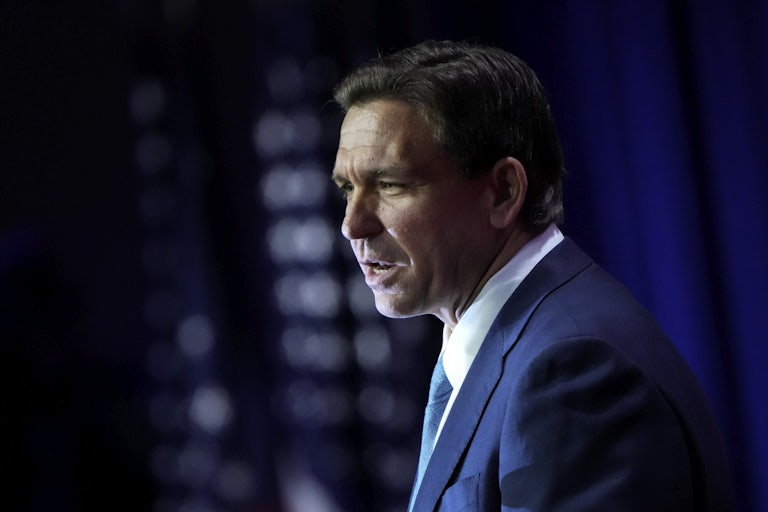
Florida GOP Governor Ron DeSantis gave his first major policy address as a presidential candidate on Monday. The economy? Tax cuts and deregulation? How to revive manufacturing? How we’re all part of one glorious shining city on a hill?

You haven’t been paying much attention to the governor if you thought any of those things. The nominees for topic of his first presidential policy address were, of course, LGBTQ people, librarians, teachers, those seeking and providing abortions; but the lucky winner this morning? Undocumented immigrants.

In a nutshell, DeSantis is promising to be worse than Donald Trump on immigration.

According to CNN, DeSantis, who spoke at a Veterans of Foreign Wars post in Eagle Pass, Texas, vowed to dispatch the military to the border and commence a “mass detention and deportation” (CNN’s words) of undocumented immigrants. He also pledged to end birthright citizenship and, yes, Build. The. Wall.

“For decades, leaders from both parties have produced empty promises on border security, and now it is time to act to stop the invasion once and for all,” DeSantis said. “As president, I will declare a national emergency on day one and will not rest until we build the wall, shut down illegal entry, and win the war against the drug cartels. No excuses. We will get it done.”

His camp also took one of its first shots at Trump over the weekend by tweeting: “Trump ran on this same promise in 2016, but ended up deporting fewer illegals than Barack Obama.”

As governor, DeSantis has banned sanctuary cities, sent Florida law enforcement and National Guard officers to the Texas border, and cracked down on workforce immigration violations. And of course there were his famous stunts where he sent undocumented immigrants by plane to Martha’s Vineyard and Los Angeles to troll the libs.

So this will be the heart of DeSantis’s campaign, although presumably LGBTQ people and librarians and abortion-seekers will all have their day in the Sunshine State sun, as it were. That is, assuming his campaign lasts long enough. He’s slipping in the polls against Trump, and Politico posted a piece Monday morning about a serious political etiquette gaffe he pulled in New Hampshire that offended those notoriously delicate Granite State “how things are done” sensibilities (he scheduled an event there at the same time as a previously scheduled Trump event, in front of some kind of important Republican women’s group).

So maybe the people he’s targeting don’t need to be so scared.

Supreme Court Paves Way for New Louisiana Congressional Map

If the map is redrawn to include a new majority-Black district, it could help Democrats retake the House.

Drew Angerer/Getty Images
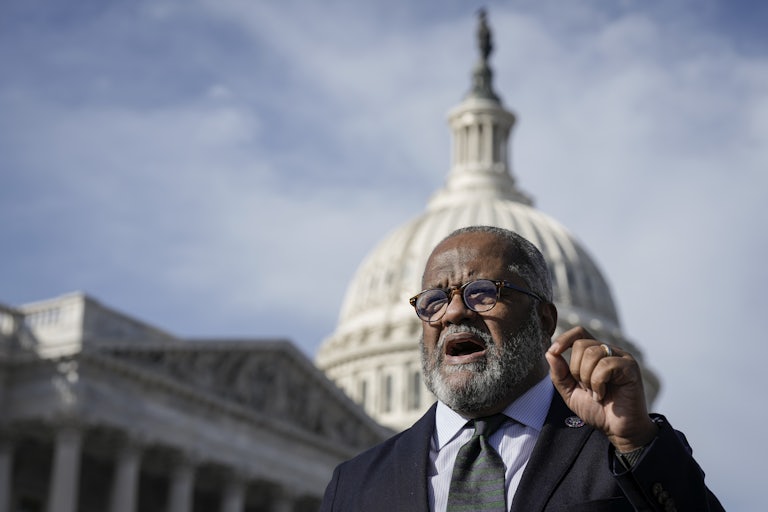
Representative Troy Carter of Louisiana

The Supreme Court on Monday lifted a stay on a lower court’s ruling requiring the Louisiana state legislature to add another majority-Black congressional district ahead of the 2024 elections. The move came after a surprise decision earlier this month ordering Alabama to redraw its congressional districts, with two conservative justices joining all three liberal justices in ruling in favor of the state’s Black voters.

The high court’s unsigned order sent the case back to the U.S. Fifth Circuit Court of Appeals, requiring the issue to be resolved “in advance of the 2024 congressional elections in Louisiana.” The Republican-led state legislature had passed a congressional map last year that made only one out of Louisiana’s six congressional districts majority Black, even though roughly one-third of the state’s population is African American. Representative Troy Carter, who is Black, is the only Democrat in the Louisiana delegation.

“This decision shows that in a healthy democracy fair and equitable representation matters, whether to the people of Louisiana or anywhere else in the world,” Carter wrote on Twitter on Monday.

Opponents of the congressional maps in Alabama and Louisiana argued that the districts diluted Black voters’ strength. The Alabama decision could also affect similar court challenges in South Carolina and Georgia. New majority-Black districts likely give Democrats a better chance of retaking the House. In the wake of the Alabama decision, the Cook Political Report shifted five of its House ratings in Democrats’ direction, with analyst Dave Wasserman predicting that “it’s very likely two formerly Solid R seats will end up in Solid D.”

One potential casualty: Louisiana Representative Garret Graves, whose seat the Cook Political Report had already moved from “Solid R” to “Toss Up” earlier this month. Graves is a key ally of Speaker Kevin McCarthy, and was one of the House Republicans who negotiated the debt limit deal with the White House. The Supreme Court order thus could have far-reaching effects not only for the makeup of the House but for the political dynamics within the House Republican conference.