Breaking News
Breaking News
from Washington and beyond

Marco Rubio Just Opened a New Front in Trump’s War on Higher Education

The Secretary of State said he and his allies would be “aggressively” revoking the visas of Chinese nationals.

Marco Rubio wears a suit and red tie and stares blankly
Anna Moneymaker/Getty Images
Marco Rubio in May

The Trump administration is escalating its war on international students by moving to cancel the visas of Chinese students in the U.S.

Secretary of State Marco Rubio announced Wednesday night that the White House would work to “aggressively revoke” visas of Chinese nationals who are studying in “critical fields” or have ties to the Chinese Communist Party. Rubio also said that the State Department would “enhance scrutiny” of all visa applications from China, including Hong Kong.

The administration’s decision will likely escalate tensions between China and the U.S. and cause issues on university campuses, as students from China make up the second-largest nationality among international students in the country. In 2024, 20 percent of student visas to the United States were granted to Chinese nationals, and there are an estimated 275,000 Chinese students currently in the U.S.

Universities across the country depend on Chinese students in their research laboratories, and the fact that many pay full tuition is of great financial benefit. Chinese students electing to further their education in the U.S. are often the most academically talented students.

It’s not clear what Rubio meant by “critical fields,” although U.S. officials have been worried about Chinese researchers in the physical sciences, according to The New York Times. Rubio also didn’t elaborate on how the U.S. will determine affiliations and loyalties to the CCP, leaving open the possibility that authorities could draw such conclusions on individuals without evidence, as they have with Salvadoran and Venezuelan immigrants regarding gang membership.

The move is latest salvo on international students by the White House, which has sought to revoke visas and deport students from other countries on dubious grounds ranging from alleged antisemitism to allegedly smuggling embryos into the country that were actually brought for research purposes, and various minor infractions, including one case of a Japanese student who caught too many fish on a church trip.

Rubio’s announcement is also the latest provocation of China by President Trump, who inflamed ties with Beijing with his ill-planned tariffs before backtracking earlier this month. Will China retaliate against this attack on its students in the U.S., and will Trump stick to this decision or once again chicken out?
Harvard Scores Huge Win in Escalating War With Trump

Donald Trump is trying to target one of Harvard’s main sources of income: international students.

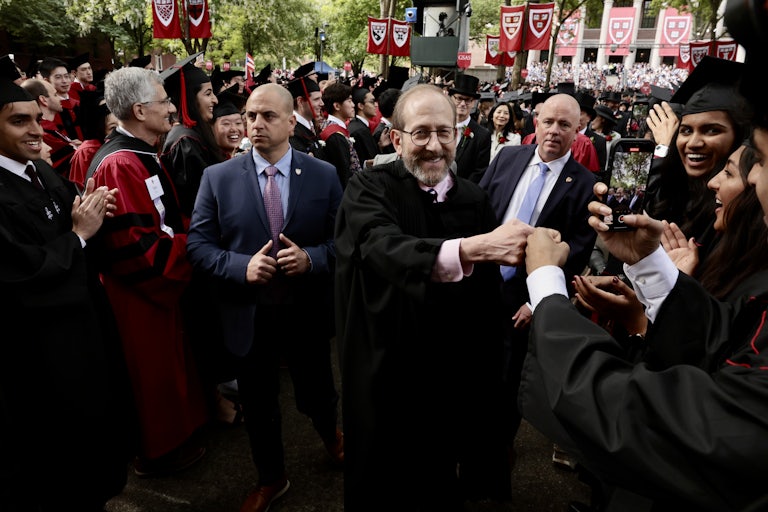
Harvard students applaud and fist-bump university President Alan Garber as he leads the graduation ceremony procession
Craig F. Walker/The Boston Globe/Getty Images
Harvard University President Alan Garber leads the graduation ceremony procession
A federal judge on Thursday blocked the Trump administration’s attempt to strip Harvard University of the ability to enroll international students. 
U.S. District Court Judge Allison Burroughs agreed to extend a temporary restraining order preventing the Trump administration from enforcing its action, after the government gave the school a 30-day deadline to challenge its revocation of Harvard’s Student and Exchange Visitor Program certification.
Burroughs said she intended to issue a preliminary injunction, which would prevent the Trump administration from moving forward without the proper legal procedures. “I do think an order is necessary. It doesn’t need to be draconian, but I want to make sure nothing changes. I want to maintain the status quo,” Burroughs said at the hearing Thursday.  
News of the order sparked a wave of relief at Harvard’s commencement, as students learned that the government’s crackdown on their peers could not be enforced—for now. 
Homeland Security Secretary Kristi Noem announced last week that the government would revoke Harvard’s SEVP certification because the school had supposedly failed to comply with the administration’s requests for information. Noem alleged that Harvard had collaborated with the Chinese Communist Party and failed to address antisemitism on campus.
If Harvard lost its SEVP certification, not only would the university not be allowed to accept foreign students for the 2025–2026 academic year, but those who were already enrolled would have to transfer or lose legal status, as well. International students currently make up about a quarter of Harvard’s student body.
In a brief filing last week, Burroughs granted Harvard’s request for a temporary restraining order, after the university immediately sued the government for what the school called an “unlawful and unwarranted action.”
The Trump administration responded Wednesday night, requesting that Harvard provide evidence “to rebut the grounds for withdrawal of certification” and even more information about its international students, as well as assurances to provide “a campus environment free from violence and antisemitism.” 
In a post on X Thursday, Noem claimed that the school had demonstrated a pattern of “endangering its students and spreading American hate.”
The administration’s crackdown on Harvard comes amid a broader crusade to shutter pro-Palestinian speech on campuses, following the arrests of several international students for a range of noncriminal activity, including advocating for institutional divestment from Israel in an op-ed and having family ties to a former adviser for Hamas—a blatant violation of their First Amendment rights. 
This latest development also comes hours after Secretary of State Marco Rubio said he would begin “aggressively” revoking the visas of Chinese students. The administration has also temporarily halted all student visa interviews.
This story has been updated.

Stephen Miller Sets Terrifying Goal for Daily ICE Arrests

Donald Trump’s deputy chief of staff also issued a chilling warning about what to expect.

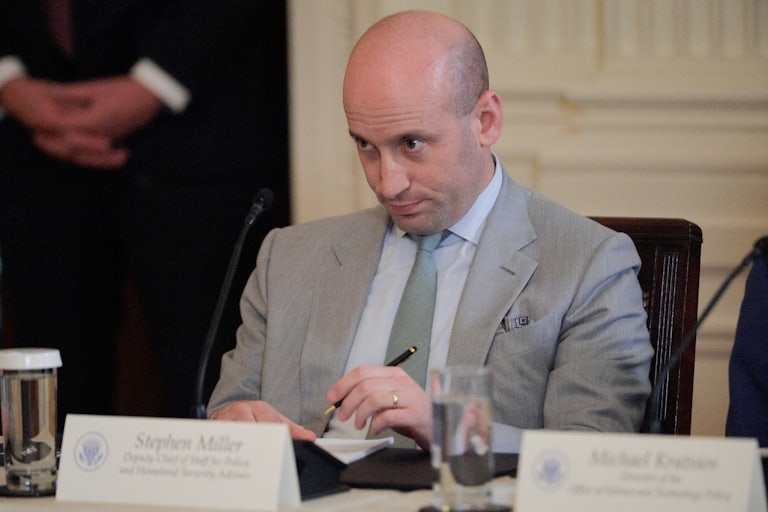
Stephen Miller sits in Donald Trump’s "Make America Healthy Again" press conference
Chip Somodevilla/Getty Images

White House deputy chief of staff Stephen Miller warned that the number of Immigration and Customs Enforcement arrests are about to grow exponentially.

The Trump administration’s ghoulish immigration politico said on Fox News Wednesday that he and Homeland Security Secretary Kristi Noem were looking to set a goal of a “minimum 3,000 arrests for ICE every day” to reach a target of one million deportations a year.

“President Trump is gonna keep pushing to get that number up higher each and every single day so we can get all of the Biden illegals who were flooded into our country, out of our country,” he added.

Already, there has been a marked increase in deportations under Donald Trump. In the first 100 days of the Trump administration, ICE said it had removed a whopping 65,000 people. By comparison, ICE arrested 759 immigrants a day during the final stretch of the Biden administration.

Last week, ICE embarked on a nationwide sweep of arrests at immigration courts, dismissing immigrants’ legal cases just moments before taking them into custody.

Despite assurances from members of the Republican Party that Trump’s immigration crackdown would focus primarily on criminals, many of the individuals being detained have no criminal record. Some of them are U.S. citizens or legal residents and children. It’s clear that imposing such a high quota will lead to wrongful arrests on increasingly shaky legal grounds.

Boosting immigration enforcement will come with a hefty price tag: Congress’s latest budget bill has earmarked an additional $150 billion over five years to further the president’s immigration agenda. ICE has already begun to line the pockets of private prison companies to expand the government immigrant detention capacity with new facilities.

Surprise! New “MAHA” Report Is Full of Junk Science and Fake Studies

The latest Robert F. Kennedy Jr.’s “Make America Healthy Again”

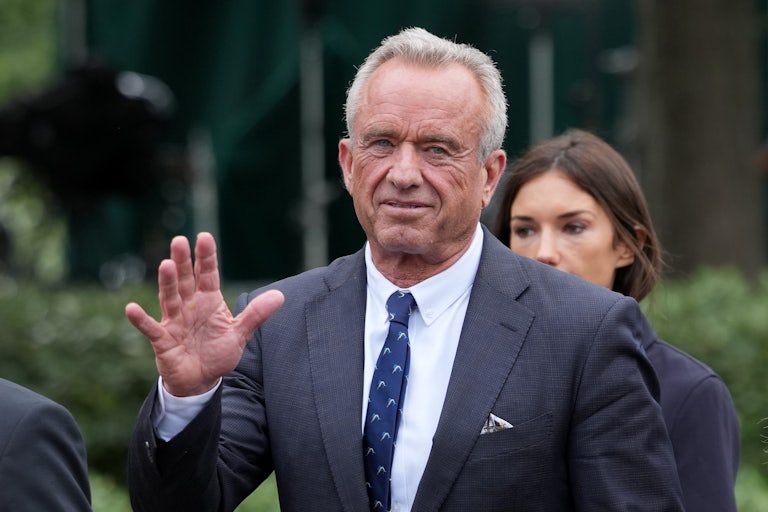
Robert F. Kennedy Jr. holds his hand up while walking outside
Photo by Kevin Dietsch/Getty Images
Robert F. Kennedy Jr. earlier this month.

Robert F. Kennedy Jr.’s “Make America Healthy Again” report cites fabricated studies and draws the wrong conclusions.

The secretary of health and human services brags that the report, released last week, is based on “gold-standard” science drawn from over 500 studies and other sources. But in reality, NOTUS found, its citations are error-ridden, with missing links, incorrect conclusions, and sometimes even made-up studies.

In one case, the supposed author of a study on anxiety in adolescents, epidemiologist Katherine Keyes, was surprised to find she was cited in the report for a paper she didn’t even write.

“The paper cited is not a real paper that I or my colleagues were involved with,” Keyes told the publication in an email. “We’ve certainly done research on this topic, but did not publish a paper in JAMA Pediatrics on this topic with that co-author group, or with that title.”

In fact, the study in question—“Changes in mental health and substance abuse among US adolescents during the COVID-19 pandemic”—may not have been written by anyone. The link to it in the report doesn’t work, and the citation claims that it appeared in the twelfth issue of the 176th edition of the journal JAMA Pediatrics, which doesn’t contain a study with that title.

That isn’t the only study cited by the MAHA report that doesn’t seem to exist. Two studies cited in a section titled the “corporate capture of media” about how drug advertisements have led to more ADHD and antidepressant prescriptions being written for kids don’t show up in scientific journals, according to NOTUS. One of its listed authors told the publication that he never wrote such a paper, and another author may not exist—they don’t have a digital footprint.

In other parts of the MAHA report, conclusions are drawn from papers that don’t even touch on the topics or methods Kennedy’s report cites, and other researchers cited in the report claim their studies were mischaracterized. Kennedy doesn’t seem to be aware of the issues in the report, extolling how great it is on social media.

“Never in American history has the federal government taken a position on public health like this,” Kennedy said, according to a White House post on X.

Kennedy has a long history of pushing medical misinformation. A well-known anti-vaccine activist, his tenure as HHS secretary has been marked by questionable decisions and statements. Kennedy has stopped the department from recommending Covid vaccines for children and pregnant women, claimed that the measles vaccine contains aborted fetuses, and pushed for fluoride to be removed from state water supplies, among many other misguided decisions.

Earlier this week, Kennedy threatened to bar scientists in the National Institutes of Health from publishing their work in the world’s leading medical journals, claiming that the publications are “corrupt.” That was before he published his error-riddled report, though. Earlier this month, Kennedy did say something that is worth following: He said the public should not look to him for medical advice. Considering how much information in his signature report appears to be made up, that sounds like a good idea.

Elon Musk Tried to Sabotage a Trump Deal With a Rival Company

Elon Musk blatantly used his proximity to Donald Trump to boost his own businesses.

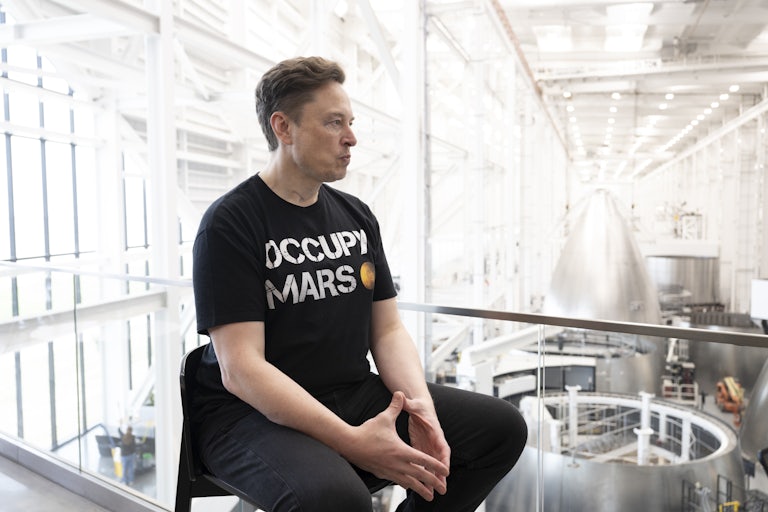
Elon Musk purses his lips while sitting in the SpaceX facility in Brownsville, Texas
Marvin Joseph/The Washington Post/Getty Images

Elon Musk’s proximity to Donald Trump offered him unparalleled influence on the U.S. president—influence that he tried to weaponize.

The tech executive openly objected last month to a massive data-center deal in the works between OpenAI—one of Musk’s rival companies in the burgeoning field of artificial intelligence—and the United Arab Emirates, according to White House sources that spoke with The New York Times. He complained to Trump’s AI adviser David Sacks, protested the deal to other White House officials, and claimed that the arrangement shouldn’t go to OpenAI, citing fairness toward other AI companies.

Meanwhile, Musk tried to shoehorn his own AI company, xAI, into the deal, The Wall Street Journal reported Wednesday. He failed.

The problem arose when Musk learned that OpenAI CEO Sam Altman would be joining Trump on his tour of several Middle Eastern countries. News of the emerging deal made Musk angry, according to the Journal. So angry that he insisted on joining the trip, appearing beside the U.S. president in Saudi Arabia. Musk also threatened members of G42, an Emirati AI development firm controlled by the brother of UAE’s president, claiming that the deal would not move forward unless his company xAI was one of the startups involved.

Musk did manage to land himself a massive business deal during Trump’s trip. On the second day, Musk announced Saudi Arabia had approved the use of Starlink within the country.

Musk’s exit from the government has been swift and complicated as key players across Trumpworld turned against the world’s richest man. In the few short months that Musk ran DOGE, reports emerged that practically everyone in the White House hated him. He had stomped on the toes of Trump’s Cabinet, failing to consult them before paring down federal agencies technically under their control. Earlier this week, Musk whined that DOGE had become a “whipping boy” for the administration’s failures. He told CBS that Trump’s “big, beautiful bill” was actually a bad idea.

Musk was Trump’s top financial backer in the 2024 election, spending at least $250 million in the final months of the president’s campaign after Trump was shot in July. Musk had also promised to funnel funds toward other Republicans, declaring in the wake of the November election that his super PACs would “play a significant role in primaries.” In the following months, Musk threatened to use his money to fund primary challengers to Trump’s agenda and go after Democrats, and that he would be preparing “for the midterms and any intermediate elections, as well as looking at elections at the district attorney level.”

The week after Trump returned from the Middle East trip, however, Musk announced at the Qatar Economic Forum that he had “done enough” political spending.

“I think in terms of political spending, I’m going to do a lot less in the future,” Musk said.