What’s Behind MAGA’s Strange New Crush on Solar Energy?
And why is the administration and its influencer crew drawing a line between solar and wind?

Is MAGA changing its tune on solar energy? Since the start of the year, a dizzying array of social media posts and news reports have pointed to the possibility, even as the administration continues to double down on its anti-wind policies and rhetoric. Why solar? And why now—especially given that President Trump continues to fulminate against its renewable energy cousin, wind power?
Let’s recap, because sorting through this is not easy.
On January 24, Trump shared a video on Truth Social that seemed to endorse rooftop solar for households as a way to free up energy for the industrial parts of the grid and help the United States compete with China. Four days later, The Daily Caller published an op-ed from Newt Gingrich declaring that “American energy must not pick winners and losers,” that the energy market could use “more of everything,” and that “solar and wind power are popular, with 80 percent and 74 percent respectively backing local construction.”
On February 4, Axios reported that a new poll from a Trump-aligned polling firm, commissioned by First Solar, found that a majority of Trump voters support solar. Katie Miller, Stephen Miller’s wife and former press secretary to Mike Pence, promptly retweeted it on X, saying, “Solar energy is the energy of the future.… We must rapidly expand solar to compete with China.” A little over a week later, Miller posted a chart on X, noting, “Solar is now the dominant source of new U.S. power capacity and is on track to surpass coal in total installed capacity before the end of 2026.”
A week after that, on February 19, Semafor reported a poll from Kellyanne Conway’s firm showing that Trump voters support solar. And the following week, Politico’s Greenwire reported “three agency career officials” confirming that the Interior Department was now “reviewing at least 20 commercial-scale projects that have languished in the permitting pipeline since President Donald Trump took office in January 2025.” Specifically: solar projects. Greenwire noted that this coincides with “the artificial intelligence boom—and the electricity demands helping hike consumer power bills,” and that “some congressional Republicans” have objected to Trump’s complete rejection of renewables.
The next day, February 27, Politico finally shed some light on what might be driving this: The outlet obtained access to a “confidential memo” from early February from renewable energy group the American Clean Power Association, outlining a new strategy to “engage Conway and conservative influencers like Miller” on behalf of solar energy. “As part of the campaign, ACP is working with a series of conservative influencers to secure opinion media placements authored by conservative columnists, former Republican lawmakers, and other credible Republican voices in conservative outlets,” the memo stated. Politico also noted that Conway’s poll had been commissioned by American Energy First, an advocacy group founded by ACP. (Not mentioned in the Politico piece, but notable: AEF first created accounts on X, Instagram, and Truth Social in January. This campaign has ramped up very quickly.)
Miller denied to Politico that she was being paid for her solar advocacy. But four days later, The Washington Post published a piece in which she declined to comment on the payment question. (She did double down on her advocacy, saying that solar “solved” Australia’s “rolling blackout issues” and that solar “should be a driver of the solution” to rising energy costs.)
The Post story pointed to other signs that MAGA may be pivoting. “Among the loudest” of the MAGA solar advocates, it noted, “may be on-again, off-again Trump adviser Elon Musk, whom Miller worked for as he designed and executed the president’s initiative to slash the federal workforce. Musk is now throwing his influence behind a moonshot effort to wrest solar manufacturing away from China.” There are signs of broader adoption too. “In Virginia, a coalition of conservatives pushing for more solar power is printing ‘Make Solar Great Again’ hats.” And a “Richmond-based group funded by industry and philanthropists called Energy Right,” led by an alum from the first-term Trump Interior Department, “has been working with conservatives there to push solar forward in the statehouse and local communities.” Interestingly, the Post reports, Energy Right recently founded the “America First Energy Project” in Louisiana—seemingly unaffiliated with ACP’s American Energy First, but a striking linguistic echo.
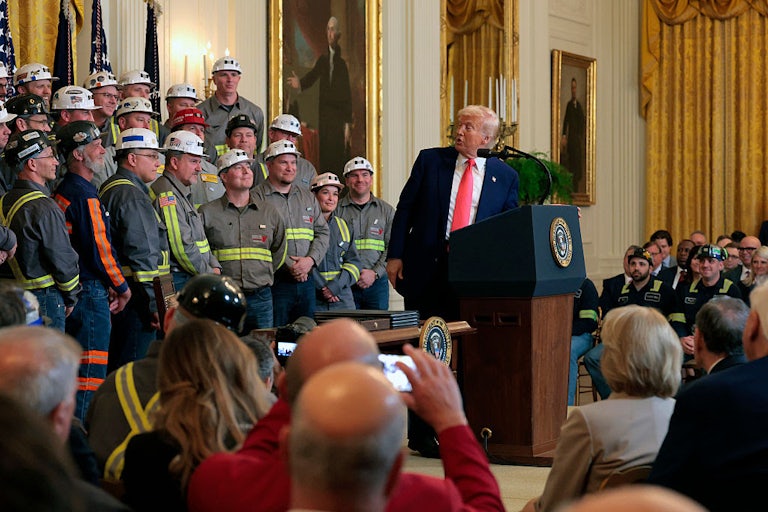
Throughout this multi-month saga, the president has been on a more or less constant tirade, interrupted only by breath, sleep, and distraction, against offshore wind—his January speech in Davos being a prime example. This week, The New York Times reported that the Trump administration remains so committed to sinking wind power that, after having its attempts to halt multiple offshore wind projects rejected by the courts, the administration is now contemplating buying off the companies in question: paying one energy company $1 billion not to build the wind farms and to instead invest in natural gas in Texas.
What in the Sam Hill is going on here? Successful lobbying is nothing new, but the speed with which this solar campaign seems to have succeeded is a little unusual, particularly given Trump’s doubling down on wind power as some kind of satanic scam. Nor is conservative voters’ support for solar new—it’s been showing up in other polls for years, long before Conway’s. What’s new is the leaders now embracing the cause. Is it really possible, you may wonder, that the only thing keeping prominent Trumpers from endorsing solar before was that no one had considered paying them for said endorsement?
I don’t have the answers here, but there are a few points worth considering as context. First, while Trump has demonized renewable energy in general, and financial incentives for rooftop solar got scrapped in the 2025 GOP budget bill, both Trump and others have demonized solar conspicuously less than wind, which appears to be a particular bugbear.
The MAGA figures pivoting to solar are stressing this distinction. Kellyanne Conway’s memo to American Energy First, detailing the results of the poll it commissioned, concludes by saying that “solar, unlike wind, is not viewed through a partisan lens; it is seen as a means to an end.” Since the survey summary doesn’t document any questions about wind at all, it’s hard to know where that conclusion is coming from. Independent polling finds only a slightly larger spread between Democrats and Republicans for wind than for solar: In 2024, Pew found a 27-point gap on solar versus a 32-point gap for wind, and Yale/George Mason, looking at parties’ extremes, found a 51-point gap between liberal Dems and conservative Republicans on solar, versus a 57-point gap on wind.
The U.S. solar industry, however, is about twice the size of the U.S. wind industry in installed capacity, and also larger in terms of market value. New solar installations are typically less financially and logistically fraught than new wind installations, and a lot are planned for the next few years. The solar industry may have both more money for lobbying and better stats to deploy in its favor.
There’s also another thing that might be driving the speed of this political pivot. Conway’s poll, though headlined as showing “Trump voters’” thoughts on solar energy, wasn’t interviewing all Trump voters. Instead, it was interviewing Trump voters in five specific states: Indiana, Ohio, Arizona, Florida, and Texas. The latter three are among the top five states for currently installed solar capacity, with Texas the “fastest-growing solar economy,” according to the Solar Energy Industries Association. Arizona is the third-fastest-growing solar economy, Indiana is fourth, Florida is seventh, and Ohio is eighth. SEIA also reports that Texas stands to lose 51 percent (162 projects) of new solar capacity due to new federal policies, Arizona 53 percent (15 projects), Ohio 40 percent (14 projects), and Indiana 35 percent (10 projects).
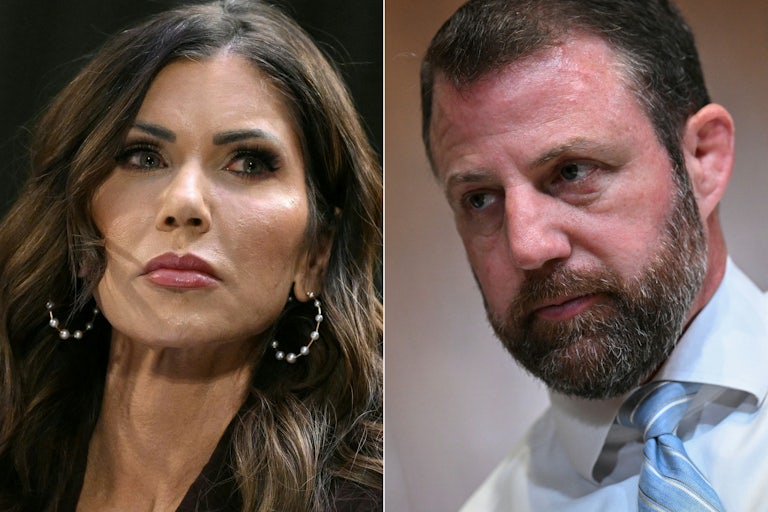
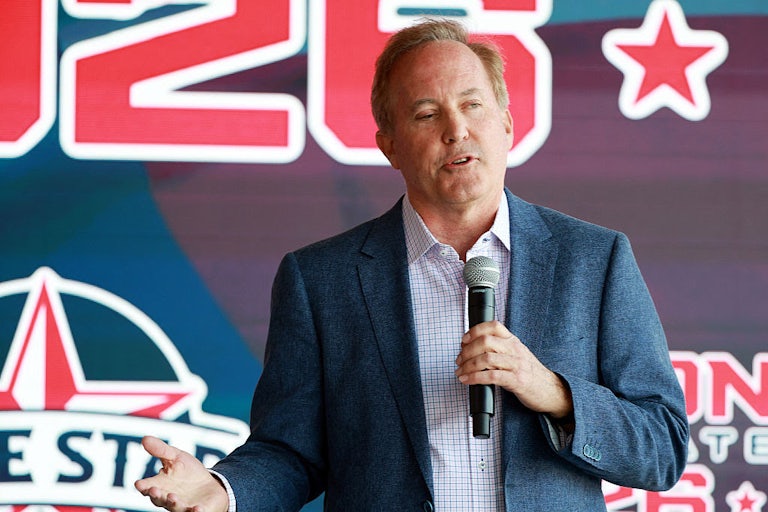
Several of these states are also home to embattled Republican congresspeople. In Texas, as Republican Senator John Cornyn and MAGA challenger Ken Paxton duke it out in a primary runoff, current polling suggests that Democratic nominee James Talarico has a decent shot at beating either of them in the November midterms. (Notably, one of the first polls showing Talarico leading the Trump-aligned Paxton came out in late November last year, just before the MAGA tide seemed to turn on solar.) In Ohio, Republican Senator Jon Husted is in a dead heat with former Democratic Senator Sherrod Brown. Either of those races could flip control of the Senate. In Florida, noted Trump acolyte Cory Mills, who seems to be even more stunningly scandal-prone than Paxton, is looking vulnerable.
Of course, several of these states are also home to significant wind power—particularly Texas, which leads the country in wind power. And you’d think that would complicate the narrative here. Then again, the Trump administration’s attacks on wind have mostly been on offshore installations—in addition to making it a bit harder to install wind power on federal lands. Texas’s wind farms aren’t offshore, and they’re mostly on private lands. So the contradiction between the position on solar and on wind, as it pertains to Texas, perhaps isn’t as significant as it might first appear.
Is Republican fear of the midterms making solar lobbying more successful than it might otherwise be? Hard to say. Pending new, more extensive reporting on the solar lobbying network, the idea can’t be dismissed.
Stat of the Week
“Earliest 100-degree temperature on record”
That’s what the National Weather Service is predicting for parts of the country this week and next, as a massive heat wave envelops the American West and Southwest.
What I’m Reading
The Latest Front in the Battle Over Climate Lawsuits: Bills Wiping Out Liability
An important update on state efforts to hold fossil fuel companies accountable for climate change, and make them shoulder some of the costs of adapting and recovery after climate-fueled disasters:
Republican lawmakers in multiple states and Congress are advancing proposals to shield polluters from climate accountability and prevent any type of liability for climate change harms—even as these harms and their associated costs continue to mount.
It’s the latest in a counter-offensive that has unfolded on multiple fronts, from the halls of Congress and the White House to courts and state attorneys general offices across the country.
Dozens of local communities, states and individuals are suing major oil and gas companies and their trade associations over rising climate costs and for allegedly lying to consumers about climate change risks and solutions. At the same time, some states are enacting or considering laws modeled after the federal Superfund program that would impose retroactive liability on large fossil fuel producers and levy a one-time charge on them to help fund climate adaptation and resiliency measures.
But many of these cases and climate superfund laws could be stopped in their tracks, either by the conservative majority on the U.S. Supreme Court or by the Republican-controlled Congress.
Read Dana Drugmand’s full report at Inside Climate News.
This article first appeared in Life in a Warming World, a weekly TNR newsletter authored by deputy editor Heather Souvaine Horn. Sign up here.