Life in a Warming World
A weekly reckoning with our heated planet—and the fight to save it

Nope, Billionaire Tom Steyer Is Not a Bellwether of Climate Politics

You may have read lately that voters don’t care about global warming. These stories tend to fall apart under scrutiny.

Tom Steyer, wearing a blue blazer, light blue dress shirt, and grey pants, holds his hands out while standing at a microphone and speaking, in front of a background reading "Time100 Next."
Mike Coppola/Getty Images
Tom Steyer speaks during the TIME100 Next event on October 24, 2023.

What should we make of billionaire Tom Steyer’s reinvention as a populist candidate for California governor, four years after garnering only 0.72 percent of the popular vote in the 2020 Democratic presidential primary, despite obscene spending from his personal fortune? Is it evidence that he’s a hard man to discourage? (In that race, he dropped almost $24 million on South Carolina alone.) Is it evidence that billionaires get to do a lot of things the rest of us don’t? Or is it evidence that talking about climate change is for losers and Democrats need to abandon it?

Politico seems to think it’s the third one: Steyer running a populist gubernatorial campaign means voters don’t care about global warming.

“The billionaire environmental activist who built his political profile on climate change—and who wrote in his book last year that ‘climate is what matters most right now, and nothing else comes close’—didn’t mention the issue once in the video launching his campaign for California governor,” reporter Noah Baustin wrote recently. “That was no oversight.” Instead, “it reflects a political reality confronting Democrats ahead of the midterms, where onetime climate evangelists are running into an electorate more worried about the climbing cost of electricity bills and home insurance than a warming atmosphere.”

It’s hard to know how to parse a sentence like this. The “climbing cost of electricity bills and home insurance” is, indisputably, a climate issue. Renewable energy is cheaper than fossil fuels, and home insurance is spiking because increasingly frequent and increasingly severe weather events—driven by climate change—are making large swaths of the country expensive or impossible to insure. The fact that voters are struggling to pay for utilities and insurance, therefore, is not evidence that they don’t care about climate change. Instead, it’s evidence that climate change is a kitchen table issue, and politicians are, disadvantageously, failing to embrace the obviously populist message that accompanies robust climate policy. This is a problem with Democratic messaging, not a problem with climate as a topic.

The piece goes on: “Climate concern has fallen in the state over time. In 2018, when Gov. Gavin Newsom was running for office, polling found that 57 percent of likely California voters considered climate change a very serious threat to the economy and quality of life for the state’s future. Now, that figure is 50 percent.”

This may sound persuasive to you. But in fact, it’s a highly selective reading of the PPIC survey data linked above. What the poll actually found is that the proportion of Californians calling climate change a “very serious” threat peaked at 57 percent in 2019, fell slightly in subsequent years, then fell precipitously by 11 points between July 2022 and July 2023, before rising similarly precipitously from July 2024 to July 2025.

Why did it fall so quickly from 2022 to 2023? Sure, maybe people stopped caring about climate change. Or maybe instead, the month after the 2022 poll, Congress passed the Inflation Reduction Act, the most significant climate policy in U.S. history, and people stopped being quite so worried. Why did concern then rise rapidly between July 2024 and July 2025? Well, between those two dates, Trump won the presidential election and proceeded, along with Republicans in Congress, to dismantle anything remotely resembling climate policy. The Inflation Reduction Act fell apart.

I’m not saying this is the only way to read this data. But consider this: The percentage of respondents saying they were somewhat or very worried about members of their household being affected by natural disasters actually went up over the same period. The percentage saying air pollution was “a more serious health threat in lower-income areas” nearby went up. Those saying flooding, heat waves, and wildfires should be considered “a great deal” when siting new affordable housing rose a striking 12 percentage points from 2024 to 2025, and those “very concerned” about rising insurance costs “due to climate risks” rose 14 percentage points.

This is not a portrait of an electorate that doesn’t care about climate change. It’s a portrait of an electorate that may actually be very ready to hear a politician convincingly embrace climate populism—championing affordability and better material conditions for working people, in part by protecting them from the predatory industries driving a cost-of-living crisis while poisoning people.

This is part of a broader problem. Currently, there’s a big push from centrist Democratic institutions to argue that the party should abandon climate issues in order to win elections. The evidence for this is mixed, at best. As TNR’s Liza Featherstone recently pointed out, Democrats’ striking victories last month showed that candidates fusing climate policy with an energy affordability message did very well. Aaron Regunberg went into further detail on why talking about climate change is a smart strategy: “Right now,” he wrote, “neither party has a significant trust advantage on ‘electric utility bills’ (D+1) or ‘the cost of living’ (R+1). But Democrats do have major trust advantages on ‘climate change’ (D+14) and ‘renewable energy development’ (D+6). By articulating how their climate and clean energy agenda can address these bread-and-butter concerns, Democrats can leverage their advantage on climate to win voters’ trust on what will likely be the most significant issues in 2026 and 2028.”

One of the troubles with climate change in political discourse is that some people’s understanding of environmental politics begins and ends with the spotted owl logging battles in the 1990s. This is the sort of attitude that drives the assumption that affordability policy and climate policy are not only distinct but actually opposed. But that’s wildly disconnected from present reality.

Maybe Tom Steyer isn’t the guy to illustrate that! But his political fortunes, either way, don’t say much at all about climate messaging more broadly.

Stat of the Week
3x as many infant deaths

A new study finds that babies of mothers “whose drinking water wells were downstream of PFAS releases” died at almost three times the rate in their first year of life as babies of mothers who did not live downstream of PFAS contamination. Read The Washington Post’s report on the study here.

What I’m Reading

More than 200 environmental groups demand halt to new US datacenters

An open letter calls on Congress to pause all approvals of new data centers until regulation catches up, due to problems such as data centers’ voracious energy consumption, greenhouse gas emissions, and water use. From The Guardian’s report:

The push comes amid a growing revolt against moves by companies such as Meta, Google and Open AI to plow hundreds of billions of dollars into new datacenters, primarily to meet the huge computing demands of AI. At least 16 datacenter projects, worth a combined $64bn, have been blocked or delayed due to local opposition to rising electricity costs. The facilities’ need for huge amounts of water to cool down equipment has also proved controversial, particularly in drier areas where supplies are scarce.

These seemingly parochial concerns have now multiplied to become a potent political force, helping propel Democrats to a series of emphatic recent electoral successes in governor elections in Virginia and New Jersey as well as a stunning upset win in a special public service commission poll in Georgia, with candidates campaigning on lowering power bill costs and curbing datacenters.

Read Oliver Milman’s full report at The Guardian.

This article first appeared in Life in a Warming World, a weekly TNR newsletter authored by deputy editor Heather Souvaine Horn. Sign up here.

A Ray of Hope Amid the Climate Information War

Climate advocates aren’t losing when it comes to information. They’re losing when it comes to money. That’s a totally different problem.

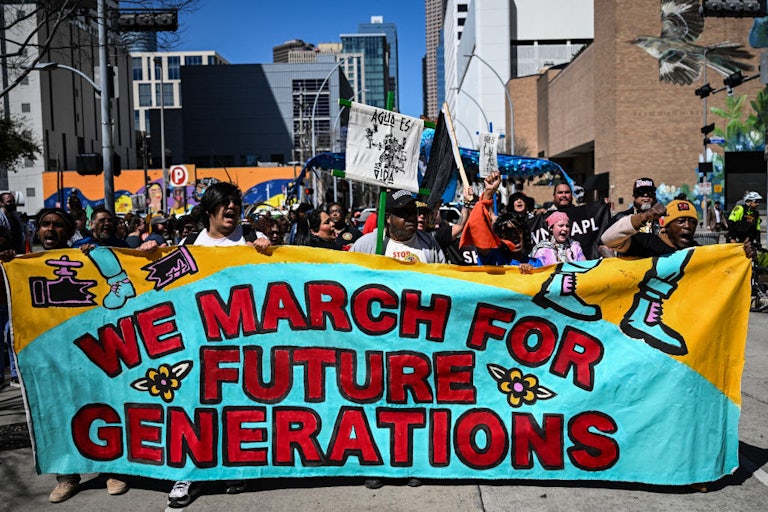
Protesters hold a banner reading "We March for Future Generations."
Ronaldo Schemidt/Getty Images
Demonstrators protesting the Ceraweek by S&P Global energy conference on March 10

Climate advocates “worry they are losing the information war,” The New York Times reported this week. Climate disinformation is pervasive, and “only 21 of the nearly 200 countries that signed the Paris Agreement” signed a declaration at this year’s U.N. climate conference about trying to address that. While polls show the public is concerned about climate change, bogus claims about clean energy being unreliable or damaging are “steadily growing, amplified by social media,” and those urging policy responses to the climate crisis are increasingly “labeled ‘alarmists’ who propose radical solutions,” wrote reporters Lisa Friedman and Steven Lee Myers.

This is depressing, maddening stuff. TNR has been covering climate obstructionists’ transition from straightforward “denial” to these more elaborate forms of disinformation since at least 2020, and in recent years the problem has only gotten worse.

But I have a quibble: Climate advocates aren’t losing the information war. They’re losing the money and power war. That’s an important distinction—not least because it requires a different approach, one focused on radically curbing the influence of money in politics. And while losing the money and power war might seem even grimmer than losing the info war, there’s actually a ray of hope in all this.

It’s not just that 65 percent of Americans say they’re at least “somewhat worried” about climate change. Per the latest large-scale survey from the Yale Program on Climate Change Communication, 48 percent say people in the United States are being harmed “right now,” with 46 percent saying “they have personally experienced the effects of global warming.”

If you say you have “personally experienced the effects of global warming,” you are basing that in part on concrete experience—even if you can be influenced in how you interpret that experience. In the Obama years, the percentage of people who said they personally experienced the effects of global warming was in the 20s and 30s, but it has risen steadily since then, and in the 2020s has never dropped below 40 percent.

The experiences of climate change are going to become easier, not harder, to recognize in coming years. Perhaps the fossil fuel industry and its allies are pushing disinformation so wildly right now because they know this is an uphill battle. Arguably, they have already lost it. They cannot possibly win the information war when the information every day becomes more observable with the naked eye—and in people’s finances. Will people easily dismiss climate and affordability policy as “radical” as their homes tank in value, food and insurance costs spiral, and severe weather destroys their homes, finances, and lives? Maybe not.

Where climate obstructionists clearly are winning is the policy arena—the money, the power. The Trump administration is taking a sledgehammer to nearly every climate-friendly policy enacted by the prior administration. Tech titans and big banks are backing off their once-shiny promises to reduce their emissions, and the race to build more data centers for AI is slowing or even reversing the energy transition. Establishment Democrats are backing away from climate policy out of fear of losing elections to Republicans—even though there’s not a ton of evidence that this is a good strategy, and ample evidence for the opposite strategy.

What the climate obstructionists are also in danger of winning is the nihilism war. As Aaron Regunberg and other writers at TNR and elsewhere have pointed out, the fossil fuel industry is, to a certain extent, counting on people’s limited energy and constant discouragement. “Big Oil wants us to succumb to nihilism when it comes to climate change,” Aaron wrote last week. But they’re conspicuously nervous when people refuse to succumb. The moves that companies are now backing away from all emerged after the 2020 election, when people thought Democrats were going to get serious about climate change and media coverage of Greta Thunberg and others seemed to have shifted public opinion. Big companies were scared, and were hoping that flashy pledges could stave off more serious policy.

Fossil fuel interests still have a lot of power and options, of course: They can push for criminalizing protest; they can fund politicians friendly to their interests. They do this regularly, and it may yet prevent action on climate change coming in time to avert utter catastrophe. But when people start to revoke the fossil fuel industry’s so-called social license to operate—by making it socially unacceptable to work for, invest in, or promote planet-destroying polluters, and divesting from these products—that’s the stuff that seems to really unsettle the industry and its political allies. Hence right-wingers going all in on the risible idea that divesting from fossil fuels is a form of discrimination.

Again, the industry can leverage its considerable money on the spin machine (and it helps that it doesn’t seem to care how self-destructive its messaging may be to the wider society). But it’s up against considerable headwinds when it comes to human psychology and what people seem to care about.

Specifically, the industry’s arguments against climate policy have mostly leaned on two items: jobs and affordability. Democrats may have an edge over their more fossil fuel–friendly Republican opponents on energy affordability, and climate policy creates jobs too. More importantly, jobs aren’t the trump card they seem to be. Corny as it may sound, the numbers suggest that love matters more—by a lot. Last year, The New York Times reported on an international poll that found that “protecting the planet for the next generation” was by far the most popular argument for taking climate action—12 times more so than the “promise of creating jobs.”

“At the heart of this is love,” Anthony Leiserowitz, the director of the Yale Project on Climate Change Communication, which conducted the study, told the Times. “People love particular people, places and things. And those people, places and things are being threatened.”

Obstructionists don’t have the advantage on all fronts. As Aaron recently wrote, there’s an easy answer to fossil fuel companies’ hope that you will tune out: “Disappoint them: Don’t give in.”

Stat of the Week
51%

That’s how much homeowner’s insurance rates have increased in the past six years in Washington state. Two residents whose rates more than doubled are now suing Big Oil companies and the American Petroleum Institute, accusing the fossil fuel industry of driving these increases via severe weather events associated with climate change.

What I’m Reading

LA Wildfire Survivors Want to Rebuild All-Electric, but a Utility Is Using Customer Funds to Incentivize Gas Appliances

Today in wild industry spending to prevent the clean energy transition:

After January wildfires destroyed more than 18,000 buildings in Los Angeles, a growing movement of residents who lost their homes want to rebuild all-electric, recognizing that burning gas in household appliances contributes to the climate-driven increase in the destructiveness of wildfires. An attribution study found that climate change made the January fires 35 percent more likely.

But the country’s largest gas utility, SoCalGas, is using funds from its customers to incentivize wildfire survivors to rebuild with fossil gas instead of going electric.

The monopoly gas provider in Southern California is offering thousands of dollars’ worth of rebates to wildfire survivors who rebuild with gas appliances. The rebates are paid for by California utility ratepayers through a California Public Utilities Commission (CPUC) energy efficiency program.

Read Hilary Beaumont’s full report at Inside Climate News.

This article first appeared in Life in a Warming World, a weekly TNR newsletter authored by deputy editor Heather Souvaine Horn. Sign up here.
Parenthood Has Made Me Detest Robots

It’s hard to laugh when tech companies are gobbling up your kids’ future for a profit.

An adult holds a baby who reaches out to hold hands with a humanoid robot.
VCG/Getty Images
A kid interacts with a robot at China’s first “7S” humanoid robot shop, on November 12.

You can’t throw a pacifier in American discourse without hitting someone talking about how having kids changed them. From Pete Buttigieg to Sarah Palin to the legions of guys who had daughters and realized sexual harassment is bad, many people apparently receive wisdom from parenthood they weren’t getting any other way.

This “as a parent…” talk can sound smug—which is weird, given that these moral revelations come from the humbling experience of having your ass handed to you daily by a creature the size of a marmot. I never thought I would be one of those people. But it’s true, parenthood has changed me in at least one way: I hate robots even more than I did before.

Last week, the internet lit up with giggles as one of Russia’s first humanoid robots was presented in Moscow, marching tentatively onstage to the Rocky theme song, only to face-plant and be hauled off by embarrassed handlers. The video made the rounds, even appearing on The Late Show With Stephen Colbert.

I can’t laugh at this stuff. Instead, it enrages me.

Humanoid robots are the perfect symbol for the suicidal absurdity of the AI frenzy. What is the point of making a robot walk like a human—like a toddler for now, but eventually a grown adult? According to robotics industry publications, it’s so they can replace humans more easily. To borrow Nvidia’s creepy phrasing, “Our world is built for humans by humans.” So making a robot look like a human makes it easier to appropriate that world—sorry, “collaborate” with humans, as Nvidia puts it. Those metal toddlers want your job, particularly if you work in manufacturing.

Scratch that. The companies making these metal toddlers want all of our jobs. As Colbert noted, immediately after laughing at the downed robot, the top country song by digital sales last week was written by AI. Social media companies, meanwhile, think they’ve figured out a particularly good way to monetize this technology: AI-generated ads to sell you more stuff.

As Ketan Joshi recently wrote at TNR, “Meta’s push to force-feed advertising slop into every single corner of the massive digital space it controls could not have worse timing.” Despite the company’s stated intent to purchase “renewable energy certificates,” the projected energy needed to power generative AI is breathing new life into the gas and even the coal industry. It’s also pushing our electricity bills higher and higher.

Say any of this to a member of the AI cult, and you’ll inevitably hear something about how AI is going to help humans, not hurt them. It will save lives, they say, pointing to algorithms’ ability to process reams of medical data quickly. Or you get some kind of reheated West Wing monologue about how lots of lifesaving technologies were accidental by-products of other scientific inquiry, so “discovery” is inherently good.

This is the same logical fallacy deployed by the plastics industry, which argues against policies discouraging single-use plastic packaging by pointing to artificial heart valves. While that may sound convincing, it’s important to remember that these two things are not mutually exclusive—it’s like saying policies to reduce car usage will eradicate ambulances—and that this rhetoric is coming from people who make a profit from both products.

That’s why the humanoid robot is the perfect symbol. While algorithmic data crunching might have some good uses, the very expensive push to develop technology that more specifically replicates human skills—think bipedal walking, think creativity—is the world’s worst party trick. It’s slowing or even reversing the energy transition at a time when every extra emission brings us closer to crisis. It’s taking up vital resources like water and critical minerals. It’s creating a bubble that may soon crash the economy. It’s producing a lot of rubbish and misinformation. And it’s doing all of this for the sole purpose of making investors money by replacing human labor.

Those metal toddlers aren’t funny. They’re part of a multibillion-dollar project to make the future uninhabitable for actual toddlers.

Stat of the Week
$20,500

That’s the average drop in home value for the 25 percent of the nation’s homes that are most vulnerable to hurricanes and wildfires, according to analysis from The New York Times. (It’s more than twice that for the most vulnerable 10 percent.)

What I’m Reading

First, the frogs died. Then people got sick.

Frog mortality used to be an academic curiosity. Then researchers realized it was driving a huge increase of malaria in humans. From the Post’s new series on the impact of biodiversity decline:

In the United States, researchers have shown that a collapse of insect-eating bat populations prompted farmers to use more pesticide on crops, which in turn led to a higher human infant mortality rate.

Around the Great Lakes, the reemergence of gray wolves has had the surprising effect of keeping motorists safe. The canines prowl along roads while hunting, spooking deer from crossing and reducing collisions with cars.

Also in North America, invasive emerald ash borers devastated ash trees, contributing to elevated temperatures and an increase in cardiovascular and respiratory deaths.

India may have witnessed the most astounding ecological breakdown of them all. After vultures experienced a mass die-off, the livestock carcasses they once scavenged piled up. Packs of feral dogs took the place of vultures, resulting in a rise in deaths from rabies.

Read Dino Grandoni’s and Melina Mara’s full report at The Washington Post.

This article first appeared in Life in a Warming World, a weekly TNR newsletter authored by deputy editor Heather Souvaine Horn. Sign up here.

Boston’s Election Results Are the Big, Untold Story This Week

Michelle Wu’s quiet landslide defies conventional wisdom about alienating business interests. And it could turn Boston into one of the most interesting climate policy incubators in the country.

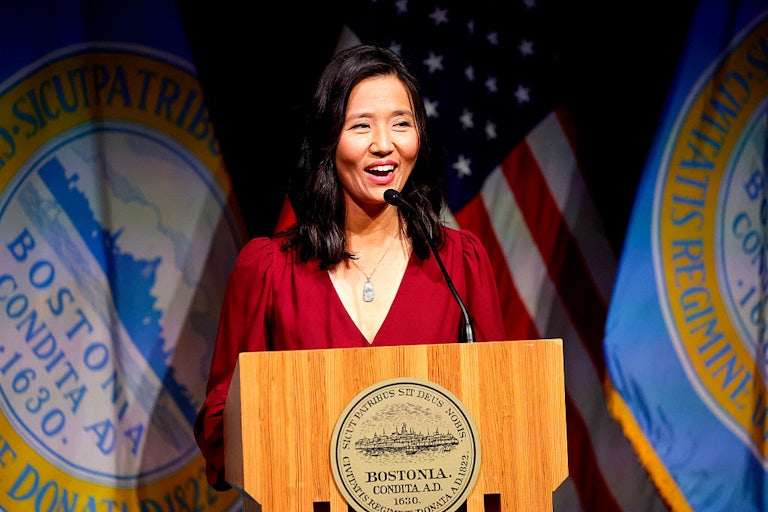
Michelle Wu, dressed in red, speaks at a podium.
Barry Chin/The Boston Globe/Getty Images
Boston Mayor Michelle Wu delivers the “State of the Schools” address on October 28.

All progressive eyes are on New York City this week, after democratic socialist Zohran Mamdani cruised to victory amid voter turnout not seen since the 1960s. New York City could now become a testing ground for left-wing policies including widespread rent control, free buses, universal childcare, public school rooftop solar, and public grocery stores.

TNR writers have previously written about how significant some of these could be as a form of climate policy, reducing emissions while helping offset the costs (for example, with food prices) associated with rising temperatures. But Mamdani may yet face stiff headwinds on getting these policies implemented. And that’s why another, far less publicized result on Tuesday night is significant: 200 miles to the north, Boston Mayor Michelle Wu secured the City Council seats she needed to proceed with an ambitious vision for climate and housing policy.

As The Boston Globe’s Sabrina Shankman noted this summer, Wu initially seemed slow to implement her lofty Green New Deal campaign proposals. But free bus routes, net-zero requirements for new buildings, and a “very, very detailed” and aggressive climate plan released this summer reversed that impression. She then won the September preliminary election so definitively that her competitor dropped out and Wu ran uncontested on Tuesday—a stunning result given that her opponent was extremely well funded and business interests and particularly the real estate industry don’t like Wu. That kind of stuff often sinks politicians in this country.

The one obvious check on Wu going forward would have been if she lost allies in the City Council elections on Tuesday, thus depriving her of majority votes for her policies. Instead, one of her closest and reportedly most precarious allies, Henry Santana, fended off a challenge from former District 3 councillor Frank Baker, ultimately securing a decisive victory, despite facing an—I kid you not—10-to-one campaign-coffer ratio in Baker’s favor as of August. Wu going all in supporting Santana seems to have made a difference.

It will be tempting for non–New Englanders to write this off, as they usually do, believing Massachusetts is so blue that nothing that happens there is relevant for politics elsewhere in the country. But progressive policies don’t always fly in Massachusetts, for the same reason they fail elsewhere. “Polls confirm that Bay State voters are resolutely progressive on a range of issues,” Robert Kuttner wrote in The American Prospect in 2023. “But on policy, Massachusetts continues to lag far behind other Democratic trifecta states. If you unpack why this is the case, you appreciate that it isn’t only right-wing Republicans who undermine both democracy and popular faith in democracy. It’s also corporate Democrats in one-party states.” At the wider state level, Kuttner argued, governors and legislators assiduously avoid pissing off the business lobby.

Granted, Boston is well to the left of the wider state. But there’s also another reason Wu cementing power is significant: Climate policy needs testing grounds.

This is why congestion pricing in NYC has been so closely watched by climate activists and so disproportionately attacked by the right, including President Trump, TNR’s Liza Featherstone argued in March. Not only do serious climate proposals—of which there are many, but precious few implemented in full—need pilot programs in American politics; in a world where the primary rhetorical attack on climate policies is that they’re unrealistic, expensive, and will make people’s day-to-day lives worse, successful ones offer proof of concept for cities, states, and countries everywhere. The right-wing obsession with congestion pricing is not an accident, Liza wrote, and it has implications far beyond even climate policy: “It’s important to them to stop this bold government solution to improve our lives because real solutions and positive experiences with government endanger the entire right-wing project.”

Michelle Wu now has the council majority needed to proceed with testing more of these policies. And she has it because she and her allies are somehow winning the battle against business interests. Boston’s election results won’t get top billing this week. But ignoring them would be a mistake.

Stat of the Week
2.8 degrees Celsius (5 degrees Fahrenheit)

This is the U.N.’s projection, released last week, on how much the Earth is expected to warm relative to preindustrial levels if we stay on our current trajectory. Most experts, as well as the Paris climate agreement, say warming needs to be limited to “well below” two degrees Celsius, and ideally 1.5, to manage risk.

What I’m Reading

EU countries weaken 2040 climate plan in eleventh-hour deal

In a dampening result ahead of the UN COP30 climate conference in Brazil next week, the EU scaled back its climate plan to appease member states that wanted “to delay a landmark carbon pricing system and to allow governments to outsource emissions reductions to other countries.”

It’s a troubling sign, from the climate standpoint, that the impact of Trump’s presidency is starting to snowball abroad:

The EU has traditionally been among the most ambitious negotiators at COP, but with its climate agenda under pressure from both rightwing politicians and trading partners such as the US, campaigners fear that the weakened target will undermine its diplomatic arguments as it tries to keep other countries on board with reducing emissions sufficiently to avoid devastating climate events in future.

Read the full report at the Financial Times.

This article first appeared in Life in a Warming World, a weekly TNR newsletter authored by deputy editor Heather Souvaine Horn. Sign up here.

Was This White House Press Release Written by “The Onion”?

The Trump administration marked Earth Day with a publication that read like satire, but instead was a faithful representation of their twisted view of the world.

Donald Trump salutes.
Tom Williams/Getty Images

Media outlets celebrated Earth Day on Tuesday with a flurry of forced optimism: “reasons to be hopeful,” how to feel useful by “taking a plalk” (picking up litter as you walk) and not reproducing, data showing that climate policy is globally very popular, and why “we’re still winning the climate fight.” Climate groups spent the day breathing a collective sigh of relief that the Trump administration did not, contrary to rumor, mark the day by stripping green groups of their nonprofit tax status.

The White House instead laid off hundreds more staffers in the Environmental Protection Agency and issued a press release worthy of The Onion.

“On Earth Day, We Finally Have a President Who Follows Science,” the statement declared of an administration that has cut so much funding for science that 75 percent of 1,200 scientists responding to a survey by the journal Nature said they were considering leaving the country. The Trump administration has also laid off thousands of researchers, sidelined climate research, frozen all new grants from the National Science Foundation, appointed noted anti-scientific kooks who praise discredited measles treatments, and reportedly plans to completely eliminate the EPA’s science and research arm.

The release further listed eight “key actions President Trump is taking on the environment.” He’s “promoting energy innovation for a healthier future,” the release announced, as Trump attempts to revive coal—a fuel so old its use predates the birth of Christ—while cutting black lung programs for coal miners. He’s “championing sound forest management”—an odd way of describing rolling back forest protections while firing so many U.S. Forest Service workers that their ability either to fight fires or administer logging contracts has come into question.

The third item on the list says, “President Trump is ending the forced use of paper straws,” which can contain PFAS and are probably not much if at all better than plastic ones. This is more accurate than the last two statements, but technically Trump only signed an order reversing federal purchasing policies that favor paper over plastics. And the idea that he did this to protect people from PFAS (known as “forever chemicals”) is risible, given that the administration has reversed a plan to limit PFAS in industrial wastewater, is trying to reverse bans of PFAS in consumer goods, and just canceled about $8 million in grants for research on how to prevent PFAS “from accumulating in crops and the food chain,” according to reporting this week from The New York Times.

“President Trump is cutting wasteful regulations that stifle innovation and raise costs,” the release continues. It explains that this means “pausing restrictive emissions rules for coal plants and revising the National Environmental Policy Act implementation,” which will save “American families thousands annually on energy bills and [prove] that a strong economy and a healthy environment go hand-in-hand.” In reality, energy prices are spiking, in part due to Trump’s tariffs; the administration is dead set against renewables, which are cheaper than fossil fuels; and the “wasteful regulations” the administration is targeting were projected to save 200,000 lives over the next 25 years.

“President Trump is protecting public lands,” the release says, explaining that this means “opening more federal lands and waters for oil, gas, and critical mineral extraction.” Also, the first Trump administration invested in conservation, the release insists. (In 2020, one conservationist described the last four years of Trump conservation policies as “gleefully” taking “a meat cleaver to our national monuments and land protections.”)

Then come two desperate attempts to include some positive spin on tariffs, which are tanking the economy: “President Trump is pushing back on unfair trade practices that harm the environment and undercut U.S. producers and exporters,” and “Trump is cracking down on China—the most prolific polluter in the world.” The release denounces, specifically, Chinese overfishing—a practice the Trump administration is encouraging at home—and ocean plastic pollution. Trump’s election is widely perceived to have torpedoed the world’s best chance for a global treaty to limit plastic pollution.

The release concludes by saying that “Trump is protecting wildlife,” specifically by “pausing certain wind projects.” Last week, the administration proposed a rule change that would gut the Endangered Species Act by claiming that destroying habitat—the primary driver of endangerment and extinction—doesn’t count as “harming” wildlife.

Anyway, go ahead and take that “plalk.” Earth Day comes but once a year.

Stat of the Week
100 million asthma attacks

That’s the effect the Trump administration’s rollback of just 12 EPA rules could have, E&E News reports.

What I’m Reading

Meet the Trump supporters who love wind energy

“We aren’t going to do the wind thing,” Trump told supporters at a rally on inauguration weekend. But in Iowa, a state that has backed Trump in three out of three of the last elections, wind energy is huge, generating a majority of the state’s energy. Vox’s Benji Jones talks to some of the people benefiting from renewables:

“It’s a real blessing for us,” said Dave Johnson, a livestock farmer in northern Iowa who leases his land to a utility that installed four turbines on his property. He earns about $30,000 a year from the four turbines combined, he told Vox. Johnson’s son also has turbines on his farm.

Johnson, a Republican who says he voted for Trump, had the turbines installed primarily because he wanted his farm—where he raises cattle and hogs—to generate more value. “I never had a 401(k),” he said. “I farmed and stuck everything back into the farm. This is the 401(k) that I never had.”

Read Benji Jones’s full report at Vox.

This article first appeared in Life in a Warming World, a weekly TNR newsletter authored by deputy editor Heather Souvaine Horn. Sign up here.