Davos Still Sucks
How can the World Economic Forum earnestly pretend to address global crises while being funded by the corporations that fuel these crises?

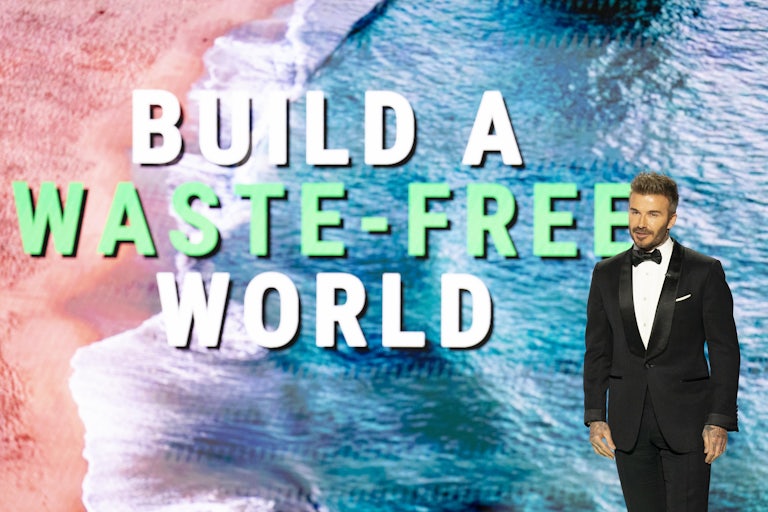
The annual World Economic Forum meeting in Davos used to be a better party, The Washington Post reports this week. “A decade ago, political power brokers and corporate bigwigs gathered here in the Swiss Alps under an upbeat theme,” Ishaan Tharoor writes. “It was time for ‘resilient dynamism,’ declared the organizers of the 2013 meeting.… Ten years on, there seems to be less optimism.”
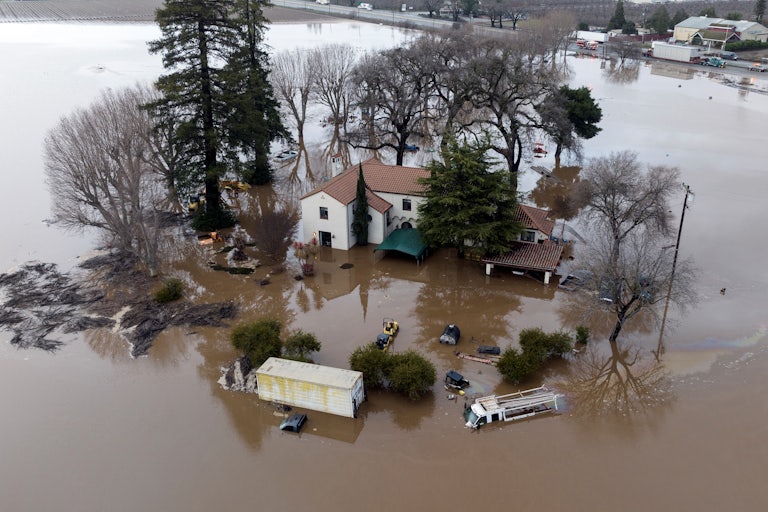
Well. I should jolly well hope so. Tharoor notes attendees’ concerns this year: “war, climate catastrophe, energy price chaos, inflation, epidemics of hunger and disease, political instability and widening inequity.”
These are serious issues. They’re also issues that many of the corporations bankrolling the World Economic Forum have contributed to, with abandon. They’re issues they have lobbied governments to keep from addressing rigorously—for fear strong policies will interfere with their business models.
Shell, whose internal emails show it was never particularly serious about reducing emissions, is a WEF partner. So is Chevron—the company that’s dedicated over a decade to persecuting a single lawyer who it blames for making it pay up after its subsidiary Texaco poisoned Indigenous lands in the Ecuadorian Amazon. So are Cargill, Tyson, and JBS—who together control a staggering percentage of U.S. meat production, who did not exactly cover themselves in glory during the pandemic, and whose industry is well known for obstructing climate policy.
This is a bleak game one could play for hours with the WEF’s member and partner lists. The very same day Tharoor’s story published, a new report dropped showing that the biggest banks on the Glasgow Financial Alliance for Net Zero’s “net-zero banking alliance grouping” have in fact continued to finance fossil fuel expansion, to the tune of $270 billion. The list of those banks contains a lot of familiar names.
“One of the biggest banks involved in GFANZ is HSBC,” The Guardian reported on Tuesday, “which announced restrictions on oil and gas financing last month. But it has approved 58 transactions worth $12bn in capital to fossil fuel developers, since joining a GFANZ grouping in April 2021, according to the Reclaim Finance report.” Wouldn’t you know it? HSBC is a WEF partner too.
The list of corporations behind the annual Davos bash is not a tangential issue. While WEF has certainly hosted some serious people over the years, the organization is fundamentally funded by its corporate members and partners, for the purpose of “bring[ing] together decision-makers from across society to work on projects and initiatives that make a real difference,” per the statement on WEF’s website. Bringing together decision-makers is, of course, a polite way of saying that CEOs get to hang out in a Swiss resort with world leaders all week. So while they self-describe as a group that can solve the world’s problems (their stated goal is to have a “positive impact at all levels of society”), it’s not exactly surprising that over the years, the forum has largely spotlighted free-market solutions that corporations like. (As the conservative British magazine The Spectator noted this week, giving top corporations weeklong access to the world’s most powerful policymakers “is the picture-perfect example, not of free market capitalism, but of crony capitalism.”)
So apparently Davos is less fun these days now that attendees feel a sense of “permacrisis” and are no longer so sure that globalization is winning. That gloomy mood is probably for the best: There is no reason these particular people should be feeling good about themselves and their track record running world affairs. And hey, maybe if this party gets depressing enough, it’ll be canceled next year altogether. For all WEF’s talk about Davos being a “carbon neutral” event, the fact remains that private jet emissions quadrupled during Davos 2022 as compared to an average week. That’s one thing you could genuinely say the forum excels at: hot air.


Bad News
Faulty arguments about whale conservation are being deployed against offshore wind installations, instead of an acknowledgment that the main threat to whales comes from boats and climate change, according to this in-depth report from Clare Fieseler at the Post and Courier.
Stat of the Week
.png)
That’s the proportion of forest carbon offsets from the world’s leading offset provider, Verra, that turn out to be totally useless, according to a new analysis.
Elsewhere in the Ecosystem
Assessing ExxonMobil’s Global Warming Projections
If you haven’t read at least the top summary of the buzzy new piece out in Science—about how ExxonMobil’s internal predictions about climate change in the 1970s and ’80s were actually extremely accurate—it’s worth your time. (The top, shaded portion is very user-friendly, even if reading scientific papers isn’t usually your jam, and right now it’s not behind a paywall.)
In 2015, investigative journalists discovered internal company memos indicating that Exxon oil company has known since the late 1970s that its fossil fuel products could lead to global warming with “dramatic environmental effects before the year 2050.”… Many of the uncovered fossil fuel industry documents include explicit projections of the amount of warming expected to occur over time in response to rising atmospheric greenhouse gas concentrations. Yet, these numerical and graphical data have received little attention.…
Our results show that in private and academic circles since the late 1970s and early 1980s, ExxonMobil predicted global warming correctly and skillfully. Using established statistical techniques, we find that 63 to 83% of the climate projections reported by ExxonMobil scientists were accurate in predicting subsequent global warming.
Read G. Supran, S. Rahmstorf, and N. Oreskes’s article in Science.
This article first appeared in Apocalypse Soon, a weekly TNR newsletter authored by deputy editor Heather Souvaine Horn. Sign up here.