Breaking News
Breaking News
from Washington and beyond

The Dangerous Concessions Kevin McCarthy Made to Become House Speaker

The House is set to vote on a new rules package with several provisions that cater to the far right. Here’s what’s in the proposal.

Nathan Howard/Getty Images

The House of Representatives votes later Monday on a new package of operating rules that includes chilling changes that could seriously damage the United States.

Kevin McCarthy was elected speaker of the House after 15 hellish votes, during which he made concession after concession to the farthest-right members of the chamber. The rules package for 2023 looks very different because of that.

Some moderate Republicans have already said they plan to oppose the package, such as Representative Tony Gonzales, who said he is against proposed potential defense budget cuts. Representative Nancy Mace expressed concerns over the lack of information about the “backroom deals” McCarthy made to win.

Here’s a look at some of the most dangerous proposals:

1. Motion to “vacate the chair”

Not only did McCarthy give all his dignity to his most extreme colleagues, he also apparently ceded all his actual power to them too. The California Republican agreed to restore the motion to vacate, which would allow any single member of the House to call for a vote to remove him.

Considering at one point 21 Republicans had blocked his bid for the speaker’s gavel, McCarthy will have the threat of removal hanging over his head throughout his entire tenure as speaker. He will spend his speakership rushing to please the people who finally agreed to put him there, rather than governing. And if he is removed, the House could be stuck in an endless loop of speaker votes, preventing the chamber from accomplishing anything.

2. Rules Committee assignments for the Freedom Caucus

McCarthy also agreed to give three seats on the powerful House Rules Committee to the Freedom Caucus, the far-right coalition. The House Rules Committee has a lot of influence over what bills and amendments make it to the floor. Freedom Caucus members could now block or stall actually useful legislation from ever reaching a vote. Politico called this “the single most significant surrender of leadership power that we’ve seen in decades.”

3. Slashed spending

The new rules will cap the debt ceiling, or the maximum amount of money the U.S. can borrow, to its level from two years ago. If the U.S. government reaches its soon-to-be-lower borrowing limit, it could default on its debt or fail to make a repayment. If that happens, already high prices and inflation could skyrocket, sending the U.S. into a recession.

Defaulting means the government will also be unable to pay military salaries and Social Security benefits. A lower debt ceiling would also mean less funding for programs such as Medicare and Medicaid, SNAP or food stamps, and meal programs for low-income students.

4. The Holman rule

McCarthy also agreed to reinstate the Holman rule, which lets lawmakers propose reductions in federal salaries, in the number of employees at federal agencies, and in the budget for certain programs. Federal pay or budgets can be slashed to $1, effectively defunding programs. Already on the chopping block is the Internal Revenue Service. The agency is chronically understaffed but has also come under fire for its apparent failure to audit former President Donald Trump’s taxes in a timely manner.

5. Gutting federal investigators’ power

McCarthy also agreed to two proposals that would hugely undermine Congress’s credibility. First, one proposal will gut the Office of Congressional Ethics, an independent federal watchdog, just as it was considering investigations into lawmakers who defied the January 6 investigative committee and serial fabulist George Santos.

The new rules would reimpose term limits on the OCE’s board members and restrict the window for hiring new staff to the first 30 days of the new congressional session (a week of which has already been wasted by McCarthy’s endless speaker votes). The changes would force out three of four Democratic-appointed board members and would run out the clock on hiring while new ones are approved, leaving the OCE unable to investigate anything.

But McCarthy is on board with investigating the FBI and the Department of Justice. He agreed to a proposed House Judiciary subcommittee to investigate the so-called “weaponization” of the federal government. The group will have access to any information shared with the House Intelligence Committee, which is usually the highest level of classified intelligence.

The subcommittee will supposedly act as a watchdog for ongoing criminal investigations, but an earlier version of the proposal limited the probe’s scope to the FBI, the Department of Homeland Security, and the Department of Justice.

Two ongoing investigations are into rioters who stormed the Capitol on January 6, 2021, and into Trump over his removal of classified documents after losing the 2020 election.

7,000 Nurses Go on Strike in New York City

More than 7,000 nurses at two of New York City’s largest hospitals are on strike, demanding better wages and better working conditions.

Striking health care workers hold up signs like "I SAVE LIVES WHO'S GOING TO SAVE MINE?," "ON STRIKE FOR BETTER CARE," and "MORE NURSES = BETTER CARE."
Jeenah Moon/Bloomberg/Getty Images
Nurses and health care workers during a strike at Mount Sinai Hospital in New York on January 9

Over 7,000 New York City nurses went on strike Monday, protesting poor pay and tough working conditions due to chronic understaffing.

The strikes at the Bronx’s Montefiore Medical Center and one of Manhattan’s Mount Sinai hospitals come after negotiations broke down Sunday evening.

The New York State Nurses Association had warned that workers at all 12 city hospitals with union contracts would go on strike if agreements could not be struck. After the announcement, seven hospitals struck tentative deals, including two late Sunday—but no agreement has been made yet at the two giant hospitals with nurses on strike Monday.

Nurses are disgruntled by staffing shortages, leading to long hours in tough conditions and not enough pay to match such circumstances, in which they are stretched thin trying to care for all their patients.

“Nurses don’t want to strike. Bosses have pushed us to strike by refusing to seriously consider our proposals to address the desperate crisis of unsafe staffing that harms our patients,” the New York State Nurses Association union said in a statement.

“The decision to go on strike is never an easy one, particularly for workers who care so deeply about the patients and communities they serve,” said New York City Central Labor Council AFL-CIO President Vincent Alvarez. “But hospital executives created this crisis by failing to hire, train, and retain nurses while at the same time treating themselves to extravagant compensation packages. Now it’s time for them to fix what they’ve broken.”

About 3,600 U.S. health care workers died in the first year of the pandemic alone. Now, some two and a half years after thousands drummed their pots and pans in support of the essential workers in one of the epicenters of the Covid-19 pandemic, nurses are left striking for better working conditions.

Marjorie Taylor Greene, Who Spread a Conspiracy Theory Just Last Week, Says Her QAnon Days Are Over

The Georgia representative is trying to position herself as a moderate, as Kevin McCarthy finally takes up the mantle as House leader.

Al Drago/Bloomberg/Getty Images

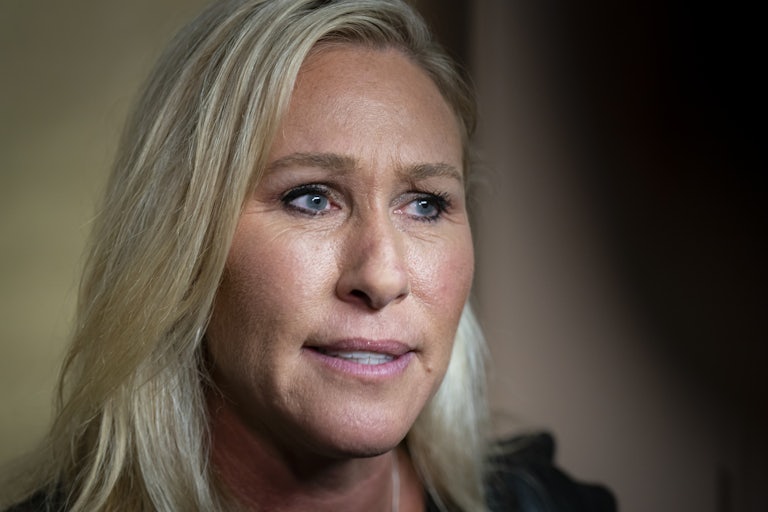
QAnon queen Marjorie Taylor Greene says she has backed away from the sprawling conspiracy theory web, conveniently at the time she is set to hold a decent amount of power in Congress.

In a Sunday interview on Fox News, Greene said she had been “sucked into some things I had seen on the internet,” including QAnon. But, she assured host Howard Kurtz, those beliefs are “so far in the past.”

She also said she never campaigned on QAnon theories because they were “not something I believed in,” a claim on which Kurtz did not press her.

This is, of course, blatantly untrue. Not only was Greene the first open QAnon supporter to be elected to Congress, but she has also wholeheartedly embraced many other conspiracy theories, including that a plane did not crash into the Pentagon during the 9/11 attacks; that the 2021 California wildfires were caused by space lasers owned by Jewish people; and that the 2020 election was stolen.

Just last week, she spread a conspiracy theory that Covid-19 vaccines contributed to Buffalo Bills safety Damar Hamlin’s cardiac arrest. She also regularly pushes the old grooming conspiracy theory about LGBTQ people being pedophiles.

Former White House aide Cassidy Hutchinson told the January 6 investigative committee that Greene discussed the QAnon conspiracy group multiple times with Donald Trump and his then chief of staff Mark Meadows. During one of those conversations, Greene told Meadows that her QAnon supporters would be attending the January 6 “Stop the Steal” rally in Washington, which eventually turned into the Capitol riot.

The only thing that’s different now is that Greene stands to have outsize influence in Congress. She has been a staunch supporter of Kevin McCarthy’s bid for speaker of the House, which he finally won Friday after four days none of us will ever get back and the loss of all his dignity. In the run-up to the vote, Greene urged her colleagues to back McCarthy, causing heated clashes with her former far-right allies in the House.

Moderate Republicans have expressed a desire to work with Democrats to prevent extreme bills from passing. Having now positioned herself as more moderate (than a few months ago), Greene could have a say in those deals.

Top Republicans Remain Silent on the Attack on Brazil’s Democracy

Thousands of supporters of Jair Bolsonaro, Brazil’s former far-right president, stormed the Congress in an attack that has been compared to January 6. Republicans don’t have much to say about it.

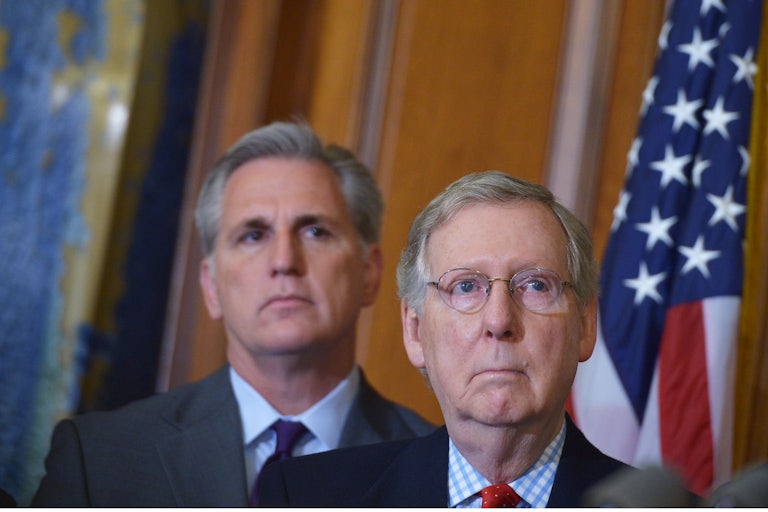
Republican leaders Mitch McConnell and Kevin McCarthy look on with their mouths closed
MANDEL NGAN/AFP/Getty Images

Thousands of supporters of Jair Bolsanaro, Brazil’s former far-right president, descended upon and invaded several government buildings on Sunday, in an attack on democracy that has been compared to January 6. Officials worldwide have condemned the attack and expressed support for President Luiz Inácio Lula da Silva’s government. This includes an array of Democratic officials, from Abigail Spanberger to Jamaal Bowman, starting all the way at the top:

It’s hard to link to all the other statements from Democrats, given how many have spoken out on the frenzied attack. And many are actively expressing their support for Lula as the rightful president, rather than just sharing amorphous defenses of democracy.

Meanwhile, there have been few Republicans speaking out in defense of democracy, or even issuing hodgepodge statements on law and order. Republican leadership has remained completely silent, with no statements from Mitch McConnell or Kevin McCarthy. Donald Trump, who incited our own January 6, 2021, attack, has similarly been quiet.

The few statements from Republicans have come from Representatives George Santos and Brian Fitzpatrick and Senator Rick Scott.

It’s very easy to be cynical, to view Republicans’ general silence in response to a massive coordinated attack on Brazil’s democracy as unsurprising, given how many of them tacitly if not actively supported a similar attack on their own soil just two years ago. Yet it’s worth reaffirming as often and clearly as possible how radically extreme this party is that you can count with one hand how many of its members say they care about the will of the people.

After 15 Tries and Most of His Dignity Gone, Kevin McCarthy Becomes House Speaker

This was the fifth-longest House speaker election in history, with the most votes since before the Civil War.

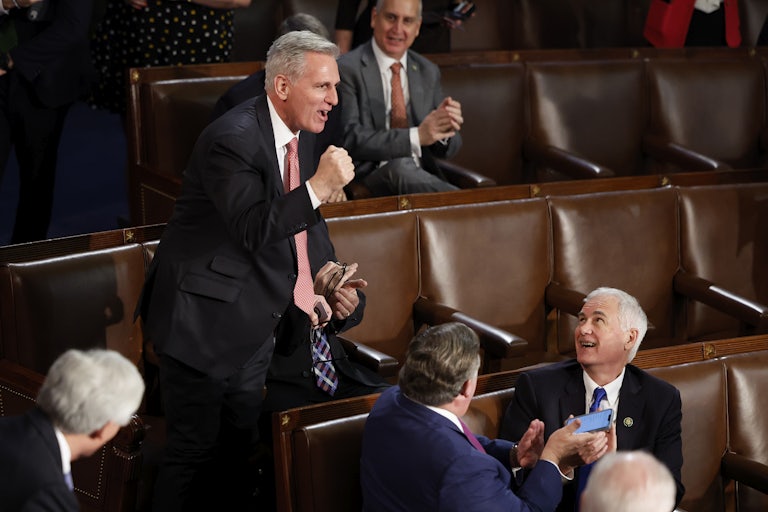
Kevin McCarthy cheers in the House chamber during the election for speaker, as other representatives look on.
Chip Somodevilla/Getty Images

Early Saturday morning, Kevin McCarthy finally crossed the threshold to become speaker of the House. The result comes on the fifth day, in the fifteenth round of voting, of what has become the fifth-longest speaker election in American history, and the longest since before the Civil War.

McCarthy secured 216 votes, with several earlier Republicans defectors instead voting “present” and lowering the number of votes he needed to win. Throughout the week, McCarthy had struggled to eclipse even 200 votes, starting first at 203, before dropping to 202 and even 201 as a group of 19 Republicans continually voted against him, round after round. Meanwhile, Democrats proffered a united front, giving Hakeem Jeffries 212 votes over and over again.

Finally, on Friday afternoon, in the twelfth vote, some movement began to occur as McCarthy continued to cave in to the demands of his defectors. As pressure mounted, just enough Republicans voted late Friday night into Saturday morning to push McCarthy through and secure the speakership that continued to evade him.

But the speakership vote is not even half the battle. If there was this much chaos just to elect the House speaker, imagine what this portends for any other vote or House business. Indeed, further pandemonium may be closer on the horizon than McCarthy was counting on:

If the rules package McCarthy put together to secure the speakership fails after he secures the speakership, there’s no telling what other hurdles may lie ahead. There’s been so much attention placed upon the 19 Republican defectors that McCarthy may have taken for granted the nearly 200 other members of his party, let alone the 212 Democrats, who might have other ideas.

Good luck, Kevin.

More on the Speaker Drama