Breaking News
Breaking News
from Washington and beyond

Think Ron Desantis’s Twitter Space Was Bad? What Came After Was Even Worse.

To say DeSantis’s presidential announcement did not go well is an understatement.

Anna Moneymaker/Getty Images

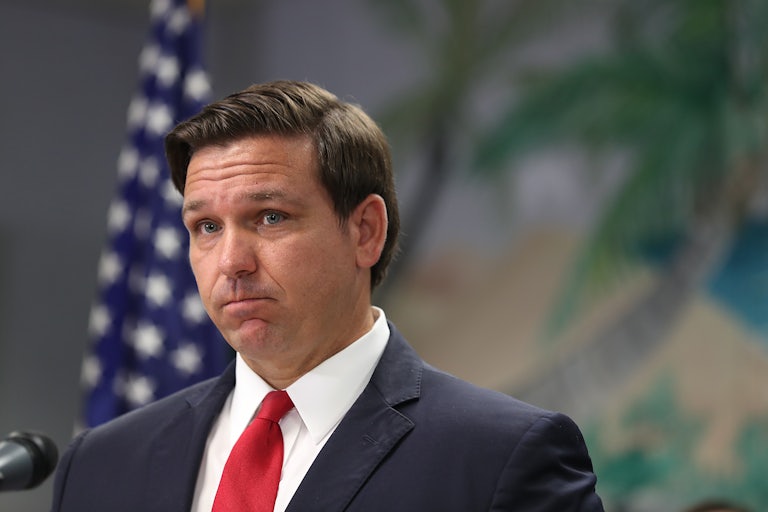
Ron DeSantis somehow managed to follow his disastrous Twitter Space with an equally cringey Fox News interview.

The Florida governor formally announced he was running for president Wednesday night in a Twitter event with Elon Musk and David Sacks. To say things had gone poorly would be an understatement, with constant glitches and bad jokes derailing any sense of pomp or celebration. But DeSantis’s subsequent interview on Fox News didn’t really improve things.

When host Trey Gowdy asked how DeSantis would address the war in Ukraine, the Florida man launched into a rant about how the military is too “woke.” “First, I think what we need to do as a veteran is recognize that our military has become politicized,” DeSantis said. “You talk about gender ideology, you talk about things like global warming that they’re somehow concerned, and that’s not the military that I served in.”

He did not mention what he specifically would do about Ukraine. (Recall that DeSantis has previously faced blowback from Republicans for saying Ukraine is not a vital interest.)

Gowdy then asked about the government’s role in addressing climate change (which, props to him for semi-acknowledging that it’s real). DeSantis promptly responded that the weather has been subject to “politicization.”

Insisting that hurricanes have not gotten more intense in recent years, DeSantis instead said, apropos of nothing, “I think what we should be doing in the United States is focusing on being energy independent.”

It’s interesting how quick DeSantis was to denounce things being too politicized, considering all the things he has recently decided to politicize in his home state: bathrooms, drag queens, children’s books, and Disney World, to name a few.
The Ron DeSantis Twitter Campaign Launch Was a Disaster

The Florida governor’s attempt to kick off his presidential candidacy from deep within Elon Musk’s collapsing empire went exactly as well as you’d expect.

Joe Raedle/Getty Images

Ron DeSantis’s presidential launch was supposed to be a rebranding moment. Faltering in the polls in recent weeks, the Florida governor had lost much of the heir-to-Trumpism sheen he had earned during his tenure in the Florida statehouse. If he once seemed like the future of the Republican Party, lately he’s just seemed, well, weird: Upon closer inspection—and put next to Donald Trump—he has been robotic, odd, and uncharismatic.

But DeSantis’s campaign launch on Wednesday was supposed to turn the page on all that. Rather than the usual pageantry—a rally in a hometown, flanked by family, broadcast on Fox News during prime time—DeSantis’s team decided to take a big risk. They would take the campaign to Donald Trump’s turf and launch it on Twitter, in a live interview with influencer David Sacks and Twitter CEO Elon Musk. DeSantis was coming for Trump’s core audience: the terminally online.

Well, you get what you pay for, I guess! Hundreds of thousands of users logged on to watch the campaign launch on Twitter Spaces only to overload the social network’s wheezing servers. Musk and Sacks could occasionally be heard mumbling in grainy audio. Mostly, though, there was just silence. It was glitchy, awkward, and strange—a metaphor for DeSantis’s own faltering presidential campaign. “You broke the internet,” Musk could be heard awkwardly mumbling at one point. It was a comment better directed at himself, given the current shambolic state of Twitter.

Thirty minutes after it was scheduled to start, the event finally got underway—with the expected array of awkward braying about “free speech” and dismissal of invocations of racism. DeSantis shrugged off a recent NAACP travel advisory: “Under the leadership of Governor DeSantis, the state of Florida has become hostile to Black Americans and in direct conflict with the democratic ideals that our union was founded upon,” NAACP President and CEO Derrick Johnson said. Musk similarly dismissed criticisms that Twitter had become overloaded with Nazis, racists, and freaks under his leadership.

Wasn’t this supposed to be a campaign kickoff? If so, it could hardly be described as a success. A few hundred thousand viewers is impressive, but DeSantis probably could’ve gotten significantly more if he had launched on, say, a Fox News prime-time show. He would, at the very least, have gotten some level of broadcast professionalism (and substantially less hold music): The glitchy, awkward, audio-only format of Twitter Spaces hardly helped assuage concerns that DeSantis lacks the charisma and human touch most successful presidential campaigns require.

Still, DeSantis ultimately got the extremely online event he wanted: one aimed at Musk fanboys and other online weirdos. But that doesn’t mean it was a success. Much like a recent rocket, this can only be described as a classic failure to launch.

Entire House Laughs at Marjorie Taylor Greene After She Asks for Decorum

The irony of the far-right congresswoman talking about decorum

Anna Moneymaker/Getty Images

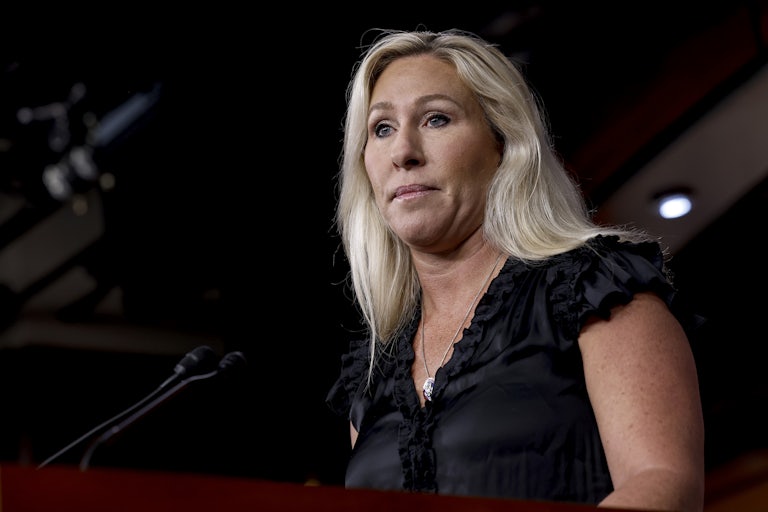
The entire House laughed in Marjorie Taylor Greene’s face on Wednesday when she called for decorum in the chamber.

Speaking during a House session, the far-right congresswoman said, “Members are reminded to abide by decorum of the House.” Democrats erupted into laughter.

Greene’s not really one to talk about decorum. She has spread conspiracy theories, made racist comments about co-workers, encouraged violence against Democrats, and essentially called for sedition.

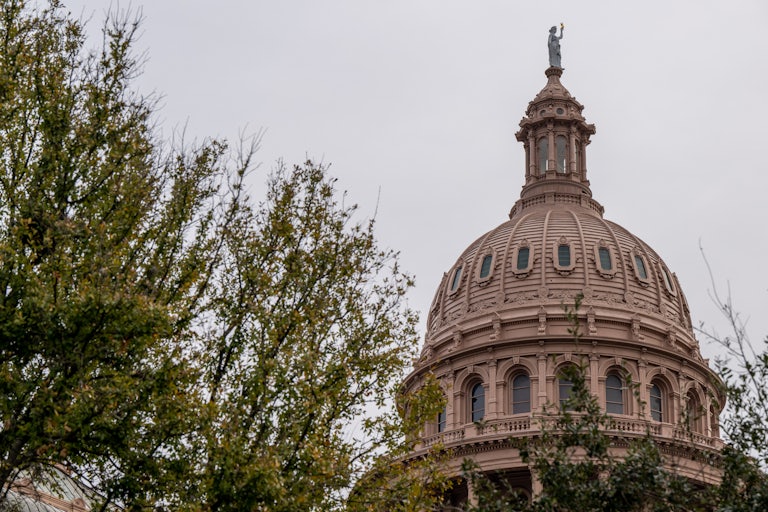
A Texas Bill That Would Have Banned Chinese People From Owning Property Has Failed

The bill would have also targeted citizens of three other countries.

Brandon Bell/Getty Images

A bill that would have banned people from China and three other countries from owning property in Texas failed to reach the House floor, with its death a huge relief to the state’s Asian American community.

The bill would have prohibited citizens from China, Iran, North Korea, and Russia from owning agricultural and oil leases. It passed the Senate in April with the support of all Republicans and one Democrat, and Governor Greg Abbott said he would sign it despite the measure being widely slammed as racist and xenophobic.

But the House never granted the bill a hearing. Speaker Dade Phelan canceled a planned session, killing dozens of bills, including the property ownership measure. There are a few long-shot measures that lawmakers can take to force the bill through, such as tacking it on to another measure, but they are unlikely to work.

“While our community has succeeded in stopping this terrible bill, it does not undo the racist and xenophobic rhetoric lobbed by elected officials,” the nonprofit Asian Texans for Justice said in a statement. “We will continue to stand up against discrimination and racism against the Asian American community.”

The property ownership bill had sparked multiple similar measures, including within Texas. State Republican lawmakers came under fire in March for a bill that would ban students from the same four countries from all public colleges and universities in the state. That bill never made it out of committees.

Louisiana is also pushing a package of bills that would ban “foreign adversaries,” including Chinese companies and citizens, from buying land in the state. Governor Ron DeSantis signed a law that would prohibit citizens of certain countries from buying homes and land in Florida. Chinese citizens are almost entirely banned, with few exceptions, while there are similar but slightly lighter restrictions on citizens of Cuba, Venezuela, Syria, Iran, Russia, and North Korea. A group of Chinese citizens who live and work in Florida are suing the state over the law.

All of these measures are painfully reminiscent of measures that have been implemented over the centuries to keep people of color out of the United States, ranging from the Chinese Exclusion Act in 1882 to former President Donald Trump’s travel ban that targeted North Koreans, Iranians, and several other Muslim-majority countries. Foreigners and their work are often subjected to racial and political scapegoating when people blame them for a host of issues in American society.

The Texas measures may have died, but the hostility toward immigrants is alive and well.

GOP Lawmaker Erases Maxwell Frost’s Valid Point on Student Debt From the Record

Representative Virginia Foxx, a top recipient of cash from student loan companies and for-profit colleges, acted offended by Frost’s comments on student debt relief.

Bill Clark/CQ-Roll Call, Inc/Getty Images Jemal Countess/Getty Images for People's Rally to Cancel Student Debt

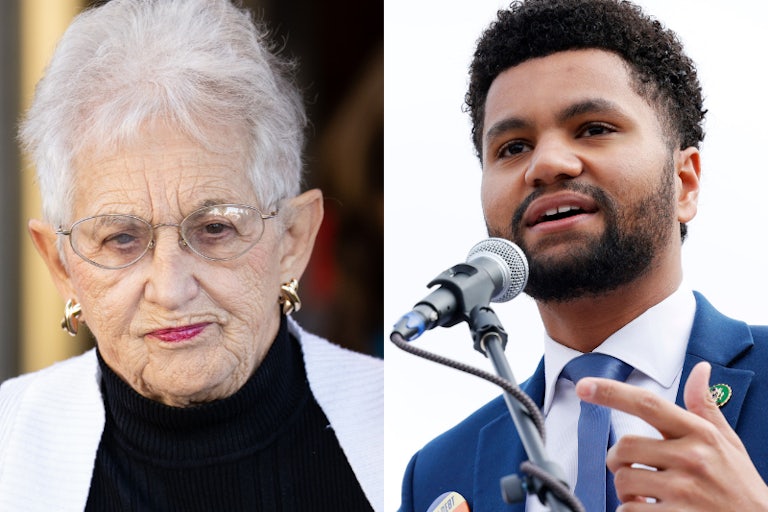
Maxwell Frost deconstructed a central conservative talking point against relieving millions of people from student debt—and apparently offended an absurdly bought-out Republican representative while doing so.

“If we legislated using the logic that you bring to this issue today, women and Black folks wouldn’t have the right to vote because it would be unfair to those who never got to vote before them,” said Frost on the House floor Wednesday, speaking against a resolution to repeal President Biden’s student loan debt forgiveness plan. “If we legislated using your logic, that because there was an injustice, we can’t fix it because it’s unfair to those who never had it fixed, means we would never progress on any issue in this country.”

“Why do you bring that bigoted logic to this issue as it relates to students, but not any other issue?”

The “bigoted logic” remarks prompted Republican Representative Virginia Foxx, whom Frost was addressing, to apparently become offended.

“I demand his words be taken down,” Foxx said with a frown.

Frost agreed on his own part to withdraw the “offending words” and proceed onward.

“If we used this logic on every single issue, we would never have progress on anything,” he said. “And the truth of the matter is that young people and people don’t have student debt because we live beyond our means. We have student debt because we’ve been denied the means to live.”

Foxx’s bristling at Frost’s remarks are unsurprising. In numerous election cycles, the almost two-decade North Carolina representative has been the leading recipient of donations from the for-profit education industry and from student loan companies, according to OpenSecrets.

Recall, these figures are out of 435 House members.

In total, Foxx has received over $665,000 from the for-profit education industry and another $86,000 from student loan companies.

The cozy relationship began in 2006—her first reelection cycle—when she was one of the leading House recipients of cash from student loan companies, raking in over $10,000 from the industry. From 2014 through 2022, she remained in the top 10 recipients from the industry; in 2016 and 2018, she was the leading recipient.

And in the for-profit education industry, the figures are even more staggering. From 2016 to 2022, Foxx was the number one recipient of cash from the industry, collecting hundreds of thousands of dollars each cycle. In 2014, she was the number-two leading recipient; in 2012, the seventh-leading one.

For-profit schools are infamous for defrauding students and charging them exorbitant amounts of money, making false promises of what kind of education they offer, and deceptively targeting marginalized communities and veterans.

All this cash has left Foxx a longtime proponent of leaving students with crippling debt—impairing the economic and social prosperity they could gain by not being held down by such a burden.

“I have very little tolerance for people who tell me that they graduate with $200,000 of debt or even $80,000 of debt because there’s no reason for that,” Foxx once said on a radio show, further complaining that students want success “dumped in their lap.”

Meanwhile: