Breaking News
Breaking News
from Washington and beyond

Bennie Thompson Lashes Out at Jan. 6 Text-Message Deleting Trump Administration Holdover

The former Jan. 6 committee chairman hasn’t stopped policing the insurrection beat.

Representative Bennie Thompson
Chip Somodevilla/Getty Images
Representative Bennie Thompson

The January 6 committee may have closed up shop when the GOP took over the House, but that doesn’t mean that Bennie Thompson, the Mississippi Democrat who was its chairman, has stopped scouring the landscape for targets. On Thursday, Thompson, the ranking Democrat on the House Homeland Security Committee, called on Department of Homeland Security Inspector General Joseph Cuffari to resign, citing deleting “business” texts on a government-issued phone and bungling an investigation into deleted Secret Service text messages.

Why would a Democrat go after an IG in a Democratic administration? Maybe because Cuffari is a Trump administration holdover whose resume includes a stint as a policy adviser to Republican Governors Jan Brewer and Doug Ducey of Arizona. Oh—and because the texts he deleted may have had to do with the whereabouts and movements of Secret Service agents on Jan. 6.

Last July, Cuffari admitted that the Secret Service, which currently falls under the purview of DHS, conspicuously deleted text messages on January 5 and January 6. Those messages would have been valuable to the Jan. 6 committee. Not long after Cuffari’s admission, members of Congress learned that Cuffari and his team actually knew that the texts were deleted—and had known for months, without notifying congressional investigators.

If anything, the call by Thompson and Congressman Glenn Ivey, the ranking member of the subcommittee on Oversight, Investigations, and Accountability, has been measured and reserved. It’s taken them this long to demand that someone else have Cuffari’s job despite the mounting evidence against the inspector general. Earlier this week Thompson and Ivey introduced the Department of Homeland Security Inspector General Transparency Act aimed at addressing “years of troubling reports calling into question the quality, effectiveness, and transparency of the DHS Office of Inspector General’s oversight activities as well as its management,” according to a press release.

Keep in mind that this isn’t just any old inspector general job. DHS covers border security, immigration, the Secret Service, and cyber security, among other topics. Whoever runs oversight over that agency is in an enormously important and influential position. Cuffari’s tenure satisfied, to some extent, Donald Trump’s agenda. Thompson’s moves suggest that Cuffari’s conduct is still in line with the Trump administration’s values. Thus the push to get Cuffari out as soon as possible. 

“Your apparent violations of Federal criminal laws and your mishandling of key investigations within DHS have undermined any confidence in your ability to carry out your duties,” the two Democratic lawmakers wrote in a letter publicized on Thursday. “We must restore credibility to the OIG in order to have independent oversight and accountability within DHS. Your resignation is the necessary first step.”

It’s amazing it’s taken this long for Democrats to make these calls.
Did Tim Scott Intentionally Kill Police Reform So He Could Run for President?

The only Black Republican senator seemed worried about politics when he scuttled what could have been bipartisan legislation, a new book says.

Bill Clark/CQ-Roll Call, Inc/Getty Images

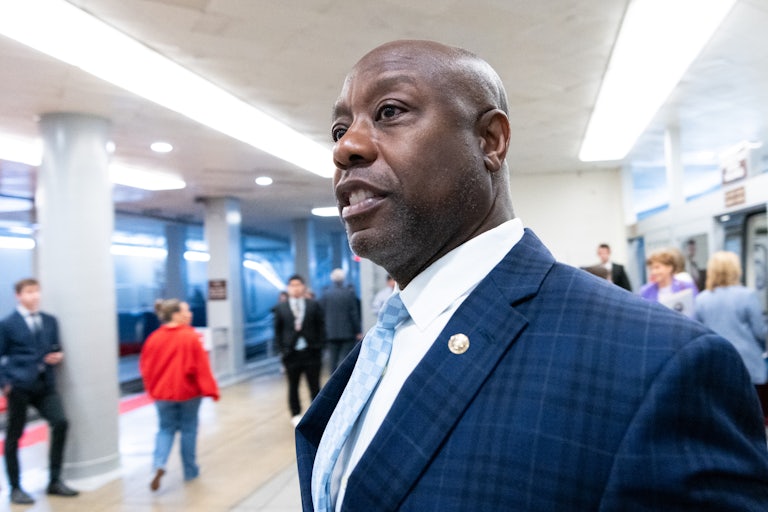
Tim Scott has positioned himself as the Republican most serious about police and civil rights reform. But it turns out he may have sabotaged a (very moderate) police reform bill he and Senator Booker worked on in 2021, perhaps in preparation to run for president.

The revelations come from Ben Terris’s new book The Big Break, in which he traces efforts between the two cross-the-aisle Black senators to work together and craft a police reform bill. In 2021, Scott’s office told Booker’s that if they could get some support from police organizations, they “would be able to get enough Republicans to pass the thing,” Terris writes. And soon, Senator Booker reached a police reform package that did indeed earn potential support from two police organizations—the Fraternal Order of Police and the International Association of Chiefs of Police—so long as Republicans could agree to the same text they had seen.

Booker’s team took the bill to Scott’s office.

But shortly after Scott’s office received the bill, a copy was curiously leaked to the National Sheriffs’ Association. Then, Terris writes, “With the Sheriffs’ Association as a shield, Scott rejected the offer. Even though the bill would have added millions of dollars to police department budgets, he accused Democrats of wanting to ‘defund the police,’ something that almost no one in Congress had been saying for months.”

The turn of events came as a surprise to Booker’s team. “It made [them], and other Democrats, pretty sure that Scott hadn’t been serious about passing legislation for quite some time… In fact, there were some on Booker’s team who had come to believe that Scott didn’t want to have a police reform bill weighing him down if he ever decided to run for president.”

Scott’s office did not respond to The New Republic’s request for comment.

In 2020, Scott did introduce his own police reform bill, called the JUSTICE Act, crafted in the aftermath of the murders of George Floyd by Minneapolis officer Derek Chauvin and Breonna Taylor by Louisville police officers Jonathan Mattingly, Brett Hankinson, and Myles Cosgrove.

That bill actually did threaten to defund the police, if local departments were found not to be compliant with policies like banning chokeholds, stopping no-knock warrants for drug cases, and eliminating racial profiling practices.

“Our bill says that we will defund the departments if they don’t ban chokeholds,” Scott said in a Facebook live event in June 2020.

The bill failed after it met opposition, in part because it didn’t deal with qualified immunity, which protects officers from being held accountable for violence or misconduct against the people they’re supposed to protect.

Fast forward years later, and police are indiscriminately arresting and even murdering people protesting police brutality and environmental degradation; killing a migrant worker who just wanted to finish his shift after being fired; and arresting journalists covering protests against the brutal murder of a homeless person.

Meanwhile, last month, Scott joined all his Republican colleagues, and eight Democrats and independents, in voting to overturn Washington, D.C.’s police reforms that would have banned chokeholds and made body camera footage of officer-caused deaths, or serious uses of officer force, more accessible to the public.

Such is the spineless legacy Scott apparently brings to his almost-certain-to-lose presidential campaign.

Pablo Manríquez contributed reporting to this story.

A Tough Question for Republicans: Investigate Child Labor—or Promote It?

The House seems to be passing on an opportunity to investigate a child labor scandal.

Representative Virginia Foxx
Chip Somodevilla/Getty Images

The House is taking a pass on probing a Biden administration child labor scandal. Here’s the reason why.

One of the more Gothic recent developments in the Republican Party is its positioning itself as the party of child labor. In February, The New York Times handed congressional Republicans, practically on a silver platter, a camera-ready Biden administration scandal: About 100 migrant children in 20 states “described [performing] jobs that were grinding them into exhaustion” in flagrant violation of child-labor laws. The Times followed up in April with a report blaming the situation on ineffective coordination between the Labor Department, the Health and Human Services Department, and the Biden White House. The Labor Department reported a 37 percent increase in child-labor violations in 2022. Surely House Republicans would set aside their investigations into various phony Biden administration scandals and shift their attention to this very real one.

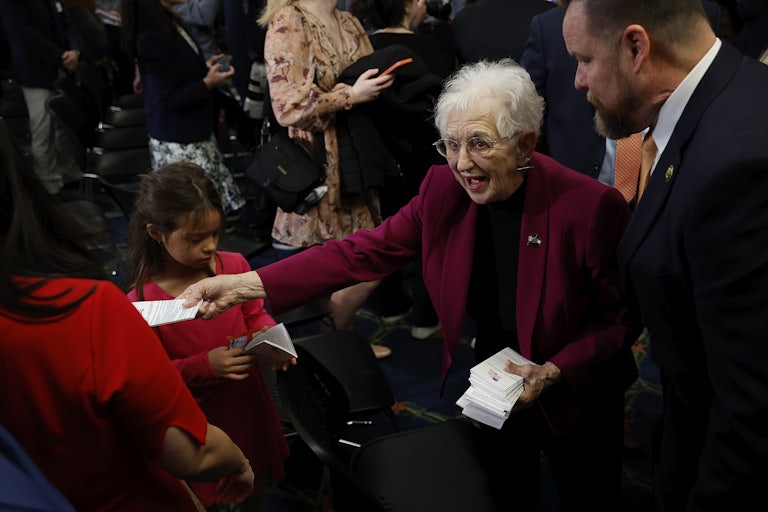
It didn’t happen. It fell this week to the senior Democratic member of the House Education and Labor Committee, Bobby Scott, to write a letter to GOP committee chair Virginia Foxx urging her at long last to schedule a hearing on “the illegal employment of children in unsafe conditions.” Scott released the letter to the press Thursday afternoon.

Why won’t Foxx reach for this low-hanging fruit? Partly because, as Scott notes, it would spotlight inadequate funding for federal agencies like the Labor Department’s wage and hour division and the National Institute for Occupational Safety and Health, and Republicans prefer to starve those agencies. But mostly Foxx is resisting because Republicans are pressing hard at the state level to deregulate child labor. More than a dozen state legislatures have introduced such bills, and four statesNew Hampshire, Arkansas, New Jersey, and Iowa—have enacted them. That’s liable to come up in a congressional hearing on the scourge of child labor. Better to take a pass.

Trump Is Begging for a New Trial in E. Jean Carroll Case

The former president, found guilty of sexual abuse, is getting desperate.

James Devaney/GC Images

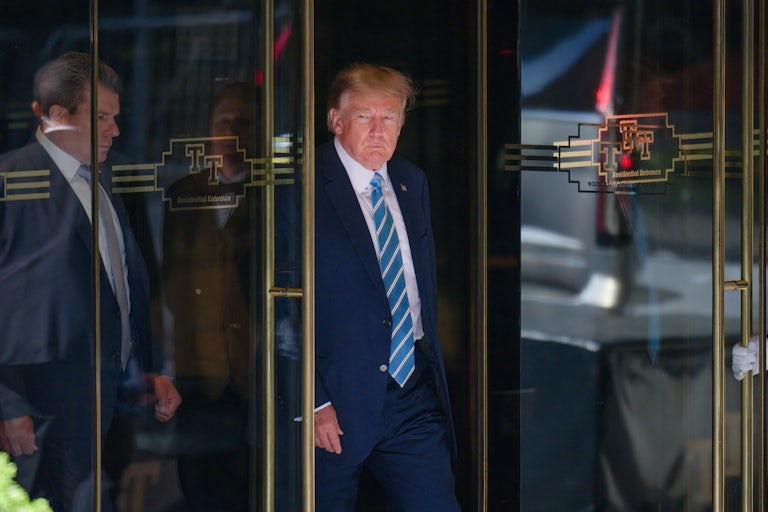
Donald Trump cannot accept that he was found liable for sexually abusing E. Jean Carroll, and on Thursday asked for a new trial in the decided case.

Trump was unanimously found liable in May for sexual abuse and battery against Carroll in the mid-1990s, and for defaming her in 2022 while denying the assault. He was ordered to pay her about $5 million in damages. Carroll has two more defamation lawsuits against Trump pending: one from 2019 and one from last month, after he bashed her during the CNN town hall.

Trump’s lawyers argued in court documents that he had been charged too much for damages. They said that the $2 million award for sexual abuse was “excessive” because the jury determined Carroll had not been raped and that his assault had not caused her any mental injury.

The lawyers also said the $2.7 million for defamation was “based on pure speculation.” They asked that the total damages either be reduced to $900,000 or that the judge grant an entirely new trial.

Carroll accused Trump in her 2019 memoir of raping her in the Manhattan Bergdorf Goodman department store in the mid-1990s. She initially sued him twice for defamation: first in 2019, when he said she made up the rape allegation to promote her book, and again in November for posts he made about her on social media.

Carroll is not the only woman to accuse Trump of sexual assault, but her case was the first to make it to a courtroom. Trump continues to vehemently deny all of the allegations and launched fresh vitriol at Carroll during the disastrous CNN town hall last month. So Carroll sued him for defamation again.

Trump and his allies have repeatedly tried to thwart Carroll’s various lawsuits. Last week, a judge denied an attempt to throw out the 2019 defamation suit by Trump ally James H. Brady, who argued that the former president was being unfairly treated because he is a “white Christian.”

And on Monday, Trump and his legal team also requested that the 2019 suit be dismissed, arguing that he couldn’t have defamed Carroll then because he was technically telling the truth when he denied raping her.

Supreme Court Makes It Easier for Dems to Retake the House With Voting Rights Ruling

The court’s decision affects congressional district maps across the country, and a few Republicans are in big trouble.

Capitol building
Anna Moneymaker/Getty Images

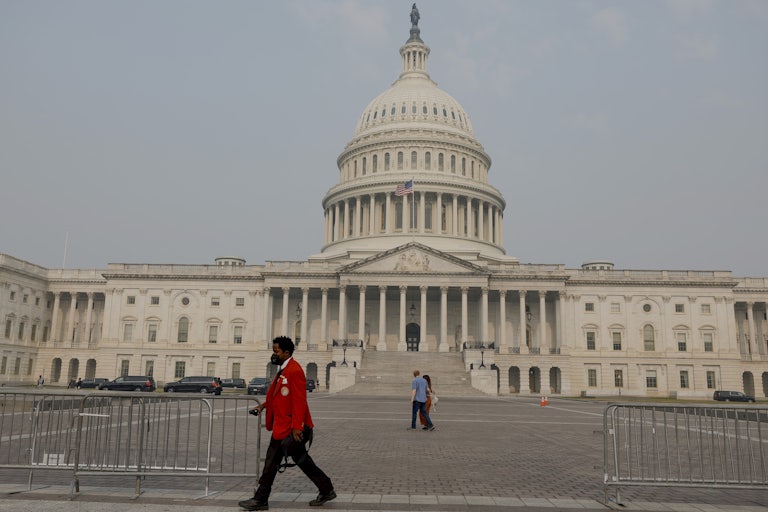
The Supreme Court’s ruling Thursday that Alabama’s congressional district map discriminated against Black voters could have bigger implications for several Southern states—and could help Democrats retake the House in 2024.

The biggest change and most immediate impact, obviously, will be in Alabama. But a handful of other states where racially gerrymandered districts are facing legal challenges could also see a very different map in the coming election. That includes Louisiana, South Carolina, and Georgia—and may affect races beyond that.

Democrats currently have 212 seats in the House of Representatives, and they would only need to reclaim six to retake the majority in the chamber.

Alabama

Alabama will have to redraw its map to create two majority-Black districts, which could set a precedent for rulings in the other states. There are seven congressional districts in the state, and six of them are held by Republicans.

Here are the Republican representatives who could be most in trouble from the redistricting:

  • Jerry Carl
  • Barry Moore
  • Mike Rogers

Georgia

Georgia Democrats lost a seat to Republicans during the 2022 midterms after the state GOP redrew the 6th district to include more conservative, majority-white areas. A judge could rule later this year that the new map illegally dilutes the Black vote and needs to be redrawn. The Republicans who could be at stake are:

  • Barry Loudermilk
  • A. Drew Ferguson

Louisiana

The Supreme Court previously blocked a lower court’s ruling to redistrict Louisiana to include a second majority-Black district, until it could issue its Alabama ruling. And now that we have a decision on Alabama, Louisiana will likely also have to redraw its maps to stop diluting the Black vote. That means Republicans who might lose their seats are:

  • Garret Graves
  • Julia Letlow

South Carolina

The Supreme Court agreed to hear the challenge to a South Carolina court ordering the state to redraw its 1st district.

Good luck to Nancy Mace.