Breaking News
Breaking News
from Washington and beyond

Judge Hearing Florida Abortion-Ban Case Has a Huge Conflict of Interest

Florida Supreme Court Justice Charles Canady does not see any reason to recuse himself from the case.

Florida Supreme Court

The Florida Supreme Court heard arguments Friday on a case that will decide the future of abortion rights in the state. And there’s one very big conflict of interest: One of the justices ruling on the case is married to a Republican state representative who co-sponsored the six-week abortion ban.

Since Roe v. Wade was overturned, Florida has allowed abortion up to 15 weeks, making the state a major hub for people seeking abortions in the South. Governor Ron DeSantis signed a new law in April that would ban abortion after six weeks, before most people even know they are pregnant. If the state Supreme Court upholds the 15-week ban and dismisses the legal challenge in the case it is now hearing, then the more radical six-week ban will automatically go into effect.

The seven-justice bench includes five conservatives appointed by DeSantis, who has made his opposition to abortion access clear. It also includes Charles Canady, who refuses to recuse himself from the case.

Canady is married to state Representative Jennifer Canady, who co-sponsored the six-week ban. Again, the Supreme Court’s ruling in this case will directly impact whether the six-week ban is triggered into law.

Prior to serving as a justice, Canady was a Florida representative during the 1990s. While on Capitol Hill, he sponsored multiple bills to ban “partial-birth abortion,” which is not a thing.

Unfortunately, even despite Canady’s refusal to recuse himself, the rest of the court does not offer much more hope.

Another justice, Meredith Sasso, is married to DeSantis loyalist Michael Sasso. DeSantis appointed Michael Sasso as vice chairman of the controversial Disney oversight board. Sasso resigned in May, although he did not explain why. While the Disney case has no bearing on abortion, Justice Sasso’s close link to DeSantis could indicate how she leans on reproductive rights.

Arguments did not get off to a strong start Friday when a third justice, Carlos G. Muniz, suggested that legal abortion violated fetal personhood. Anti-abortion activists argue that humanity begins at conception and thus fetuses should be afforded legal rights. But health experts warn this line of thinking could be used to criminalize doctors who provide lifesaving care.

If the 15-week ban is upheld and the six-week ban allowed to take effect, abortion access will effectively be wiped out throughout the southern United States. North Carolina Republicans recently forced through a law banning abortion at 12 weeks, and South Carolina Republicans passed a law banning the procedure at six. All three states had become abortion havens in the South after the fall of Roe.

Abortion rights advocates in Florida, though, are hopeful they can win back abortion protections. The abortion rights group Floridians Protecting Freedom is working to get an abortion rights referendum on the state’s 2024 ballot. The group says it has collected nearly three-quarters of the 900,000 verified signatures from registered voters required for the ballot initiative.

If it succeeds, then abortion protections would likely be enshrined in the state constitution, overriding any laws the legislature has passed. A February study by the Public Religion Research Institute found that 64 percent of Floridians believe abortion should be legal in all or most cases.
Alito: Recusing From Cases Involving Friends Would “Disrupt” Supreme Court’s Work

The Supreme Court justice is refusing to recuse from an upcoming case with one of his colleagues.

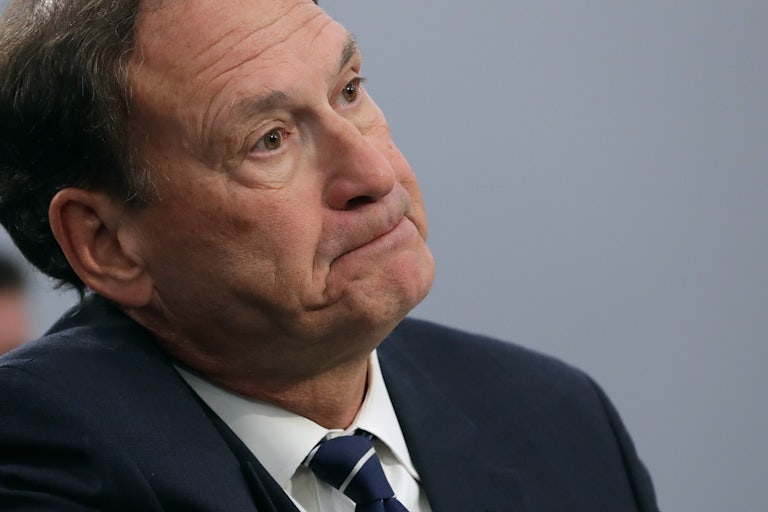
Supreme Court Justice Samuel Alito
Chip Somodevilla/Getty Images

Justice Samuel Alito refused Friday to recuse himself from an upcoming Supreme Court case, even though one of the attorneys in the suit published fawning profiles of him in The Wall Street Journal.

The reason? Recusing from cases that involve longtime colleagues would “disrupt” the Supreme Court’s work, Alito argued.

Senate Democrats warned Chief Justice John Roberts last month that Alito had violated ethical standards by sitting for two Wall Street Journal interviews with lawyer David Rivkin, because Rivkin was also representing a couple asking the Supreme Court to review a tax case. But Alito pushed back Friday, arguing that recusing himself would actually be detrimental to the high court’s work.

“When Mr. Rivkin participated in and co-authored the articles, he did so as a journalist, not an advocate,” Alito said in a statement.

“We participate in cases in which one or more of the attorneys is a former law clerk, a former colleague, or an individual with whom we have long been acquainted. If we recused in such cases, we would regularly have less than a full bench, and the Court’s work would be substantially disrupted and distorted.”

It’s highly unusual for justices to sit for interviews. But Alito has regularly given preferential treatment to the Journal’s editorial page, which is known for its ultraconservative leaning. In one of the interviews with Rivkin and Journal editorial page features editor James Taranto, Alito argued Congress has no “authority” to require the justices to adopt a formal code of ethics. Both articles were published in the Journal’s opinion section and praised Alito’s work. In yet another op-ed, which Alito wrote himself, he tried to defend accepting luxury vacations from conservative donors.

The justices’ behavior has come under intense scrutiny following the revelations that Alito and Clarence Thomas have accepted hundreds of thousands of dollars’ worth of vacations and other gifts from Republican donors over the years. Neither justice disclosed any of the gifts.

The Supreme Court has operated since its creation without a formal code of ethics, and largely without supervision. Congress has begun to push for legislation that would require the bench to adopt a formal code, but many of the justices—Alito in particular—have been resistant.

Damn: Georgia Grand Jury Wanted Lindsey Graham Charged in Trump Indictment

A report from the Fulton County grand jury recommended charges against all the Republican senator for his role in trying to overturn the 2020 election.

Jim Lo Scalzo/Pool/Getty Images

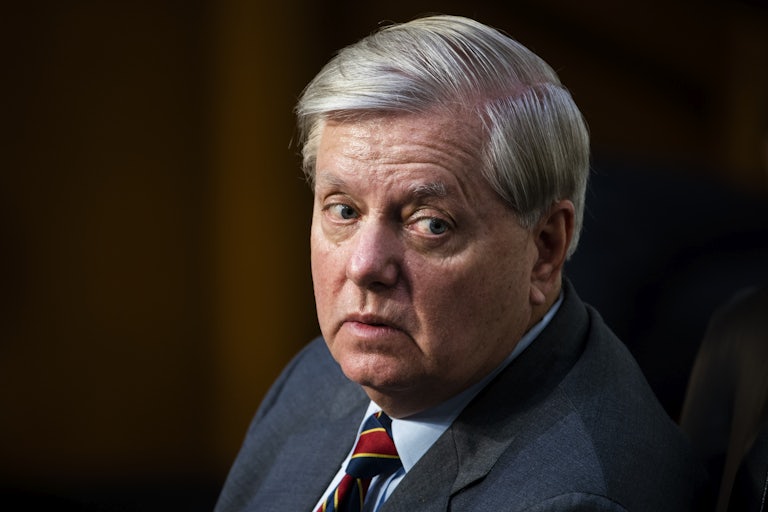
Senator Lindsey Graham and former Georgia Senators Kelly Loeffler and David Perdue all narrowly escaped charges for their role in trying to overturn the 2020 election, according to a new report from the Georgia grand jury.

Trump and 18 co-defendants were indicted in August for trying to overturn Georgia’s 2020 election results and charged with felony racketeering. The special grand jury’s full report was released Friday, and it revealed that Fulton County District Attorney Fani Willis had left several major players out of her 41-count indictment.

The grand jury had also recommended that Graham, Loeffler, and Perdue be indicted for their role in trying to overturn Georgia’s 2020 election results. Other people Willis left out include Trump’s lawyers Boris Epshteyn and Lin Wood, former Trump national security adviser Michael Flynn, and Republican strategist Cleta Mitchell.

Graham, a steadfast Trump loyalist, had been summoned to testify before the grand jury over a phone call he had made to Georgia Secretary of State Brad Raffensperger. According to Raffensperger, Graham asked whether the secretary had the power to throw out all mail-in ballots from certain counties.

Raffensperger told The Washington Post he felt Graham was asking him to illegally discount valid ballots. This phone call occurred a week before Trump’s own infamous phone call to Raffensperger, during which he begged the secretary to “find” the exact amount of votes needed to flip Georgia to Trump. Raffensperger held firm in both cases.

Loeffler and Perdue, also both vocal Trumpists, had embraced and actively pushed Trump’s false claim that the election had been rigged. A log of text messages that Loeffler had sent and received after the 2020 election was called for Biden showed her thought process behind deciding to challenge the vote results. Perdue, for his part, filed a lawsuit alleging that fraudulent or counterfeit ballots had been counted in Georgia’s most populous county.

Both senators were fighting to stay in office at the time. Loeffler and Perdue ultimately lost to Senators Raphael Warnock and Jon Ossoff in a runoff election, a historic upset that flipped the Senate to Democratic control. Trump’s repeated claims of election fraud are widely considered to be factors that led to Loeffler’s and Perdue’s defeat.

Republicans Want New Term for “Pro-Life” After Losing So Many Elections

Of course, Republicans will never change their position on taking away abortion rights. But they want a new way to say it.

Jeremy Hogan/SOPA Images/LightRocket/Getty Images
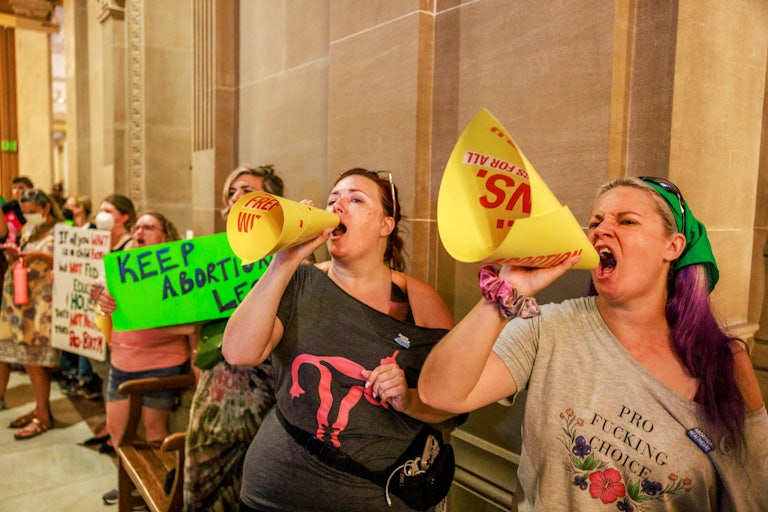
Abortion rights activists chant slogans as the Indiana Senate debates before voting to ban abortion during a special session in August 2022.

Republicans have lost so many elections over abortion that they’re thinking of changing up their strategy.

No, they’re not introducing better policies. They’re picking a term other than “pro-life.”

Republicans have suffered a steady stream of losses over abortion rights since the Supreme Court overturned Roe v. Wade in 2022. During a Senate Republicans closed-door meeting this week, GOP strategists said the issue was how voters react to the term “pro-life” and suggested coming up with a new label, NBC reported late Thursday.

The strategists encouraged lawmakers to be as specific as possible when they discuss their stances on abortion. Senator Todd Young came up with the brilliant phrase “pro-baby policies.”

Senator Josh Hawley summed up what he thought the problem was: “Most voters think [‘pro-life’] means you’re for no exceptions in favor of abortion ever, ever, and ‘pro-choice’ now can mean any number of things,” he told NBC. “So the conversation was mostly oriented around how voters think of those labels; that they’ve shifted. So if you’re going to talk about the issue, you need to be specific.”

“You can’t assume that everybody knows what it means,” he added. “They probably don’t.”

It actually seems pretty clear that voters do know what “pro-life” means. Since Roe was overturned, Republicans have banned abortion completely in 14 states. In many other states, Republicans have limited abortion access with cruel laws to the point that the procedure is effectively banned anyway.

Meanwhile, the vast majority of Americans—62 percent, to be exact—believe abortion should be legal in all or most cases. They have repeatedly demonstrated this at the voting booth. If a referendum to increase abortion rights is on the ballot, or if a candidate runs on a pro-abortion platform, then people always vote to protect abortion, even in traditionally Republican strongholds.
The Senate meeting is one of the first times that Republicans have openly acknowledged they are suffering losses over abortion, but they are taking the completely wrong lesson away.

“I think their messaging was not the problem,” Christina Reynolds, a spokesperson for Emily’s List, told NBC. Emily’s List is a nonprofit that promotes female-identifying candidates who support abortion rights.

“Their position is the problem, and they’re going to be stuck with those positions.”

Guilty! Trumpist Peter Navarro Convicted of Contempt of Congress

The former Trump adviser was found guilty after a jury deliberation of just four hours.

Win McNamee/Getty Images

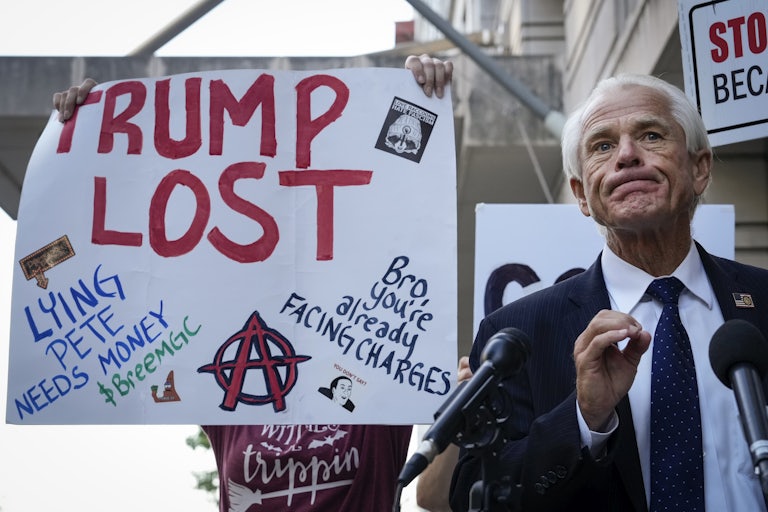
Donald Trump’s former adviser and top loyalist Peter Navarro was convicted Thursday of criminal contempt of Congress for failing to comply with a subpoena from the congressional January 6 investigative committee.

Navarro was indicted in June 2022 for failing to provide testimony and failing to provide documents to the House select committee investigating the January 6 insurrection. He has said he didn’t comply with the subpoenas because Trump had told him to claim executive privilege—except Trump failed to tell the January 6 committee about this, nor did he submit anything to back up Navarro’s claim. The jury deliberated for just four hours before returning the guilty verdict.

“That man thinks he’s above the law,” prosecutor John Crabb said during closing arguments. “In this country, nobody is above the law.”

Each of the two counts against Navarro carries a maximum one-year prison sentence, as well as a maximum $100,000 fine. Navarro is the second Trump ally to be found guilty of defying a subpoena related to January 6. Former Trump adviser Steve Bannon was similarly found guilty of contempt of Congress last year for refusing to comply with a January 6 committee subpoena. He was sentenced to just four months in prison and a $6,500 fine. Bannon appealed his case and has yet to serve his sentence.

Navarro had tried to claim executive privilege before the trial too. He argued that Trump had directed him to assert privilege so he could avoid the charges. Presiding Judge Amit Mehta rejected Navarro’s request last week.

Navarro is now the latest member of Trump’s inner circle to face legal consequences for the former president’s efforts to overturn the 2020 election. Trump has been indicted multiple times himself, alongside dozens of allies.