Breaking News
Breaking News
from Washington and beyond

Elena Kagan Hits Back at Samuel Alito, Endorses Supreme Court Ethics Reform

At least one Supreme Court justice thinks something needs to change.

Supreme Court Justice Elena Kagan has broken ranks with some of her colleagues—most notably Samuel Alito—to call for a formal code of ethics for the nation’s highest court.

The Supreme Court has been mired in controversy since the spring, in the wake of reports that Justices Clarence Thomas and Samuel Alito have accepted lavish gifts from billionaire Republican donors. Many people have called on the court to establish an ethics code to help prevent such situations in the future—which the justices have resisted.

But “it just can’t be that the court is the only institution that somehow is not subject to checks and balances from anybody else. We’re not imperial,” Kagan said Thursday at a judicial conference. “Can Congress do various things to regulate the Supreme Court? I think the answer is: yes.”

It’s hard to see Kagan’s comment as anything other than a direct response to her fellow justice Samuel Alito, although she said it was not. Alito recently said Congress should back off from trying to regulate the court.

“I know this is a controversial view, but I’m willing to say it,” he said in an interview with The Wall Street Journal. “No provision in the Constitution gives them the authority to regulate the Supreme Court—period.”

This is untrue, as Section III of the Constitution explicitly says that Congress can determine how to organize the court, and Kagan stated as much. “Of course, Congress can regulate various aspects of what the Supreme Court does,” she said. “Congress funds the Supreme Court. Congress historically has made changes to the court’s structure and composition. Congress has made changes to the court’s appellate jurisdiction.”

Chief Justice John Roberts has also begged Congress to stay out of the court’s business—but that may be because he has since come under fire for shady behavior too, albeit of a much less brazen variety than his colleagues Thomas and Alito. His wife, Jane Roberts, has allegedly been paid more than $10 million by multiple law firms—at least one of which argued a case before her husband, after it had already paid her hundreds of thousands of dollars.

Thomas has for years accepted hundreds of thousands of dollars’ worth of gifts from GOP megadonor Harlan Crow, in the form of island-hopping yacht vacations. The Nazi memorabilia collector also paid for Thomas’s nephew’s tuition, and he bought a Thomas family property, where Thomas’s mother still lives.

Thomas also has repeatedly refused to recuse himself from cases that relate to the January 6 riot—despite the fact that his wife, Ginni Thomas, is a major right-wing activist who encouraged then–chief of staff Mark Meadows to overturn the election.

Alito accepted a luxury vacation from a billionaire Republican megadonor as well. Right-wing activist (and then–head of the Federalist Society) Leonard Leo helped organize the trip, and also attended.

And the scrutiny is not limited to the conservative justices: Justice Sonia Sotomayor is under fire after the Associated Press reported that her staffers pressured institutions where she was scheduled to speak to buy hundreds, even thousands, of copies of her books.

Congress finally made a move to rein in the court two weeks ago, when the Senate Judiciary Committee advanced a bill that would require the justices to adopt a code of ethics. The measure would create rigorous new financial disclosure rules, as well as establish a process for submitting and investigating ethics complaints against the justices.

The bill will have a hard time passing the Senate, though, where Democrats have a razor-thin majority. It is unlikely to pass the House at all because the chamber is controlled by Republicans, who have accused the left of trying to “delegitimize” the Supreme Court (although the court seems to be doing that just fine on its own).

The GOP’s New Trump Defense: Juries Are Bad

Republicans want Trump’s conspiracy trial moved because Washington D.C. is too Democratic.

Photo by Samuel Corum/Getty Images
Donald Trump speaking at a rally in Washington shortly before his supporters stormed the Capitol on January 6, 2021

Republicans are demanding that Donald Trump’s trial for trying to overthrow the 2020 election be moved outside of Washington, D.C., suggesting that he won’t get a fair trial in the city because a lot of Democrats live there.

Trump was arraigned Thursday in the nation’s capital for attempting to overturn the election. He pleaded not guilty to four counts of conspiracy to defraud the United States, conspiracy to corruptly obstruct an official proceeding, obstruction of and attempt to obstruct an official proceeding, and conspiracy against the right to vote.

The GOP, which has staunchly maintained that he did nothing wrong, has now begun to insist that there’s no way Trump will get a fair trial in Washington. “Washington, DC is a ‘swamp’ and it is unfair to have to stand trial before a jury that is reflective of the swamp mentality,” Florida Governor Ron DeSantis, who is theoretically running for president against Donald Trump, tweeted. He also admitted he has not read the indictment yet.

By “swamp mentality,” he likely means “left-leaning.” Washington is an overwhelmingly Democratic city, and 95 percent of residents voted for Joe Biden in 2020. On Thursday, only a handful of Trump supporters showed up to the courthouse, while nearly 100 people stood outside to celebrate Trump’s arrest.

That doesn’t mean the city’s potential jurors can’t do a fair job, though. And the answer is not to move the trial to the “politically unbiased nearby State of West Virginia,” as Trump has demanded. Trump’s lawyer John Lauro has also pushed to move the trial to West Virginia. (By the same logic of why Washington would be biased, Trump won West Virginia by more than 30 points in 2020, his second-largest margin of victory in the election.)

The answer is to leave the trial exactly where it is. The Sixth Amendment of the Constitution states that “in all criminal prosecutions, the accused shall enjoy the right to a speedy and public trial, by an impartial jury of the State and district wherein the crime shall have been committed.”

Trump is not just accused of conspiracy and obstruction; he is accused of conspiring and obstructing in Washington. The only person Trump has to blame for the location of his trial is himself.

More on Trump's (Third) Indictment

Ron DeSantis’s Reset Needs a Reset

The struggling presidential candidate is banking on Iowa to win the nomination. It’s not going well.

Photo by Stephen Maturen/Getty Images
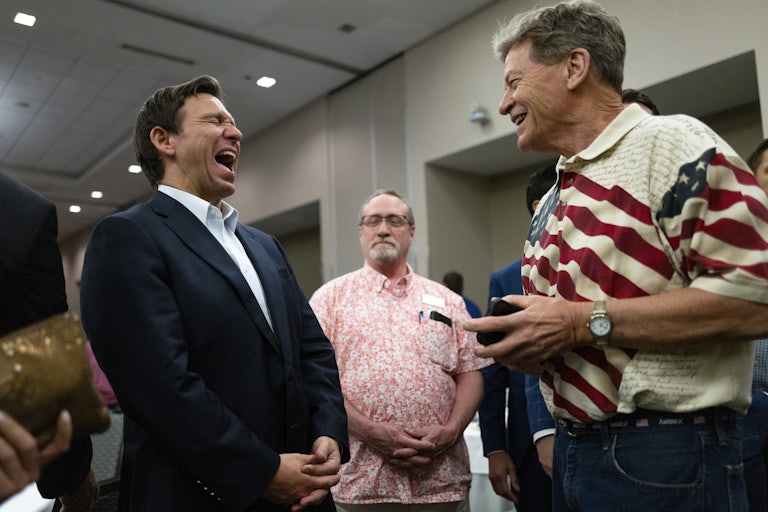
Ron DeSantis being normal in Iowa.

Ron DeSantis’s presidential campaign is not going well. The Florida governor has money problems. He has charisma problems. But mostly he has a Donald Trump problem: His candidacy is based on the idea that he is electable and competent and yet he is lagging far behind his main rival while running an inept, flailing, campaign.

Still, presidential campaigns can change on a dime and DeSantis has long banked on doing well in early primaries and caucuses and using that momentum to capture the nomination. In keeping with that strategy, he has spent seemingly as much time in Iowa as he has in his own state of Florida—despite the fact that he is, at least ostensibly, the governor of the Sunshine State. There have been times over the past few months when it seems like he’s running for president of Iowa as much as he is running for president of the United States. He is in the state practically every week. He even suggested he would consider Iowa Governor Kim Reynolds as his running mate.

And yet it has gotten him almost nowhere. On Friday, The New York Times closed out its week of polls with a survey of Iowa voters. The Times did its best to put a positive spin on the results. Donald Trump, they found, is doing 10 points worse in Iowa than he is in the country as a whole: Only 44 percent of voters in the state plan on caucusing for him at this time. But this is hardly good news for DeSantis: He is only doing three points better in Iowa than he is nationally. Twenty percent of Iowans support him, compared to 17 percent nationally. In a head-to-head matchup between the two—something that almost certainly won’t happen—DeSantis still lags far behind. Trump leads him 55 to 39 percent when the choice is whittled down to the two front-runners, though there is a sliver of good news: Those numbers are more or less flipped among college-educated Republicans.

Still, this is yet another dreadful sign for DeSantis. He needs an early win to show Republicans that he can take on Donald Trump. Yes, the caucuses are a long way away. But there’s no evidence that DeSantis’s strategy is working, even after an early reset.

Pro-Gun Control Tennesse Democrats Overwhelmingly Win Reelection

State representatives Justin Jones and Justin Pearson, who were pushed out of office by Republicans for gun control advocacy, just won landslide victories.

Jason Kempin/Getty Images
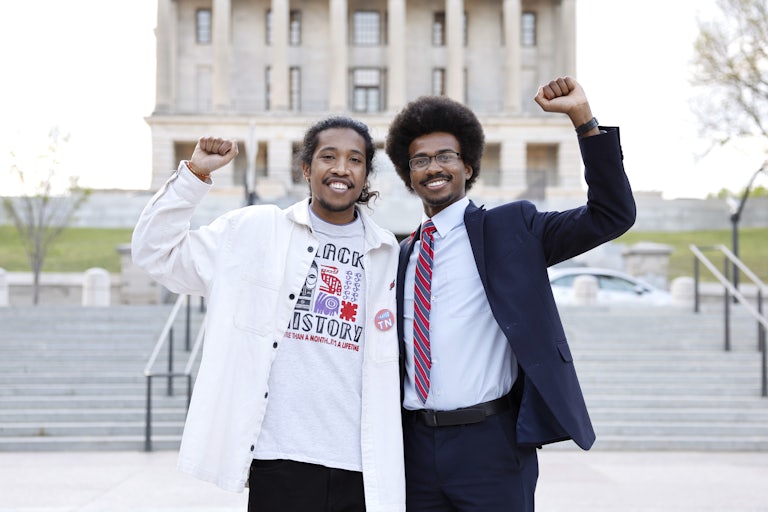
Tennessee State Representatives Justin Jones and Justin J. Pearson in April

Democratic state Representatives Justin Jones and Justin Pearson, who were expelled from the Tennessee legislature for protesting for gun control in April, were reelected to their seats in landslide victories on Thursday.

Jones and Pearson brought national scrutiny to Nashville in the wake of a school shooting in March, when they and fellow Democrat Gloria Johnson joined thousands of pro–gun control protesters in the Capitol building. Republicans voted to expel Jones and Pearson, both Black men, for allegedly violating chamber rules, but they fell one vote short of expelling Johnson, a white woman. Jones and Pearson were unanimously reinstated by their district councils until a special election could be held.

The two men swept handily to victory in that special election on Thursday. Jones defeated his Republican opponent with nearly 80 percent of the vote, while Pearson took home more than 90 percent of the votes in his district.

“Today is a landslide victory by the people, for the people, and in a community with the people,” Jones told The Tennessean in a statement. “Republicans tried to expel our democracy and then tried to buy it, but the voters of District 52 sent a message to extremist Republicans: we will not be silenced.”

Pearson told supporters Thursday that they had sent a “crystal clear” message to the state Republican Party: “You can’t expel a movement. You can’t expel hope.”

Both men have continued to advocate for gun legislation reform since they were reinstated by their district councils. Meanwhile, Johnson—who celebrated Jones’s and Pearson’s victories Thursday—is reportedly planning to challenge Marsha Blackburn for Senate.

Florida Bans AP Psychology for Violating Draconian “Don’t Say Gay” Law

Ron DeSantis’s war on education is getting more extreme every day.

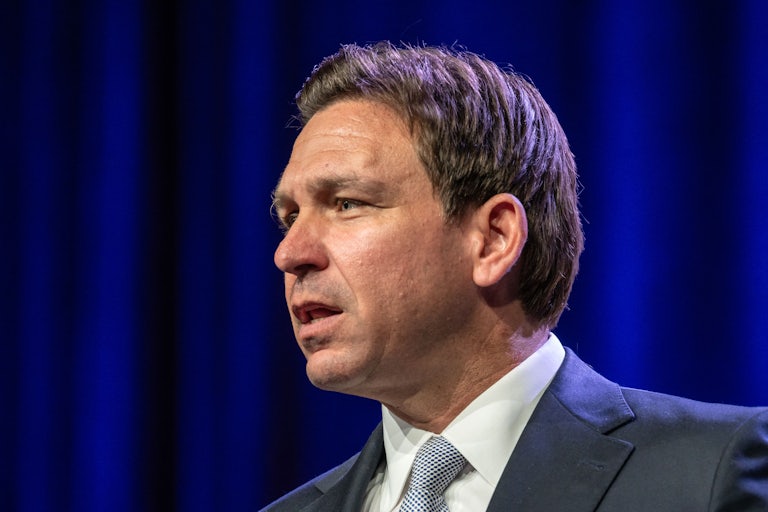
Ron DeSantis
SERGIO FLORES/AFP/Getty Images

Florida has effectively banned Advanced Placement Psychology in all public schools because the course includes content on sexual orientation and gender identity, a violation of the state’s draconian “Don’t Say Gay” law.

The College Board revealed the ban on Thursday, adding that it has heard from teachers across the state who are heartbroken by the news.

“We are sad to have learned that today the Florida Department of Education has effectively banned AP Psychology in the state by instructing Florida superintendents that teaching foundational content on sexual orientation and gender identity is illegal under state law,” the College Board said in a statement. “The state has said districts are free to teach AP Psychology only if it excludes any mention of these essential topics.”

According to the Orlando Sentinel, nearly 27,000 students in Florida took A.P. Psychology last year, and the course has been offered in the state since it was first launched in 1993.

A.P. Psychology asks students to “describe how sex and gender influence socialization and other aspects of development.” Florida’s Department of Education had asked the College Board to omit these sections from the curriculum, a move the organization rejected.

“We have learned from our mistakes in the recent rollout of AP African American Studies and know that we must be clear from the outset where we stand,” the College Board said in a statement in June.

The College Board stressed that the lessons on sexual orientation and gender identity are part of the class and, if they are erased, the course will not be able to carry the A.P. designation.

Florida Governor Ron DeSantis expanded the state’s “Don’t Say Gay” law in May, banning lessons on sexual orientation and gender identity in every grade. He has waged a war on education in the state, targeting anything he perceives as too “woke.”

Earlier this year, DeSantis forced the College Board to water down its A.P. African American studies course, stripping Black Lives Matter and the work of many queer Black writers from the curriculum. Last month, the state Department of Education announced that middle school students will be required to learn that “slaves developed skills which, in some instances, could be applied for their personal benefit.”