Breaking News
Breaking News
from Washington and beyond

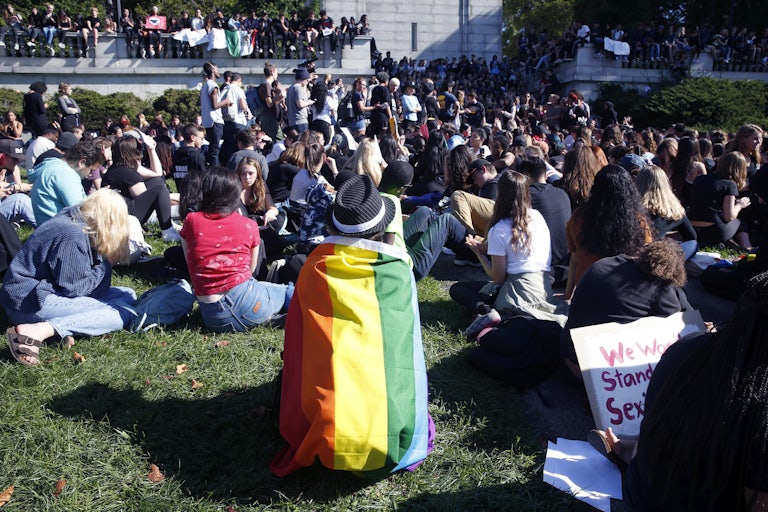
At Least 32 Trans People Have Been Killed So Far This Year

The real number is likely far higher, according to a new report from the Human Rights Campaign.

Vuk Valcic/SOPA Images/LightRocket/Getty Images

At least 32 transgender and gender-nonconforming people have been killed this year, the Human Rights Campaign said in a report published Wednesday, a few days before Transgender Day of Remembrance.

The HRC said that the toll could well be higher because anti-trans violence is often misreported or unreported altogether. Almost all the victims listed in the report are people of color.

While the details of these cases differ, it is clear that fatal violence disproportionately affects transgender women of color—particularly Black transgender women,” the report said.

The data does not include people who died by suicide.

The toll is lower than the year before, which saw at least 57 trans and nonbinary people killed. But it comes amid a raft of anti-trans legislation throughout the United States.

State governments, particularly in Republican-led areas, have passed legislation seeking to ban trans girls from playing on girls’ sports teams and prevent gender-affirming care in hospitals.

Virginia Governor Glenn Youngkin unveiled a policy in September that requires trans and nonbinary students to get permission from their parents to use their correct pronouns or gendered bathrooms. Even if parents grant that permission, school faculty and staff can still refuse to honor a student’s gender.

Ohio’s House passed a bill in the spring prohibiting trans women and girls from playing alongside cisgender women and girls. The bill had originally included a horrifying measure that would require anyone suspected of being trans to undergo a genital inspection.

That portion was eventually removed from the bill, which could go before the state legislature for a final vote before the end of the year.

And Florida passed a law in March, nicknamed the “Don’t Say Gay” law, that banned discussing sexual orientation or gender identity in the classroom.
Congress Just Passed a Bill to Limit Sexual Harassment NDAs. 109 Republicans Voted Against It.

The Speak Out Act had already passed unanimously in the Senate.

Anna Moneymaker/Getty Images

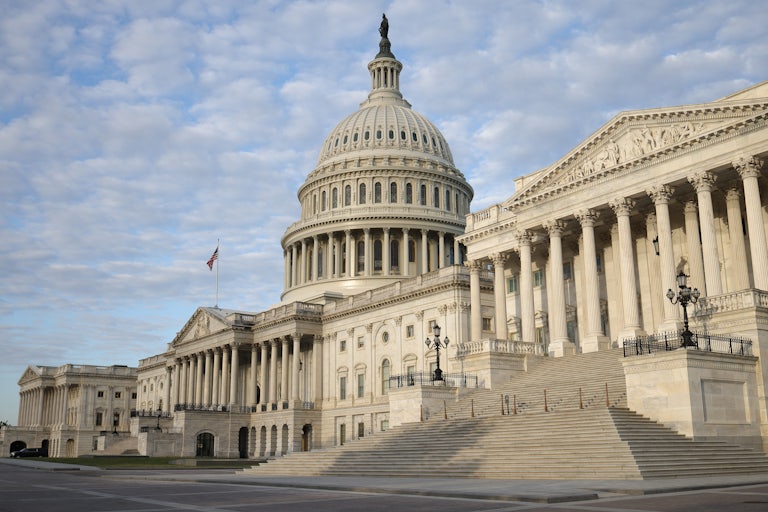
On Wednesday, the House passed the Speak Out Act, legislation that prohibits the use of nondisclosure agreements, or NDAs, in cases of workplace sexual harassment or sexual assault. In other words, the bill empowers victims to speak out, share their stories, and seek justice without fear of retaliation for breaking previously signed NDAs.

The House passed the act 315–109—a decent showing of bipartisanship, yet a glaring mark on the 109 Republicans who voted against it. Over half the House Republican caucus voted against the bill, while the Senate passed it with unanimous consent in late September.

Thwarting the use of NDAs is important, as they have been weaponized to bind victims from speaking out against abusive employers or workplace superiors. That prevents victims from stopping potential future harm from being inflicted upon colleagues. Gretchen Carlson and Julie Rognisky, former Fox News employees and advocates for the bill, are familiar with this dynamic. Both bound by NDAs, the pair filed lawsuits against late Fox executive Roger Ailes, alleging sexual assault.

“The goal of the silencing mechanisms is to isolate you, to make you feel like you’re the only one that this is happening to, to protect predators by ensuring that nobody will know,” Roginsky told The 19th. “What survivors go through is something that has driven countless women out of the workforce because they have to choose between staying in an untenable situation silently or leaving their chosen careers.”

The Speak Out Act follows a related bill, signed by President Joe Biden in March, that prohibits companies from “resolving” claims of sexual assault and sexual harassment through arbitration. Such resolution processes allowed superiors to discreetly deal with cases away from public scrutiny, enabling them to get away with abusing employees at will.

Such bills are straightforwardly to the public’s benefit. They protect victims of sexual assault and harassment. They empower workers who are exploited by their employers. And they support the public’s interest: Job applicants become aware of the culture they could be joining; consumers of a company know what kind of culture they could be supporting.

And still, 109 Republicans found a way to vote against it.

37 Republican Senators Tried To Stop the Marriage Equality Bill From Moving Forward

The Senate has cleared a major procedural hurdle on the bill, but not without opposition from Republicans.

SAUL LOEB/AFP/Getty Images

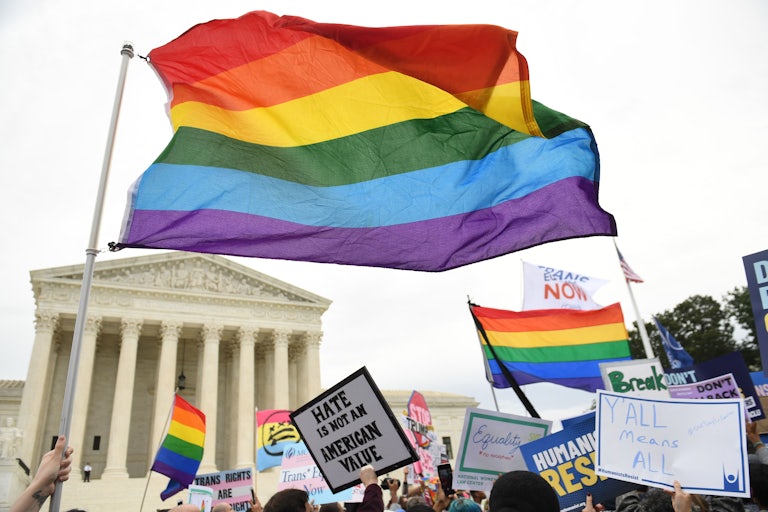
A total of 37 Republicans senators voted Wednesday, in the year 2022, against advancing a bill that would enshrine marriage equality.

The Respect for Marriage Act, which applies to both same-sex and interracial marriage, would require that two people be considered married so long as their marriage was legal in the state in which it was performed. The act also repeals a 1996 law defining marriage as between a man and a woman, which has remained on the books despite being declared unconstitutional by the Supreme Court in 2015.

Many civil rights activists have warned that after the Supreme Court overturned Roe v. Wade in June, same-sex marriage may be next on the chopping block.

The Senate voted 62–37 to advance the bill and is expected to invoke cloture—meaning decide to make the final vote—as soon as Thursday. The final vote could come by the end of the week or the end of the month.

The chamber had added an amendment to the bill clarifying certain protections for religious organizations. The bill needed 60 votes to succeed in the final vote, and with 12 Republicans joining the Democrats in advancing it, the legislation looks likely to pass.

It will then return to the House of Representatives before President Joe Biden can sign it into law.

The act already passed the House over the summer, although 156 voted against it—including a shockingly hypocritical “nay” vote from Representative Glenn Thompson, who attended his son’s same-sex wedding just a week later.

Remember That Time Elon Musk Tried to Start a Comedy Website?

In remembrance of Thud

Taylor Hill/Getty Images

There are various plausible explanations for why Elon Musk acquired Twitter. Maybe, blinded by incompetent ego, Musk believes he alone can make Twitter transcend new boundaries. Perhaps his billionaire lifestyle has led him to desire new stimulation, and that comes in the form of owning one of the largest social media companies in the world.

Or possibly, Musk still holds on to his foregone dreams of being seen as funny, which is why he was so tickled to announce “comedy is now legal on Twitter” after buying it.

In March 2018, Musk tweeted “Thud!” and announced his new “intergalactic media empire,” a satire project he was pursuing with former Onion editors Ben Berkley and Cole Bolton.

The idea behind Thud was to bring satire into the real world, creating ambiguity between reality and parody. This involved the creation of distinct websites promoting items like satirical ancestry tracing services and endlessly shooting guns.

The vision was ambitious given how difficult it would be to generate much advertising revenue on largely distributed content, without even a central homepage for fans to stay plugged in. But the challenge only animated Musk’s imperious pioneering spirit. “It’s pretty obvious that comedy is the next frontier after electric vehicles, space exploration, and brain-computer interfaces,” Musk told The Daily Beast. “Don’t know how anyone’s not seeing this.”

The fate of Thud gave a clue as to how Musk would run Twitter, which is to say, not really at all. The Verge reported that Musk hadn’t planned to make much of a profit with Thud, and he didn’t really establish a plan to guide the project’s progress. He mostly just threw money at it. And when he began to worry that the project’s work could harm SpaceX or Tesla’s reputations, he pulled out, selling the company to Berkley and Bolton in January 2019—months before Thud even launched in March.

Thud continued pushing projects out as long as it could before shutting down in May 2019.

Though Thud’s vision may have been overly ambitious, it wasn’t just the fault of Berkley and Bolton. They had an idea, and acted accordingly with the financial backing of Elon Musk. That the company fizzled out had a lot to do with a bored billionaire who throws money wherever his mind wanders next, with little interest in maintaining a sense of accountability with those ventures.

As The Onion itself suggested years ago:

After Deadly UVA Shooting, Republicans Are Really Worried About … the Pride Flag in Schools

The far-right account Libs of TikTok is at it again.

Paul Chinn/The San Francisco Chronicle/Getty Images

Despite the fact that a University of Virginia student opened fire on his former football teammates over the weekend—the latest in a grim trend of U.S. school shootings—somehow guns are not what Republicans are worried about in schools.

The far-right account Libs of TikTok tweeted a photo Monday of an LGBTQ pride display in a Georgia middle school, along with the fearmongering caption: “Imagine walking into your child’s school and seeing this.”

Social justice activist Matt Bernstein snapped back that there might actually be something a little more frightening.

According to the Gun Violence Archive, there have been at least 115 gun-related incidents that resulted in a minimum of one person dying or being injured at or near schools this year. That includes suicides on campus.

Of those 115 incidents, 12 were mass shootings, which the Gun Violence Archive defines as shootings with at least four victims either injured or killed.

Those mass shootings include the horrific massacre at an elementary school in Uvalde, Texas (22 dead, 17 injured); an attack on a graduation ceremony in Hot Springs, Arkansas (one dead, four injured); another on a high school in St. Louis, Missouri (three dead, four injured); and Sunday’s shooting at UVA.

The shooter, a former football player, opened fire on the team as they were returning from a game. Three players were killed and another two students wounded. The shooter was charged Monday with three counts of second-degree murder and three counts of using a handgun in the commission of a felony.

The U.S. has a long history of gun-related violence, but tighter regulations have been slow to materialize. Congress passed a landmark bipartisan gun-control law over the summer, but it has many opponents, including on Capitol Hill.