Breaking News
Breaking News
from Washington and beyond

“Everything Everywhere All at Once” Director Slams Anti-Drag Bills in Oscars Speech

Daniel Scheinert used his emotional Oscars acceptance speech to defend drag.

Kevin Winter/Getty Images
Daniel Scheinert and Daniel Kwan accept the best director award for “Everything Everywhere All at Once” onstage during the ninety-fifth annual Academy Awards on March 12.

One of the directors of indie breakout film Everything Everywhere All at Once slammed growing Republican attempts to ban drag performances during one of their many acceptance speeches at the Oscars ceremony.

The multiverse-spanning film about martial arts, mental health, and family ties swept the Oscars Sunday night, racking up seven wins that included some historic victories in the best actress and best supporting actor categories.

When accepting the award for best directing, Everything Everywhere All At Once directors Daniel Kwan and Daniel Scheinert (referred to as “the Daniels”) called out the importance of community for creativity.

“We want to dedicate this to the mommies, all the mommies in the world,” Scheinert said. “To our moms, specifically my mom and dad, Ken and Becky. Thank you for not squashing my creativity when I was making really disturbing horror films, or really perverted comedy films, or dressing in drag as a kid, which is a threat to nobody.”

Scheinert’s comment was met with cheers throughout the audience. He was referring to the more than 20 bills attacking public drag performances being considered in state legislatures throughout the United States. Tennessee recently became the first state to pass one of these bills into law.

On a larger scale, Republican-led states are cracking down on LGBTQ rights, from the drag bans to prohibiting gender-affirming care for minors and removing books featuring LGBTQ characters from school libraries.

One of the storylines in Everything Everywhere All at Once is about matriarch Evelyn, played by Michelle Yeoh, coming to terms with her daughter Joy’s (Stephanie Hsu) sexuality.

Kwan also highlighted how important a community is to creating art. “The world is opening up to the fact that genius does not stem from individuals … but rather, genius emerges from the collective,” he said.

“We are all products of our context. We are all descendants of something and someone.”

Texas Man Sues Three Women for $1 Million for Helping His Ex-Wife Get an Abortion

The lawsuit is thought to be the first of its kind since the state’s severe abortion law went into effect last year.

Abortion pills
STORMI GREENER/Star Tribune/Getty Images

A Texas man is seeking more than $1 million in damages by suing three women who helped his ex-wife terminate her pregnancy.

Marcus Silva of Galveston County alleges that, after his then wife learned she was pregnant in July 2022, she conspired with two friends to illegally obtain abortion pills to end the pregnancy, The Texas Tribune reports. Roe v. Wade was overturned in June 2022, triggering Texas’s ban on abortions with narrow exceptions.

Current state law allows any private citizen to sue anyone who “aids or abets” an abortion after about six weeks of pregnancy. Claimants can receive $10,000 in damage for each such case, incentivizing an essential witch hunt by residents to snitch on people who seek abortions. Silva’s lawsuit reportedly is the first filed under the law.

Silva alleges that his then wife had received information about Aid Access, an organization that provides abortion medication by mail in and outside of the United States. The lawsuit cites text messages showing the two women finding access to the medication in Houston, where the women resided.

The lawsuit alleges a third woman delivered the medication to Silva’s wife, and cited text messages indicating that she proceeded to carry out the abortion at home.

The couple, who have two daughters, divorced in February.

Silva’s lawsuit is pursuing a wrongful death case, arguing that the three women who assisted his ex-wife’s self-managed abortion are culpable for murder under state law. Former Texas Solicitor General Jonathan Mitchell, the credited architect of Texas’s restrictive abortion ban, is representing Silva.

Mitchell also wants to add the abortion pill manufacturer as a defendant once it is identified, the Tribune notes. Along with the over $1 million Silva seeks, the lawsuit is pursuing an injunction to stop the defendants from distributing abortion pills in the state.

Read more at The Texas Tribune

House Republicans’ Crazy Caucus Responds to Biden’s Budget With an Utterly Unserious Proposal

Have fun with this one, Speaker McCarthy!

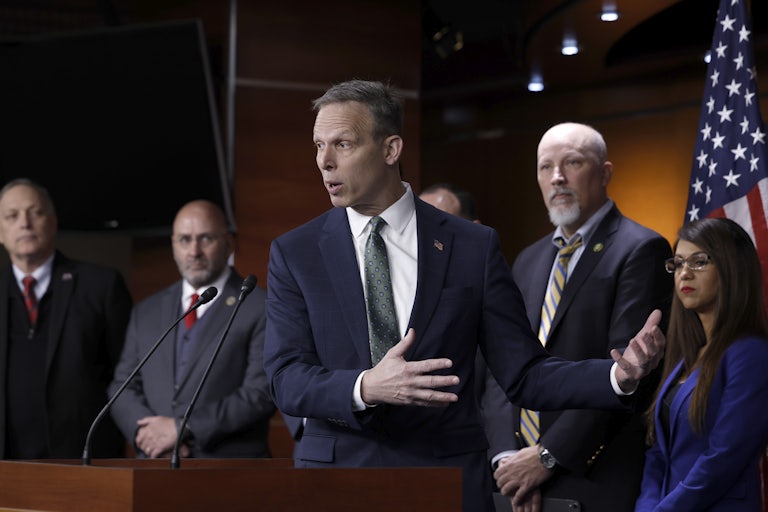
House Freedom Caucus Chairman Rep. Scott Perry
Anna Moneymaker/Getty Images
House Freedom Caucus Chairman Representative Scott Perry at a press conference on March 10

While President Biden’s budget proposal calls for expanding services, from childcare and universal pre-kindergarten to Medicare, an extremist group of House Republicans countered with their bargaining terms for agreeing to raise the debt ceiling: Cut, cut, cut.

The House Freedom Caucus released their demands on Friday, calling to slash Biden’s plan to relieve over 40 million people from student debt burdens, rescind unspent Covid-19 funds, cut climate change funding and $80 billion for IRS enforcement, and cap future spending for the next decade at 2022 levels.

The radical proposal also calls to restore work requirements on welfare programs and restore nondefense discretionary spending to pre-Covid levels. And it ambiguously calls to end “federal regulations and subsidies” in order to increase domestic energy production.

The debt ceiling is the limit to how much the government can borrow to pay for spending that Congress has already approved. Congress has to raise the ceiling by the summer in order to avoid potentially defaulting, which would cause a massive crisis that could upend the global economy. On Friday, Treasury Secretary Janet Yellen warned the House Ways and Means Committee that such a crisis has never happened before and its occurrence would “trigger an economic and financial catastrophe.”

The House Freedom Caucus has outsize influence over the party direction. It forced Kevin McCarthy to concede to an array of demands in exchange for support for his speakership bid. Since then, McCarthy has had to tread somewhat lightly between the ultraright caucus and the rest of his party.

Republicans have been unified in their opposition to a simple raise of the debt ceiling and have demanded that Democrats accept cuts to spending instead, but the party has not come to a consensus around the nature of those cuts.

While McCarthy and most Republicans are happy to cut spending, the House Freedom Caucus’s demands may be a bridge too far for some members, politically. Even if McCarthy and other Republicans somehow bless the House Freedom Caucus’s proposed cuts, the package would likely be dead on arrival in the Democratic-led Senate and would certainly be vetoed by Biden in any case.

The president, after all, has been adamant that he won’t negotiate over the debt ceiling. “I don’t know [if] there’s much to negotiate on,” he said on Friday.

What Is Silicon Valley Bank, and Why Is It Collapsing?

The nation’s sixteenth-largest bank—and a favorite of tech startups—is having The Worst Week Ever.

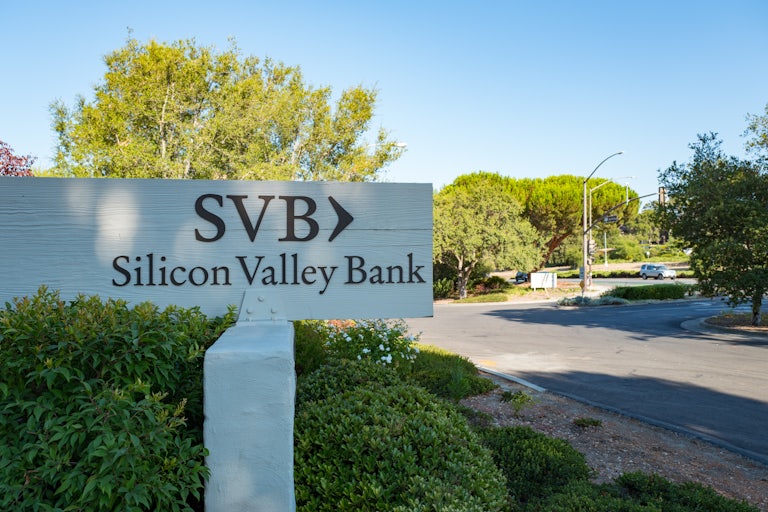
Silicon Valley Bank
Smith Collection/Gado/Getty Images

Silicon Valley Bank, a major lender for tech startups, was shut down Friday by California regulators.

SVB was struggling to raise enough funds to offset a nearly $2 billion loss on bond sales. Customers worried that the bank would collapse entirely and rushed to withdraw their funds, further destabilizing it.

The California Department of Financial Protection and Innovation swooped in and closed the bank Friday morning, putting the Federal Deposit Insurance Corporation, or FDIC, in charge of SVB’s assets.

The FDIC announced that SVB’s branches will reopen Monday, and insured customers will be able to access their deposits then.

Here is a look at what happened to Silicon Valley Bank.

1. What is Silicon Valley Bank?

Silicon Valley Bank is the sixteenth-largest bank in the United States. It primarily operates in Northern California and thus is relatively unknown outside of Silicon Valley.

However, the bank partnered with nearly half of all venture-backed technology and life sciences companies in the U.S. Silicon Valley Bank lent to higher-risk startups that have taken a hit from the Federal Reserve’s high interest rates as well as decreasing venture capital investment.

2. What went wrong?

Silicon Valley Bank announced Wednesday evening that it needed to raise more than $2 billion. It outlined a plan to do so that included selling $1.25 billion in common stock, which are shares that give holders voting rights, and $500 million in convertible preferred shares, which do not give the holder voting rights.

SVB also said that investment firm General Atlantic had agreed to a deal to sell $500 million in common stock.

But SVB’s customers were apparently not appeased by the plan, and the bank’s stock value has plummeted at least 60 percent since then.

3. What caused the collapse?

The Fed has hiked interest rates aggressively over the past year to try to bring down record-high inflation. The higher rates caused venture capital investments to shrink, while the bank’s clients used up cash much faster than before due to price increases. As a result, SVB’s startup customers had far less money to deposit.

To make up for its cash losses, SVB sold $21 billion in securities—but at a $1.8 billion loss, prompting the plan to sell off shares and stabilize itself with the new funds.

Instead, investors panicked and began withdrawing their money from the bank. This created a vicious feedback loop, where the bank appeared increasingly unstable and unsustainable, prompting more customers to take out their money.

4. What was the bank trying to do?

SVB was in talks to sell itself, right up until regulators took over, after its attempts to raise more cash failed. Several large financial institutions were reportedly considering purchasing the bank.

But because so much money was flowing out as customers withdrew their funds, it was difficult to assess SVB’s value anymore, making it less appealing to any potential buyers.

5. Why is this important?

Investors are worried that SVB’s troubles are a bellwether of what is to come for the rest of Silicon Valley, and the financial sector at large. The day before SVB announced its fundraising plan, cryptocurrency lender Silvergate Capital Corp said it would be shutting down, rattling the market. Shares in other banks fell Thursday as concerns over SVB grew.

The high interest rates mean that other banks that attempt to sell off bonds to make fast cash will be forced to do so at a loss, like SVB, according to Bloomberg. If customers get nervous, banks will have to compete harder to keep them, for instance by offering higher interest rates on savings. Doing that will chip away at what the banks are able to earn for themselves.

Things will be particularly difficult for small and midsize banks, Bloomberg noted. Those institutions don’t have as many funding flows, meaning they would have to sell more stock and take more hits.

Trump Will Probably Be Forced to Listen to the Revolting Access Hollywood Tape in Court

A judge has ruled that the offensive recording can be used as evidence in E. Jean Carroll’s defamation trial against him.

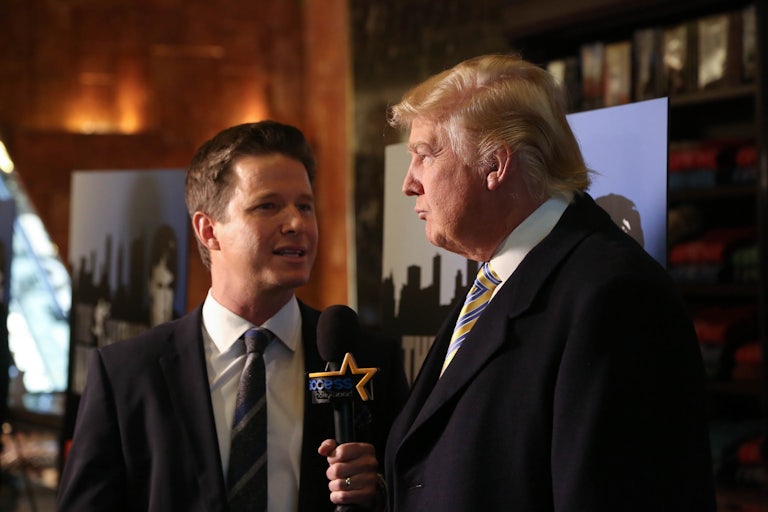
Billy Bush of “Access Hollywood” interviews Trump
Rob Kim/Getty Images
Billy Bush of “Access Hollywood” interviews Trump in 2015.

A federal judge ruled Friday that the infamous Access Hollywood tape in which Donald Trump bragged about groping women without their consent can be used as evidence in the defamation trial brought by a woman accusing him of rape.

Writer E. Jean Carroll is suing Trump for defamation and sexual assault. Trump has rejected the rape allegation and repeatedly argued that the 2005 recording of him was just “locker-room talk,” and thus irrelevant to the case.

But Judge Lewis Kaplan determined otherwise. “In this case, a jury reasonably could find, even from the Access Hollywood tape alone, that Mr. Trump admitted in the Access Hollywood tape that he in fact has had contact with women’s genitalia in the past without their consent, or that he had attempted to do so,” he wrote in his decision.

Kaplan also ruled that testimony from two other women who accuse Trump of sexually assaulting them can be introduced as evidence in the trial. Most of the evidence that Mr. Trump seeks to keep from the trial jury is to the effect that Mr. Trump allegedly has abused or attempted to abuse women other than Ms. Carroll in ways that are comparable to what he allegedly did to Ms. Carroll,” he wrote in his decision. “In other words, Ms. Carroll offers evidence to show that Mr. Trump has a propensity for such behavior.”

Carroll accused Trump in her 2019 memoir of raping her in the Manhattan Bergdorf Goodman department store in the mid-1990s. She has sued him twice for defamation: first in 2019, when he said she made up the rape allegation to promote her book, and again in November for posts he made about her on social media. She isn’t alone: At least 26 women have accused Trump of sexual harassment or assault since the 1970s, all of which he has denied.

The Access Hollywood tape, from a 2005 taping of the show, caught Trump on a hot mic saying, “When you’re a star, they let you do it. You can do anything. Grab ’em by the pussy.” It became public in 2016, just days before his second debate against Democratic presidential nominee Hillary Clinton.

Now, it seems, Trump will soon have to hear the tape replayed to him in court. Kaplan has set the trial date for April 25.