Breaking News
Breaking News
from Washington and beyond

Louisiana Republicans Want to Ban Colleges From Teaching About Racism

Critical race theory fearmongering is working its way into every level of education.

Watchara Phomicinda/Getty Images
A student in California demonstrates against a critical race theory ban. Republicans have advanced such measures across the country, and have targeted colleges and universities as well.

The Louisiana state Republican Party thinks that diversity, equity, and inclusion, or DEI, programs on college campuses are too “divisive” and should be banned.

The Republican State Central Committee, or RSCC, the state GOP’s governing body, unanimously passed a resolution Saturday asking the state legislature to ban DEI offices at all Louisiana colleges and universities, both public and private.

The resolution refers to DEI offices as “bureaucracies” that “operate as divisive ideological commissariats” and are “a threat to academic freedom and academic integrity.” It calls for the state legislature to pass bills that will remove DEI departments from all higher education institutions in Louisiana.

The resolution passed the majority-white body by a voice vote “with no discernible dissent,” according to NOLA.com. The RSCC membership, which includes multiple state senators and representatives, voted on the measure during the state party’s quarterly meeting in Baton Rouge.

The move comes amid a growing push by Republicans to ban “woke ideology” (a.k.a. freedom of thought) in schools. The GOP has spent the past few years working to transform critical race theory, or CRT, into a political boogeyman. CRT is a framework for understanding the legal underpinnings of systemic racism in U.S. society and politics; Republicans have framed an advanced academic field of study as something that’s being used in elementary schools to indoctrinate young children. Slowly but surely, the same rhetoric is being applied to education at all levels.

One of the prime offenders of late has been Florida Governor Ron DeSantis, who has vowed to defund all DEI programs at state universities. He also banned high schools from teaching an A.P. African American studies class, deeming it “woke indoctrination,” and pressured the College Board to gut the course syllabus.

In Texas, the state Senate approved a bill last week that would bar college and university professors from “compelling” students to adopt certain political beliefs. The bill’s sponsor insisted his measure would not censor any topics of discussion, but critics warn the legislation is too vaguely worded and could actually curb difficult, nuanced conversations about issues such as race and gender.

Montana Anti-Drag Bill Would Ban Dolly Parton and Glam Rock

What a way to make a living!

Jeff Kravitz/Getty Images
Country singer Dolly Parton

Montana Republicans are working 9 to 5 to prohibit minors from attending drag shows, but a recent amendment to an anti-drag bill could ban more than they perhaps intended.

House Bill 359 has passed both the state House of Representatives and the Senate Judiciary Committee. It still needs to be voted on by the entire Senate. If it passes, it will ban minors from attending drag performances and ban publicly funded organizations from hosting drag shows. The bill specifically targets Drag Story Hour, an event where drag queens read stories to children.

But the bill was amended Friday to change the definition of what constitutes drag. Under the changes, a drag performance is “an obscene performance that features drag queens, topless dancers, exotic dancers, strippers, or similar entertainers who provide entertainment that appeals to a prurient interest,” meaning of a sexual nature.

A drag queen is “a male or female performer who adopts a flamboyant or parodic feminine persona with glamorous or exaggerated costumes and makeup.” The amendment removes the mention of dressing differently from “the performer’s gender assigned at birth.”

As journalist and transgender rights activist Erin Reed pointed out, this means that the bill could affect glam rock, wrestling, and performances by Dolly Parton. Queen Dolly herself has said she has exaggerated her appearance to be “flashy” and “flamboyant.”

If it becomes law, Montana’s drag ban would categorize any business that serves alcohol and hosts a drag show as a “sexually oriented business.” They could face a fine of up to $10,000 and even lose their liquor license if they repeatedly violate the law.

The measure also bans public schools or publicly funded institutions such as museums and libraries from hosting drag performances, specifically Drag Story Hour. The institution would be fined $5,000 for hosting a show, and the staff member who approved it could lose their teaching or librarian certification.

Critics of Montana’s bill have previously pointed out that the measure would affect theater productions of Mrs. Doubtfire, Rent, or several Shakespeare plays. It could even target Halloween costumes.

Montana is the latest state to advance a (vaguely worded, extreme) measure attacking drag performances, which have become a particular target for the right wing in recent years. In March, Tennessee became the first state to pass a law banning drag performances, but the measure was blocked by a judge before it could go into effect on the grounds that it was overly broad and violated free speech rights.

C-SPAN Cameras Embarrass Kristi Noem After She Says NRA Is More Than Old White Guys

Is this … woke?

Scott Olson/Getty Images

On Friday, scores of Republicans, including every 2024 hopeful, descended upon Indianapolis to chum it up with NRA members in the aftermath of two devastating mass shootings in Kentucky and Tennessee. And the results have been as appallingly wild as one could imagine.

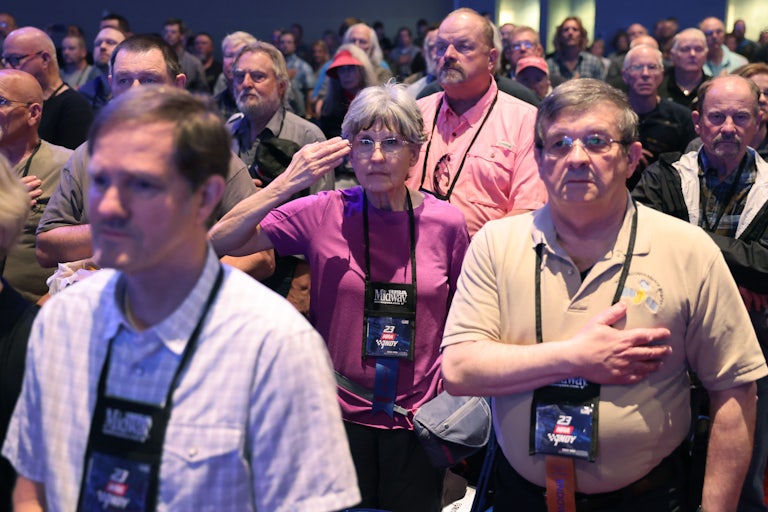
South Dakota Governor Kristi Noem insisted that, contrary to the deluded media’s narratives, the NRA is much more diverse than is given credit. That, indeed, the attendees of the convention represent a mass movement of people of all stripes ready to go to battle to defend their right to own killing machines.

As to the validity of her proposition, well, take a look:

Beyond trying to score woke points about how diverse and inclusive the NRA is, Noem also glowingly discussed how her almost-2-year-old granddaughter apparently “already has a shotgun, and she already has a rifle.”

“Soon, [she’ll] need them,” Noem said about the toddler.

Noem also signed an executive order on stage, one that “blocks state agencies from contracting with large banks that discriminate against firearm-related industries.”

The performance of it all was laughable for a moment, but plainly demoralizing in sum. In the immediate wake of two horrific shootings—among over 150 that have swept the nation already this year—Republicans like Noem put on their shiniest holster belts and did their jig. All to impress one of the entities most responsible for a culture that’s so violently obsessed with guns it cannot fathom another reality.

Republicans may earn an A+ from the NRA; but on the matters of protecting children, of maintaining the sanctity of life, of guaranteeing people the assured liberty to live a healthy and safe life, they are not even on the grading scale.

NRA CEO Says Politicians Who Don’t Like Guns Should Go to Bed Afraid

Just a casual threat from the head of the NRA

Scott Olson/Getty Images
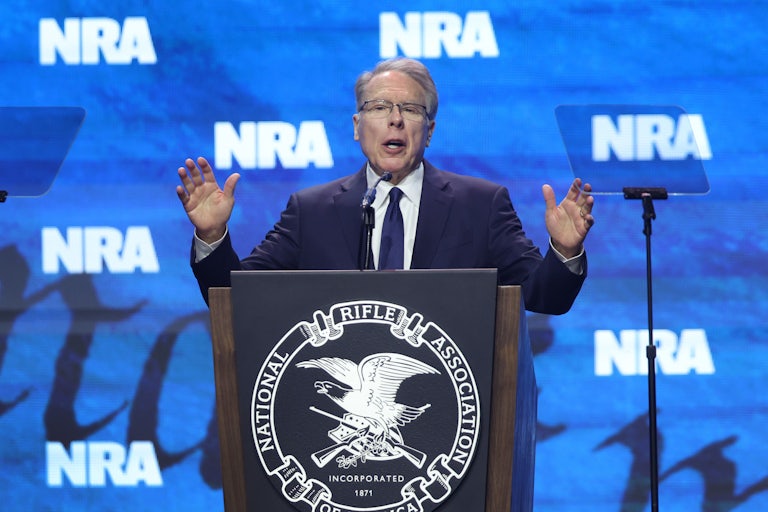
NRA executive vice president and CEO Wayne LaPierre

The NRA’s top executive, Wayne LaPierre, kicked off the organization’s annual convention Friday by threatening pro–gun control politicians.

The National Rifle Association convention is taking place this weekend in Indianapolis, on the anniversary of one of the deadliest mass shootings in the city’s history and on the heels of two major mass shootings in the last month.

“Gun-hating politicians should never go to bed unafraid of what this association and all of our millions of members can do to their political careers,” LaPierre told the crowd, to cheers.

https://twitter.com/atrupar/status/1646941951625666577

LaPierre’s chilling threat shows just how much influence the gun lobby has in politics. No Republicans have challenged his remark so far. Meanwhile, every Republican running or rumored to be running for president is speaking at the convention.

Elsewhere in the country, Republicans seem fully in thrall to gun rights (meaning, unfettered access to firearms). One of the most recent mass shootings was in Nashville, when a shooter killed three children and three adults at a private Christian grade school. Tennessee Governor Bill Lee initially hedged on increasing gun control, but he pulled an about-face earlier this week after thousands of protesters marched to the state Capitol to demand new legislation. Republican House Speaker Cameron Sexton indicated his party was willing to work toward “bipartisan solutions.”

But on Thursday, House Republicans shot down a “red flag” bill that would prevent future shootings like the one at the Covenant School.

Supreme Court Temporarily Pauses Abortion Pill Restrictions

The legal fight on the FDA’s approval of mifepristone continues.

OLIVIER DOULIERY/AFP/Getty Images
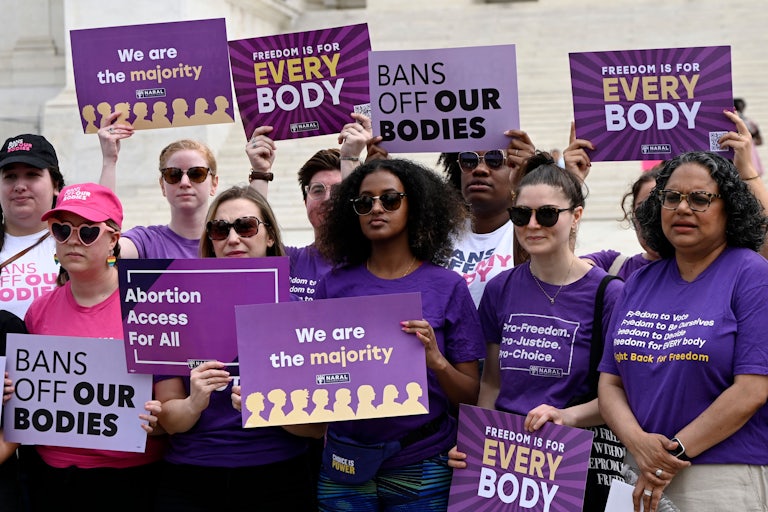
Abortion rights advocates rally outside the U.S. Supreme Court on April 14.

The Supreme Court on Friday temporarily paused lower court rulings that restricted access to the abortion pill mifepristone, which would have dealt a major blow to national abortion access had it gone into effect.

A Texas federal judge ruled last week that mifepristone, one of the medications used to induce an abortion, had been improperly approved by the Food and Drug Administration and should be yanked from the U.S. market. The Department of Justice appealed the decision, but the Fifth Circuit Court only partially stayed the ruling while it considers the full appeal suit. Meanwhile, dueling rulings on the pill made it tricky for the FDA to figure out what exactly it should do next.

The Supreme Court decided to stay the Texas ruling until April 19, meaning mifepristone’s status remains unchanged—for less than a week. Economist reporter Steven Mazie, who covers the Supreme Court, pointed out that this is purely an administrative stay to give the court time to consider the appeal.

Both the Department of Justice and Danco Laboratories, which manufactures mifepristone, had appealed the Fifth Circuit ruling to the Supreme Court. Both received identical responses about the administrative stay. Danco argued that the partial stay would “irreparably injure” its business because it would have to change its drug labels, recertify providers, and get approval for a supplemental new drug application, all processes that could take months.

Danco also pointed out that it could not comply with both the Fifth Circuit ruling and the dueling injunction out of Washington ordering that mifepristone access remain unchanged. The company argued that if the Supreme Court weren’t willing to completely stay the Texas ruling, then the high court should hear the entire case now and make a final decision.

A bigger issue at play, though, is that non-elected judges who do not have medical backgrounds are making decisions about medication. As Rachel Rebouché, the dean of Temple University’s law school, previously told The New Republic, “The question for appellate courts is not just about abortion but about deference to a federal agency’s expertise.”

The Texas ruling “undermined” the FDA’s authority, she said. “To take seriously that it ignored risks, risks unsupported by any credible evidence, suggests questions as to what federal courts might decide about other federal agencies’ decisions.”