Breaking News
Breaking News
from Washington and beyond

The Supreme Court May Preemptively Ban a Federal Wealth Tax

Given the recent ethics questions about justices’ interactions with billionaires, it’s an interesting case to take on.

Robert Alexander/Getty Images

The Supreme Court took up a case on Monday that could make it nearly impossible for Congress to pass a federal wealth tax, giving the justices an opportunity to torpedo a major Democratic policy proposal before it can be enacted. The plaintiffs who brought the case have all but urged the court to do exactly that.

In Moore v. United States, the justices will consider whether a provision of former President Donald Trump’s tax-reform law in 2017 violated the Sixteenth Amendment, which allows Congress to collect federal income taxes. As part of a complex restructuring of federal corporate tax laws, the 2017 law imposed a one-time “mandatory repatriation tax” on American taxpayers who owned more than 10 percent of a foreign corporation.

Charles and Kathleen Moore, the titular plaintiffs, owned 11 percent of an Indian farm-equipment company when the 2017 law went into effect. Thanks to the provision in question, they paid roughly $15,000 in additional taxes the following year. The Moores filed a lawsuit against the federal government and argued that the tax was unconstitutional because their partial ownership of the company did not count as “income” under the Sixteenth Amendment.

The lower courts rejected that argument, however, and ruled that the tax had essentially targeted years of deferred foreign income. That prompted the couple to ask the Supreme Court to intervene. While the case hinges on a tax passed by Trump and a Republican-led Congress, the petition invited the justices to use it to prevent Democrats from imposing a federal wealth tax in the future.

“This is no idle threat,” the Moores said in their petition for review, referring to a federal wealth tax. They cited proposals by the Biden administration and Oregon Senator Ron Wyden to tax billionaires based on their assets, none of which have passed Congress. “There is every reason for the Court to resolve the pivotal constitutional question of realization now, when its judgment can inform lawmakers and stands to head off a major constitutional clash down the line,” the couple told the justices.

In a Wall Street Journal op-ed published in 2021, two of the Moores’ lawyers also declared unambiguously that the lawsuit “stands to slam shut the door on a federal wealth tax like the one Sen. Elizabeth Warren wants to enact.” They made a direct pitch to “the courts” to hear the Moores’ case “now” to make it easier to block a wealth tax in the future.

“If the courts confirm the Sixteenth Amendment’s limited reach now, that would relieve them from having to do so in a politically explosive case directly challenging a wealth tax,” the two lawyers concluded. “The courts would do well to remind Congress at this opportune time that its taxing power is not without limits.”

The Justice Department had urged the justices to reject the case, noting there was no split on the issue in the lower courts and arguing that the Ninth Circuit Court of Appeals had correctly applied the relevant precedents. On the wealth-tax question, the government also pointedly noted that the Supreme Court does not have the constitutional power to issue advisory opinions about hypothetical legislation that has not been enacted into law by Congress.

Debates over a wealth tax’s constitutionality are not new, of course. After Massachusetts Senator Elizabeth Warren made her proposal to enact one as a centerpiece of her 2020 presidential campaign, more than a few legal scholars argued that such a tax would not fall within the Sixteenth Amendment’s parameters. (Warren and other wealth-tax proponents disagree.) If Congress implemented such a tax in the future, a legal challenge to it in the courts would be virtually guaranteed.

The court’s decision to hear the Moores’ case also comes at an awkward time for the justices, to say the least. ProPublica and other major news outlets have reported extensively on Justice Clarence Thomas’s fruitful relationship with Harlan Crow, a billionaire and GOP megadonor, in recent months. Last week, the publication also reported that Justice Samuel Alito went on a free luxury fishing trip in Alaska in 2008 with billionaire Paul Singer, who gave the justice a free ride on his private jet to get there. Both Thomas and Alito have denied that they acted improperly by not disclosing the billionaires’ gifts on their annual financial-disclosure forms; Alito even took to the Wall Street Journal’s op-ed section to defend himself.

Only four votes are needed for the justices to take up a particular case. The court does not disclose how the justices vote on petitions for review, so it is not known if Thomas or Alito voted to hear the Moores’ lawsuit. Americans will get a clearer perspective on their views in the case when the court hears oral arguments in the fall term. As the justices wrestle with rapidly declining public esteem and multiple ethics controversies, taking up a case that could protect billionaires from wealth taxes before Congress can even pass them is an interesting choice.
Guess Who’s Targeted in Ron DeSantis’s First Major Policy Address?

LGBTQ people? Authors of banned books? Those seeking abortions? Close, but not quite.

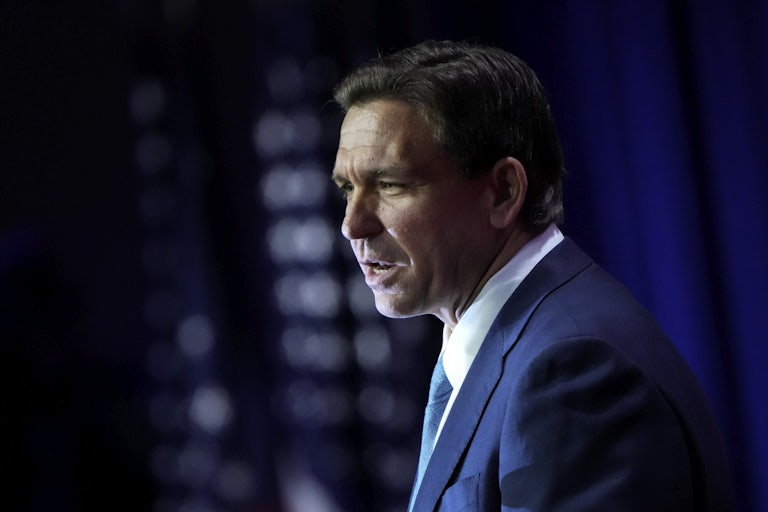
Ron DeSantis
Drew Angerer/Getty Images

Florida GOP Governor Ron DeSantis gave his first major policy address as a presidential candidate on Monday. The economy? Tax cuts and deregulation? How to revive manufacturing? How we’re all part of one glorious shining city on a hill?

You haven’t been paying much attention to the governor if you thought any of those things. The nominees for topic of his first presidential policy address were, of course, LGBTQ people, librarians, teachers, those seeking and providing abortions; but the lucky winner this morning? Undocumented immigrants.

In a nutshell, DeSantis is promising to be worse than Donald Trump on immigration.

According to CNN, DeSantis, who spoke at a Veterans of Foreign Wars post in Eagle Pass, Texas, vowed to dispatch the military to the border and commence a “mass detention and deportation” (CNN’s words) of undocumented immigrants. He also pledged to end birthright citizenship and, yes, Build. The. Wall.

“For decades, leaders from both parties have produced empty promises on border security, and now it is time to act to stop the invasion once and for all,” DeSantis said. “As president, I will declare a national emergency on day one and will not rest until we build the wall, shut down illegal entry, and win the war against the drug cartels. No excuses. We will get it done.”

His camp also took one of its first shots at Trump over the weekend by tweeting: “Trump ran on this same promise in 2016, but ended up deporting fewer illegals than Barack Obama.”

As governor, DeSantis has banned sanctuary cities, sent Florida law enforcement and National Guard officers to the Texas border, and cracked down on workforce immigration violations. And of course there were his famous stunts where he sent undocumented immigrants by plane to Martha’s Vineyard and Los Angeles to troll the libs.

So this will be the heart of DeSantis’s campaign, although presumably LGBTQ people and librarians and abortion-seekers will all have their day in the Sunshine State sun, as it were. That is, assuming his campaign lasts long enough. He’s slipping in the polls against Trump, and Politico posted a piece Monday morning about a serious political etiquette gaffe he pulled in New Hampshire that offended those notoriously delicate Granite State “how things are done” sensibilities (he scheduled an event there at the same time as a previously scheduled Trump event, in front of some kind of important Republican women’s group).

So maybe the people he’s targeting don’t need to be so scared.

Supreme Court Paves Way for New Louisiana Congressional Map

If the map is redrawn to include a new majority-Black district, it could help Democrats retake the House.

Drew Angerer/Getty Images
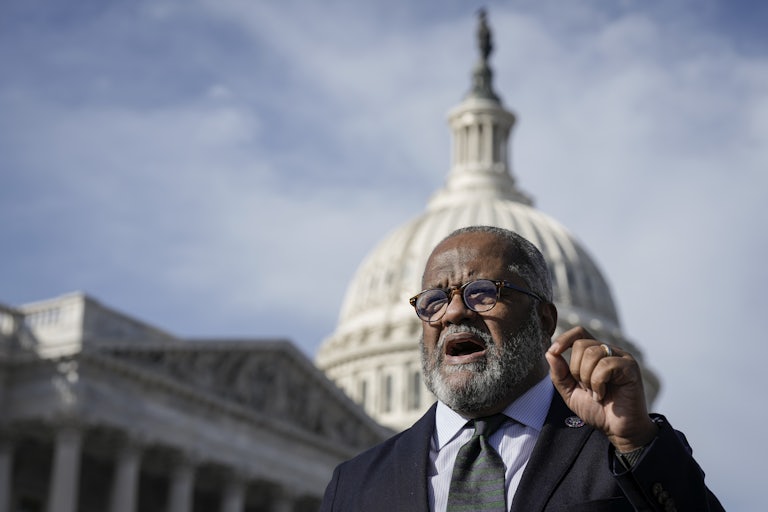
Representative Troy Carter of Louisiana

The Supreme Court on Monday lifted a stay on a lower court’s ruling requiring the Louisiana state legislature to add another majority-Black congressional district ahead of the 2024 elections. The move came after a surprise decision earlier this month ordering Alabama to redraw its congressional districts, with two conservative justices joining all three liberal justices in ruling in favor of the state’s Black voters.

The high court’s unsigned order sent the case back to the U.S. Fifth Circuit Court of Appeals, requiring the issue to be resolved “in advance of the 2024 congressional elections in Louisiana.” The Republican-led state legislature had passed a congressional map last year that made only one out of Louisiana’s six congressional districts majority Black, even though roughly one-third of the state’s population is African American. Representative Troy Carter, who is Black, is the only Democrat in the Louisiana delegation.

“This decision shows that in a healthy democracy fair and equitable representation matters, whether to the people of Louisiana or anywhere else in the world,” Carter wrote on Twitter on Monday.

Opponents of the congressional maps in Alabama and Louisiana argued that the districts diluted Black voters’ strength. The Alabama decision could also affect similar court challenges in South Carolina and Georgia. New majority-Black districts likely give Democrats a better chance of retaking the House. In the wake of the Alabama decision, the Cook Political Report shifted five of its House ratings in Democrats’ direction, with analyst Dave Wasserman predicting that “it’s very likely two formerly Solid R seats will end up in Solid D.”

One potential casualty: Louisiana Representative Garret Graves, whose seat the Cook Political Report had already moved from “Solid R” to “Toss Up” earlier this month. Graves is a key ally of Speaker Kevin McCarthy, and was one of the House Republicans who negotiated the debt limit deal with the White House. The Supreme Court order thus could have far-reaching effects not only for the makeup of the House but for the political dynamics within the House Republican conference.

Sarah McBride Aims to Be First Openly Trans Member of Congress

The Democratic lawmaker from Delaware formally announced her bid for the House of Representatives.

Sarah McBride
Rich Fury/Getty Images for Human Rights Campaign
Sarah McBride

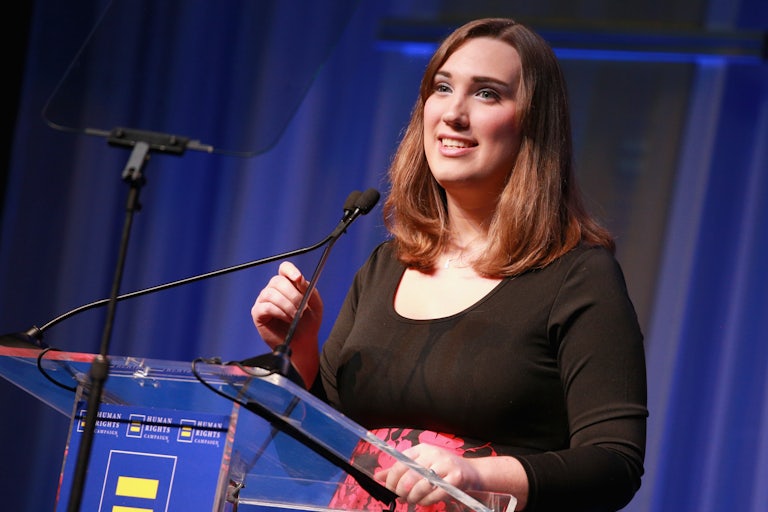
Delaware state Senator Sarah McBride on Monday announced she is running for the House of Representatives. If she wins the election next November, she would become the first openly transgender member of Congress, taking office at a time of rapidly escalating attacks on trans and LGBTQ people.

In a campaign video posted to Twitter, McBride highlighted the right’s attacks on teachers and education, the high cost of prescription drugs, and her own work passing paid family and medical leave as a state senator in Delaware.

She told The New York Times she is also looking to use her campaign to talk about gun safety, reproductive rights, affordable early childhood education, and elder care.

McBride is running to replace Representative Lisa Blunt Rochester in Delaware’s at-large House seat. Blunt Rochester, the first woman and Black representative in the state, is leaving the seat to run for Senate and replace Democratic Senator Tom Carper, who is retiring.

McBride, 32, has broken political barriers before. She was the first openly trans woman to intern at the White House in 2012, the first openly trans person to speak at the Democratic National Convention in 2016, and she became the highest elected trans politician in the country when she won her state Senate seat in 2020.

“I think there was a false sense of security that a lot of people had over the last decade. There was a sense that if we simply worked for it, change was inevitable. But the reality is that inevitably is the exception in our nation’s history,” McBride told The 19th about her decision to run for Congress.

McBride’s run comes as the rights of LGBTQ and trans people in America are under renewed attack. The Human Rights Campaign found that the 2023 legislative session was the worst year on record for anti-LGBTQ legislation, and more than 75 anti-LGBTQ bills have already been signed into law. Nearly half of the bills introduced this year target trans people in particular, including bathroom bans, gender-affirming care bans, and transgender sports bans.

Still, McBride told The 19th, she finds hope in the fact that previous generations—including LGBTQ Americans—overcame the seemingly insurmountable odds before them.

“From Stonewall to the steps of the Supreme Court, it has always been in our biggest challenges that we take our most significant steps forward,” she said. “And I truly believe that if we summon our hope, and we persevere, that we can ensure that the story of this moment will not be the story of bigotry and backlash, but of progress and pride.”

Greg Abbott Wants More Texans to Be Mauled by Vicious Dogs

Gov’s veto spree included a bill that would have increased penalties for owners of attack dogs.

Brandon Bell/Getty Images
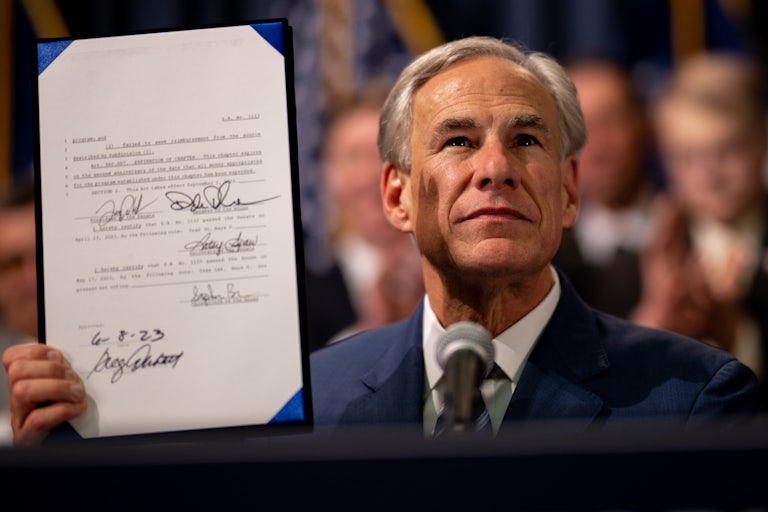
Texas Governor Greg Abbott

We already know that Texas Governor Greg Abbott wants people to be able to make citizens’ arrests of anyone who aids and abets the act of seeking an abortion. You can’t do that in Texas. But if you own a pit bull that tears into a human being’s flesh, all is cool.

According to the San Antonio Report, the GOP governor went on a veto spree last weekend, in part because he was miffed that a property tax relief bill he was pushing failed to pass. He vetoed 77 bills—among them, the Ramon Najera Act, named after an 81-year-old man who was mauled to death in San Antonio in February by two pit bull mixes. Evidently, according to the Report, people letting their vicious dogs roam neighborhoods unleashed is kind of a thing in San Antone.

The bill was sponsored by Democrats, so it probably never had much of a chance. Abbott argued that existing local laws were sufficient, and to be fair, the owners of the killer dogs in question were jailed. Still, it’s funny to hear a very conservative Republican governor complain about the “overcriminalization” of any illegal activity. Proponents of the law argue that the loose dogs are a genuine menace and a stronger message needs to be sent to the owners.

People killed by violent dogs aren’t the only humans who were on the business end of Abbott’s version of compassion in the last few days. He also rescinded two local laws in Austin and Dallas that provided outside workers a right to a certain amount of shade and water breaks.

He did so in the midst of a massive heat wave.

Oh—and a few days after Abbott acted, a 35-year-old lineman in the town of Marshall died after experiencing symptoms of heat illness. The heat index was 100 degrees while the man was working.

These moves come two weeks after Abbott sent a busload of migrants to Los Angeles in his latest let’s-use-human-beings-as-props stunt.

So now we know what you really don’t want to be in Greg Abbott’s paradise: an undocumented immigrant who works outside and who attracts the attention of an unleashed pit bull.