Breaking News
Breaking News
from Washington and beyond

McCarthy Compares Biden to Nixon (!) in Doubling Down on Impeachment Call

One of these things is not like the other.

House Speaker Kevin McCarthy speaks at a podium
Anna Moneymaker/Getty Images
House Speaker Kevin McCarthy

Republicans have accused Joe Biden of corruption for months, despite having yet to produce a shred of evidence. But House Speaker Kevin McCarthy just escalated the bogus investigation by putting impeachment on the table.

And his justification? Biden is basically like Richard Nixon.

McCarthy accused the Biden administration of using “government much like Richard Nixon used [it] by denying us to get the information that we need.”

The GOP says Biden and his son Hunter are guilty of influence peddling and accepting bribes—but again, there has been zero proof of this. Unable to come up with any evidence, Republicans also accuse the president of weaponizing federal agencies to cover up his family’s crimes.

“All I’m saying is … where’s the truth? You’ve got to get to the bottom of the truth,” McCarthy told reporters Tuesday. “And the only way Congress can do that is go to impeachment inquiry that gives Republicans and Democrats the ability to get all the information.”

When asked if he was caving to the far-right wing of the GOP by entertaining talk of impeachment, McCarthy insisted, “I have nothing to do about who in the party [sic]. This is about America.”

Other Republicans have tried to impeach Biden before. Both Marjorie Taylor Greene and Lauren Boebert introduced articles of impeachment over Biden’s handling of immigration at the U.S.-Mexico border—a sore point that led to Greene calling Boebert a “little bitch” on the House floor.

When Boebert introduced her articles in June, McCarthy called the move premature and urged his fellow Republicans to oppose it. He reportedly told lawmakers that impeachment ”strengthens Biden and weakens us.”

But it seems, now, the House majority leader has simply fallen in line with the rest of his party.
DeSantis Campaign Unemployment Rate Skyrockets More Than 33 Percent

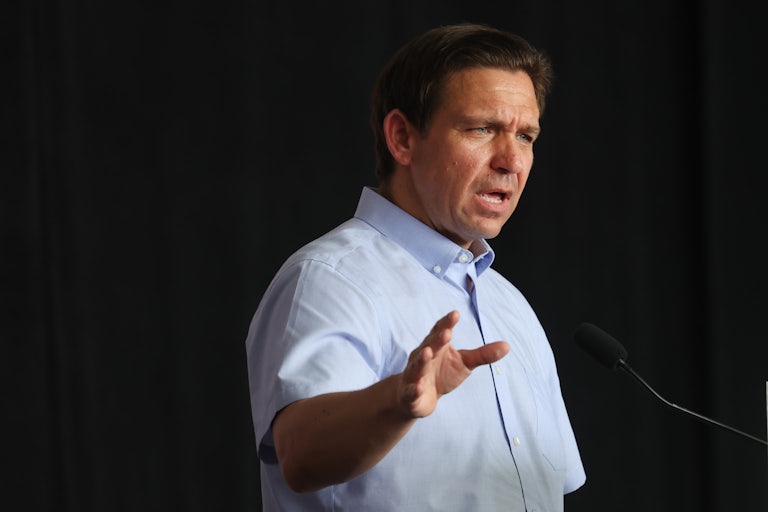
Ron DeSantis has laid off more than a third of his campaign staff, as he struggles to make headway in the race.

Ron DeSantis
Scott Olson/Getty Images
Ron DeSantis

Things are not looking good for Team Ron DeSantis.

New reports indicate that the unemployment rate within the DeSantis campaign has skyrocketed by roughly 40 percent. Thirty-eight people, across different departments, have been let go, Politico reported Monday, as DeSantis tries to reboot an effort that has struggled desperately to make headway against his chief rival, former President Donald Trump, in the polls.

Those who’ve been sent their walking papers include the two senior-level advisers who left the campaign earlier this month, as well as roughly 10 other individuals cut from the event-planning team.

The DeSantis campaign had swelled to more than 90 staff members in its first two months—meaning these recent cuts amount to more than a third of the total head count.

The layoffs come as the campaign said it would be rebooting to a “leaner-meaner” operation to right its flailing takeoff.

DeSantis had originally sought to position himself as the most viable Republican alternative who could take on Donald Trump in 2024, even as the field of candidates kept growing.

But his numbers just haven’t matched the claim that he offered the GOP base a younger and more electable Trump. Additionally, the DeSantis team has struggled to meet its fundraising expectations. Though the campaign raised $20 million in the last quarter, $3 million of that was dedicated for the general election, and small-donor Republicans just aren’t contributing very much to his coffers. The campaign has also burned through nearly 40 percent of the amount it had previously raised, to the tune of about $1.5 million per week.

There’s not much to show for all that money: DeSantis is still nowhere close to catching up to Trump in the polls.

A Monmouth University poll released Tuesday found that nearly seven in 10 Republican voters say Trump is either “definitely” (45 percent) or “probably” (24 percent) the strongest Republican candidate against President Joe Biden. And nearly half of Republican voters say DeSantis would be a weaker candidate than Trump. 

Even Trump’s two indictments (which don’t include two more that are potentially on the way) aren’t enough to make DeSantis rise in the polls.

Meanwhile, the DeSantis campaign keeps creating controversies for itself. Just this past weekend, a top campaign staffer reshared a video with an image of DeSantis, a Nazi symbol interposed over the Florida flag, and soldiers on the march. Earlier this month, the campaign created another bizarre and rabidly homophobic video—then tried to plant it in a fan account to make it look like it came from the outside.

And last week, the Florida governor defended his state’s right to require middle schools to teach that slavery was of “personal benefit” to some enslaved people.

When he’s not attacking public schools, LGBTQ people, or abortion rights, the Florida governor spends his time trying to find some other way to wage his war on woke.  But none of this has paid off: not with donors, not in poll numbers. And now, his own campaign has finally been forced to reckon with it.

Ohio Republicans’ Rotten Anti-Abortion Plan Just Suffered a Major Setback

Abortion rights advocates have officially made it on the ballot this November.

Sarah L. Voisin/The Washington Post/Getty Images
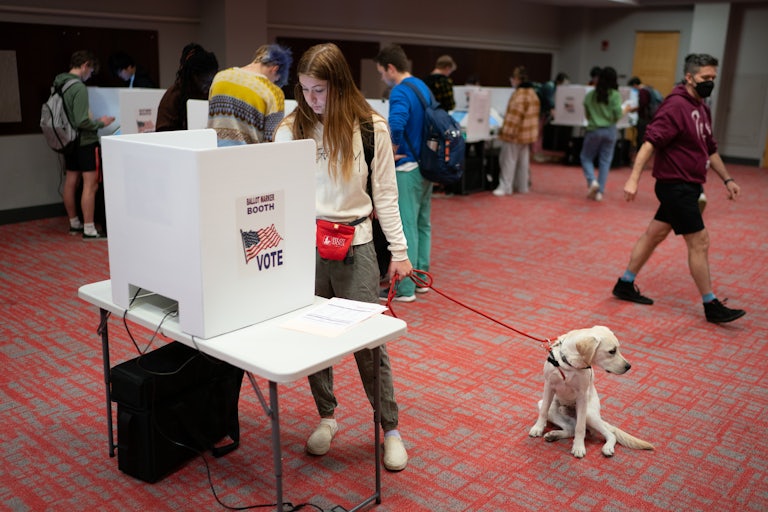
A student voting in Columbus, Ohio

Abortion rights advocates in Ohio have officially secured enough signatures to put an amendment protecting abortion on the ballot in November.

Republicans are doing everything they can to prevent Ohioans from enshrining the right to abortion in the state constitution, but reproductive rights advocates cleared one hurdle on Tuesday. They were required to submit 413,487 signatures from 44 counties to ensure the measure would be on the ballot.

They officially submitted 495,938 signatures from 55 counties, certifying that the measure will go up for a vote in November.

Abortion is currently legal in Ohio until about 22 weeks, although not for lack of GOP efforts. After Roe v. Wade was overturned, a trigger law went into effect in Ohio that banned abortion after six weeks, before people even know they are pregnant. That law has been temporarily blocked.

The constitutional amendment would allow people to decide for themselves about all reproductive health, including contraception, fertility treatments, continuing or terminating a pregnancy, and miscarriage treatment. The state could only restrict abortion access after a doctor determines the fetus is viable, or could survive outside the uterus. And even then, abortions can be performed if the patient’s health or life is at risk.

Ohio currently requires only a simple majority of votes to amend the constitution. But Republicans have decided to pull out all the stops in their attempt to block the abortion amendment. So first, Ohioans will vote in August on a measure that would raise the threshold for constitutional amendments to a 60 percent vote.

Although GOP lawmakers insist the move is not about abortion, Secretary of State Frank LaRose gave the game away in June, saying, “This is 100 percent about keeping a radical pro-abortion amendment out of our constitution.”

But all their work may still fall short. A USA Today Network/Suffolk University poll released last week found that only 26 percent of Ohio voters support increasing the amount of votes needed to amend the constitution, while 57 percent oppose it.

Another poll, released Monday by the same organizations, found that 58 percent of Ohioans support the amendment to guarantee access to reproductive services, while just 32 percent oppose it. The support crosses party lines, with a third of Republicans backing the amendment, as well as 85 percent of independent women—a crucial demographic.

This is unsurprising for anyone who has actually been paying attention. Every time abortion rights are on the ballot, people vote to increase protections, not take them away. And despite Republicans’ best efforts, abortion rights keep winning.

UPS and Teamsters Reach “Most Historic” Labor Deal Ever, Likely Averting Strike

“I have never seen a national contract that levels the playing field for workers so dramatically as this one.”

TIMOTHY A. CLARY/AFP/Getty Images

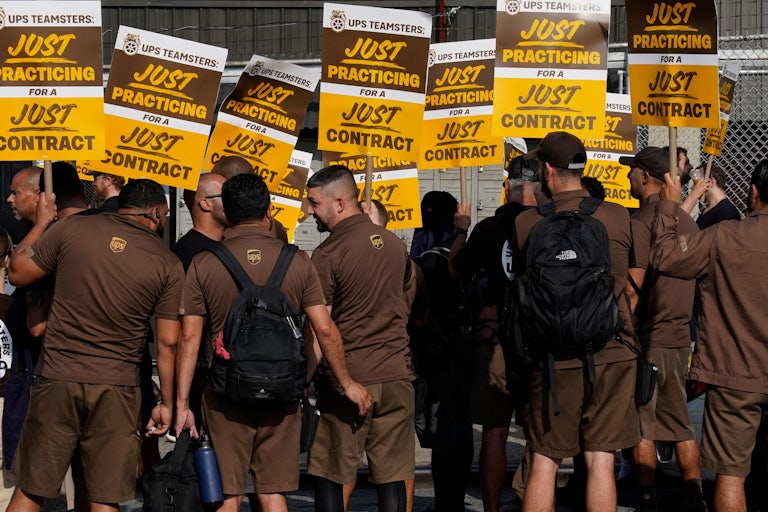
The Teamsters union reached a “historic” tentative contract agreement on behalf of UPS on Tuesday, securing major wins for workers and likely averting a strike at the last minute that would have crippled shipping nationwide.

Negotiations for UPS workers broke down earlier this month, and a strike looked increasingly likely with every passing day. But Teamsters resumed talks Tuesday and managed to get “the most historic tentative agreement for workers in the history of UPS,” the union said in an announcement. The new benefits and protections will affect more than 340,000 UPS employees.

“In my more than 40 years in Louisville representing members … I have never seen a national contract that levels the playing field for workers so dramatically as this one,” said Fred Zuckerman, the Teamsters’ general secretary-treasurer,  in the statement.

The new benefits include massive wage increases that will see full-time workers earn up to $49 per hour (the highest salary for delivery drivers in the country) and part-time workers earn up to $23 per hour. The contract also eliminates a two-tier wage system that caused anger over pay inequalities.

The agreement improves health and safety conditions, including improved air conditioning in the cabs and ventilation in the cargo hold. (Recall that just last month, a postal worker in Texas collapsed and died while working, due to the excessive heat.) Employees will get Martin Luther King Jr. Day off for the first time, and they can no longer be forced to work overtime on their days off. The contract will also create thousands of new jobs so part-time workers can transition to full-time.

The union will vote to ratify the deal, likely next week. Until they approve it, the threat of a strike still looms in the background. If UPS goes on strike, it will be the largest single-employer strike in U.S. history. Experts warn that a 10-day strike could cost the economy $7 billion, and the shifted flow of packages would be more than other carriers such as FedEx and the U.S. postal service can manage.

But leaders are confident that the deal delivers for their members.

“Rank-and-file UPS Teamsters sacrificed everything to get this country through a pandemic and enabled UPS to reap record-setting profits,” union president Sean O’Brien said in the statement. “The union went into this fight committed to winning for our members. We demanded the best contract in the history of UPS, and we got it.

“We’ve changed the game. This contract sets a new standard in the labor movement and raises the bar for all workers.”

Vaccine Politics Linked to Excess Republican Deaths During Covid, Study Finds

“It’s one of the most telling metrics I’ve seen in how the politicization of the pandemic has played out in the real world.”

Eric Lee for The Washington Post/Getty Images
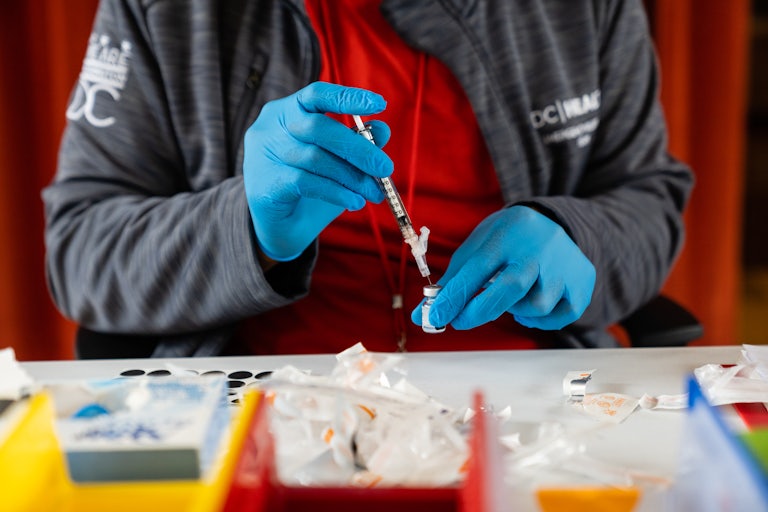
A lead nurse prepares a syringe with a Covid-19 vaccine in Washington, D.C.

Political divisions over vaccines may have caused “thousands” of unnecessary deaths during the Covid-19 pandemic, according to a new study, which found that registered Republicans in Ohio and Florida had a significantly higher excess death rate than Democrats—after vaccines became widely available.

Yale University researchers examined 538,159 deaths in people aged 25 and up in Florida and Ohio from March 2020 to December 2021. The study, published in the JAMA International Medicine journal on Monday, found that there was no significant difference in excess death rates between Republicans and Democrats until April 2021.

But starting on May 1, 2021, after vaccines were available to all adults, the excess death rate for Republican voters spiked dramatically, becoming 43 percent higher than the excess death rate for Democrats. The study found that differences in excess death rate were concentrated in counties with lower vaccination rates, and particularly among Ohio voters. (“Excess death” refers to the increase in the number of deaths compared to the pre-pandemic death rate.)

The differences in excess mortality by political party affiliation after Covid-19 vaccines were available to all adults suggest that differences in vaccination attitudes and reported uptake between Republican and Democratic voters may have been a factor in the severity and trajectory of the pandemic in the U.S.,” the study said.

One of the researchers, Jacob Wallace, said the report shows a “very sad story.”

“It’s possible that thousands of deaths … could have been averted,” said Wallace, an assistant professor of public health at Yale.

The researchers warned that there could easily be other factors than political affiliation that contributed to the excess mortality rate, such as underlying medical conditions, socioeconomic status, or health insurance coverage. They noted that they had to use county vaccination status, not individual vaccination status, and they only had data from Florida and Ohio that did not include cause of death. “Hence, our results may not generalize to other states,” they said.

But their work is just the latest study to indicate that Republicans may have caused preventable deaths through their irresponsible messaging on the dangers of vaccines or the inefficacy of public health restrictions such as face masks and social distancing. A nationwide survey published in March by the University of South Florida found that only 49 percent of Republicans were confident that Covid vaccines are safe. In comparison, 88 percent of Democrats trusted the shots.

“It’s one of the most telling metrics I’ve seen in how the politicization of the pandemic has played out in the real world,” USF School of Public Affairs professor Stephen Neely, who conducted the March poll, told The Washington Post of the new study published Monday.

And the partisan vaccine skepticism isn’t going anywhere. Robert Kennedy Jr., a prominent anti-vaxxer, is running for president, and he’s fairly popular among Republicans. But what’s perhaps most troubling is that Covid vaccine divisions could affect vaccination rates for children, the people who need that protection the most.

“All of us in vaccine policy are very concerned that the controversy and contentious atmosphere that has surrounded Covid vaccines—much of it along party lines—is going to have negative consequences for pediatric vaccination … in the years ahead,” said Jason Schwartz, another researcher on the Yale study. “We’re already seeing indications to that effect.”