Breaking News
Breaking News
from Washington and beyond

Why Is Dianne Feinstein Still in the Senate?

In a new conversation, the California senator seemed completely unaware that she wasn’t in Washington, D.C., for over two months.

California Senator Dianne Feinstein
Drew Angerer/Getty Images

Dianne Feinstein seems to think she was never on a leave of absence from her job.

On Tuesday, Senator Dianne Feinstein, flanked by a team of staffers, fielded some questions from the press after voting on the Senate floor, reports Slate.

She reported that she was “feeling fine,” though suffering from a nondescript “problem with the leg.”

She was then asked by a reporter what the response from her colleagues has been like since her return back to the Hill.

“No, I haven’t been gone,” Feinstein responded. “You should follow the—I haven’t been gone. I’ve been working,” she continued.

She was then asked if she meant she had been working from home.

“No, I’ve been here. I’ve been voting,” she insisted. “Please. You either know or don’t know.”

The comment is curious given the gravity of how consequential Feinstein’s absence—and indeed, lack of voting—has been over the past few months. Feinstein has been absent from the Senate since February 27, having been hospitalized in early March for a case of shingles.

During that time, Democrats were unable to advance court nominees. Her absence has been used by senators like Dick Durbin as justification for why Supreme Court ethics legislation cannot be advanced. Republicans, aided by weak politicians like Joe Manchin, have been able to vote to pass inane resolutions like overturning an Environmental Protection Agency rule to reduce truck pollution.

When Feinstein was asked Tuesday about members who have called for her resignation, she deflected and was apparently wheeled away.

Slate asked Senator Sheldon Whitehouse about whether there was any optimism for Feinstein to return to being a fully functioning, contributing member of the Judiciary Committee.

“I’m gonna leave that to the medics,” he responded.
Here Are the Democrats Who Voted to Let D.C. Cops Use Neck Restraints and Hide Body Cams

A handful of Democratic senators voted with Republicans to reject Washington, D.C.’s police reforms, spitting in the face of its right to self-government.

Kevin Dietsch/Getty Images

On Tuesday, eight Democrats and independents joined Senate Republicans in voting to overturn Washington, D.C.’s police reforms.

Senators Joe Manchin, Jon Tester, Jeanne Shaheen, Catherine Cortez Masto, Maggie Hassan, Jacky Rosen, Angus King, and Kyrsten Sinema all joined in the effort to overrule time and work that residents and officials have invested to make their city safer.

The new resolution to overturn D.C.’s local rule was introduced by Republicans in March, just hours after Biden and Congress killed a different bill reforming D.C.’s criminal code (that, more than anything else, updated codes that hadn’t been dusted off in over 100 years).

The resolution aims to overturn an array of reforms made in the aftermath of a string of brutal police killings nationwide. Among the reforms are provisions outlawing the use of neck restraints, like that used by Minneapolis Police Officer Derek Chauvin to kill George Floyd in May 2020.

D.C.’s reforms also call to make body-camera footage of officer-caused deaths, or serious uses of officer force, more accessible to the public. They moreover expand membership and inclusion on governing bodies like the Police Complaints Board and Use of Force Review Board—small asks given how often police departments get away with sweeping misconduct and outright violence under the rug.

The reforms also ban employment of new officers if they were previously determined by other agencies to have been responsible for serious misconduct, or if they were forced out of previous jobs for “disciplinary reasons.” Nothing radical about having baseline standards for what type of person is allowed to be empowered to enforce the law; whatever happened to “with great power comes great responsibility?”

Biden can—and is expected to—veto the Senate vote. Consequently, some shrewd pundits have characterized it all as a “messaging vote,” a low-stakes vote that allows conservative senators to say, “Look, we didn’t support this radical bill,” come election time. After all, Biden will veto it, so what does it matter anyway?

But what is the “message” to be had here, really? What does it tell voters that eight Democratic caucus members joined this farce to overturn D.C.’s democratic will? What does it tell voters that these so-called Democrats found it prudent to bend the knee to bad-faith right-wing attempts to obstruct even moderate checks on unaccountable police forces? If politics is meant to be about making an argument, about convincing people and rallying them to your side, the only message communicated by this cowardly vote is that D.C.’s autonomy is indeed up for debate, that having baseline standards for what the police can and can’t do to the citizenry is somehow an out-of-field demand, and that you as an elected official lack the conviction to stand for anything at all.

So, sure, clever punditry class: Call it a “messaging vote.” Meanwhile, as Democrats continue to allow these right-wing attacks to appear just part of reasonable debate, actual reforms will remain as moderate as this D.C. police reform actually was. In the eyes of the media and political class, the goalposts will remain the same, and the bounds of what change we can actually strive for will continue to narrow. And all of it because a handful of feckless Democrats are allowed, even encouraged, to cower and join out-of-touch attacks on even modest changes to our violent, unaccountable system of justice and power.

We Officially Have a Resolution to Expel George Santos

Democrats are forcing a vote on the New York representative who made up basically his entire life story and was charged on 13 criminal counts.

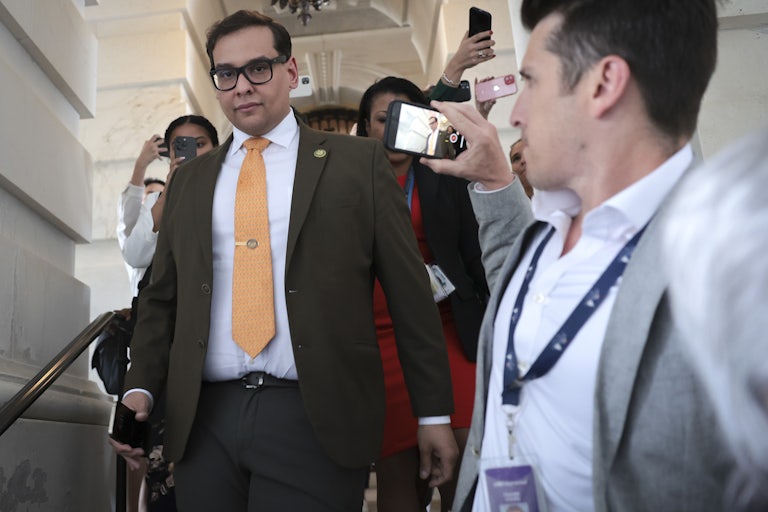
New York Representative George Santos walks down the stairs as reporters surround him
Win McNamee/Getty Images

Democratic Representative Robert Garcia introduced a measure Tuesday to force a floor vote on whether to expel serial fabulist George Santos from the House of Representatives.

Santos was charged in federal court last week with 13 counts of various forms of financial fraud. He has pleaded not guilty to all of them. The embattled New York congressman is still facing investigations by local and state authorities. He also confessed last week to stealing checks in Brazil 15 years ago, in return for prosecutors dropping the criminal case against him.

“George Santos is a fraud and a liar, and he needs to be expelled by the House,” Garcia said in a statement Tuesday. “News that federal prosecutors are filing 13 criminal charges against George Santos should have been the final straw for Kevin McCarthy, but he refuses to act. Republicans now have a chance to demonstrate to Americans that an admitted criminal should not serve in the House of Representatives.”

Garcia’s motion is privileged, so House Republicans must schedule a vote on the resolution by Thursday. They have not given any indication yet of when the vote will take place. The resolution will need a two-thirds majority to pass.

Santos is barely six months into his first congressional term, and he is known only for scandal. He appears to have fabricated the bulk of his professional and educational resume. He claimed his mother survived 9/11 (she was not even in the country) and similarly lied that his grandparents fled the Holocaust and four of his employees were killed in the Pulse nightclub shooting. Last week, he was charged for money laundering, wire fraud, and theft of public funds, including claiming Covid-19 unemployment fraud when he wasn’t unemployed.

The resolution to expel him is unlikely to pass, even though the vast majority of his constituents want him gone. Despite a federal indictment for Santos, most Republicans still aren’t calling for his removal from Congress. In fact, Santos has continued to vote on bills and maintains that he will run for reelection.

House Speaker Kevin McCarthy has so far resisted condemning Santos. The strongest rebuke McCarthy has offered yet was saying last week that he wouldn’t support the freshman congressman’s reelection campaign. But McCarthy and other Republican leaders have avoided saying whether they will force Santos out of Congress, for a very simple reason: They need him.

Republicans hold the House majority by the thinnest of margins, and McCarthy appears to be struggling to get his party to present a united front. He can’t afford to lose a single vote, so if Santos is out, then McCarthy will be in trouble.

John Fetterman Asks Bank Execs if CEOs Who Crash Banks Should Get Work Requirements

The Pennsylvania senator challenged former executives from Silicon Valley Bank and Signature Bank about the bank collapses.

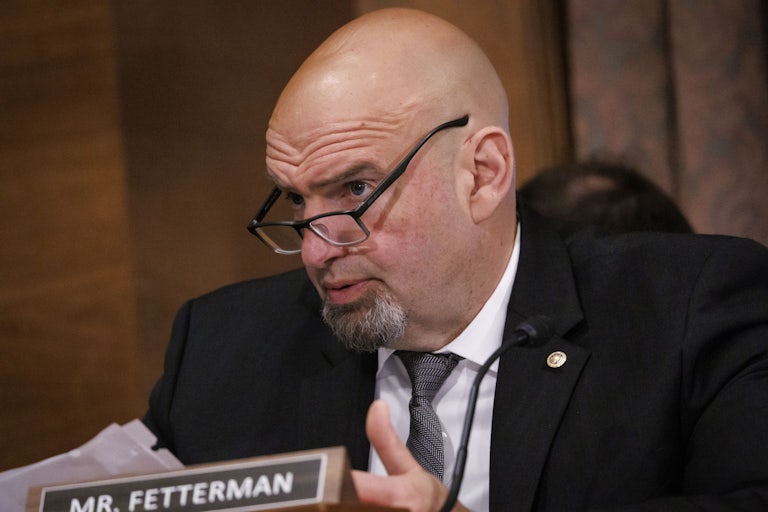
Pennsylvania Senator John Fetterman at a congressional hearing
Ting Shen/Bloomberg/Getty Images
Pennsylvania Senator John Fetterman

During a Tuesday hearing on the failures of Silicon Valley Bank and Signature Bank, Pennsylvania Senator John Fetterman took the banks to task.

“Republicans want to give a work requirement for SNAP, you know, for a hungry family to have these kinds of penalties, or some kinds of working requirements. Shouldn’t you have a working requirement after we bail out your bank?” Fetterman challenged Silicon Valley Bank President Greg Becker. “Because [Republicans] seem to be more preoccupied [with] SNAP requirements for hungry people, but not about protecting the taxpayers that will bail [out the banks].”

Fetterman’s pointed question came in a larger line of questioning that pointed out the contradictions endemic within the American economy.

“Is it an inside joke that no matter how incompetent or how greedy, the government will always bail you out when your bank crashes?” Fetterman inquired. “Everyone has to realize that no matter how bad I behave, no matter how big my raise is, my bonuses and everything, we will come in and bail it,” he continued, asking Becker if he believes it’s all a “running joke in the circles of banking that ‘no matter how bad we have, we are going to be saved.’”

“I don’t believe that’s the case,” Becker responded.

“Really?” Fetterman said, incredulously. “Do you believe that that is not outrageous: that no matter how deplorable your performance is, you are made whole—all by taxpayers.… What if we didn’t come out and bail out your bank, what would’ve happened?”

Becker answered by saying that their shareholders did lose their value, that he believes it was important to protect their clients, and that businesses would have been significantly impacted if they were not bailed out.

“Is it a staggering responsibility that the head of a bank could literally crash our economy?” Fetterman countered. “It’s astonishing.… They also realize that now they have a guaranteed way to be saved,” he continued. “Isn’t it appropriate that this kind of control should be more stricter?”

Fetterman posed more and more questions challenging such a status quo—in which banks can make off just fine no matter their negligence, while taxpayers pay for the life-ring buoys while being subject to stricter requirements for benefits—to no answers.

“Thank you, Senator Fetterman; didn’t see an eagerness on the panel to answer your questions, thank you,” Senator Sherrod Brown concluded.

Florida Passes Bill to Protect Billionaires if Their Exploding Rockets Kill People

Florida lawmakers have some good news for Elon Musk and Jeff Bezos.

Veronica G. Cardenas/Bloomberg/Getty Images
The SpaceX South Texas launch site in Boca Chica Village in Brownsville, Texas, on September 26, 2020

Millions throughout America are trying alternative diets: plant-based, paleo, low carb. And now there’s a new group of people whose meals mainly consist of boots: practically the entire Florida legislature.

Florida lawmakers, on both sides of the aisle, have sent a bill to Governor Ron DeSantis that would expand legal immunities to protect private space companies like Elon Musk’s SpaceX or Jeff Bezos’s Blue Origin when workers suffer injuries or even die. The Spaceflight Entity Liability Bill broadens when space companies are exempted “from liability for injury to or death of a crew resulting from spaceflight activities.”

Florida’s move to expand liability protections comes as billionaires’ rockets keep exploding and more and more private companies are taking wealthy passengers on interstellar adventures. An analysis by the Florida state Senate admits outright what the entire point of the legislation is: “This bill has the potential to limit the cost of litigation to businesses engaging in spaceflight activities.”

The bill  mandates “crew” and participants alike fill out a waiver that grants legal immunities to space companies in cases of injury or death.

It also expands the definition of “spaceflight entity” to include any entity authorized to conduct spaceflight activities, beyond ones that are solely associated with the United States Federal Aviation Administration. It cuts out language ascribing liability to spaceflight entities for damage caused from “inherent risks” of spaceflight activity; instead, the bill broadens the scope of liability immunity to include all spaceflight activities.

Moreover, the bill amends language that orders entities to be liable for injury if they had actual knowledge, or reasonably should have known, of risks. The new language only orders legal liability for “actual knowledge” of risks, meaning there is no longer any expectation for companies to be responsible for damages from risks they “reasonably should have known” about.

The bill passed the state Senate 39–0 and the state House 107–5. The overwhelmingly bipartisan move to grant special legal protections to bloated companies run by some of the richest people in the world is mirrored by how much these entities donate to politicians of both parties.

Musk’s SpaceX has spent some $8 million in lobbying efforts since 2020 and donated another $1 million to members of both parties during the 2022 election cycle alone. Bezos’s Blue Origin has spent some $6.3 million in lobbying efforts since 2020, while sending just over half a million dollars to members of both parties during 2022.