Newsletter
Power Mad
A weekly review of the rogues and scoundrels of American politics

The Democrats Have More Power Than They Realize. Here’s How to Use It.

They can’t just wait for Trump’s screw-ups to bring him down.

Senate Minority Leader Charles Schumer House Minority Leader Hakeem Jeffries speak at a press conference.
Kevin Dietsch/Getty Images
Senate Minority Leader Charles Schumer and House Minority Leader Hakeem Jeffries speak at a press conference.

To hear Senate Minority Leader Chuck Schumer tell it, despite the fact that the party just brutally lost an election and have failed to elucidate a strategy for winning back the voters they’ve recently lost to Trumpism, the Democrats actually have the Republicans right where they want them. As Semafor’s Burgess Everett recently reported, Schumer has urged everyone to just chill out and wait. “Trump will screw up,” he said, adding that Trump’s decision to release a bunch of violent insurrectionists on an unsuspecting public is actually “the best thing that’s ever happened,” which is certainly news to me. “I didn’t know he’d screw up so soon,” Schumer said, adding, “This is going to be a pattern.”

As I’ve written before, the Democrats’ enduring theory of political change is that Republicans will cock things up enough to get the public back on their side—despite the numerical paucity of bona fide, persuadable swing voters out there in the hinterlands. In the narrow sense, however, it’s probably true that backlash is the spark that will end Trumpism. But for Democrats to wait for it is political malpractice for two key reasons: First, they’re not entirely locked out of parliamentary maneuvering. More importantly, whether locked out of power or not, every elected Democrat still has constituents—citizens who depend on their elected officials for material support during these trying times. Telling these people that they’re on their own would be downright criminal.

Democrats haven’t treated their constituents decently of late. By all accounts, phones on Capitol Hill have been constantly a-jangle with calls from voters prompted by “Call your congressperson” campaigns from Democratic Party–affiliated organizations such as MoveOn and Indivisible, and tensions are mounting. This week, Axios reported that Democratic members are “pissed” at the organizations for sending so many angry callers their way, on the grounds that they are “barking up the wrong tree given their limited power as the minority party in Congress.”

But as Indivisible’s co-founder Leah Greenberg takes pains to point out, the idea that Democrats have no parliamentary levers at their disposal isn’t actually true. “Our supporters are asking Democrats to demand specific red lines are met before they offer their vote to House Republicans on the budget, when Republicans inevitably fail to pass a bill on their own,” said Greenberg, citing the fact that tight margins within the fractious GOP House caucus make it all but certain that Speaker Mike Johnson will need Democratic votes to keep things running. That means a parliamentary fight might, indeed, be in the offing.

Should Republicans fail to get must-pass budget measures enacted with their majorities, Democrats should be prepared to let Johnson know that the cost of their votes is subject to inflation. As Representative Alexandria Ocasio-Cortez told The Independent, “It is the Republican majority’s responsibility to gather the votes necessary for them to pass their agenda.” Short of that, she says, “any concession necessary for the Democratic Party to assist them ... must be incredibly substantial.”

This is all correct, and it’s going to be very disappointing if Democrats do what I expect them to do: give up their leverage to lend blank-check support to the GOP because they think that adhering to norms of comity and bipartisanship will earn them plaudits from the public and open doors to further rapprochement with the GOP. This is loser talk: The angry voters won’t be mollified, the Republican cooperation won’t come, and Democrats will lose still more political ground. It’s absurd to think that this path leads to fewer phone calls—unless, of course, the message they want to send to their base is to just give up.

But even if a surprisingly different Democratic Party shows up on that day, they need to understand that they still have constituents who need help in the meantime, and adopting a “wait for the GOP to screw up” footing is the worst possible response for this moment. Think logically: At the other end of every Trump screw-up is a hurt person. Trump’s mistakes cost people their lives and livelihoods.

Moreover, it’s important for Democrats to remember that when this Trump administration functions as intended, it will feature an administrative state bent to the task of implementing Trump’s designs for vengeance on his political enemies, and the tools now under the control of he and Elon Musk can facilitate the granular immiseration of Democratic voters. In a preview of coming attractions, New York City Comptroller Brad Lander awoke on Wednesday to discover that the Trump administration had clawed back $80 million in FEMA funding that had already cleared. This is the plan: To effectively immiserate blue states and make it as hard as possible for Democrats to govern the places where majorities want them in office.

Democrats thus cannot simply sit back and watch as the full force of Trump’s authoritarian project falls on the heads of their constituents. And while their parliamentary options are limited, they still have some resources to bring to bear on this problem. They have their own deep-pocketed donors. They have nongovernmental expertise on which they can call. They have a small universe of nonprofits and support organizations that can work on the local and community level. Democrats need to marshal and deploy this capital to help keep people informed, keep them safe, and keep them a couple steps ahead of the Trump administration’s depredations. (Which they can do, considering the GOP wrote all their plans down.)

And while I hate to beat a dead horse, I must reiterate that Democrats really need to start playing the media game according to the rules the industry has set—and which their opponents have so agreeably mastered—instead of waiting for some period of media reformation that will never occur as long as so many incompetents, deadbeats, and goons are running the show. Democrats need to be aggressively launching counter-narratives, starting conflicts, and flooding the zone with the same fervor and volume as the GOP. There should be daily, coordinated P.R. attacks on the Trump administration. (Representative Robert Garcia’s “dick pic” stunt during Wednesday’s “DOGE Committee” meeting was an example of a perfectly executed play in a media environment where crass conflict is required to gain purchase in the attention economy.)

The recent air disaster at National Airport provides an illustrative example of where Democrats might have done more. Not long after news broke of the crash, eagle-eyed social media users pulled a January 22 press release from Democratic members of the House Transportation and Infrastructure Committee criticizing Trump for his “dangerous freeze of air traffic control hiring.” What should have followed hard on the heels of the crash was a concerted effort among Democrats to brandish that prescient press release and hang it on Trump.

Now, I’d bet I know why Democrats didn’t do this: To their mind, it would have been a cynical cheap shot. So they held back, and the next day the Trump administration chalked the crash up to diversity hiring, and that’s the topic the media spent the day dishing on, to the detriment of a wider universe of people than died in the original catastrophe. Lesson learned: The first cheap shot wins, so govern yourself accordingly and take them. Stop fretting about getting scolded by the punditocracy’s various schoolmarms for being rude and uncivil! Their approval will only lose you elections. Instead, welcome their disdain.

As Josh Marshall recently wrote, “Fundamentally this is a battle of public opinion.” Democrats need to treat those constituent phone calls as the front lines of this fight. This is where you provide information about Trump’s disastrous governance, where you disseminate information about what ordinary citizens can do and who can help them do it, where you outline your playbook for fighting back (remember, Project 2025 was written and published before Republicans won anything), where you vow that you’ll never surrender the fight, and where you help a scared nation feel less alone. If you provide people with information, resources, and specific political commitments, they will organize and act—and add vital grease to the wheels of that longed-for political comeback. What lies on the other end of those phone calls isn’t a burden, it’s an opportunity. Grow up, get over yourselves, and get back in the game.

This article first appeared in Power Mad, a weekly TNR newsletter authored by deputy editor Jason Linkins. Sign up here.

Trump’s Abuse of Power Comes as No Surprise

Somehow, Democrats got badly caught out by the president doing all the things he spent the past two years saying he was going to do if reelected.

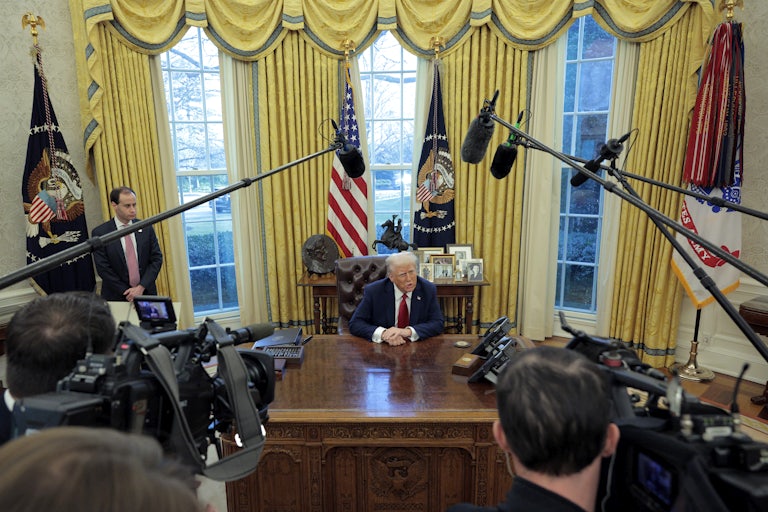
President Donald Trump talks to reporters from the Resolute Desk after signing an executive order.
Chip Somodevilla/Getty Images

The most surprising thing about Donald Trump is that there are still people here, in the year 2025, who retain the capacity to be surprised by Donald Trump. The man has no depths to plumbcontains no multitudes; to scratch his surface is to know the man entirely. We know that what he wants most in life is for the voices on his television to be praising him. We know that the biggest reason he ran for a second term is to avoid jail and that, now that he’s back, his main goal is to make off with as much money as he can. We know what kind of president he will be (bad) and how he’ll leave the country (worse). Trump is often described as a “pugilist” in the press. I’m not sure people know what that word means, because he’d be awful at pugilism. All of Trump’s punches are telegraphed.

Nevertheless, D.C. Democrats seem to be some of the last people to learn that there is nothing left to learn about Trump. Trump’s first week back seems to have caught them off guard, so much so that they’ve largely spent the last few days tiptoeing around as multiple crises unfolded. They’ve been careful, circumspect, cautious—and they’ve gotten absolutely banjaxed as a result. It wasn’t until Trump tried to turn off the entire federal government that they recovered a bit of fighting spirit, vowing to escalate the conflict with the GOP into a “street fight.”  

It’s great that they got there in the end; I look forward to this street fight, but I’ll believe it when I see it. Still, one of the Democrats’ big problems is the sheer number of times you can use the word “belatedly” to describe their reactions. It might have been better if Democrats had actually used the time between Trump getting reelected and Trump getting inaugurated to prepare to confront the things that Trump spent over a year saying he was going to do.

On Tuesday morning, The Bulwark’s Sam Stein reported on BlueSky that Democrats were planning to do a press conference on Trump’s decision to pardon the January 6ers—which occurred a full week prior—even as the effects of the Trump administration’s funding freeze were making headlines. The Democrats’ approach raises serious questions about their pathological inability to participate in the modern news cycle. Moreover, the pardoning of the January 6ers became a fait accompli the moment Trump won the election. The time to start raising a hue and cry over those pardons was thus November. 

Stein noted this lag: “Two parties running at different speeds.… Unclear if there is a presser today to go after the OMB’s power play to take over all federal grant money.” Democrats actually did manage to work the breaking news story into their brief in a rare display of nimbleness. But despite the hasty agenda change, Democrats seemed as if they’d not been following the political news for a staggeringly long amount of time. “Last night,” Chuck Schumer said of Trump’s attacks on the civil service, “President Trump plunged the country into chaos without a shred of warning.”

Trump’s actions were of course preceded by copious warnings, most notably in the form of Trump repeatedly saying that he planned to tear down the civil service and replace it with loyalists willing to use the federal government as his own instrument of plunder and revenge. In addition to these warnings, many stories generated well ahead of time elucidated Trump’s purge plans—a tightly reported piece from Jonathan Swan in Axios and two well-trafficked features from The New York Times and Vanity Fair among the biggest stories detailing Trump’s shock-and-awe schemes for the civil service. 

Readers of this very newsletter know that I wrote about Trump’s plot back in September 2022, using my patented journalism technique of listening to what Republicans say they are going to do and then writing it down and publishing it to the internet. All of these stories, based on nothing more than the public statements and documented plans of Donald Trump and his cronies, are what we in the biz would call a “warning.” 

There’s a long list of bad habits that Democrats need to break at this point, but we’ll add this to the list: Be ready to respond to the things that Republicans plan to do when they’ve given you several months of head start. If there is a takeaway for Democrats after Trump’s first 10 days in office, it’s that procrastination and lollygagging really kills. Fortunately, there’s still an easy way for them to get two steps ahead of the curve.

For instance, it’s never been a mystery that Project 2025 has essentially been the punch list for Trump’s second term—the White House is already very dutifully ticking items off. Any uncertainty about this ended this week when it was discovered that metadata in the Trump administration’s OPM memos indicated that they shared authors with the Project 2025 manifesto. Once that was publicly disclosed, the administration rather clumsily attempted to scrub that metadata from those memos. 

Based upon all of this, it seems pretty clear that this administration is just going to keep making its way through Project 2025’s pages. Democrats could probably finagle a copy of that document, given that it is publicly available, and maybe even start messaging against it.

Another thing I recommend Democrats get ahead of is the Trump administration’s plans to enact a national abortion ban. Now, I know what you’re thinking: Republicans can be pretty cagey and evasive when confronted on this matter. Here’s a fun fact: Several Republican-appointed Supreme Court justices even told Democrats during their confirmation hearing that Roe was “settled law” before they actually went and unsettled it. Chances are good, folks, that Republicans are actually doing this thing colloquially known as “lying.”

Yes, I know that Trump has repeatedly said that he would not sign a national abortion ban that comes across his desk into law. In the first place, yes, he absolutely would (see above: “lying”), but more importantly, he does not need a bill to arrive on his desk to enact a ban. As we have rather relentlessly reported here at The New Republic, Trump’s Department of Justice will enforce a law that’s already on the books known as the Comstock Act to ban abortion, something that Vice President JD Vance asked Merrick Garland’s DOJ to do when he was still an Ohio senator. 

There is no reason Democrats can’t simply count the contents of Project 2025 and a national abortion ban as done deals, things the GOP is going to roll out sooner or later, and start publicly sparring about them, along with the GOP’s other antisocial and unpopular plans. Republicans will complain, and there’s definitely a strain of pundits who will disapprove, but remember: Those people suck, and being on their bad side is evidence of good politics. Besides, with no legislative majority and thus no prospect of enacting legislation, Democrats may as well spend their time fighting the GOP, complaining about their ideas, and working the refs. 

Democrats have some reason to feel a little gun-shy about ramping up these kinds of attacks. The media, too often, reported on Trump’s denials of Project 2025 and his assertions about signing a national abortion ban way too credulously. But that’s a reason to start naming and shaming the media personages who got it so badly wrong. More to the point, Democrats need to spur, if not entirely resuscitate, a popular opposition to Trump and start planning an electoral referendum of what will be another round of failure and misrule. That begins with something that resembles energy and action, no matter how constrained you may be in parliamentary terms.

You look stupid when you’re a week late to a news story, and pathetic when saying you weren’t warned about the stuff that Trump publicly and repeatedly said he’s going to do. This administration wants to burn it all down, and measured responses won’t work as a counter; you can’t wait for your lawyers to go over the text of Trump’s executive orders and for your pollsters to focus-group the optimal response. Besides, you shouldn’t need to when you can just say, “Trump is fucking up the country and plundering the federal government.” Hopefully this week will prove to be a teachable moment heralding a quick course correction, because there’s one thing that Democrats can never say about Trump’s plans: that they weren’t told.

This article first appeared in Power Mad, a weekly TNR newsletter authored by deputy editor Jason Linkins. Sign up here.
The Washington Post Commits an Unpardonable January 6 Sin

Jeff Bezos’s increasingly meretricious newspaper stooped to publish a pathetic “both-sides” defense of the violent mob that stormed the Capitol.

Trump supporters clash with police and security forces as people try to storm the U.S. Capitol Building on January 6, 2021.
Joseph Prezioso/Getty Images
Trump supporters clash with police and security forces as people try to storm the U.S. Capitol Building on January 6, 2021.

Well, I hate to say I told you so. Back in December, I warned that Donald Trump’s plan to pardon the January 6 insurrectionists was going to be greeted by the media with prewritten takes about how President Biden’s own use of the pardon power justified a decision to free a violent mob. Today, The Washington Post’s editorial board, tasked with the mission of obtaining 200 million paying users while simultaneously following owner Jeff Bezos’s directive to make the venerable newspaper substantially more mendacious, made me look prescient.

“The outgoing and incoming presidents both abused their pardon powers on Monday, undermining the rule of law and setting dangerous precedents that perpetuate America’s divisions,” they wrote. According to the pundit logic here, Biden “started the trouble” after he preemptively issued pardons to immunize members of his family, administration, and Congress from future prosecution related to their activities during his term in office. Then Trump “ended the day by giving clemency” to the aforementioned insurrectionists. Just a bad day all around, and everyone’s to blame!

To put it charitably, this is a bungle from the editorial board. In the first place, the editors demonstrate a real inability to follow cause and effect chains; here asserting that the “the trouble” began with Biden’s preemptive pardons, when the use of the term “preemptive” clearly suggests a precipitating event. In this case, somebody forgot the well-documented history of Donald Trump publicly announcing his plans to persecute members of Biden’s family and administration, over and over again. Just this week, Trump intimated in an interview that he might go after Biden specifically because he wasn’t corrupt enough to pardon himself on the way out the door.

Then, once “the trouble began,” the editors suggest that Trump’s decision to pardon the January 6ers naturally followed from Biden’s actions—leading the reader to make the logical leap that the pardons handed out in the morning forced Trump’s hand later that day. But again, a reminder: Effect follows cause, and it was actually Biden’s hand that was forced when Trump repeatedly made the wanton persecution of his family and colleagues one of his big campaign promises. Meanwhile, Trump’s plan to pardon the insurrectionists has been a done deal for some time; it was another one of his oft-repeated campaign promises.

But the larger problem here is the way the Post editors senselessly flatten two wildly different actions by two wildly different presidents. Their main concern with Biden’s pardon is that it “opens the door for future presidents to likewise immunize their families and staffs from merely theoretical prosecution by their successors.” Meanwhile, they say that Trump’s decision to loose the January 6ers onto the world “risks emboldening militias and others to commit future acts of barbarity in support of political aims.”

Maybe these two things aren’t the same? It sounds to me like I’d grade the Biden pardons as a 3 out of 10 on the “I’m Worrying About the Precedent This Sets Whilst Stroking My Chin Thoughtfully” scale, whereas it’s safe to say I’d give the potential for “future acts of barbarity” a substantially higher rating. What if—and I’m just spitballing here!—one of these theoretical consequences is a lot graver than the other? And honestly, what if one of these theoretical consequences is a lot less theoretical than the other, given that an attempt to unlawfully overturn a legitimate election result actually happened?

Back in December, when I was lamenting the Post’s decision to run an insane op-ed suggesting that Biden should pardon the January 6ers himself because it would, according to the idiots who wrote this idea down, bring the country together, I pointed out that one of the very best reasons for Biden not to do that is that you don’t want to be responsible for setting free the type of person who is likely to reoffend. Say what you want about the people Biden preemptively pardoned, but I don’t see a lot of violent crimes in their future.

I can’t (frankly, I won’t) say the same thing about the January 6ers. One of those whom Trump pardoned this week—specifically a guy who tossed an explosive device into the Lower West Terrace tunnel of the U.S. Capitol—has already been rearrested on a gun charge that had been left pending. According to Politico, he’s got some fun priors: a previous conviction for “domestic violence battery by strangulation in June 2017” and “resisting law enforcement with violence and battery of a law enforcement officer” in October 2021. In short, a real gem, and I’d be willing to bet there are other jewels among his scofflaw comrades. The granting of clemency to this sort of criminal is the kind of thing that more often than not ends a political career. We’ll see how Trump fares now that he’s taken ownership of all of these Willies Horton.

The most worrying thing is that the most scintillatingly obvious aspect of Trump’s actions completely eluded the Post’s contemplations: that the possibility that these offenders might reoffend might be why they got a pardon in the first place. The main political focus of Trumpism has been establishing the rule of impunity. Trump’s actions here should be regarded as a calculated maneuver to very quickly and substantially reassert that impunity. All of these people who committed acts of political violence have been liberated, the obvious implication being that future criminal acts undertaken on Trump’s behalf will be viewed approvingly.

Here, the fears go well beyond the actual mob of men and women who stormed the Capitol four years ago. These pardons signal that anyone is welcome to get into the game; that a get-out-of-jail-free card is waiting as a reward. And as writer Julian Sanchez noted, Trump needn’t be an active field marshall of these irregulars: “An efficient fascism does not require much direct state violence. It merely requires the assurance that private violence aligned with the desires of the regime will go unpunished.”

This should be easy to understand. Whatever the ethical implications of Biden’s pardons—and I’ll stipulate to the fact that there are some that are worthy of concern—he actually hasn’t established a precedent that other future individuals might exploit, as there isn’t going to be another Biden administration or Biden family for Trump to threaten with unjust prosecutions. Trump’s pardons, on the other hand, beckon forth future acts of violence. Overnight, America has become a more dangerous place to run for office against the GOP, to say nothing of how risky it now is simply to be the person charged with counting votes and certifying elections. It’s disconcerting that the people running a major newspaper in our nation’s capital aren’t intelligent enough to grasp these distinctions.

Shove the Presidency Down Trump’s Throat

Liberals spent the president-elect’s first term trying and failing to kick him out of office. This time out, they need to turn the White House into a prison.

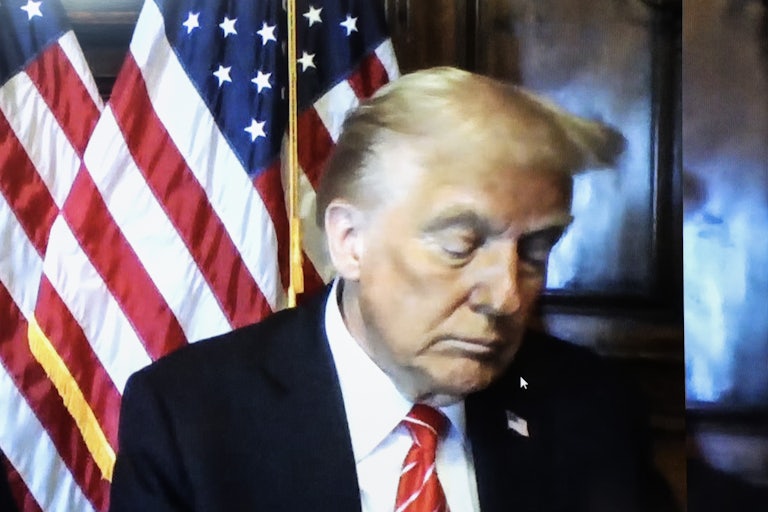
Donald Trump appears virtually at Manhattan criminal court in New York, US, on Friday, Jan. 10, 2025.
Brendan McDermid/Getty Images

The most recent entry in the “good advice for Democrats” canon comes from occasional TNR contributor and Bulwark writer Jonathan V. Last, who wrote, “The job of the Democratic party comes in two parts. First: Do not help Republicans. Not in any way. Second: Make Donald Trump own every bad outcome that happens, anywhere in the world.” True enough. The only problem here is the lack of an organized Democratic Party to actually serve as an aggressive opposition party. We could use one of those!

Nevertheless, there is a lesson here for liberals that we should perhaps heed while Democrats in Washington debate how supine they want to get for the incoming administration. During Trump’s first term, much of the mainstream left organized itself around the idea that “this was not normal” and that surely our over-regarded system of norms would save us from Trump. And so deep investments were made in various quick fixes—an impeachment effort and the Mueller investigation chief among them—that seemed to offer the hope of prematurely canceling the Trump presidency, without much regard for how difficult it is to actually oust a president (or for the decades of evidence suggesting that our justice system routinely fails to hold the rich and powerful to account, more broadly).

A second Trump era offers the opportunity for a change of course—a second reckoning of sorts. I think that Last is on to something when he suggests that Trump’s opposition should force him to “own every bad outcome that happens, anywhere in the world.” I’d actually take this a step further. Rather than exert so much energy trying to thrust Trump out of the presidency, liberals would be well served to spend their time thrusting the presidency upon Donald Trump. Instead of searching for illusory quick fixes for the existence of the Trump administration, start demanding the Trump administration fix everything quickly.

If there’s one thing we’ve learned from the sample size of one Trump presidency and his four years out of power, it’s that Trump is a bog-standard rich white guy whom the justice system is largely incapable of bringing to heel. He has powerful friends (oligarchs, Supreme Court justices), deep pockets, and a well-tempered ability to joust in the media. By now we’ve watched ol’ Donny “wriggle out of this one” on multiple occasions; he seems to thrive if you put him at the center of something he can deem to be a witch hunt—even when those hunters bag their quarry, as prosecutors did in his hush-money case.

But Trump has historically faltered when he’s been forced to contend with the actual pressure of the presidency and its myriad responsibilities (see also: the Covid-19 pandemic) because his ideas are bad and he doesn’t have a deep and abiding interest in public service to really make a sustained effort to confront, let alone solve, the biggest problems we face.

President Barack Obama found the presidency to be an exhaustingly taxing job, so much so that he famously went to somewhat mind-blowing lengths to limit the nonpresidential decisions he had to make in order to stay keen enough to handle the toughest of the choices on his plate. Trump, by contrast, mostly showed up late to work and watched cable news all day. Had the coronavirus not emerged as a global threat, he might have made it through his first term having not felt the pressure of the job at all. In his second term, it should be the task of liberals to force Trump to swallow a daily spoonful of the very real job stress that Obama struggled so mightily to endure.

To get there, liberals need to get into the business of identifying the problems that real Americans face (which honestly, is something they could stand to relearn how to do) and more forcefully blame Trump for those problems’ continued existence. They need to raise a hue and cry over everything under the sun that’s broken, dysfunctional, or trending in the wrong direction; pile line items on Trump’s to-do list, wake him up early and keep him up late. Every day, get in front of cable news cameras and reporters’ notepads with a new problem for Trump to solve and fresh complaints about the work not done.

What pitfalls lie ahead? It looks like there will be rough economic headwinds in the form of a potential housing crisis and a labor shortage, for starters; another potential public health crisis looms in the form of bird flu (and probably his own Health and Human Services secretary). There is a real possibility of a market-slaying tech-bubble burst on the medium-term horizon as well. There will also be pitfalls that arise from Trump’s own policies, beginning with the fact that his mass deportation scheme will likely torch the domestic economy. Beyond that, there will be the typical crises of American life—economic predators, polluters, corporate scofflaws, and public health concerns—that Trump has either shown no interest in helping abate or has personally empowered via the decisions of his plutocratic-minded Supreme Court appointments. Democrats should already be planning to hang all the foreseeable albatrosses around his neck, and gaming out how they’ll swiftly nail Trump to the wall for the crises that catch him by surprise.

For certain, Democrats can be grateful if he actually makes good on any of his “I alone can fix it” promises. (Or rather, they can take credit for having goaded Trump to get off his ass and do his job.) But as I’ve suggested before, in advice that Last echoes above, Trump should truly be left to solve these problems on his own. He’s claimed a mandate and congressional majorities, so let him (and his fellow Republicans) figure it out, with Democratic votes on offer only if massive policy concessions supporting Democratic Party interests are included.

Not for the first time will I point out that none of what I’m suggesting Democrats do is outside the norm of typical American politics. I’m merely suggesting that Democrats compete on the same political playing field that Republicans already occupy, instead of waiting for some more favorable terrain to reveal itself. (Which, by the way, it won’t.) Democrats need to have an aggressive and coordinated media strategy involving all of their members, surfacing derogatory information about Republicans, enumerating the problems they’ve failed to address, and filling the news hole with fresh complaints. They need to show real backbone and take pride in their refusal to participate in enacting the GOP’s policies.

Right now, in these heady moments prior to his second inauguration, Trump’s second term could not be going better for him. Over these last remaining loose and responsibility-free days, he’s been able to imagine himself achieving epochal accomplishments—annexing Canada or buying Greenland. Trump has been free to bask in the unknown possibilities of what’s to come. Immediately after he’s sworn in for the second time, that fantasia will fall away and he’ll be responsible for solving a planet’s worth of problems.

It’s always been something of a mystery why someone who was making it in America as an idle rich celebrity asshole abruptly changed course and decided that what he really wanted to do with his life was to become responsible for an entire nation and its problems. Howard Stern famously warned Trump prior to his first run that he “only had about 10 good years left before he starts to drool on himself,” and it was best he spend it at leisure rather than subject himself to the constant slings and arrows of being president. There’s no doubt in my mind that the version of Trump in the parallel universe where he took Stern’s advice is a lot happier. In this universe, liberals would do well to find creative ways to make Trump regret his choices.

This article first appeared in Power Mad, a weekly TNR newsletter authored by deputy editor Jason Linkins. Sign up here.
The MAGA Right’s Plan to Destroy the Fourteenth Amendment

It’s the part of the Constitution that guarantees all Americans something Republicans despise: equal protection under the law.

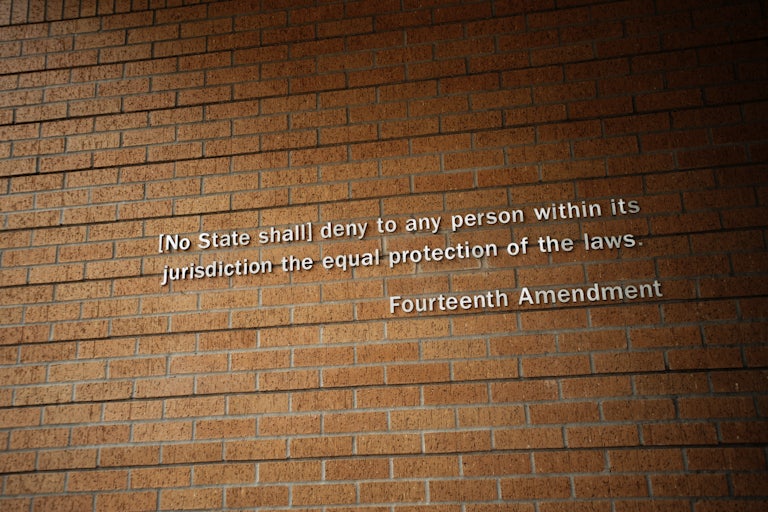
Part of the Fourteenth Amendment as posted on the wall of Little Rock Central High School National Historic Site in Little Rock, Arkansas. The text reads '(No State shall) deny to any person within its jurisdiction the equal protection of the laws.'
Paul Natkin/Getty Images
Part of the Fourteenth Amendment as posted on the wall of Little Rock Central High School National Historic Site in Little Rock, Arkansas.

Another January 6 has come and gone, and with it the furtive remembrances of the day that touched off so much institutional collapse. Not that you’d know anything was amiss in Washington, where Democrats made an elaborate show of underscoring the peaceful transfer of power—seemingly not aware that the very act of melodramatizing something that should simply be background noise in a stable democracy only suggests the papering over of a greater disorder.

It’s been fashionable to argue that the 2021 coup plot actually succeeded or, perhaps more accurately, never ended. Either way, the reality is that January 6 may have passed on the calendar but it is not done with us yet. What began on that day was much more than a mere attempt to overturn an election, it was actually a forcible rejection of the principles of democracy that arose out of the post–Civil Rights era. President Barack Obama used to suggest that his election was evidence that the United States was shaping into the “more perfect union” of its dreams. The latest election suggested that what we’re actually rounding into is a mafioso state ruled by a strongman and his affiliated oligarchs. 

This year, the right will be coming after the strongest bulwark against their corrupt vision for our future. It is one of the most important accomplishments of the Reconstruction era, and one of the most critical safeguards of justice, citizenship, and equal protection under the law: the Fourteenth Amendment. What makes this amendment so important is that it plays an outsize constitutional role in enabling the possibility of a robust multiracial democracy. That also makes it a prime target of those who want to prevent such a thing from coming into being.

It makes sense that this battle should kick off with an insurrection. One of the most interesting things about the January 6 attacks is that they were something for which we, the people, had specifically prepared, writing into the Fourteenth Amendment language—which TNR’s Matt Ford described as “thunderous and unequivocal”—barring any person who had sworn an oath of office and subsequently gone on to engage in “insurrection or rebellion” from ever again holding federal office. 

When Colorado voters sued their secretary of state, Jena Griswold, in an attempt to use this constitutional fail-safe to evict Donald Trump from the ballot, it brought Griswold into conflict with the Supreme Court. Like many observers, I felt the disqualification effort would prove fruitless before that body but that the justices would take safe harbor in the lack of any criminal convictions of Trump to make the more abstruse argument that there was too much doubt about his culpability in the insurrection to deny him a place on the ballot in accordance with the disqualification clause. 

Instead, as Ford documented, the majority opinion took a much more severe and unprecedented approach to the problem, effectively applying a judicial line-item veto to the Fourteenth Amendment itself, thereby nullifying its use as an electoral fail-safe. The ruling, Ford wrote, “paves the way for insurrectionists to run for and hold federal office despite the Constitution’s categorical language that disqualifies them,” along the way deciding “questions that weren’t before the justices in this case in the first place,” and providing answers that “will only immunize these and future insurrectionists from potential consequences.”

That the Supreme Court demonstrated a willingness to tear a hole in the Constitution has only emboldened the right to take further aim at the Fourteenth Amendment. (It’s not ideal that a loud segment of the political press, who typically venerate the Constitution in flamboyant fashion, also found the disqualification clause worthy of their ridicule.) As Ford noted in November of last year, the Trump administration is planning to go after another section of the amendment’s unequivocal language—that which protects birthright citizenship. And they’re road-testing a new argument advanced by Trump-appointed federal Judge James Ho, a onetime originalist defender of birthright citizenship who has carved out a unique exception to the rule:

Birthright citizenship is supported by various Supreme Court opinions, both unanimous and separate opinions involving Justices Scalia, Thomas, Alito, and others. But birthright citizenship obviously doesn’t apply in case of war or invasion. No one to my knowledge has ever argued that the children of invading aliens are entitled to birthright citizenship. And I can’t imagine what the legal argument for that would be.

That makes two of us! Given the extreme unlikelihood that there are any living humans who participated in either an invasion or a war on U.S. soil who are now prospective U.S. citizens, I should simply be able to go on never worrying about this. But given the propensity of Republicans to refer to legitimate asylum-seekers as “invaders” and the campaign comparison of Haitian Americans residing in Ohio to illegitimate citizens, I’m starting to think that Ho intends “war or invasion” as something far more malleable and abstract than the literal definitions of those terms.

All of which would be perfectly consistent with Trump’s second-term agenda, in which he’s promised to transform the federal government into an instrument of personal revenge and roll back the rights and benefits that people and groups he disfavors currently enjoy. As TNR contributor Susan Rinkunas recently reported, much of this will come down in a battle to strip citizenship from people, and the Fourteenth Amendment will be under attack once again:

The Fourteenth Amendment was intended to extend full citizenship to formerly enslaved Black people, and it undergirds the right of all Americans to be treated equally under the law, no matter who they are or in which state they reside. Yet over the past year, conservatives have been increasingly open in their beliefs that pregnant women, transgender adolescents, affirming parents of trans kids, and immigrants are not legally entitled to the Fourteenth Amendment’s protections—all while arguing that fertilized eggs are. Republicans are using strategic litigation to effectively rewrite the Fourteenth Amendment to prioritize conservative white men and embryos above and beyond everyone else. They are warping something used to grant rights into a bludgeon to take them away, and are redefining who counts as a person in the United States.

Those who are familiar with Wilhoit’s law—which holds that conservatism, in the words of Ohio classical music composer Frank Wilhoit—“consists of exactly one proposition.… There must be in-groups whom the law protects but does not bind, alongside out-groups whom the law binds but does not protect”—will recognize that Trump’s plans aren’t novel but rather stem from the primordial ideas that have long guided his party along its postmodern evolution into a haven for authoritarianism and oligarchy. 

What’s changing now is that the right’s embrace of this philosophy is becoming more explicitly stated; the need to couch this despicable notion in what Wilhoit referred to as “an elaborate backwash of pseudophilosophy” is less necessary now that the Supreme Court has granted the president monarchic immunity powers and indicated its openness to redact and rewrite whole parts of the Constitution. Thus begins the great unbinding of the right from their constitutional obligations, and the lifting of constitutional protections for those they deem to be “enemies within.”  

This article first appeared in Power Mad, a weekly TNR newsletter authored by deputy editor Jason Linkins. Sign up here.