Newsletter
Power Mad
A weekly review of the rogues and scoundrels of American politics

What the Democrats Must Learn From the People of Los Angeles

Conflict with Trump’s lawlessness is inevitable—and the fight cannot be ducked.

A protest against ICE immigration raids in Los Angeles, on June 11
Tayfun Coskun/Anadolu/Getty Images
A protest against ICE immigration raids in Los Angeles, on June 11

The only real surprise about the clashes in Los Angeles is that anyone is surprised by them. Of course Donald Trump, in an attempt to get his moribund deportation numbers up, sent masked goons to indiscriminately snatch undocumented immigrants from their workplaces; he long ago made clear that this was part of his plan. And of course the people of Los Angeles have erupted with fury, seeing their loved ones and co-workers hauled away for swift deportations to unknown destinations. It would be shocking if they hadn’t.

There’s little about this presidency that a majority of Americans support, and Trump seems uniquely uninterested in changing their minds. This is his m.o. His entire reelection platform was basically, “They can’t throw me in jail if I’m the president,” and the only thing he’s done since his return is to use the office to mete out vengeance on everyone who he believes has wronged him—just as he said he would. That’s why the biggest lesson of the unrest in Los Angeles is simply this: We are, at all times, hurtling toward conflict with the Trump administration, and the future of our democracy depends on understanding this and fighting it head-on.

Angelenos know the score and have responded in kind. As TNR’s Melissa Gira Grant wrote this week, “What we are witnessing in Los Angeles is not only a protest; it is self-defense.” When indiscriminate ICE raids ramp up in other metropolitan areas, I’d expect the same level of citizen resistance. But the protests have been a vital counteroffensive to Trumpism, as well: As TNR’s Matt Ford explains at length, they have done much to expose the weakness of the president and the fakery behind his anti-immigrant crackdown. Over at The New York Times, Jamelle Bouie concurs, wryly noting that “strong, confident regimes are largely not in the habit of meeting protests with military force, nor do they escalate at the drop of the hat.”

The Trump administration is angry and humiliated—and grossly unprepared. They have not done the planning necessary to pacify a city, and they don’t have the numbers to do it either. The National Guard members they have activated are famously sleeping on floors and complaining about how the administration is using 29-day deployments to avoid having to pay for active-duty benefits. And the president’s coalition is starting to fracture: Florida state Senator Ileana Garcia, who helmed Latinas for Trump during the election campaign, denounced the president’s crackdown this week. Another California Republican issued a statement urging the administration to “prioritize the removal of known criminals over the hardworking people who have lived peacefully in the Valley for years.”

The protest movement, meanwhile, is in the ascendance. Polls indicate widespread disapproval of the president’s actions in L.A. It’s having somewhat of a magnetic effect. California Governor Gavin Newsom—who’s spent the year running a clout-chasing podcast themed around the virtue of conceding political arguments to right-wing weirdos—finally put his instincts for self-aggrandizement to good use. His daring the president to come and arrest him was an excellent moment of bluff-calling. And much to my astonishment, The New York Times editorial board managed to get through an entire essay excoriating Trump without also slagging the protesters. The days for that sort of bothsidesism are over: Studies show that a robust civil resistance movement is absolutely necessary to stem the slide into authoritarianism. The forces that are mobilizing against Trump fit the bill.

While these displays of courage should be celebrated, there are still too many Democrats in Washington who are hesitant to step up—and who mirror the administration’s lack of preparedness. This week, California Senator Alex Padilla demonstrated that he was up for the fight, disrupting a press conference from Homeland Security Secretary Kristi Noem and getting manhandled and briefly detained as his reward. Still, many of his Capitol Hill colleagues seem to not understand the moment at all. Even as Angelenos were putting themselves in harm’s way to stop ICE raids and humiliate the Trump regime, 75 House Democrats were signing their name to a resolution expressing “gratitude to law enforcement officers, including U.S. Immigration and Customs Enforcement personnel, for protecting the homeland.” Beyond that, I’m seeing the same basic reluctance among Beltway Democrats to recognize that they’re in a content-creation war. Republicans are still much quicker to grab a microphone or position themselves in front of a television camera. And even Trump understands that the biggest virtue of deploying Marines to California is that he’ll get the media to report it.

But this is precisely why Democratic reluctance to frontally confront Trump, in the hopes that some more favorable political terrain might reveal itself—or the president might finally, fatally, shoot himself in the foot—is dangerous. Like I said, we are at all times hurtling toward a conflict with this administration. And the number of people carrying guns to this conflict continues to go up. At some point, someone is either going to be ordered to fire one of those guns on a civilian or they are going to refuse the order to do so, and we’ll be knee-deep in the big muddy of a turbocharged crisis. At that point, pivoting to the price of eggs isn’t going to be sufficient.

As Brian Beutler explains in a recent Off Message newsletter, Democrats have been having an almighty struggle with the basic concept of forethought. We have, for a long time, been operating under the ambient threat that the administration was going to provoke the public into a spectacular anti-administration response, whereupon Trump would do something like invoke the Insurrection Act or otherwise activate some militarized rejoinder. People have long been anticipating the need for blue-state governors to get out in front of the threat. “We knew he’d wield immigration enforcement cruelly, in a manner designed to draw protesters into the streets, and we knew he’d be eager to deploy troops once protests began,” Beutler writes.

For all of Newsom’s recent exploits, Beutler believes that he might have done much better if he had “prepared for wide-spectrum confrontation with Trump, instead of brushing aside almost all hot-button issues as perilous distractions.” It’s hard to fathom that anyone anticipated that Trump’s anti-immigrant animus could have been hand-waved away with rhetorical tricks or a strategy of avoidance: Trump’s pledge to deport millions of people was his only noteworthy policy proposal on the campaign trail. The day to start preparing to confront the inevitable abuse of power was, thus, the day after Trump was elected. As Beutler notes, “I’m pretty sure all of these questions were ponderable and answerable in November of last year—but only by leaders who understood what was coming and [were] determined to fight it.”

At any rate, the time for anticipating what Trump might do has long passed. The conflict has arrived, and we are in a perilous moment. That said, I’d worry more if the people were mirroring the reticence and timidity of many of our political elites. But as we’ve seen in Los Angeles—and are likely to see as anti-Trump protests spread across the nation this weekend—no one is waiting for politicians to step in and be the grand marshal of this growing dissident movement. Democratic leaders may still be waiting for the “time, place, and manner of our choosing” to take the fight to Trump. But Angelenos have countered, “What better place than this? What better time than now?”

This article first appeared in Power Mad, a weekly TNR newsletter authored by deputy editor Jason Linkins. Sign up here.

Joe Biden Is the Least of Democrats’ Problems

Some commentators say the former president’s age and acuity will be a litmus test for 2028 candidates. They are embarrassingly wrong.

Former President Joe Biden takes his hand to his heart during the National Anthem.
Allison Robbert/Getty Images

Well, folks, the Democratic Party really went through it this week. Last weekend, it was disclosed that former President Joe Biden was diagnosed with a particularly aggressive form of prostate cancer that had metastasized to his bones. Coming smack-dab in the center of the hype cycle from Jake Tapper and Alex Thompson’s book about how Biden’s inner circle kept his infirmity out of sight, the episode only magnified the party’s gerontological problems. On Wednesday, like a rush delivery from the coda store, all of this was underscored by the passing of Virginia Representative Gerry Connolly, who recently was named the ranking member of the House Oversight Committee despite his own cancer diagnosis.

The Democrats’ Biden reckoning is a real choose your own adventure. To my mind, this was a case of elite failure: not just from the fabled “politburo” troika of Biden insiders that led the charge to keep Biden’s struggles from the limelight, but also from the party elders who engineered this mishap in the first place. They slaughtered their younger candidates in the 2020 presidential primary, mercilessly took down the one among them who dared to suggest Biden was too old, and forced a party-wide acclamation of Biden’s nomination following the South Carolina primary, which put us irrevocably on the path to his subsequent 2024 candidacy. This was, indeed, the Original Sin.

While there’s no end of atoning to do, some commentators have stretched this melodrama to the breaking point by suggesting that Biden’s “age and mental acuity” will be a litmus test for the party’s 2028 candidates. Let me just say this: I truly hope that it will be one, because if voters in three years still care a whit about Biden then that would mean the economy did not end up in shambles, the constitutional order and the rule of law are still very much intact, and the decimation of the civil service has been reversed. This is what a lot of pundits don’t understand: The only way Biden would have salience as a “litmus test” issue in 2028 would be if his successor governed through wisdom and competence.

Naturally, that will not be the case because Biden’s successor is Donald Trump—an omnidirectionally corrupt fuckup and criminal. If anything, Trump has provided a new avenue for those journalists who maybe neglected the story of Biden’s mental infirmity to redeem themselves, by hopping on the story of Trump’s own mental infirmity. Though oddly, few seem to be working that beat, and many of the voices that admonished the Biden-era media for these failings have fallen curiously silent. (TNR, I should note, is all over the story of Trump’s cognitive decline.) That’s too bad: The scandals at the core of the Tapper-Thompson tome remain live issues in American life. Gather unto you some scoops, reporters! This is low-hanging fruit!

Meanwhile, as the entire political journalism industry dithers, Republicans are using the story as a heat shield to skate on their bad plans for the country and their worse abuses of the Constitution. Flying under the radar this week is a report from the Cato Institute that included detailed profiles of 50 undocumented immigrants whom the Trump administration sent to a prison in El Salvador even though they were not guilty of any crimes while stateside. The administration ran afoul of another federal judge after shipping another group of migrants to South Sudan, a nation that’s on the verge of a renewed civil war.

In Washington, Republicans are trying to bring a budget bill to term that will slash programs for the needy to furnish a one-time payout for plutocrats, throw millions off their health insurance, and explode the budget deficit. Beyond that, we have the ongoing crimes of the administration that I laid out last week, up to and including the needless deaths that will occur at the hands of Elon Musk’s destruction of critical aid agencies and Robert F. Kennedy’s lethal grotesqueries of public health. All of which is to say: There will be no reason in the world for any Democrat worthy of office to be on any kind of apology tour by the time 2028 rolls around.

That doesn’t mean there won’t be critical litmus tests for Democrats—or that all of them will pass with flying colors. Right now, the most important way that the Democratic leaders of the future are going to distinguish themselves will be the extent to which they devote their lives to fighting Trump, tooth and nail. As Talking Points Memo’s Josh Marshall wrote this week:

The overriding problem Democrats have today is a general belief that they’re not effective at fighting for what they believe in or what the country needs to be protected from. There’s a related, but secondary issue that they worry that Dems are most focused on issues that are obscure or not connected to the lives of the great majority of people struggling to make ends meet. That lack of fight is shattering for self-identified Democrats as well as highly damaging for genuine independents and low-information voters who genuinely flip from party to party from election to election. That is overwhelmingly the challenge Democrats have right now.

“The idea,” Marshall adds, “that up-for-grabs voters are waiting for important signals out of a bizarre intra-party score settling over Joe Biden’s age is just such unreal bubble thinking that it beggars belief.” Meanwhile, if we are looking to recent events for Democrats failing those crucial litmus tests, consider the fact that 16 of them joined Trump’s Senate acolytes in passing a crypto-friendly deregulation bill, in just the latest example of the party’s willingness to cave to that scam industry. The fact that this bill would most likely set the clock ticking on the next great financial crisis, in much the same way that the Financial Services Modernization Act of 1999 paved the way for the last one, is to my mind a more massive failure than anything that Biden’s inner circle did as they conspired to hide his enfeeblement.

At any rate, for those so concerned about Biden and his health, I’ve good news: He won’t be running for office again. The Democratic campaigns of the future can and should opt to neither hire nor rely upon the bad and incompetent advisers whose actions helped Trump get elected.

These are the easy bars to clear. More important litmus tests remain: Who fought the hardest? Who proved worthy of the public trust? Who best used the tools available to them to relentlessly discredit Trump and the GOP? Who sent packing the small army of loser pollsters and consultants that have kneecapped the party? Who successfully learned to speak to the public like someone not umbilically connected to a Beltway focus group? The road out of the Trump Dark Ages will be paved by those who pass those tests, not those who occupy the pundit-approved opinion on a prior president who, come 2028, will be … well, let us not speculate.

This article first appeared in Power Mad, a weekly TNR newsletter authored by deputy editor Jason Linkins. Sign up here.
Let’s Start Talking About Jail Time for Trump and His MAGA Enablers

Trump is the head of a criminal syndicate, and he should be treated accordingly.

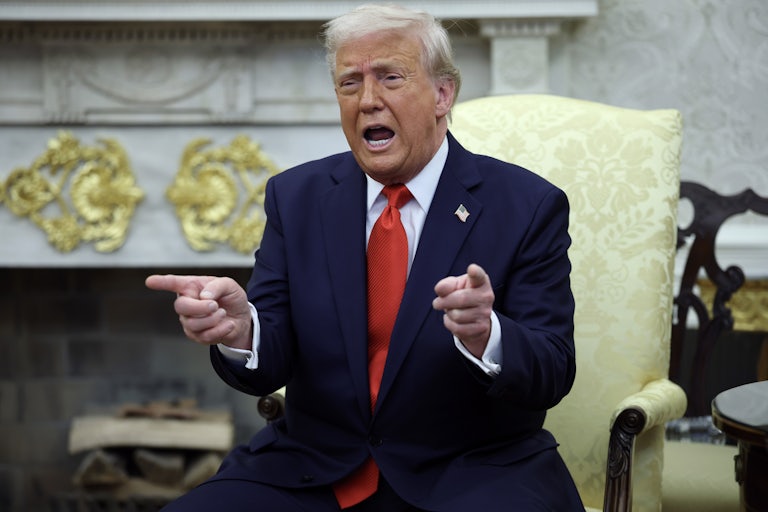
Donald Trump points and speaks while sitting in the Oval Office
Win McNamee/Getty Images

What’s in the water in the state of Maryland? Whatever it is, it’s certainly more invigorating than the sewage that Robert F. Kennedy Jr. and his grandchildren have been swimming in. A few weeks ago, one of the Old Line State’s senators, Chris Van Hollen, dropped his gloves to take on President Donald Trump’s unlawful banishment and imprisonment of Kilmar Abrego Garcia. This week, his House colleague Kweisi Mfume was responding to an administration flirting with suspending the habeas rights of its citizens in stark, but welcome terms. “It’s a damn shame to continue to see what is happening to our nation under the guise of this Trump administration and his Department of Government Evil,” he said. “He and Elon Musk, really in my opinion, deserve to be arrested and charged with assault on the Constitution.”

One of the more unfortunate realities of the Trump era is that to speak the plain truth about it requires you to get over the feeling that you’re being shrill or alarmist. “I know that might sound crazy and ludicrous,” Mfume said, commenting on his call to arrest the president and his pet oligarch. As someone who’s spent the past few years issuing Cassandra-like warnings only to watch so many of my ostensible industry peers take a dive, I can relate. But the thing about Cassandra is that she’s correct, and so is Mfume. Trump isn’t a president. He’s the head of a criminal syndicate, and he should be treated accordingly—now and, even more importantly, when he and his accomplices are finally out of power.

Trump 2.0 has been a remarkable speedrun into lawlessness, a testament to the fact that there might have actually been some adults in the room during his first term. (During which time he still fomented an insurrection and got impeached twice!) Now, freed from those guardrails that were once upstanding, he’s rocketed into a new level of infamy. I once held that George W. Bush’s reign was much more costly than Trump’s. No longer; his return has truly been a thing apart. As TNR’s Alex Shephard documented this week, Trump’s trip to the Gulf States has been a vertically integrated grift, in which the president has racked up more corrupt enterprises than most politicians manage in their whole careers.

This week’s skullduggery is, of course, just one brief crime spree among many. Over at The Nation, Jeb Lund lays down the lengthy rap sheet that Trump has written for himself in his first 100 days. The Trump administration has heisted the private data of millions of Americans, unlawfully terminated thousands of federal employees, extorted law firms and businesses and broadcasters; they’re gaming the markets, raking in corrupt money with crypto-tokens, kidnapping people and exiling them to foreign prisons without due process, and much much more. As Lund notes: “The question is not whether Trump and his people committed a crime while you read that last sentence but how many.”

It shouldn’t come as any surprise that the Trump administration is canceling the FBI’s investigations into white-collar criminals. But if these sorts of crimes aren’t dramatic enough for you, we could also simply stick with good old-fashioned manslaughter. As TNR’s Matt Ford reported this week, one of the hallmarks of Trump’s public health policies is that they will kill a lot of children—probably not a surprise given that the aforementioned Kennedy is well known for directing officials in Samoa to run an open-air eugenics experiment that killed 83 kids. “The net effect of these policy changes,” Ford writes, “is to make this country a more dangerous place for Americans to give birth and grow up.”

Abroad, Trump administration policies have the same eugenicist bent. As TNR contributor James North chronicled, the gutting of PEPFAR—the Bush-era HIV/AIDS intervention that has saved countless lives in Africa and one of the most highly regarded U.S. policies the world over—“has already sentenced tens of thousands of people in Africa to death, and with each week that passes with the program stuck in limbo, many thousands of needless deaths will follow.”

The administration’s approach to PEPFAR is of a piece with a range of policy decisions that will, in the best-case scenario, cede soft-power space to China and others to secure the developing world’s regard for stepping into a vacuum and providing humanitarian assistance. The worst-case scenario is, naturally, millions of needless deaths. Back in March, The New York Times’ Nicholas Kristof attempted to quantify the harms done by the Trump administration’s decimation of foreign aid agencies in terms of lives lost. Here are his calculations: 1.65 million deaths from AIDS, 500,000 from lack of vaccines, 550,000 from lack of food aid, and approximately 300,000 each from lack of malaria and tuberculosis prevention, respectively.

This all raises an interesting question: How many people have to die before the word holocaust is in play? I’m not gunning for shock value here, at least not solely. I want to suggest that there is a certain necessary logic to what has to follow corrupt misrule of this kind: tribunals, trials, punishment, prison, and the running to ground and defunding of the entire Trump syndicate.

It’s an undertaking that will require no small amount of courage, and it will break with a long-standing status quo that has favored the absolution of numerous mortal sins, from the Bush administration’s unlawful torture network to Wall Street’s ruination of the economy to the many costly foreign misadventures that have feathered the nests of the military industrial complex over the years. The “look forward, not backward” ways etched into the civic firmament have served us poorly; in retrospect, what we had to look forward to was this exact moment with this perfidious administration.

Real accountability is not something I expect will be popular with the rotted mass media and its grotesque aversion to good governance or the wholly out-of-touch pundit class, whose opinions on Trumpian corruption tend to lag years behind most functional adults’. This is where the avatars of “Let the bad guys off the hook and move on” obtained their intellectual cover over the years. Suffice it to say, they’ll like a better world wrought from taking these criminals down and locking them up just fine. But those who want to pursue justice for all those wronged by this administration should expect to be branded as heretical.

We hear so much about the “rule of law” these days. So many people are concerned about it! They just don’t know what’s going to happen to it. Even among the gravely worried, there is this sense that the “rule of law” is like a machine someone turned on at some point in the past, which runs in the background of American life like some sort of ambient presence. What the rule of law really is, it turns out, is the sum total of our deeds—and our inaction. The rule of law lives or dies on our willingness to act—occasionally with grim resolve. It’s time for people who value justice to screw their courage to the sticking place.

This article first appeared in Power Mad, a weekly TNR newsletter authored by deputy editor Jason Linkins. Sign up here.

The Democrats Have an Age-Old Problem

The party is stewing with tension between young blood and their decorated elders. But the real fault line may have more to do with vigor than with age.

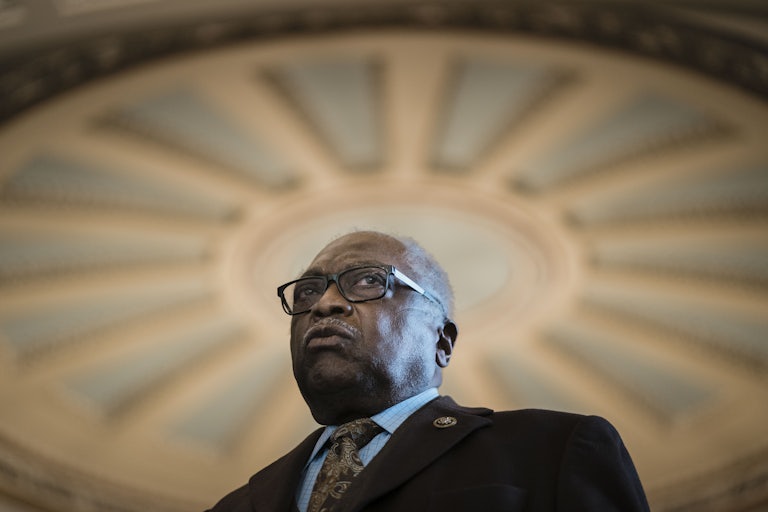
Jim Clyburn speaks beside members of the Congressional Black Caucus.
Kent Nishimura/Getty Images
Representative Jim Clyburn

It goes without saying that Democratic voters have developed some grave misgivings about the party’s gerontological bent. Well before President Joe Biden’s advanced age took him out of the 2024 presidential race, a Pew poll found that 79 percent of Americans favored some kind of age limit on elected officials. The fever for fresh blood and fighting energy has only advanced since then. As The Washington Post reported last month, “Younger Democrats are treating their party’s age issue with more urgency after” Biden’s loss.

The Wall Street Journal added fuel to the fire last week with a story that pitted younger House Democrats against their elders. “Age is a bigger headache for Democrats than Republicans for one central reason: Democrats have a lot more old members,” the Journal noted. This has come at a cost recently: Five House Democrats have died in office in the past 11 months. All were 65 or older; younger replacements might have been able to kill key GOP bills, had some key vacancies been filled. Another aging Democrat, Gerry Connolly, will have to give up his recently claimed ranking membership of the House Oversight Committee because the severe cancer diagnosis he was dealing with at the time of his ascension did not magically get better.

The Journal suggests that tensions are spiking: “Now, some younger Democrats are pushing to oust older party lawmakers, citing the need to connect more closely with the next generation of voters and energetically spar with Trump.” Representative James Clyburn went on the record to offer some wan pushback. “Nancy left her seat. Steny left his seat. I left my seat. What the hell I’m supposed to do now?” said Clyburn, who is 84, when asked about promoting younger members. “What do you want—me to give up my life?” There are many good reasons to vote for someone, but doing so to allow an aging grandee to cling to relevance deep into retirement age isn’t among them.

I’m sensitive to the argument that we cannot just discount experience and hard-won knowledge, and anyway, age isn’t the Democrats’ main fault line. What I’m seeing emerge among the Democratic base isn’t so much a tension between old and young but between inertia and the willingness to fight hard against Trumpian misrule. And that’s going to make for some strange bedfellows: Right now, the octogenarian Senator Bernie Sanders and the much younger Representative Alexandria Ocasio-Cortez are raising hell on an anti-oligarchy tour; they’re going to end up basically in the same trenches against Trump as would-be presidential candidate and current Illinois Governor JB Pritzker, who is—let’s face it—pretty much an oligarch himself. Still, these are three Democrats raring for a fight, while others either blanch at the prospect of open conflict or simply accommodate Trump.

It may be that age really is only a number. But having the ability to nimbly adapt to a new way of doing political business, in a media-information environment unlike the one with which we began this century, is what should determine if someone has a place in the Democratic Party’s ranks. In that sense, Clyburn is asking the right question: “What am I supposed to do now?”

I’m happy to assist. The most important thing any Democratic elected official can do today is wake up each morning planning to relentlessly criticize and discredit the president and his party, who give Democrats a lot to work with. This is a task that needs far greater participation among Democrats than I’m currently seeing, especially on the economic front. As I said last week, we are headed into the Summer of Scarcity, which means barren shelves, shuttered businesses, lost jobs, and a deep recession. For Democrats too afraid to talk about anything but “kitchen table issues,” this is your moment. Get after it!

I worry a lot when Clyburn says stuff like, “I think the message coming from the Democratic Party is a good message.… The problem we’ve got, I’ll say, is that we have to depend upon the media to deliver it.” Sorry, Jim, but I’ve been over this. We aren’t reforming mass media anytime soon. We have to use the cynical one we’ve got, and that means giving it what it wants: conflict, controversy, cheap shots. If you want your message in the media, you have to load up the cannon and fire. You have to give up the high road and get in the gutter, where the big political battles are fought these days. Instead of trying to beat Trump with gauzy appeals to high-flown principles, you need to follow The New Republic’s Tori Otten’s advice: Get mean and stay petty.

The Democratic Party also needs some of its members and best-known figures to start seeding the earth with the future they envision if they return to power. This begins with paving the way for “CTRL+Z 2028”—a promise to undo the damage done to the civil service with the same alacrity and doggedness with which Trump and his flunky Elon Musk destroyed it. Those plans, by the way, emerged into public view two years before the presidential election—numerous reports revealed the magnitude of right-wing schemes to dismantle the government, and numerous figures were excited to talk about the shock-and-awe tactics they were going to deploy. If we aren’t soon seeing similar stories about Democratic plans for renewal, then something is deeply wrong.

Lastly, in the middle ground between quickfire attacks and long-range vision there is the basic task of holding the Republican Party accountable. As federal jobs get cut, grants get gutted, and the important work of keeping Americans safe and healthy goes undone, Democrats need to be counting up the costs to ordinary people and raising holy hell about the harms that the Trump administration is unleashing. In fact, they allegedly have a plan to do just that: Back on April 4, the Democratic National Committee’s Ken Martin announced that the party would be launching a “People’s Cabinet,” as part of an effort to “fiercely counter Trump’s chaos and lies.” But here we are, a month later, and no such shadow Cabinet has emerged on the scene. I suspect I know why this has foundered: The party is still too in thrall to what’s known as “the iron law of institutions,” and cannot nimbly start creating positions of perceived influence without first walking through a minefield of seniority, entitlement, and ego.

Democrats need their own anti-DOGE, they need their own Project 2025, and they need to get this People’s Cabinet—or something else with the same goals—off the ground. What we need less of is navel-gazing, pissing and moaning about your cable news coverage, sops in the direction of “working with Trump” and “reaching across the aisle,” defending outdated norms, and heeding the suggestions of political consultants who haven’t made a correct observation since last century, if ever. If you’re up for the real job of uprooting Trump and building a better future, then I say it’s fun for all ages. But if you’re only suited for the latter set of tasks, then it doesn’t matter if you’re 25 or 75—politics just isn’t your bag.

This article first appeared in Power Mad, a weekly TNR newsletter authored by deputy editor Jason Linkins. Sign up here.
Americans Really Dislike Trump. But They’re About to Truly Hate Him.

Welcome to the summer of scarcity and the full-blown Trump recession.

Empty shelves are seen at a Dollar Tree store on April 28, 2025 in Alhambra, California.
Frederic J. Brown/Getty Images
Empty shelves at a Dollar Tree store in Alhambra, California, on April 28

Donald Trump’s first 100 days in office may have been the longest, figuratively speaking, of any U.S. president in history. But we can also say definitively that they were the most disastrous, ever. His draconian deportations, destruction of the federal government, and insane tariff Tilt-a-Whirls have driven his approval numbers so low as to be a modern marvel; the last time a president was this disliked after 100 days, we were fighting a world war and the Slinky was the country’s most popular toy. Trump has ended up here for no other reason than that he pursued the very policies he promised to pursue on the campaign trail. That’s the story of his first 100 days: Americans elected a dumb asshole, and natural consequences followed.

Now let’s consider the next 100 days, which look to be even worse for all of us—including the president. As The New Republic’s Alex Shephard wrote this week, there are a lot of good reasons to believe Trump’s standing with the American people hasn’t hit bottom yet, the main one being that the worst is yet to come. The president, Shephard writes, “is still stubbornly clinging to tariffs, which inevitably will cause product shortages and rising costs in the near future—not to mention a potential recession, the odds of which are worryingly high.”

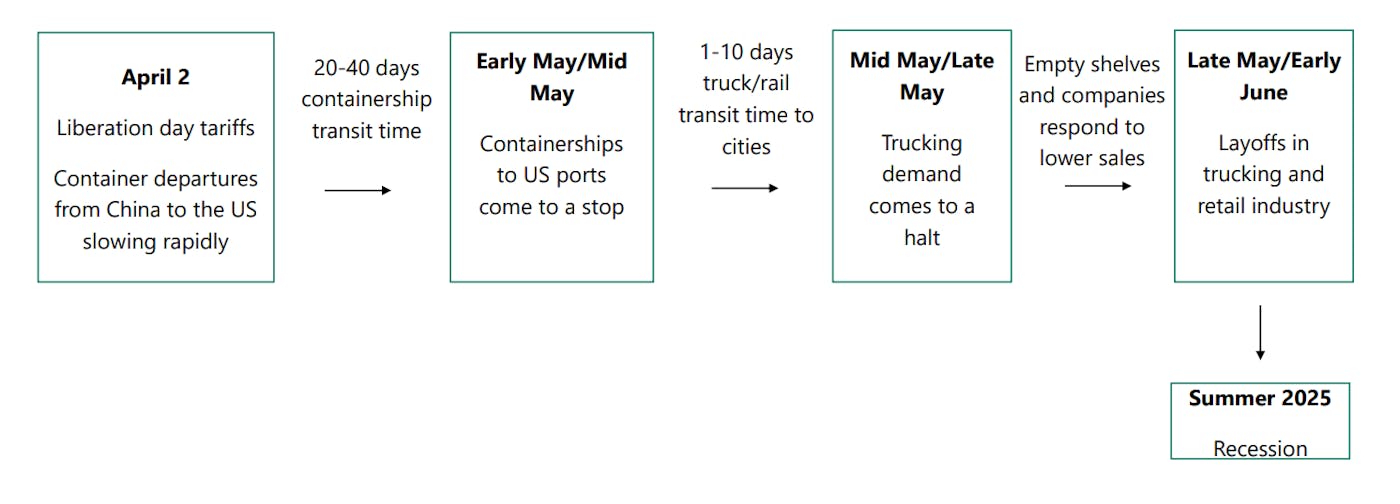
Last weekend, Apollo Global economist Torsten Slok published a preview of coming attractions in the form of a report documenting what he’s calling the imminent “Voluntary Trade Reset Recession.” As Slok documents, Trump’s economy—though quite sluggish—has been boosted by the fact that inventories rose rapidly as firms acted in anticipation of tariffs being imposed. Now that tariffs have arrived, the sugar high is over and collapse is on the way. The most straightforward way of looking at the future is on page 4 of Slok’s report.

Image depicting a flowchart of the "Voluntary Trade Reset Recession."
Apollo Global Management/Torsten Slok

What we have here is the prelude to the summer of scarcity, coming soon to a retailer near you. We are already well and fully in the stage where activity at our ports falls off a cliff. As TNR’s Tim Noah wrote this week:

This is how it begins. The recession has arrived in Seattle, with cargo shipments down 60 percent. Los Angeles will be next. As recently as November, the Los Angeles Times reported that cargo traffic at the ports of Los Angeles and Long Beach reached record highs. But last week it quoted the port’s executive director, Gene Seroka, predicting that “in two weeks’ time, arrivals will drop by 35 percent.” The reason, Seroka said, was that “essentially all shipments out of China for major retailers and manufacturers have ceased, and cargo coming out of Southeast Asia locations is much softer than normal.”

From here, Tim says, there will be less cargo to ship across the country, and inevitably, fewer people employed to do that work. Already, UPS has laid off 20,000 workers because of “current macro-economic uncertainty” that I really think wasn’t all that uncertain when Trump was reelected. This only highlights another grim reality: Even if Trump called off his tariffs tomorrow, much of the coming mayhem is baked into our future, as it would take a substantial amount of time to restart the global shipping machine. “Expect ships to sit offshore, orders to be canceled, and well-run generational retailers to file for bankruptcy,” says Slok.

The latter half of that prediction may well be the more devastating part. As Marketwatch’s Steve Goldstein highlighted, Slok said that “small businesses that account for more than 80 percent of employment and capital expenditure don’t have the working capital to pay tariffs.” In other words, Trumpnomics will soon be best known for that which is absent: products on the shelves of retailers, and businesses on the streets where you live, now shuttered.

Here is where the Wall Street versus Main Street divide is going to be keenly illuminated as Trump’s tariffs start the economic bloodletting. The White House has rather persistently explained away the turmoil its tariffs have wrought as a harm done only to high-flying financiers, and claimed that the benefits to ordinary people would soon emerge. A day after he got hit with a hundred dreadful evaluations of his first 100 days, Trump was spinning out on Truth Social, promising that the boom was on the wing.

But even as the stock markets have pitched and yawed as investors cling to their naïve beliefs that Trump has a plan (he doesn’t), those plying their trade on Main Street are planning for a different sort of boom. To hear Casey Ames—the founder of Harkla, a small, 10-person firm in Idaho that sells products for special needs children—tell it, Trump’s tariffs have already forced him to make some grim considerations.

Ames told the Idaho Statesman that his company was set to have a banner year. “We had just hired more people, and we were forecasting a really good year, even with the initial Trump tariffs,” he said. Now, however, he’s facing a massive hike in the amount of import taxes he’ll have to pay, from $26,000 to $346,000. With no domestic manufacturer capable of supplying the same goods, and knowing that even modest price hikes could crater sales, Ames is suddenly facing a situation where he may have to lay off employees.

Ames has garnered a lot of attention for sharing his experiences on social media, taking his audience behind the curtain to reveal what small-business owners have to expect as the summer of scarcity begins. Over at The New York Times, where they’ve been doing a long-running bit where Frank Luntz interviews the 14 dumbest voters in America, this fissure recently emerged: Meagan, the focus group’s lone small-business owner, told Luntz that the tariffs were a “very, very scary thing” and that she was, as a result, in “crisis mode.” If reality has started to penetrate Luntz’s Delulu Conclave, we’re all in for a world of hurt.

And that’s probably the most dreadful reckoning, as we mark the 100th day of Trump’s second term. Trump’s collapse in public opinion polling—along with the fact that he’s not likely to reverse many of his worst decisions or repair the things he’s broken—has probably set his presidency on the road to ruin. But if Trump has truly sown the seeds of his own undoing, it will be ordinary Americans who reap the proceeds of that dire harvest first, in the form of lost livelihoods and scuppered wealth. It’s going to be a rough summer—and many seasons thereafter, until one day we finally hit the nadir of Trumpian despair.

This article first appeared in Power Mad, a weekly TNR newsletter authored by deputy editor Jason Linkins. Sign up here. If you’re a small-business owner with a story to tell about how tariffs are impacting your bottom line, contact my colleague Grace Segers.

Editor’s Picks