Breaking News
Breaking News
from Washington and beyond

Rick Scott, Who Oversaw One of the Largest Medicaid Frauds in History, Wants to Be Senate GOP Leader

Well, if the leader is supposed to accurately represent their party … maybe not a bad choice!

Alex Wong/Getty Images

On Tuesday, Florida Senator Rick Scott announced his intention to run for the Senate Republican leader, challenging current leader Mitch McConnell.

It’s not surprising Scott is attempting to become the Senate minority leader after chairing the committee (the National Republican Senatorial Committee) tasked with giving Republicans the majority. After all, he has a history of failing upward.

The former hospital company CEO oversaw what was the biggest case of Medicare fraud at the time. Under his leadership, Columbia/HCA gave kickbacks to doctors to refer patients and then made patients’ conditions appear worse than they were so Medicare would pay more.

When Scott was forced out of the company as it was under investigation, he left with $300 million in stock, a $5.1 million severance, and a $950,000-per-year consulting contract for five years. The hospital, meanwhile, was fined $1.7 billion, the largest health care fraud settlement in history until that point.

Now, as Scott guns for a promotion, he’s looking to shirk accountability once again.

“Like each of you, I am deeply disappointed by the results of the recent election,” Scott said in a letter to his colleagues announcing his candidacy. “Despite what the armchair quarterbacks on TV will tell you, there is no one person responsible for our party’s performance across the country. I know there is no shortage of people who are eager to point fingers and assign blame here in Washington, but I won’t be one of them.”

Unfortunately for Scott, fingers are largely pointed at him.

For months, Scott was criticized for seeming more interested in laying the groundwork for a potential 2024 presidential bid than sufficiently managing the Senate Republicans’ campaign arm. From cutting NRSC ads featuring himself rather than fellow Republicans to visiting Iowa, Scott hasn’t exactly toned down obvious ambition.

Meanwhile, the NRSC under Scott has been under fire for mismanaging funds and lacking the wherewithal to fund critical races. “If they [NRSC] were a corporation, the CEO would be fired and investigated,” one Republican consultant told The Washington Post.

And in the lead-up to the midterm election—the red wave that never was—Rick Scott released a blueprint of his policy priorities. In it, he included a proposal to sunset all federal programs, including Social Security and Medicare, in five years. Restarting those programs would require federal reauthorization. Such a move would threaten the programs’ stability as their budget levels go through negotiations that can drag on, leaving recipients at risk of losing out on benefits.

Republicans criticized Scott for releasing the plan that, though realistically in line with the GOP’s stance of cutting public benefits, allowed Democrats to readily campaign about such a risk.

Scott is not expected to triumph in his bid for GOP Senate leader. And if McConnell wins reelection, he will become the longest-serving party leader in Senate history. While tensions broil in D.C., the two senators’ camps continue the battle online.

May the worst man win.
Tom Emmer Wins the Thankless Task of Corralling the GOP’s Likely Narrow House Majority

Meet the Minnesota Republican who led the party’s midterm campaigns.

Tom Williams/CQ-Roll Call/Getty Images
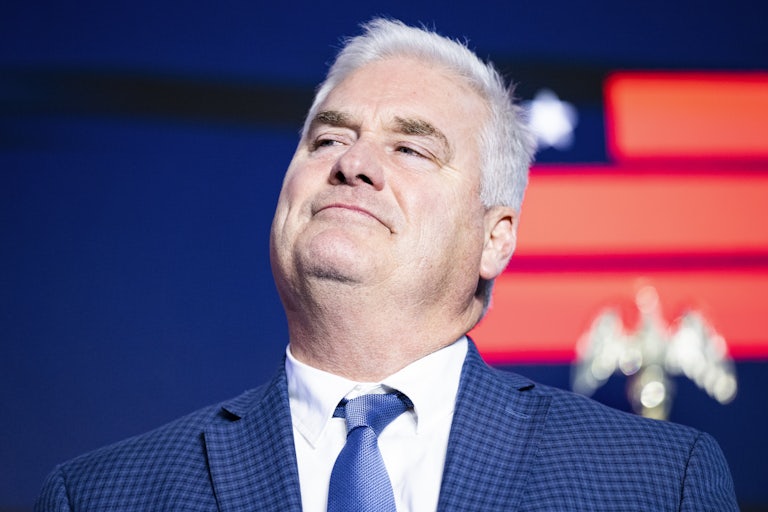
Representative Tom Emmer listens to Kevin McCarthy on election night at what was supposed to be a victory party.

When I profiled Representative Tom Emmer for The New Republic’s summer issue previewing the midterms, the Minnesota Republican seemed to be on a gilded path toward rising through his party’s ranks and wielding the power he’s long sought in Washington. As the chair of the National Republican Campaign Committee, Emmer was expected to oversee a “red wave” surge that would produce a massive GOP House majority, collecting IOUs and plaudits from new members along the way. Instead, Republicans still don’t control the Senate, and the House has yet to be called a week after the midterms, with an exceedingly narrow GOP majority.

As a result, instead of a smooth ride up the ranks, Emmer only narrowly bested Indiana Representative Jim Banks 115–106 on Tuesday to become the GOP Whip.

The whip, the third-ranking spot in House leadership, is primarily tasked with keeping party members in line and corralling votes on tough bills. Thanks to the probable narrow majority, which means that just a few stray defections from the likes of Matt Gaetz and Majorie Taylor Greene could tank the party’s aspirations, that job could end up being more of a nightmare for the next two years.

I wrote about Emmer over the summer since I’ve covered his political aspirations off and on for over a decade now. Back in 2010, Emmer was Minnesota’s Republican nominee for governor. He became known nationally as one of the ur–Tea Party candidates defining the backlash to Barack Obama’s presidency and to the RINOs who had long been the face of the GOP. As I wrote then of Emmer’s time ahead of his gubernatorial run:

He “embodied a lot of the positive attributes of Trump before Trump was cool,” said Marty Seifert, the former Republican minority leader when Emmer was in the state legislature. “Outspoken, tell it like it is. Some people may not like you because of what you say, but I’m going to say it anyway.” …

His tenure was defined by pushing far-right policy: proposals that Minnesota should chemically castrate sex offenders, impose strict voter ID laws, and outlaw abortion in all instances (as well as proposals that would also potentially outlaw certain forms of contraception and in vitro fertilization). He questioned evolution and was one of the loudest, most influential opponents of same-sex marriage. And despite two earlier DUI infractions, Emmer put forth bills to lessen penalties for drunk driving, which became fodder for opponents in later political campaigns.

Another of Emmer’s obsessions was pushing cockamamie ways that Minnesota could nullify federal laws. He was one of three co-authors of a 2010 proposal for a state constitutional amendment that would have required the governor and a two-thirds vote by legislators to approve a federal law before it could be enforced in Minnesota.

But unlike other Tea Partiers who rode the backlash against Democrats to great success in 2010, Emmer lost his campaign. He slunk away for a few years—serving time working for anti-gay-marriage groups and as a morning radio shock jock—before Michele Bachmann retired from her deep-red seat and Emmer took her place. As I wrote for Mother Jones back in 2014, Emmer had “closely replicated the Bachmann model” and was the heir apparent to carry on her pugilistic style of politics in Washington. But when he came to the Capitol, he largely receded from the limelight, sticking to his conservative views but focusing on rising through the ranks behind the scenes, eventually chairing the NRCC in 2020—when Republicans actually won more seats than Democrats despite Donald Trump losing to Joe Biden—and repeating that role in the promising 2022 cycle. “When [he was] first elected to the Minnesota House, compromise was probably not part of his M.O.,” former Minnesota House Speaker Steve Sviggum told me. “I think today there’s much more awareness of cooperation and compromise, while still having extremely conservative values.”

But between the surprising outcome of the midterms and that sense of seeking compromise, Emmer almost lost his leadership role. He reportedly earned the ire of Donald Trump and Tucker Carlson, and The National Review wrote a scathing article denouncing his whip bid this week, arguing, “He deserves the lion’s share of the blame for the GOP’s dismal showing in the House.” Still, he held on, but trying to convince an unruly cohort of extremists that he helped secure reelection will be no easy task in the months ahead.

To learn more about who Emmer is—from how he peddled election denial ahead of January 6 to his time as a “hothead” in the Minnesota state legislature—read the full profile here.

Republicans Nominate Trump Favorite Kevin McCarthy as Next House Speaker

House Republicans voted 188–31 for the California representative.

House Minority Leader Kevin McCarthy
Win McNamee/Getty Images

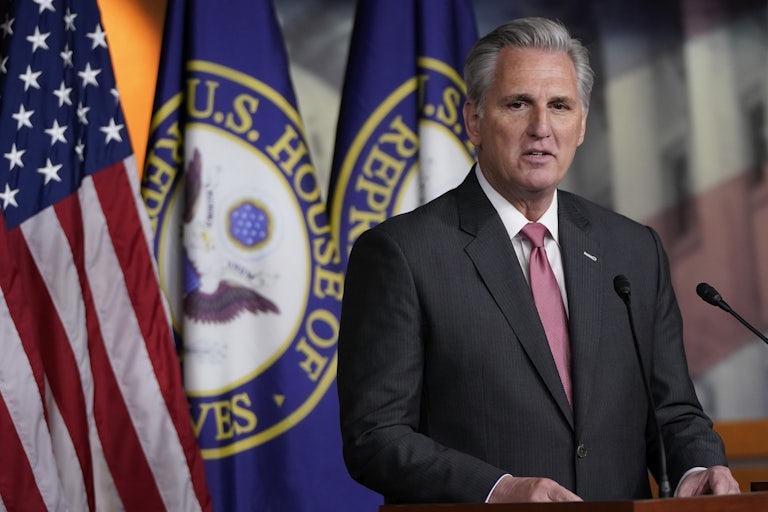
Kevin McCarthy, a major ally of former President Donald Trump, was nominated to be the next speaker of the House on Tuesday.

House Republicans voted 188–31 for the California representative, who beat farther-right Arizona Representative Andy Biggs for the nomination.

The Republican Party is one seat away from taking control of the House of Representatives. If they do, then the full chamber will vote on whether McCarthy should be speaker on January 3, once the new Congress is sworn in. McCarthy will need a total of 218 votes to win the spot.

But it’s not clear if he’ll have all those votes. His own party is not unified behind him, despite Representative Marjorie Taylor Greene urging her colleagues to back him. Florida Representative Matt Gaetz told reporters McCarthy “does not have 218 votes to become speaker. I don’t think he has 200.”

Gaetz had previously said he would back Representative Jim Jordan for speakership, not McCarthy. Dozens of conservative leaders on Monday penned a letter calling for a delay in the House leadership vote until next month.

While 31 votes against McCarthy’s nomination isn’t a small number, it also isn’t totally out of the norm. In November 2018, 32 Democrats voted against nominating Nancy Pelosi as House speaker.

McCarthy, the House minority leader, has made no secret of his ambitions to move up in the chamber—and he’s starting to get a little desperate. The Wall Street Journal reported Monday that the minority leader’s team had made several calls to Texas Democratic Representative Henry Cuellar asking him to switch parties, giving McCarthy an extra vote.

Cuellar turned them down, the Journal said, citing anonymous sources familiar with the calls.

Is Matt Gaetz Trying to Sneak His Way Out of Trump’s 2024 Announcement?

Gaetz said he couldn’t make it because the weather wasn’t looking good for his flight. But planes seem to be flying just fine.

Kevin Dietsch/Getty Images

Representative Matt Gaetz was slated to join Donald Trump for the former president’s third presidential announcement in Mar-a-Lago Tuesday night. But the Florida representative might be trying to wiggle out of it. Apparently, inclement weather is inhibiting his flight.

However, as New York Times reporter Jane Coaston pointed out, flights from Washington D.C. to Florida are all running just fine—regardless of which airport one may be flying from.

Gaetz, a proudly self-declared MAGA Republican, was among those challenging Kevin McCarthy’s House leadership. Trump, for his part, supported McCarthy’s nomination as House speaker.

But there has otherwise been no clear indicator of Gaetz also defecting from Trump. Last week, the representative spoke out amid calls from Republicans to ditch Trump following a disappointing midterm election, insisting that “only Trump can be trusted to enact the ‘America First’ agenda he ran on in 2016. We won’t accept any imitation.”

However, much has changed since even last week. As more elections have been declared, Trump’s mark has continued to decay—over 30 candidates he endorsed have lost, including far-right stars like Kari Lake and Blake Masters.

Meanwhile, even more Republicans have spoken out against Trumpism—from New Hampshire Governor Chris Sununu and outgoing Maryland Governor Larry Hogan to Wyoming Senator Cynthia Lummis and Trump’s former vice president (and potential competitor) Mike Pence.

Given the building pressure, it would not be out of the question for Gaetz to have second thoughts—or at least to cover his bases by ensuring he wasn’t in the photos for Trump’s announcement.

While Tuesday’s weather still welcomes Gaetz to safely fly down for Trump’s announcement, he may be navigating the thorny broader political climate instead by choosing not to.

Judge Overturns Georgia’s “Plainly Unconstitutional” Six-Week Abortion Ban

Most people don’t know they’re pregnant at only six weeks.

Sign reads: "The Land of the free? Choice = freedom"
Megan Varner/Getty Images

A judge in Georgia on Tuesday overturned the state’s ban on abortions after six weeks, a major win for women and gender minorities.

Georgia had passed a law in 2019 banning abortion as soon as a fetal heartbeat can be detected, which is as early as six weeks—before many people even know they are pregnant—but the legislation only took effect after the Supreme Court rolled back the nationwide right to the procedure in June.

A group of doctors and advocacy groups sued Georgia in July, seeking to strike down the law. Judge Robert McBurney sided with them Tuesday, ruling that the six-week ban “did not become the law of Georgia when it was enacted and it is not the law of Georgia now.”

Not only are two sections of the law “plainly unconstitutional,” but “there is no legal basis” for the statewide ban at all, he said in his ruling.

A spokesperson for the Georgia attorney general told the AP that they plan to appeal the decision.

The ruling is a huge win for people in Georgia, where Republican Brian Kemp was just reelected governor. Kemp had refused to say during a debate against Stacey Abrams whether he would sign more abortion restrictions into law if reelected.

Abrams had slammed his nonanswer, warning that “women are in danger” under this governor.

Her accusation was backed up by health professionals, who warned in a study that if abortion is banned in Georgia, maternal mortality will increase 29 percent. If the procedure is banned nationwide, then maternal mortality will rise 24 percent overall.

Maternal mortality among Black people nationwide will skyrocket 39 percent.

The United States already has the highest maternal mortality rate among developed nations, and Georgia has the second-highest rate in the country, of 48.4 deaths out of 100,000 births, according to the World Population Review.