Breaking News
Breaking News
from Washington and beyond

Trump Wants to Be Handcuffed for the Stormy Daniels Hush Money

Ahead of a potential criminal indictment, the former president is planning out the spectacle of his arrest.

Donald Trump exits a car as someone opens a door for him.
Jabin Botsford/The Washington Post/Getty Images

Donald Trump wants to be put in handcuffs.

The twice-impeached former president currently facing four criminal investigations told his advisers that, if he is indicted by the Manhattan district attorney’s investigation into his role for paying hush money to porn actress Stormy Daniels, he wants to turn it all into a show.

As The Guardian reports, Trump seems more concerned with how to display strength and defiance amid the potential criminal charges than he is with the charges themselves. He has essentially told advisers that if he is going to be forced to surrender to authorities and have fingerprinting and a mug shot done at the courthouse, he may as well turn the whole process into a “spectacle.”

A perp walk of a visually unphased Trump, handcuffed and flanked by the police, all in front of flashing cameras and ardent protesters, is apparently Trump’s fantasy. Unfortunately for the daydreamer, reports indicate that authorities will likely work in tandem with the Secret Service to avoid such pandemonium.

Trump’s reinvigorated thirst for being the main character seems to be a bounce back from when he was on the way out of the White House. Per The New York Times, Trump was deep in the doldrums upon being impeached for the second time, after his supporters attacked the Capitol in a failed attempt to keep him in power. Trump reportedly had a “startling melancholy in his tone and hints of self-reflection as he sighed about his advanced age and expanding waistband,” reported the Times.

But since then, presumably buttressed by his formal entrance back into politics as the leading candidate for the 2024 Republican nomination, Trump seems to be more and more back in his brash, delinquent groove. His eagerness to turn his potentially unprecedented arrest—which would make him the first former president to be criminally indicted—into a spectacle mirrors an augmented egomania displayed in, for example, his insistence that the Secret Service drive him around in a limo after he tested positive for Covid-19 so he could project strength to his supporters.

The spectacle didn’t work then (he lost the election weeks after that, and he and Melania’s cases were a few of many in the White House Covid outbreak), and it likely won’t work now. Because while Trump revels in the showbiz aspect of being criminally charged—and while this could solidify him as a martyr for at least enough primary voters to crowd out any other challenger—he is still mired in three other criminal investigations.

And one indictment alone would be enough to turn off more voters than the ones who chose not to vote for him in 2020.

North Dakota Republican Compares Letting Students Use Their Preferred Pronouns to Murder

More than a bit of hyperbole from state Representative Lori VanWinkle

Mark Rightmire/MediaNews Group/Orange County Register/Getty Images

Lori VanWinkle seems to believe respecting students’ preferred pronouns is the same as committing murder.

The Republican representative in North Dakota made the claim during a state House judiciary meeting Monday on a Senate bill that would ban schools from adopting any policies or curriculum related to “expressed gender” and allow teachers to misgender students without facing penalty. VanWinkle supported the bill and seemed to argue that respecting someone’s preferred pronouns was tantamount to accepting murder.

“I mean this seems to be like we’re promoting them to make things up that aren’t true and then endorse that,” she said, suggesting that simply allowing students to use their preferred pronouns is instead encouraging them to lie about their gender. “I just don’t understand why we’re calling ‘lying’ protecting something, when we wouldn’t do it if [students] came to school and felt like they had the right to murder people,” she added.

The bill, which also bans schools from requiring staff training on gender, passed the Senate last month. Both chambers of the North Dakota legislature are controlled by the Republican Party, as is the governor’s office.

“Senate Bill 2231 only has one outcome for North Dakota,” North Dakota Student Association spokesperson Celeste McCash told local outlet KX News. “Economic losses. Individuals who are part of the LGBTQUIA+ community and their families will not consider moving to or continuing to live in our state.”

None of that is a problem for VanWinkle. “How does this even remotely fit into our constitutional obligation to promote a high degree of intelligence, patriotism, morality, and integrity for our students in the education system?” she asked earlier in the meeting.

Since entering office last year, VanWinkle has made a habit of reading Bible verses on the House floor and focusing on bills banning gender-affirming care and mask mandates. Last month, she cited a Covid-19 conspiracy theory while debating a bill on expanded workers’ compensation for firefighters and police officers, eliciting at least one audible groan from a fellow lawmaker.

Recently, VanWinkle joined Representative Brandon Prichard—known by local outlets as the “George Santos of North Dakota,” for reportedly lying about his education and even where he lives—to push a bill that would ban drag performances in the presence of minors or on public property. That bill, H.B. 1333, is also up for consideration.

John Cornyn Calls GOP Effort to Slander Trump Investigators Waste of Time

The Republican senator had some words for the rest of his party.

Win McNamee/Getty Images

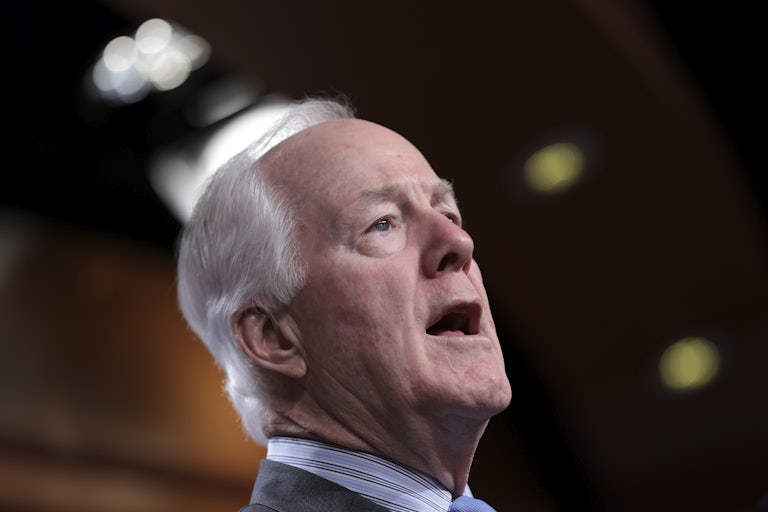
Congressional Republicans and right-wing media figures are working to discredit the Manhattan district attorney in the lead-up to a potential indictment of Donald Trump. Republican Senator John Cornyn, a two-decade member of Congress and prominent party figure, finds the effort to be a distraction.

“There’s more than enough to do,” Cornyn told Punchbowl News. “I would hope they would stick to the agenda they ran on when they got elected to the majority.”

The pronouncement by Cornyn may seem tame, but it is still significant given how much stock Trump puts into seeing who sticks out for him, and who does not.

Other Republicans have thus far mostly criticized the investigation into Trump’s alleged hush-money payment to porn actress Stormy Daniels, rather than the former president himself. Senator J.D. Vance lambasted the ongoing investigation as a baseless inquiry funded by George Soros.

House Majority Leader Kevin McCarthy and Republican Conference Chair Elise Stefanik have also perpetuated the conspiracy about Manhattan District Attorney Alvin Bragg serving at the behest of Soros. Stefanik went even further, saying that while Manhattan allows such a supposedly baseless investigation, Bragg has brought “skyrocketing crime” to the city. The latter claim is demonstrably false (violent crime has decreased since Bragg’s election).

The claim about Soros is rooted in a right-wing antisemitic scare campaign about wealthy Jewish people nefariously influencing society. This organized campaign straight from the top of Republican leadership comes from the same people who shamelessly booted Representative Ilhan Omar off a House committee for a comment she said was not meant to be taken as antisemitic but apologized for nonetheless. Republicans have never apologized for their continual invocation of the Soros conspiracy theory.

Cornyn may complain of the behavior of Republicans like McCarthy and Stefanik (not the hypocrisy about antisemitism), but he is mistaken if he thinks this was not exactly the agenda radical House Republicans “ran on when they got elected to the majority.” This kind of time-wasting, hypocritical, obstructive rhetoric was always on the front burner for Republicans—and is one reason why their “majority” is barely one at all anyhow.

Oklahoma Just Barely Expands Abortion Access to Preserve Life of the Pregnant Person

The Supreme Court ruling still leaves abortion inaccessible for most Oklahomans.

Gina Ferazzi/Los Angeles Times/Getty Images

The Oklahoma Supreme Court ruled Tuesday that the state constitution protects a woman’s right to an abortion “when necessary to save her life.”

Abortion providers and reproductive rights groups had asked the court to find that the constitution protected a person’s right to choose to end a pregnancy. But the justices ruled only on a narrow exception, leaving the majority of the state’s tight restrictions in place. This means that abortion is still inaccessible for most Oklahomans.

The majority opinion founded its argument on the constitutional provision guaranteeing that “all persons have the inherent right to life, liberty, the pursuit of happiness, and the enjoyment of the gains of their own industry.”

That section “stands as the basis for protecting a woman’s right to terminate a pregnancy in order to save her life.”

After Roe v. Wade was overturned, Oklahoma enacted a near-total abortion ban, one of the strictest laws in the country. It only made an exception for someone in a “medical emergency.” Abortion was also made a felony, punishable by up to 10 years in prison or a $100,000 fine. Individuals could sue anyone who helped provide access to an abortion.

The state Supreme Court struck down that law, ruling that “a woman has an inherent right to choose to terminate her pregnancy if at any point in the pregnancy, the woman’s physician has determined to a reasonable degree of medical certainty or probability that the continuation of the pregnancy will endanger the woman’s life.”

“Absolute certainty is not required, however, mere possibility or speculation is insufficient.”

But the court left in place a law passed in 1910 that makes it a felony to intentionally perform an abortion unless necessary to save the patient’s life. This means that health care providers will still have to tread incredibly carefully when performing abortions, lest they risk up to five years in prison. And by not ruling on elective abortions, the court’s decision means that most abortions are still not an option for state residents.

The right recognized today is so limited that most people who need abortion will not be able to access it,” Emily Wales, president and CEO of Planned Parenthood Great Plains, tweeted. “Providers’ hands are still tied by an abortion ban that would make them criminals for providing essential care.”

While it’s good that Oklahoma now has even marginally increased abortion access, the ruling makes clear that the bar is so incredibly low for abortion wins. And as writer Jessica Valenti has repeatedly noted, abortion law exceptions aren’t really about restoring rights at all. “The truth is that abortion exceptions are a lie: A political tool that’s more about helping Republicans’ public image than making abortion accessible to victims,” she wrote in a September newsletter.

Even Alex Jones Has a Problem With Donald Trump’s Calls for Protest

The far-right conspiracy theorist said Trump’s call for protest, ahead of his potential indictment, is dangerous.

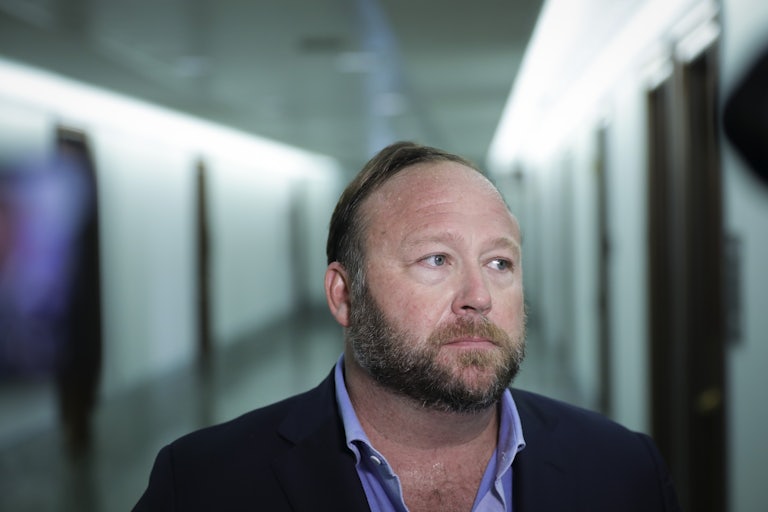
Alex Jones
Drew Angerer/Getty Images

“I’ve got an issue with Trump,” far-right provocateur Alex Jones said on Steven Crowder’s show Tuesday, referring to the twice-impeached former president’s call for protests in response to his potential indictment.

Jones disapproved of Trump’s Truth Social posts urging people to “TAKE OUR NATION BACK!” and “PROTEST, PROTEST, PROTEST!!!” He compared the call to the January 6 attack on the Capitol (which Jones called a “setup”), arguing that “he’s lighting up a cigarette while he’s playing with gasoline,” by potentially inciting “some people” to become violent once again.

Of note is that Jones’s opposition appeared largely as strategic advice to Trump, not as condemnation.

“Someday, there may be a 1776 issue, where things are so bad we gotta get physical,” Jones conceded humbly. “But I think we should exhaust all the remedies first, and I don’t think, if there is a violent revolution, it should be randomly attacking police or Capitol buildings.”

“Of course,” Crowder chimed in, nodding and verbally affirming everything Jones said about how best to carry out “violent revolution.”

Crowder continued with the baton, assuring listeners that he did not think Trump would have wanted violence. “He didn’t word it, maybe, prudently,” Crowder suggested, describing how Trump could have simply said, “‘Protest, make your voices heard peacefully,’ which he did, by the way, on January 6.”

In the weeks leading up to, and on the day of, January 6, Trump continually instructed his supporters to “show strength,” and “stop the steal.” On December 18, he insisted that he won the election. “FIGHT FOR IT. Don’t let them take it away!” Trump tweeted.

At a rally on January 6 itself, Trump dropped the word “peacefully” in once; otherwise, his remarks focused on directing his supporters to demand Congress overturn the election results. “We’re going to walk down to the Capitol, and we’re going to cheer on our brave senators, and congressmen and women,” Trump said to his supporters. “We’re probably not going to be cheering so much for some of them, because you’ll never take back our country with weakness. You have to show strength, and you have to be strong.”

This is what Crowder calls “peaceful,” as if that instills any confidence that Trump certainly did not intend to call for violence this time around.