Breaking News
Breaking News
from Washington and beyond

Trump Is Handling His Potential Indictment With His Typical Sagacity and Grace

New York City officials brace for chaos this week as the former president tries to whip his supporters into a frenzy.

A close-up of President Donald Trump, pointing in the distance.
Drew Angerer/Getty Images

Gird your loins: Former President Donald Trump hasn’t even been indicted yet, but this week is already shaping up to be chaotic.

Trump predicted over the weekend that he will be indicted Tuesday by a Manhattan grand jury for his role in paying adult film star Stormy Daniels hush money during his 2016 presidential campaign. He urged his followers on Truth Social to “PROTEST, TAKE OUR NATION BACK!”

New York Police Department officials and officers for the Criminal Courts Building in Manhattan began preparing as early as last week for a possible indictment and arraignment, The New York Times reported. On Sunday, police officials and two public safety aides from the mayor’s office met to discuss security plans in the event of protests.

It’s unclear how many Trump supporters will actually take to the streets on his behalf this time around—though there is an obvious precedent for concern: In 2021, when Trump urged his followers to attend a rally in Washington on January 6, the enormous mob ended up storming the U.S. Capitol.

This time, however, even his staunchest supporters have been more subdued. There have been some calls to action, with the New York Young Republican Club saying it will hold a “peaceful protest” Monday evening in Manhattan. Other groups have urged people to protest outside Mar-a-Lago, creating a protective barrier against any authorities who might arrive to arrest Trump. And there have been some calls online for violence against Manhattan District Attorney Alvin Bragg, who is coordinating increased security for himself and one of his top aides.

But the nearly 1,000 arrests made since January 6 seem to have turned off many people from similar unruliness. Those arrested in connection with the January 6 riot have incurred heavy legal fees, and many say that they feel Trump abandoned them. Their experience has likely made more people wary of turning out en masse to face off against law enforcement at the former president’s behest.

Even Ali Alexander, an organizer of the “Stop the Steal” movement that propagated Trump’s lie that the 2020 election was rigged, warned the former president’s supporters to stay away from New York City.

“You have no liberty or rights there,” he tweeted. “You will be jailed or worse.”

House Speaker Kevin McCarthy, a big-time Trump toady, has also discouraged protests. “I don’t think people should protest this, no,” McCarthy told reporters Sunday. “We want calmness out there.”

Representative Marjorie Taylor Greene, another die-hard Trump loyalist, seemed to imply that protests would do no good. “How many Feds/Fed assets are in place to turn protest against the political arrest of Pres Trump into violence?” she tweeted Sunday, spreading a conspiracy theory that the January 6 riot was fueled or set up by undercover law enforcement informants.

Other Trump supporters have cited this conspiracy as a reason to stay away from a potential New York demonstration.

But Greene and other Republicans are still backing Trump. House Judiciary Chair Jim Jordan and other GOP leaders are preparing to demand that members of Bragg’s office testify before Congress, Politico reported. Green also called for Bragg to testify, insisting the charges against Trump were “fake” and intended to be “used in Democrat ads.”

Trump will likely keep track of who supports him through the indictment—and wield that on the campaign trail, if he’s able to get there. Over the weekend, members of his inner circle attacked Florida Governor Ron DeSantis, considered the favorite to take on Trump for the 2024 Republican presidential nomination, for not immediately denouncing the indictment.

Pro-Trump radio host John Fredericks tweeted at DeSantis: “You have to choose between your Wall Street gangster-bankster big donor hedge fund open border benefactors—or us.”

On Truth Social, Donald Trump Jr. told people to “pay attention to which Republicans spoke out against this corrupt BS immediately and who sat on their hands and waited to see which way the wind was blowing.”

DeSantis claimed Monday that Bragg was unfairly weaponizing his office against Trump. But the burgeoning purity test is a further sign of divisions in the Republican Party, as lawmakers struggle to choose between DeSantis and Trump.
Uvalde Cops Admit AR-15 Scared Them From Saving Children

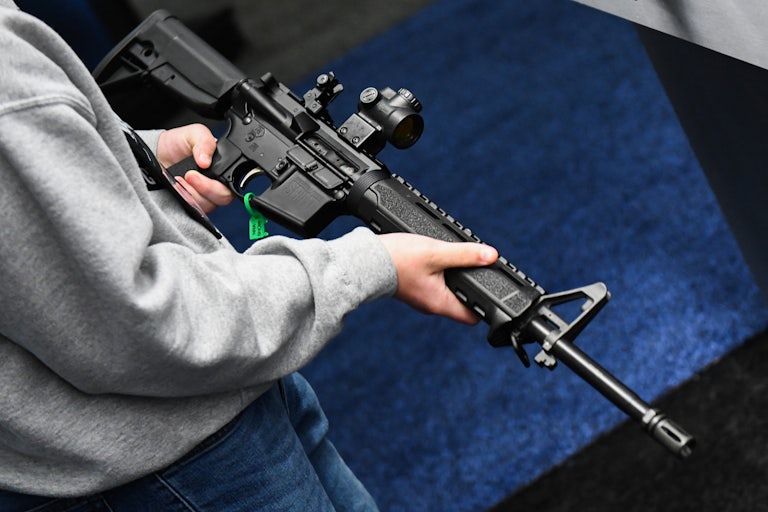
Republicans have consistently downplayed the dangers of the weapon that police fear the most.

Patrick T. Fallon/Getty Images

“You knew that it was definitely an AR. There was no way of going in.… We had no choice but to wait and try to get something that had better coverage where we could actually stand up to him.” This is what Uvalde Police Department Sergeant Donald Page admitted in an interview with investigators after the elementary school shooting that upended the community of Uvalde, Texas.

Last May, an 18-year-old, after shooting his grandmother in the face, infiltrated Robb Elementary in Uvalde, killing 19 kids and two teachers, leaving another 17 injured.

The police response has been criticized as being substantially liable for many of those deaths. Now Texas Tribune reporting reveals that one reason that there was so much maddening footage of the police officers’ inaction, as well as accounts of officers standing around, twiddling their thumbs, and even stopping other parents from taking action in their stead was because the officers themselves were fearful of the shooter’s AR-15.

“We weren’t equipped to make entry into that room without several casualties,” Uvalde Police Department Detective Louis Landry admitted in another investigation interview. “Once we found out it was a rifle he was using, it was a different game plan we would have had to come up with. It wasn’t just going in guns blazing, the Old West style, and take him out.”

The alternative to “the Old West style,” as the world saw, was nearly 400 law enforcement officers responding to a scene that let the shooter roam through the school halls for over an hour and 10 minutes, leading to the third-deadliest school shooting in America.

The Tribune notes that such hesitation in the face of an AR-15 had led police in other shootings—including at Stoneman Douglas High School in Parkland, Florida, and at the Pulse nightclub in Orlando—to respond less quickly.

Republicans, both in Texas and nationally, have opposed banning or further regulating weapons like the AR-15—even now as police officers themselves admit how dangerous the weapons are. Governor Greg Abbott derided even raising the minimum age to buy assault-style rifles from 18 to 21 years old as “unconstitutional.” Meanwhile, gun trade shows are blithely promoting guns like the “JR-15,” as on-ramp weapons for elementary-aged children.

Naturally, the debate over these weapons should not have progressed to the point where we’re learning something as obvious as: “Look, even the cops understand how petrifying these murder machines are.” If our governing structures were actually responsive to the concerns and fears of the people, one mass shooting would have been enough. The ruthless taking of innocent people—at a mall, the movies, school, the grocery store—should’ve been enough to bring some sort of change.

“(Police) knew the monster behind the door was not the kid. It’s the rifle the kid is holding,” said Jesse Rizo, who lost her 9-year-old niece Jackie Cazares in the shooting. “It’s the freaking AR that they’re afraid of.… Their training doesn’t say sit back and wait.”

If nothing else, the tapes revealed by the Tribune point to a matter of larger importance: Stronger gun regulation would protect police officers (and maybe also make them less reactionary-minded, not having to treat everyone as an existential threat), just as much it would help keep everyone else safer.

Capitol Police Had No Idea Republicans Were Giving January 6 Footage to Tucker Carlson

Repeated requests to review the footage were ignored.

Brent Stirton/Getty Images
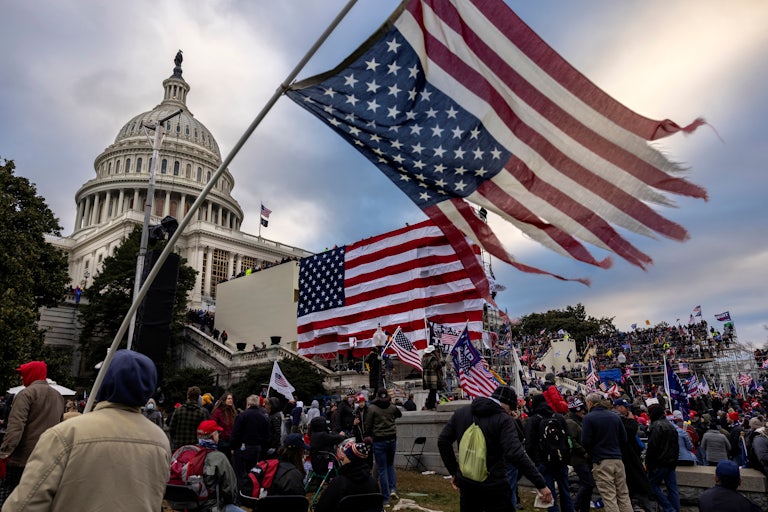
Pro-Trump protesters gather in front of the Capitol Building on January 6, 2021.

The Capitol Police were blindsided by Republicans’ decision to give security footage of the January 6 attack to Tucker Carlson, the department’s lawyer said Friday. Moreover, Capitol Police’s repeated requests to review the footage before it was released were ignored.

House Speaker Kevin McCarthy has come under fire for giving Carlson exclusive access to 41,000 hours of security footage from the 24 hours surrounding the insurrection. The Fox News host has used cherry-picked videos to completely sanitize the events of January 6, despite knowing full well himself what actually happened.

The footage “was not previewed with the Capitol Police nor was the Capitol Police informed before that access was granted,” CPD general counsel Thomas DeBiaise said in a sworn affidavit filed Friday.

“Of the numerous clips shown during the Tucker Carlson show on March 6 and 7, 2023, I was shown only one clip before it aired,” DeBiaise said. “The other approximately 40 clips … were never shown to me nor anyone else from the Capitol Police.”

DeBiaise also noted that the police force learned Carlson had gained access to the footage through media reports, not from House Republicans directly.

Both Carlson and McCarthy insisted that the footage was cleared with Capitol Police before it was released. McCarthy also intends to make the January 6 footage available to the defense lawyers for people charged in connection with the riot.

The California Republican insisted the footage was already made available to defendants under former House Speaker Nancy Pelosi. But a Pelosi spokesperson said she never authorized access to the footage because she felt that wasn’t under her purview, but that of “security officials.”

Capitol Police Chief Thomas Manger said earlier this month that once footage is given to lawmakers, he has little control over what they do with it. But he also slammed Carlson’s use of the footage, saying it minimized the violence of January 6 and was “misleading” and “offensive” about the Capitol Police’s actions.

Carlson used the footage to do exactly what people feared: present an alternate version of January 6 that sought to prove the rioters had done nothing wrong. His coverage was so bad that even some Republican lawmakers condemned it.

Democrats Who Pushed for Financial Deregulation Seem to Have No Regrets After Silicon Valley Bank

The Democrats who joined Republicans in rolling back Dodd-Frank seem perfectly fine with their vote, even after SVB’s collapse.

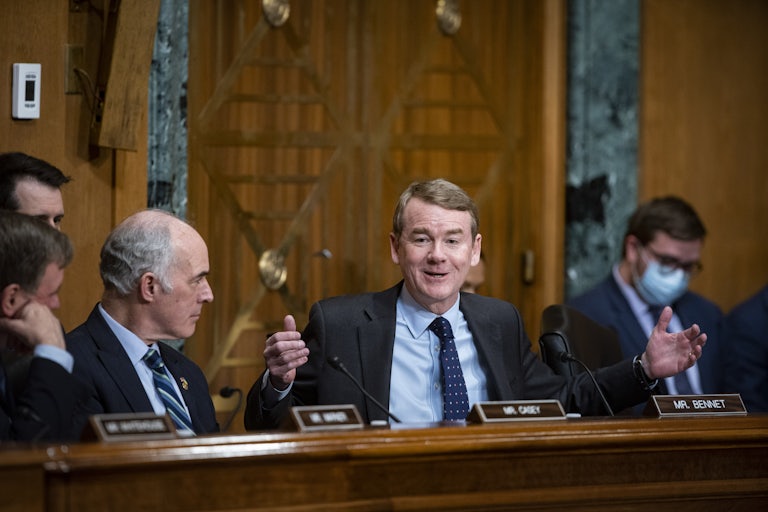
Senator Michael Bennet
Al Drago/Bloomberg/Getty Images
Senator Michael Bennet

Silicon Valley Bank collapsed last week after a massive bank run, spurred in large part by billionaire investor and GOP donor Peter Thiel. Such a collapse could have perhaps been avoided had the massive bank been subject to higher regulation and scrutiny. But not according to the Democratic senators who helped deregulate the financial industry.

The Democratic lawmakers who voted alongside Republicans in 2018 to roll back key Dodd-Frank regulations, ones that would have subjected SVB to greater regulations, seem to have no regrets for having done so.

In total, 16 Democratic senators joined all 50 Republicans five years ago in rolling back the regulations. Thirteen of those Democrats are still serving in office today, and so far this week, none have expressed regret for their 2018 decision. Most have justified their vote as support for smaller banks, skipping over the fact that the bill treated big banks like SVB as smaller than they were.

Senator Michael Bennet criticized SVB but said that he stands by his vote, under the guise of his support for smaller and rural banks.

Senator Tom Carper said Tuesday that at “this moment,” he doesn’t regret the vote, and instead called for hearings to figure out what happened.

Senator Chris Coons avoided directly answering questions from The Intercept about whether he could defend his vote given what is known about SVB now. “And just what is that?” he retorted, before pausing, adding, “Exactly,” as the elevator doors closed on a senator who cinematically refused to answer a simple question.

Senator Tim Kaine justified his vote by saying his “community banks really needed it.”

Senator Angus King told The Intercept that he would’ve voted the same way to help smaller banks and that there were still some regulations in place on SVB.

Senator Joe Manchin said he’s open to “making adjustments” to regulations but emphasized it was not a mistake to vote for the 2018 bill.

Senator Jon Tester pins the blame on the Fed, rather than the 2018 vote, saying they could have “put the same regulation on them that they do JPMorgan Chase.”

In a statement earlier this week, Senator Mark Warner invoked Dodd-Frank as a North Star to “protect depositors and make sure that our financial system remains stable,” but had little to say specifically about SVB’s management—or his own vote to weaken regulation on them. The Lever found that Warner held a fundraiser at SVB CEO Greg Becker’s home in 2016, and he also received $10,000 in donations from SVB’s PAC.

The offices of Senators Gary Peters, Krysten Sinema, Jeanne Shaheen, Debbie Stabenow, and Maggie Hassan—the remaining Democratic senators who voted for the 2018 rollback—did not respond by publication.

At this point, of course, there is no going back. But if these Democrats want to square the circle of purporting to care about smaller institutions while also recognizing where their vote may have fallen short (they don’t even have to admit they were wrong!), they could begin by supporting Elizabeth Warren’s aptly named Secure Viable Banking, or SVB, Act, which would repeal the provisions of the 2018 bill that allowed for banks like SVB to get by without stronger regulation.

It’s just that easy. The layup is there, if these Democrats want to bank it.

Texas GOP Bill Would Ban Students From China and 3 Other Countries From All Public Universities

Texas Republicans are fanning the flames of xenophobia and racism.

Brandon Bell/Getty Images
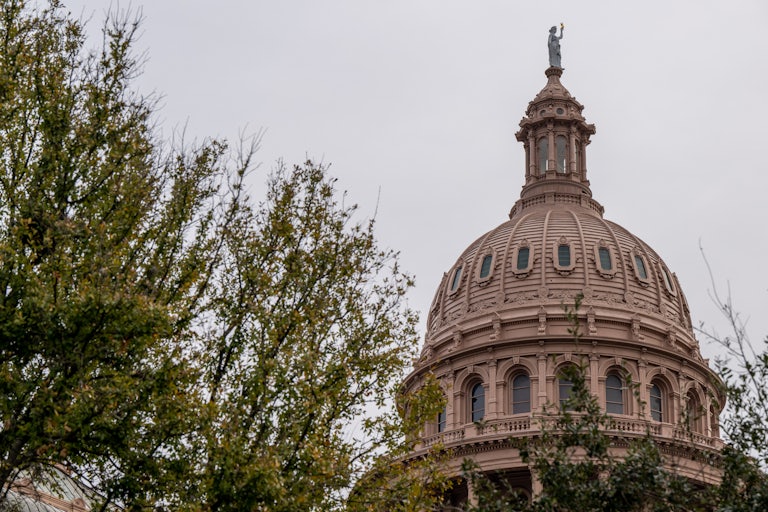
Texas State Capitol

Texas Republican lawmakers are under fire for a bill that would ban students from China and three other countries from all public colleges and universities in the state, with many calling the measure racist and xenophobic.

The bill, introduced last week, would prohibit higher education institutions from admitting international students from China, Iran, North Korea, and Russia, or any students who are undocumented. It also changes existing law to restrict the definition of a Texas resident. People who received a high school diploma or equivalent in Texas and lived in the state for three years prior to receiving that degree or for the year prior to enrolling in higher education no longer count.

The measure has “little chance of advancing” in the current legislative session, according to the San Antonio Express News, but it has still raised fears as it comes just two months after other Texas Republicans introduced a bill banning citizens from the same countries from purchasing land in the state.

That bill garnered months of backlash. Governor Greg Abbott endorsed the measure, even as local Asian American groups slammed it as racist.

Lawmakers amended the bill earlier this month to clarify that dual citizens and green card holders would still be allowed to buy property. But their attempt to cool the controversy was rightfully called out.

It’s still a fundamentally racist bill as it unfairly targets H1B visa holders, students, and refugees from exercising their full property rights,” the Texas-based Asian American group Rise AAPI said.

Both of these bills are painfully reminiscent of the Chinese Exclusion Act, which was enacted in 1882 and restricted Chinese immigration to and rights in the United States until 1943. That measure was a direct result of “yellow peril,” or racist fearmongering about Asian people. The heightened political tensions around race helped set the stage for much broader political scapegoating, when people of color were specifically blamed for issues in American society.

More recently, citizens of Iran and North Korea were targeted for years under former President Donald Trump’s travel ban. (Levels of immigration from North Korea to the United States are, of course, quite low.)

The Texas bills are also coming at a time of increased racial scapegoating. The nonprofit Stop AAPI Hate released a report in October that found Asian Americans are blamed for issues with the economy, public health, and national security.

Trump helped foment a lot of resentment towards China and Asian Americans through his rhetoric around Covid-19, calling it “Kung Flu” and the “China virus.” He and other Republicans blame China for deliberately spreading the coronavirus around the world. Their words helped spur a massive increase in anti-Asian hate in the past few years.

Lawmakers on both sides of the aisle accuse TikTok of spying on American users for the Chinese government, and the Biden administration has threatened to ban the app nationwide if it is not sold to a non-Chinese entity. But at the end of the day, it doesn’t really matter who owns TikTok: Bad actors get hold of private data all the time. China’s just a handy scapegoat.

And in February, Texas Representative Lance Gooden said he felt his Californian colleague Judy Chu needed “to be called out” and that her security clearance should be revoked.

“I question her either loyalty or competence,” he said.

Democrats rushed to Chu’s defense, with Minority Leader Hakeem Jeffries calling Gooden’s comments “dangers, unconscionable, and xenophobic.” But Chu herself summed it up best.

I very much doubt that [Gooden] would be spreading these lies were I not of Chinese American descent,” she said on MSNBC.