Breaking News
Breaking News
from Washington and beyond

“Largest Crowd I’ve Seen”: Hundreds Protest Kentucky’s Extreme Anti-Trans Bill Ahead of Veto Override

The Kentucky legislature is expected to push through one of the most extreme anti-trans bills in the country.

Yana Paskova/Getty Images

Hundreds of people, primarily teenagers, gathered outside the Kentucky state Capitol Wednesday to protest against one of the most extreme anti-transgender rights bills in the country, which the Senate is expected to vote into law.

Governor Andy Beshear vetoed the bill last week, warning that it will cause an “increase in suicide among Kentucky’s youth” if it becomes law. But the measure passed the state Senate by a veto-proof majority, and the chamber is expected to override Beshear’s veto on Wednesday or Thursday.

If it becomes law, Senate Bill 150 would ban all gender-affirming care for trans minors in Kentucky and would force doctors to detransition any minors in their care. It would prohibit discussing sexual orientation or gender identity in public schools at any level, prevent trans students from using the bathroom that corresponds to their gender identity, and would allow teachers to refuse to use a student’s preferred pronouns.

Courier Journal reporter Olivia Krauth, who has covered S.B. 150 extensively, said Wednesday’s crowd may be the biggest she’s seen during the current legislative session.

Protesters chanted, “Trans rights are human rights,” as they waved signs and listened to Democratic state senators speak.

One senator, Karen Berg, told the protesters, “You are perfect the way God made you. Remember that every moment of your life.” The bill is particularly personal for Berg, whose trans son died by suicide last year.

Later, when the session began, Berg warned her colleagues, “This hate will not stop. We know from history this is how you destroy a democracy.”

The crowd continued to grow throughout the morning, as more people showed up to express support for trans Kentuckians.

The ACLU of Kentucky described the bill when it passed as “the worst anti-trans bill in the country.” Republicans rushed S.B. 150 through the House and Senate in a record daylong sprint.

Kentucky is just the latest state to have lawmakers try to curtail LGBTQ rights. Last week, Florida advanced an anti-trans bill so broad and extreme it could also prevent people from getting breast cancer treatment. Georgia, meanwhile, passed a law banning gender-affirming care for minors and criminalizing medical workers who provide that care.

Howard Schultz Was Asked Directly if He Threatened Starbucks Workers for Unionizing. He Didn’t Say No.

Senator Bernie Sanders asked the former Starbucks CEO point-blank if he has ever threatened, coerced, or intimidated an employee for supporting a union.

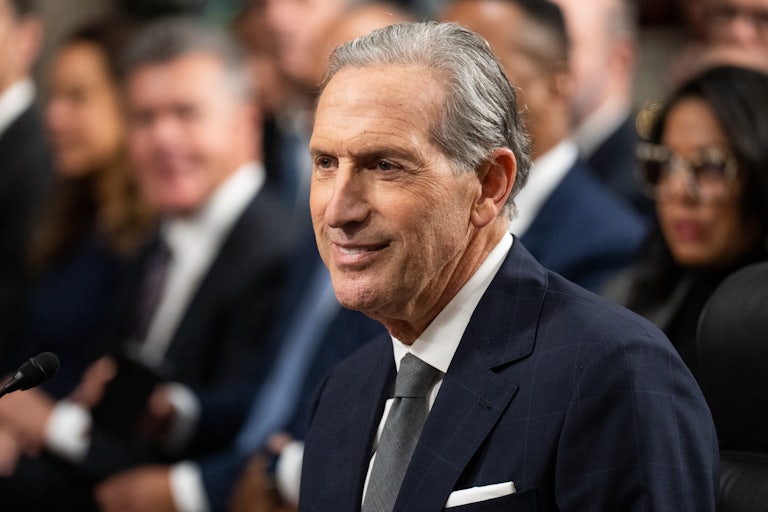
Howard Schultz smiles
Bill Clark/CQ-Roll Call, Inc/Getty Images
Howard Schultz, member of the Board of Directors and former CEO of the Starbucks Corporation

On Wednesday, as Howard Schultz testified in front of the Senate Health, Education, Labor and Pensions Committee, the former Starbucks CEO couldn’t definitively say he did not threaten workers for unionizing.

“Have you ever threatened, coerced, or intimidated a worker for supporting a union?” Senator and committee Chair Bernie Sanders asked Schultz.

Schultz waffled, saying people could have “interpreted” just as much.

“I’ve had conversations that could’ve been interpreted in a different way than I intended,” Schultz said. “It’s up to the person who received the information that I spoke to them about.”

The former Starbucks executive’s curious answer comes amid a surge of Starbucks stores attempting to unionize—and many workers accusing the massive company of working to stifle such efforts. 

Even while Schultz is surrounded by a panel of Republicans grossly sympathetic to union-busting and allowing private enterprise to march unfettered by regulation, he can’t weasel out of the basic origin of the hearing itself: Starbucks’s pattern of union-busting and threatening workers.

Tennessee Gov. Says He Lost Two Friends in the Nashville Shooting, but Now Is Not the Time to Be Angry

Reminder that Bill Lee helped loosen gun laws in his state.

Dylan Hollingsworth/Bloomberg/Getty Images

Bill Lee doesn’t have plans to change Tennessee’s gun laws anytime soon, despite the fact that earlier this week, a shooter killed three children and three adults, including some of the governor’s family friends.

A shooter opened fire at the Covenant School on Monday, killing at least three children and three adults and wounding several others. Two of the adults killed were close friends of Lee and his wife, the governor said in a video posted on Twitter Tuesday. One of them had planned to go to the Lees’ house for dinner that night.

But Lee insisted that now is not the time for change. “I understand that there is pain; I understand the desperation to have answers, to place blame, to argue about a solution that could prevent this horrible tragedy.… There will come a time to discuss and debate policy. But this is not a time for hate or rage. That will not resolve or heal,” he said

He praised school and law enforcement policies that help prepare students and staff for mass shootings—but did not point out that he helped Tennessee loosen its gun laws in the past few years, making it easier for mass shootings to happen in the first place.

Lee concluded by paraphrasing a Bible passage: “The battle is not against flesh and blood. It’s not against people. The struggle is against evil itself,” he said.

Except, he left something out. As Kentucky youth pastor Steven Levebvre noted, Lee skipped over that the battle is also against “the rulers, against the authorities, against the powers of this dark world.”

Lee and other Tennessee Republicans are burying their heads in the sand, insisting there was nothing they could have done to stop the shooting and that there is little they can do to prevent another one. In fact, they are skating around their own culpability in helping create the circumstances that allowed the shooting to happen.

Lawmakers failed two years ago to pass a red flag law that would have prevented Monday’s shooter from legally acquiring seven guns, three of which were used in the attack. In the past few years, they loosened gun restrictions and focused their energy on attacking LGBTQ rights.

Lee lost two friends, whom he said he has known for decades, in the shooting—and he still doesn’t feel spurred to action.

GOP Rep. Byron Donalds Tells People to Stop Being Emotional After Nashville Mass Shooting

The Florida representative apparently does not think the aftermath of a mass shooting is the proper time to talk about gun control.

Anna Moneymaker/Getty Images
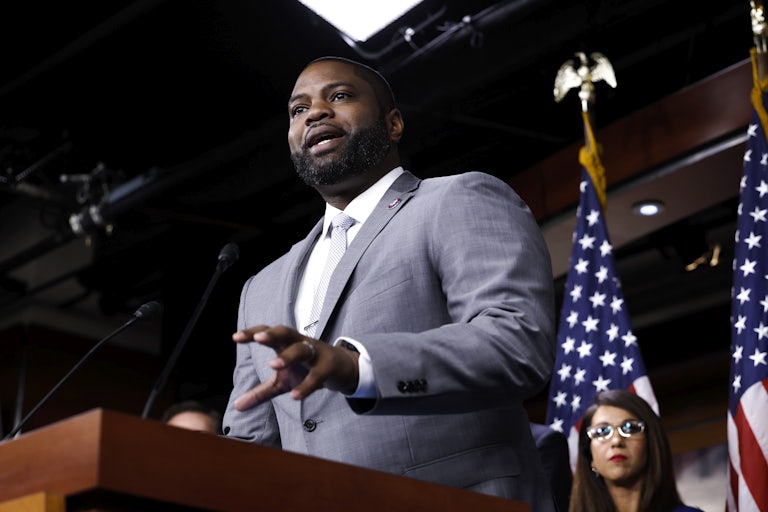
Representative Byron Donalds

Republican Representative Byron Donalds—the far right’s momentary preferred House speaker choice and onetime candidate for GOP conference chair—believes discussing gun control after yet another mass shooting is getting too “into emotion.”

Donalds made the claim after a school shooting in Nashville, Tennessee, in which three children and three adults were senselessly killed.

“Let’s not get into emotion, because emotion feels good, but emotion doesn’t solve problems,” Donalds told CNN’s Manu Raju.

Volumes could be written about an elected member of Congress chiding people for getting too emotional about six people being shot to death at a school (and the deep impacts that will last for the school, community, and victims’ families and friends).

“People are allowed to possess firearms. Need is in the eye of the beholder,” Donalds said. “I don’t question why you need a blue suit, but you got one. And I know we’re talking about something very, very different, but the Second Amendment allows American citizens to possess firearms,” Donalds continued, advancing the ludicrous analogy anyway.

Note, of course, on the basic level of what one chooses to wear, nudity and public decency laws still place reasonable regulations on how people dress in public. Even in Donalds’s wild analogy, the logic doesn’t hold; and if you were to take into account the levels of scale between apparel choice and possession of machines meant for killing, one would imagine that proportional regulation would severely limit firearm use.

Raju picked up on Donalds’s curious logic, asking the Republican why he wouldn’t support at least limiting access to weapons like the AR-15.

“If you’re gonna talk about the AR-15, you’re talking politics now,” Donalds responded.

It is unclear where the line between “political” and “not political” is in Donalds’s head. Moreover, it’s simply bizarre to make the distinction at all—everything a politician does is definitionally political. Donalds choosing to have no answer about how to stop kids from being shot in schools is just as “political” as him having even the ounce of integrity needed to admit there’s a problem at all.

This leads to the most fundamental point: that politics itself is in fact a good thing. Politics is the exercise of channeling popular will and enacting policy with respect to it. The reason that conservatives so often decry “politics” as a bad thing is because they do not operate in accordance with the democratic will. From seeking to overturn an election in which their preferred candidate lost by seven million popular votes—an effort Donalds was involved in, by the way—to not enacting gun laws supported by upward of 80 percent of Americans, Republicans are not shy about their disdain for doing anything that most people in this country want to happen.

In any other job, such behavior would get you fired; it’s beyond time the same standard is applied here.

Tennessee Shut Down a Red Flag Law That Could Have Stopped the Nashville School Shooting

Law enforcement said there are no laws in the state that would’ve allowed police to take weapons away from the shooter.

BRENDAN SMIALOWSKI/AFP/Getty Images
A child leaves flowers at a makeshift memorial for victims by the Covenant School building at the Covenant Presbyterian Church following a shooting in Nashville, Tennessee.

Tennessee lawmakers failed two years ago to pass a red flag gun law that could have stopped the shooter who attacked a grade school in Nashville.

A shooter opened fire at the Covenant School on Monday, killing at least three children and three adults and wounding several others. Police have identified the attacker as Audrey Hale, whom they said was under a doctor’s care for an undisclosed emotional disorder.

Hale was known to be suicidal and had reached out to a former classmate, Averianna Patton, with a suicide note before the attack. Patton tried to contact the police and was told to call the nonemergency number. By the time she got through, it was too late.

Hale also owned seven guns, all purchased legally before the attack, police Chief John Drake said. Three of those guns were used in the school shooting on Monday.

“There’s not a law for” reporting cases like Hale, Drake told a press conference. Had the police known about Hale, “then we would have tried to get those weapons. But as it stands, we had absolutely no idea who this person was or if (Hale) even existed.”

But there could have been a law: A Democratic state senator introduced what’s known as a red flag law in January 2020. The bill would have let family members, household members, intimate partners, or law enforcement officers petition a court to ban an individual who “poses an imminent risk of harm to the person or others” from possessing firearms.

If a judge granted the petition and issued an emergency order, the individual would have 48 hours to hand over any guns they already owned, and they would be prohibited from purchasing more until the order is terminated. But first, they would have to prove in a hearing they are no longer a threat to themselves or others.

Republicans held a supermajority in both the state House and Senate at the time (as they do now), and the bill never made it out of committees. In the years since, they have focused more on trying to curb LGBTQ rights than gun safety.

Following Monday’s tragedy, Tennessee Republicans have decided that there’s simply nothing they could have done differently to prevent the attack.