Breaking News
Breaking News
from Washington and beyond

Senator Dianne Feinstein Will Not Run for Reelection in 2024

The 89-year-old senator from California announced she will not run again in 2024, opening up the race to a field of potential Democratic candidates.

Senator Dianne Feinstein walks down a hallway, papers in hand.
Anna Moneymaker/Getty Images

Dianne Feinstein, California’s longest-serving senator, is retiring. The 89-year-old congressional veteran will serve the remainder of her term.

“I am announcing today I will not run for reelection in 2024 but intend to accomplish as much for California as I can through the end of next year when my term ends,” Feinstein said in a statement on Tuesday.

Curiously, it’s not actually clear whether Feinstein was aware the statement was released, or she just forgot it was happening. Reporter Matt Laslo asked Feinstein about the retirement, and she seemed to have forgotten, or, in a generous interpretation, misspoke:

Having served in the Senate for 30 years, Feinstein was the first female Jewish senator elected to Congress and then joined Barbara Boxer, also Jewish, in being the first female senatorial duo to represent a state at the same time.

At her best, Feinstein authored the 1994 federal assault weapons ban and chaired the Senate committee tasked with investigating and releasing a report on the CIA’s tortuous interrogation practices. At her worst, she could be seen chiding young children advocating for the Green New Deal, condescendingly complaining about them asking her to deliver a livable future. “You didn’t vote for me,” she said.

While Feinstein had filed early Federal Election Commission paperwork indicating she would indeed seek reelection in 2024, any momentum seemed to stall. In the past year, lawmakers and staffers alike have expressed concerns about the oldest sitting U.S. senator’s mental capacities and whether she could continue serving.

Amid the speculation surrounding the California senator’s future plans, other younger and well-known Democrats were raring to show their eagerness to vie for Feinstein’s seat. Representatives Adam Schiff and Katie Porter have already announced their candidacies; Representative Barbara Lee has said she will be running for Senate as well. Representative Ro Khanna has also indicated an interest in the seat, though he has said he would take Lee’s intentions into account.

This post has been updated.
There Are So Many School Shootings in America That Students Now Live Through Multiple Ones

Multiple students who survived the Michigan State University shooting also survived the shootings at Sandy Hook and Oxford High.

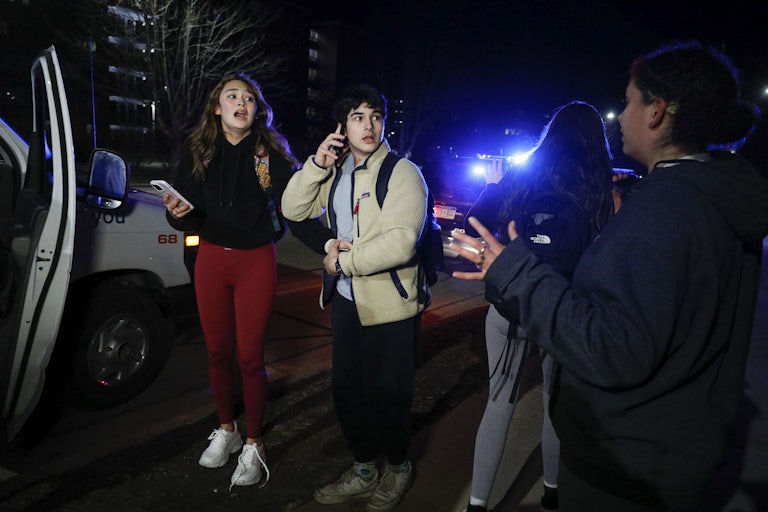
A group of three four students stands outside at night. Two of them are on the phone and look afraid.
Bill Pugliano/Getty Images
Michigan State University students react during an active shooter situation on campus on February 13.

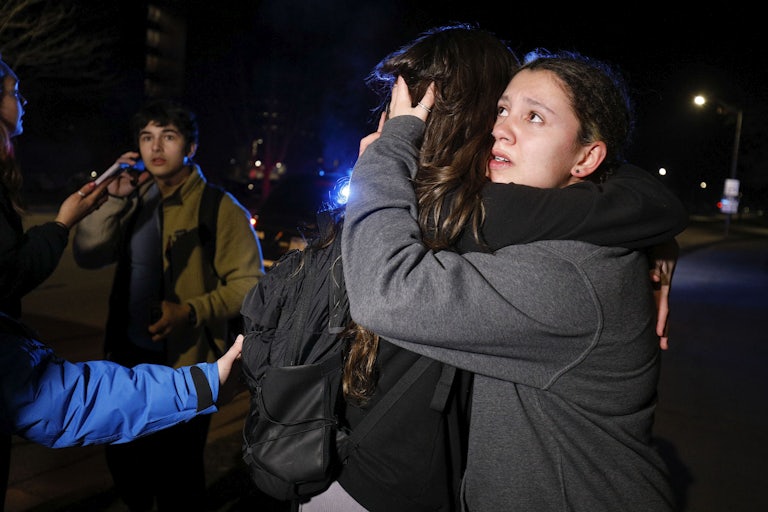
As students sheltered in place during the shooting at Michigan State University Monday night, the experience was doubly traumatizing for many, as they had lived through such a nightmare before.

The tragedy at MSU, which left three dead and five wounded in critical condition, is the sixty-seventh mass shooting this year. There have been more mass shootings than there have been days in 2023.

Horrifically, school shootings seem to have become the norm in the United States. The MSU attack was Michigan’s second school shooting in about a year, coming 14 months after a student opened fire at Oxford High School in Michigan (four dead, seven wounded). It came on the fifth anniversary of the Parkland school shooting in Florida (17 dead, 17 wounded) and a little more than 10 years after the Sandy Hook massacre in Connecticut (26 dead, two wounded). Graduates of all three schools now attend MSU.

In a video that quickly went viral, one Sandy Hook survivor slammed the MSU shooting.

@jmattttt Enough is Enough. #spartanstrong #sandyhookstrong ♬ original sound - Jmattttt

“The fact that this is the second mass shooting that I have now lived through is incomprehensible,” the 21-year-old, who uses the handle Jmattttt, said in the TikTok. “We can no longer just provide love and prayers. It needs to be legislation, it needs to be action. It’s not OK.”

One Oxford alum was across the street from where the shooting began and immediately called her mother. “She said that she had PTSD. She said she can’t believe this is happening again,” her mom told the Detroit Free Press, who asked that the student’s name not be used.

“She said, ‘Mom I just want to come home, I want to hold you.’”

The mother of another Oxford graduate, whose name was also withheld, told the Local 4 station that it was “like reliving Oxford all over again.”

The woman said that instinct kicked in for her daughter and for herself. “It’s really, really surreal to have to worry about this, and to know exactly what to do,” she said.

Three MSU freshmen had lived in Rochester, Michigan, a few towns over from Oxford, and vividly remembered the shooting there.

“I don’t feel safe anymore at MSU … and now we have to spend the next three years here,” one told local reporter Rachel Louise Just.

The Michigan state government has repeatedly called for gun control, and House Majority Whip Ranjeev Puri was livid Tuesday as he highlighted the fact that such mass shootings only happen in the U.S.

“Fuck your thoughts and prayers,” he said in a statement. “We do not need to live like this.”

Nikki Haley (Finally) Admits She’s Running for President

The former South Carolina governor has balanced a careful line of keeping warm relations with Trump while distancing herself when she had to. Now what?

Nikki Haley speaks at a podium
WADE VANDERVORT/AFP/Getty Images

Nikki Haley is running for president.

After much speculation of will-she-won’t-she spanning as far back as when she was floated as a potential vice presidential pick in 2012, the former South Carolina governor now joins the field against the same man who appointed her as U.S. ambassador to the United Nations.

Haley, like many Republicans, has carefully trodden the line between maintaining warm relations with former President Donald Trump while also trying to distance herself from the twice-impeached leader whenever she felt compelled to. But in her video announcement on Tuesday, Haley called for “a new generation of leadership,” seemingly a slight dig at Trump.

Haley also pointed out in her ad that “Republicans have lost the popular vote in seven out of the last eight presidential elections,” saying that has to change (perhaps an admission that it’s bad, and maybe invalidating, for a party to lose the popular vote).

Haley’s balancing act thus far has been pretty pathetic to watch, as has her journey to choosing to run in 2024.

After resigning as Trump’s U.N. ambassador in 2018, she moved back to South Carolina and published a memoir the following year, slowly building up funds through speaking engagements. In 2021, Haley had said she wouldn’t challenge Trump if he ran.

“I would not run if President Trump ran, and I would talk to him about it,” Haley told the Associated Press. “That’s something that we’ll have a conversation about at some point, if that decision is something that has to be made.”

And a conversation they did indeed seemingly have. Trump apparently blessed Haley’s candidacy. He recently told reporters that Haley called him in January to tell him she was considering jumping in and that he told her she “should do it.”

Though she seemingly calls for change in her announcement ad, Haley has long had the impulse to pacify Trump and has refrained from directly criticizing him the last few years. This, even while she’s running against him, says all you need to know about most of the people who have expressed interest in running against Trump: They simply don’t have the juice. Tim Scott, another South Carolina Republican rumored to be toying with a run supported by numerous members of Congress, has previously said he would support Trump in a 2024 bid (he said this after January 6, 2021), and then a year later implied he’d be happy to be Trump’s running mate.

And if Haley, or Republicans generally, plan to recoup the popular vote, they have a tall task ahead of them. Trump lost to Biden by over seven million votes in 2020. And Republicans’ unpopular agenda that focuses more on whipping up imagined culture wars and taking away the right to abortion has not paid off since, given the party’s relatively poor performance in 2022.

Haley and any other Republican of color who chooses to run will also deal not only with the Trump-elephant in the room but also navigating how they manage their own identity. In her ad, Haley described herself as “the proud daughter of Indian immigrants.” But she registered herself as “white” on her 2001 voter registration card. She has also previously invoked her Indian roots as she backed Trump’s 2020 bid, claiming “America is not a racist country,” in the same breath that she recounted discrimination her family faced upon immigrating to America.

Some of this racial navigation has also come in the form of Haley saying U.S. citizen Senator Raphael Warnock should be deported.

Haley will of course also face a challenge of being a woman of color candidate in general. One 2022 poll showed that, unfortunately, voters of all stripes see the “ideal” president as a man. But among Republicans in particular, 50 percent said the ideal president would be male while just 2 percent said she would be female.

While Haley navigates not trying to step on Trump’s toes and trying to appease the racist factions in her party, she assured in her ad that, in this ring, she has her gloves on. “You should know this about me: I don’t put up with bullies,” she said. “And when you kick back, it hurts them more if you’re wearing heels.”

The Michigan State University Shooting Is the 67th Mass Shooting This Year

There have been more mass shootings than there have been days in 2023.

Bill Pugliano/Getty Images
Michigan State University students hug during an active shooter situation on campus on February 13.

The tragic shooting at Michigan State University is the sixty-seventh mass shooting in the United States this year, according to the Gun Violence Archive.

A gunman opened fire on the campus in East Lansing, Michigan, on Monday night, killing three people and wounding five, who are hospitalized in critical condition.

There have been more mass shootings than there have been days in 2023.

Campus police said the suspect, a 43-year-old man, was not affiliated with MSU as a student or employee, and they do not yet know why he targeted the school. He died of a self-inflicted gunshot wound on Monday night.

“This truly has been a nightmare that we are living tonight,” MSU Police Interim Deputy Chief Chris Rozman told a press conference.

“We have no idea why he came to campus to do this,” Rozman said at a separate press briefing. “We have absolutely no information about what the motive was, and I can’t even imagine what the motive may be.”

This is Michigan’s second school shooting in about a year. In November 2021, a 15-year-old student in the town of Oxford opened fire on his high school, killing four classmates and wounding six others and a teacher. He pleaded guilty in October 2022 to 24 criminal charges, including terrorism causing death and first-degree murder. Some of the students who survived the Oxford High shooting experienced that trauma again Monday night.

Michigan Governor Gretchen Whitmer has repeatedly called for increased gun control, most recently in her State of the State address on January 25.

“The time for only thoughts and prayers is over,” she said during the speech. “And I want to be very clear—I’m not talking about law-abiding citizens.”

“Hunters and responsible gun owners from both sides of the aisle know that we need to get these commonsense gun safety proposals across the finish line.”

She decried the shooting early Tuesday, highlighting the “uniquely American” nature of mass shootings.

But gun regulation is a highly contentious issue in the U.S., where Republican lawmakers repeatedly block attempts to pass gun control legislation. The Supreme Court ruled last year that Americans can carry handguns for self-defense, making it easier to acquire concealed-carry permits nationwide. Meanwhile, a gun manufacturer recently brought back the “JR-15,” a child-size AR-15 rifle.

Life After the Ohio Train Derailment: Trouble Breathing, Dying Animals, and Saying Goodbye

After a train derailment in East Palestine, Ohio, leaked noxious chemicals, residents in the area are still trying to recover.

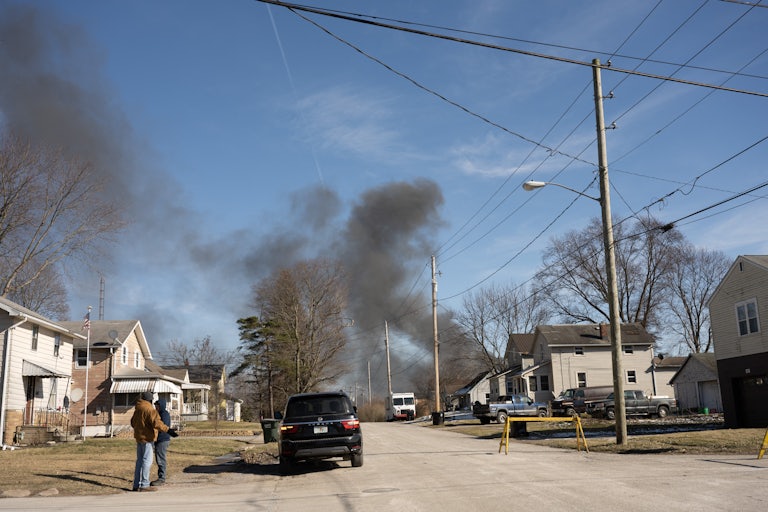
Smoke rises from a derailed cargo train in East Palestine, Ohio, in the background. Two people wearing coats stand in the left of the foreground, in a neighborhood.
DUSTIN FRANZ/AFP/Getty Images
Smoke rises from a derailed cargo train in East Palestine, Ohio, on February 4.

On February 3, a devastating 150-car train derailment in East Palestine, Ohio, leaked noxious chemicals like carcinogenic vinyl chloride into the surrounding air, soil, and water. Officials say it’s now safe for people to come home. But the harm has not stopped: People in East Palestine and neighboring towns are suffering from respiratory issues, skin reactions, and more, while animals have been found dead. And it’s not clear what support residents have—or who even qualifies for that support.

After the derailment, the Norfolk Southern train had to undergo a “controlled burning” in order to safely release the cargo’s toxic chemicals. Before this was done, Ohio Governor Mike DeWine issued a one-mile evacuation zone surrounding the crash site. Norfolk Southern has been tasked to clean up the mess. After an initial $25,000 donation to the community, the company said they would give $1,000 “inconvenience checks” to residents within the evacuation zone; the company also has offered to reimburse expense receipts for residents within East Palestine.

But residents have reported inconsistencies with the policy, and frustrations with the one-mile qualification bar, as many far beyond that zone had to evacuate and are suffering symptoms. While air tests commissioned by the rail company, and some conducted by the EPA, have thus far deemed chemical amounts to be at safe levels, some experts have warned that impacts could be enduring if and when the chemicals seep into the soil and groundwater. And people feel that neither Norfolk Southern, nor the government, offers clear guidance.

Amanda Greathouse, who resides near the crash site, evacuated about one hour after the incident. She only returned home on February 10, a full week later, to retrieve personal effects like bank and ID cards. Even then, as she and her family walked through the home donning N-95 masks and gloves, an ominous odor pervaded. After leaving, her eyes burned and itched, her throat was sore, and she had a rash; her husband and both her sisters had migraines.

The next day, the family went to Norfolk Southern’s community family assistance center to obtain the $1,000 inconvenience check. After a four-hour wait, Greathouse was informed they needed more documents. The family was forced to return to their home again to retrieve additional documents, and left with renewed symptoms.

Reports of suffering animals, from dogs and cats to fish and chickens, continue to accumulate. Taylor Holzer, an animal caretaker, lost one of his foxes. Others are in poor condition with faces swollen, stomachs upset, and eyes watering. Holzer’s dog, who hadn’t returned home until after the evacuation order was lifted, has begun coughing and gagging. “He will go into coughing fits so hard his front legs bow and he looks so uncomfortable,” Holzer said.

After the derailment, Andrea Belden noticed her two-year-old cat Leo lying motionless, heart racing and breathing labored. He remained that way overnight. Leo was found to have congestive heart failure. Fluid filled around his heart and lungs, and his liver enzymes shot up 690 percent higher than normal levels. Medication wasn’t working. He seldom moved, ate or drank, or went to the bathroom. To continue treatment, Belden would’ve had to come up with up to $18,000. She sought help from Norfolk Southern, with a letter from the vet explaining Leo’s issues likely to be connected to the vinyl chloride. The company said they would not pay for it now, but would possibly entertain it in the future. Belden couldn’t afford to continue the treatment. Norfolk Southern’s delay forced her to make an impossible decision. Leo was put to sleep. Belden still owed $9,678.23 for the treatment Leo received.

Chelsea Simpson, who also lives near the site of the derailment, has suffered from a sore throat while her 8-month-old baby has suffered respiratory issues. Urgent care doctors gave the baby a steroid while Simpson was prescribed an antibiotic. After Simpson visited her home for 10 minutes a few days ago, her eyes were bloodshot and burning.

Simpson was told by the company that she would receive reimbursements for expense receipts, but would not qualify for the $1,000 check despite residing within the one-mile zone and being among those forcibly evacuated. Meanwhile, a cleaning service the rail company has commissioned to serve those residing within the radius still reached out to Simpson—so it remains unclear why the company will not also offer her family the $1,000 check.

While Simpson has been denied compensation duly owed by Norfolk Southern policy, others outside the mile radius deserve just as much care.

On February 6, the day of the controlled burn, Therese Vigliotti, who lives 15 miles north of East Palestine, was having a cigarette and cup of coffee as she noticed a slight odor in the air. During her next smoke break, she noticed her coffee tasted strange. She then realized her tongue felt funny, and her lips and soft palate felt numb. Her throat began to hurt. Throughout the week, her throat continued to hurt and she felt a burning sensation on her tongue. She even found blood in her stool. “I appreciate the hell out of you for reaching out to me [because] I’m honestly really scared,” Vigliotti said. “And please understand I am not losing my wits over the whole thing.”

Many others TNR spoke with, in and outside the one-mile radius, reported similar symptoms: headaches, burning sensations, severe dehydration, and more. But the town’s nearly 5,000 residents are left unsure about who qualifies for what support in the face of these ailments. Left with little guidance from local officials, and increasing reports of health concerns, paranoia and distrust is growing in the community, especially after authorities last week arrested a journalist covering the derailment. People now lean on the internet and mutual support, while feeling as if the government is not helping and instead just referring them to the good will of a corporation.

“It kinda sucks we’re all getting the majority of our information from fellow residents on Facebook,” said resident Liz Smith. “So it’s hard to tell what’s true or not.”

It didn’t have to be this way. Norfolk Southern is among the gargantuan rail companies that have lobbied against a myriad of industry improvements, like updating the same braking system that failed in East Palestine. Rail workers (who just had a rail contract imposed upon them) had already warned about how corporate malfeasance could lead to a disaster like this. A nearly identical crash happened in New Jersey in 2012, when a Norfolk Southern train carrying vinyl chloride derailed. Many community members reported similar symptoms at the time to those in East Palestine; some had symptoms even years later.

“I am concerned that the area has been deemed safe so quickly without extensive data to show the risk has been reduced,” said Dr. Michael Koehler, member of the American Chemical Society’s Committee on Chemical Safety. “As long as safety concerns remain, it is hard to understand how they authorized residents to return.”

Though officials report conditions to be safe, an inordinate amount of suffering is taking place. Moreover, the cleanup after the derailment did not guarantee the soil would avoid contamination. A Norfolk Southern spokesperson conceded that “it’s hard to tell what was burned off and what went into the soil.”

In a letter to Norfolk Southern last week, the EPA noted “areas of contaminated soil and free liquids were observed and potentially covered and/or filled during reconstruction of the rail line including portions of the trench/burn pit that was used for the open burn off of vinyl chloride.” The agency noted other toxic chemicals including butyl acrylate, ethylhexyl acrylate, and ethylene glycol monobutyl ether are also continuing to be released into the air, soil, and water.

So why are people being told it’s safe to return before Norfolk Southern completes the necessary cleaning still left to be done? The controlled burning may have been the best option at the moment; vinyl chloride and other compounds are explosive, so it had to be dealt with carefully. But the cleanup doesn’t stop there, noted Delphine Farmer, chemistry professor at Colorado State University. The burning released numerous other compounds and pollutants, some of which can sneak into people’s homes without air monitors picking up on them in the specific moment they might be checking.

For her part, Greathouse doesn’t feel confident about staying in East Palestine anymore. “As soon as we got in town the first time a train went through [my] chest got tight with anxiety,” she said. “My 4-year-old is scared to be home, and honestly the possible long term health repercussions are not something I’m willing to risk with our toddlers.” It’s a decision she does not take lightly; Greathouse loves her community.

“My 4-year-old goes to the local Head Start in East Palestine. Every single one of his teachers and the family advocate have been in constant contact with us checking on him and our family in general,” she said. “I honestly don’t know how we would be making it through this without their love and support. While the government hasn’t done much, if anything, to assist, and Norfolk Southern is making aid difficult to receive, our community and the Head Start program have pulled together and we will be forever grateful for that.”