Breaking News
Breaking News
from Washington and beyond

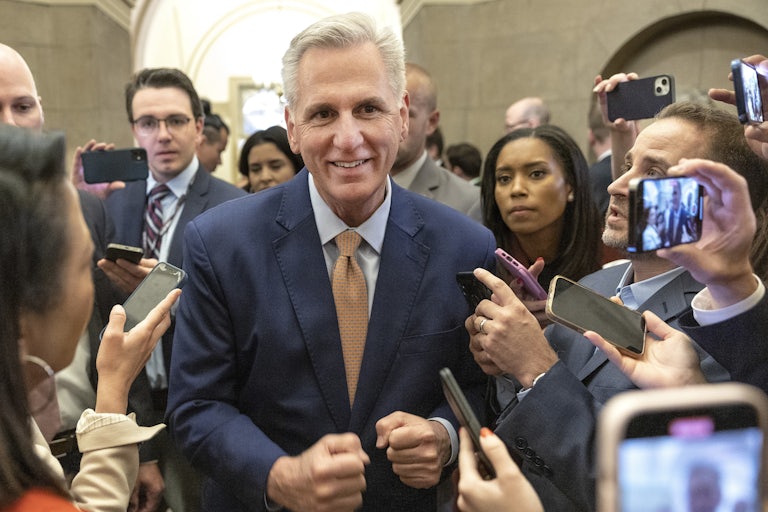
Here Are the House Republicans Expected to Vote Against the Debt Ceiling Deal

Kevin McCarthy does not have his entire party behind him.

Alex Wong/Getty Images
Kevin McCarthy

House Speaker Kevin McCarthy seems confident that he can rally enough Republican votes to pass the new debt ceiling bill—but it doesn’t look like he’ll have an easy time.

Republican and White House negotiators finally reached a deal over the weekend to raise the debt ceiling and avoid default, just days before the U.S. government runs out of money. But the outcry from the GOP has been swift.

At least 25 Republican representatives have already stated they intend to vote against the bill. Others have expressed opposition to the measure, a sign that they will likely vote “no.” Texas Representative Wesley Hunt and Florida Representative Cory Mills both said they would not vote for the deal.

Matt Gaetz said he, Ken Buck, Tim Burchett, and Andy Biggs (who has never been a McCarthy fan) “have never voted to raise the Debt Limit for this woke and weaponized government.” Victoria Spartz said she “will NOT support this gamesmanship” and suggested giving negotiators more time to make a new deal—even though there’s no time left, thanks to Republican refusal to negotiate.

Nancy Mace said she would vote “no” on the bill and called Washington “broken.” (Take this one with a grain of salt though. Mace very publicly opposed three previous GOP leadership-backed bills: one to remove Ilhan Omar from the Foreign Affairs Committee, an anti-abortion bill, and McCarthy’s previous debt limit bill. She ultimately voted for all of those measures, so the odds are good she will pull a similar 180 here.)

Other definite “no”s include Chip Roy, Anna Paulina Luna, Byron Donalds, and Lauren Boebert—all members of the far-right House Freedom Caucus that vehemently opposed McCarthy’s bid for speakership and has been a thorn in his side ever since he won the gavel. McCarthy made multiple concessions to the caucus in order to become speaker, including restoring the motion to vacate, which would allow any single member of the House to call for a vote to remove him.

Members expected to vote “no” include Andy Ogles, Clay Higgins, and George Santos. Santos’s opposition is surprising, given he essentially owes his continued congressional career to McCarthy. The speaker has repeatedly been willing to overlook Santos’s many, many fabrications and legal troubles in order to keep the House majority. Mike Lee has also indicated he opposes the bill, tweeting that the House Rules committee should reject the deal and negotiators draw up a new one, “this time without the capitulation.”

This post has been updated.
Kevin McCarthy: We’re Putting Work Requirements on ... Kids?

That’s one way to sell your debt ceiling deal to the American public.

Kevin Dietsch/Getty Images

On Tuesday, House Speaker Kevin McCarthy took to the morning shows to boast about a deal made between Republicans and White House leadership to raise the debt ceiling in exchange for spending cuts and work requirements. And one of the benefits of the deal, according to McCarthy? Requiring kids to work for their benefits.

“In this family, we may have a child that [is] able-bodied, not married, no kids, but he’s sitting on the couch collecting welfare,” McCarthy said on Fox. “We’re going to put work requirements on that individual, so he’s going to have work requi—he’s going to get a job. And he’s gonna make the life easier.”

Presumably, McCarthy was referring to individuals above the age of 18 who may be living with their family (though, given the GOP’s recent hustle to become the party of child labor, uncertainty is understandable here).

It’s unclear what exactly McCarthy is referring to in his remarks. The debt deal proposes imposing new work requirements for food assistance, or SNAP, on childless adults aged 54 and younger—raising the current maximum age of 49. The bill also lowers the percentage of people states can exempt from work requirements for SNAP. But all homeless people, veterans, and young people aging out of foster care will be exempt from the requirements. There’s not much else the bill does to target “children” sitting on their parents’ couches.

As far as cash assistance goes, the bill modifies the Temporary Assistance for Needy Families formula, potentially making it harder for some states to disburse cash assistance at all.

All that is to say, McCarthy is doing his routes on the TV news circuit, boasting about putting work requirements on “children,” all while actually not doing so at all. He’s reminding the country of Republicans’ desire to turn kids into laborers, and also misleading conservatives who actually do want such work requirements.

Trump Lawyer Wasn’t Allowed to Search for Classified Documents in Mar-a-Lago Office

Evan Corcoran was stopped by someone from searching the exact place where many of Trump’s classified documents were kept.

Donald Trump raises his hand in a wave. He wears a white Make America Great Again cap.
James Devaney/GC Images

Donald Trump’s lawyer says he was prevented from searching for classified documents in the former president’s office at Mar-a-Lago, where the FBI later found the most sensitive materials kept at the resort.

Evan Corcoran found 38 classified documents in the estate storage room last June following a Department of Justice subpoena, and he told the department that that was all there was to be found. The FBI raided Mar-a-Lago two months later and seized 101 additional classified documents, including from Trump’s office. The documents found in the office were some of the most highly classified of the entire batch.

Corcoran told associates that several Trump aides told him all materials brought from the White House after Trump left were kept in the storage room, so he only needed to search there, The Guardian reported Tuesday. Corcoran said he asked whether he should search the office too, but was sent away from the room and never allowed to search it.

Corcoran did not specify who steered him away from the office, whether it was Trump himself or an aide. A Trump spokesperson has denied the allegation. But The Guardian points out that Corcoran’s new account suggests he was intentionally misled about the documents.

This wouldn’t be the first time Trump or one of his allies misled his own legal team about the documents. A judge ruled in March that some of Trump’s attorney-client privileges could be “pierced,” after prosecutors on special counsel Jack Smith’s team found that Trump intentionally misled his own lawyers, including Corcoran, about keeping classified materials when he left office.

U.S. Judge Beryl Howell ordered Corcoran to comply with a grand jury subpoena for testimony on six different lines of inquiry. She also ordered him to hand over records of Trump’s alleged “criminal scheme,” including handwritten notes, invoices, and transcriptions of personal audio recordings.

Some of those notes revealed that Corcoran had warned Trump about needing to comply with the Justice Department’s subpoenas. The notes reveal that Trump and his valet, Walt Nauta, knew exactly where and when Corcoran was planning to search for the documents at Mar-a-Lago. Nauta had previously testified that Trump asked him to move boxes out of the storage room both before and after the subpoena was issued.

According to Corcoran’s notes, Nauta had offered to help him look through the boxes in the storage room, which Corcoran declined. But Corcoran took breaks during the multiday search, leaving the storage room unattended multiple times. The Guardian reported that it is possible prosecutors are investigating whether Nauta knew exactly what was in the boxes he was moving.

In addition to Smith’s investigation into Trump’s handling of classified documents and role in January 6, the former president is also under investigation in Georgia for his efforts to overturn the 2020 election. He has been indicted on 34 felony counts of falsifying business records for paying hush money to porn actress Stormy Daniels.

Trump was found civilly liable for sexually abusing and defaming writer E. Jean Carroll—and last week, she sued him for defamation again over comments he made about her during a CNN town hall.

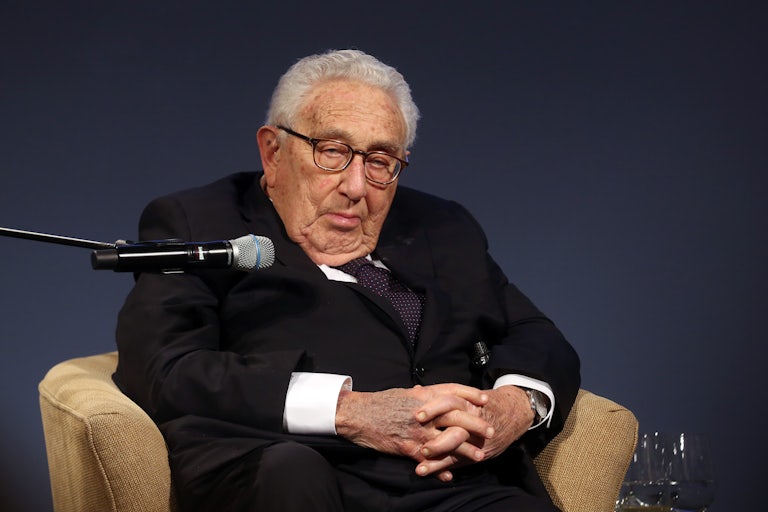
Happy 100th Birthday, Henry Kissinger

Still a war criminal

Adam Berry/Getty Images

One hundred years.

More years than many of us may be so fortunate to have on earth, a place where every minute, every day we have can significantly impact the time others have on earth too.

For years, outlets and writers have defended, sought to explain or complicate, and even hailed Henry Kissinger and his legacy.

Today, we remember all the minutes, all the days lost, from all the days Kissinger has lived and still has to come.

Happy 100th birthday, Henry Kissinger. You have a lot to answer for.

Poll: Half of Americans Don’t Know if the Abortion Pill Is Legal or Not

Republican attacks on mifepristone are succeeding.

Packages of Mifepristone tablets
Anna Moneymaker/Getty Images
Packages of Mifepristone tablets

Almost half of Americans don’t know whether the abortion pill mifepristone is legal, a report released Friday found, a sign that Republican attacks on abortion access are succeeding.

Mifepristone, one of the medications used to induce an abortion, is still legal nationwide, but it has gone through a lot of legal back-and-forth over the last few months. In April, the Supreme Court temporarily halted lower court rulings that would have restricted access to the pill. The Fifth Circuit Court of Appeals is expected to rule on mifepristone soon. If someone hasn’t been following the case closely, it would be understandable if they didn’t know what was going on anymore.

As it turns out, that is exactly the case. A poll conducted by the Kaiser Family Foundation found that 45 percent of all adults are “unsure” whether medication abortion is available in their state. If people live in a state that restricts or bans abortion, they are less likely to know what options are available to them.

For instance, in the 25 states and Washington, D.C., where abortion is legal, about 60 percent of people know current medication abortion laws. But in the 14 states where all abortion is banned, only one-third of people actually know this. More than half are unsure, and 13 percent believe medication abortion is still legal.

The confusion is the point: If people don’t know whether they can get an abortion or not, then they will be less likely to seek one out of fear of the legal repercussions. This will mean fewer abortions overall, the same result as banning mifepristone altogether. So even if the pill remains available, anti-abortion activists have already won by leaving health care providers and patients scrambling to try to figure out what options, if any, they actually have.

KFF surveyed nearly 1,700 adults between May 9 and 19, shortly after the Supreme Court kept mifepristone legal. The poll also followed a series of bombshell reports that Justice Clarence Thomas secretly accepted lavish gifts for decades from billionaire Republican megadonor and Nazi memorabilia collector Harlan Crow. These were soon followed by reports that Justice Neil Gorsuch sold property to the CEO of a law firm whose lawyers have argued about two dozen cases before the Supreme Court and that Chief Justice John Roberts’s wife was allegedly paid more than $10 million by law firms, at least one of which has argued before the Supreme Court.

The scandals have tanked public opinion of the nation’s highest court. The KFF poll found that 58 percent of Americans disapprove of how the Supreme Court does its job. This matches a poll conducted by NPR, PBS NewsHour, and the Marist Institute for Public Opinion in late April that found that 62 percent of Americans say they have not very much confidence or no confidence at all in the Supreme Court. This is the lowest number since the NPR/PBS/Marist poll was first conducted in 2018, when almost twice as many people said they had confidence in the court.

The KFF poll went a step further and found that only 37 percent of Americans trust the court to decide on cases about reproductive and sexual health. Only about half of Americans trust the court to weigh in on cases about science and technology (55 percent), the role of the federal government (53 percent), and the Affordable Care Act (49 percent).

The Supreme Court has become increasingly politicized, from the appointment process to the justices themselves, and people are starting to see it. That politicization chips away at public trust in the institution. It’s no longer clear that the court will uphold people’s rights, as opposed to wielding its almost absolute authority to impose its personal beliefs on the country.