Breaking News
Breaking News
from Washington and beyond

Republican Lawmaker Warns the “Great Replacement” Is Coming

Michigan state Representative Josh Schriver still hasn’t deleted his post.

The Michigan state Capitol building. In front of it is a pick-up truck with an American flag flying off the end.
Emily Elconin/Getty Images
The Michigan state Capitol building

A Michigan lawmaker posted an overtly racist image on Tuesday, using his office’s official account to elevate a white supremacist conspiracy theory on X, the platform formerly known as Twitter.

The image, which depicts Black silhouettes covering much of the world, with white silhouettes straddling small portions of Canada, Northern Europe, and Australia, was captioned, “The great replacement!” referring to a white nationalist far-right conspiracy theory that baselessly purports that nonwhite people, especially from Arab countries, are demographically replacing white populations.

Right-wing pundit Jack Posobiec initially posted the image, but Michigan state Representative Josh Schriver quickly reshared it, adding an emoji of a chart in decline.

Groups within his district weren’t happy about the apparent endorsement.

An independent support group of the Detroit City Football Club declared that Schriver was “not welcome” at their clubs.

“Absolutely go fuck yourself, Josh,” posted the account for the Northern Guard Supporters. “Your wife plays for our club with players from all ethnic backgrounds in a high minority population city and you’re pushing white supremacist propaganda.”

“We want to be extremely clear on this: you are not welcome at Keyworth or in DCFC,” they added.

Schriver continued to make questionable posts into Wednesday, claiming that he doesn’t “believe God is a racist but He does love the races.”

The freshman lawmaker took office in 2022, winning Michigan’s 66th House district—which has voted red since 1993—by a margin of nearly 30 percent over Democratic candidate Emily Busch.
Moms for Liberty Completely Collapses in Former Strongholds

Moms for Liberty appears to be slowly imploding.

Photo by Paul Weaver/SOPA Images/LightRocket/Getty Images
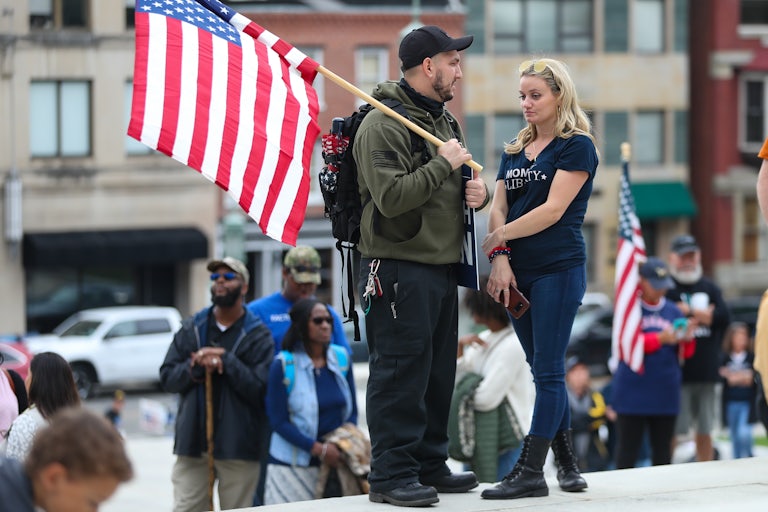
Protesters are seen holding American flags at a Moms for Liberty rally at the Pennsylvania state Capitol, October 9, 2021.

Two different chapters of Moms for Liberty faced stinging losses this week in two strongholds, the latest events in the once powerful organization’s steady decline.

Moms for Liberty experienced a meteoric rise at the start of the Covid-19 pandemic, as local chapters sprang up to push back against coronavirus restrictions in schools. The organization soon expanded to pushing book bans and opposing discussion of LGBTQ issues and race and diversity in classrooms, prompting the Southern Poverty Law Center to categorize Moms for Liberty as an extremist hate group.

But on Tuesday, the local chapter in Lehigh County, Pennsylvania, shut down due to lack of interest. The chapter had 200 members when it first formed in 2021, but just three showed up at a diner in Allentown to vote to dissolve the group, The Daily Beast reported.

Members had begun drifting away after Covid-19 mandates were lifted nationwide, but the biggest blow came in November when the chapter’s preferred candidate in a school district board election lost badly. Attendance at chapter events nose-dived, with just 20 people showing up to the holiday party.

I guess there wasn’t as much willingness to do the work that’s required to propel the movement forward,” the chapter founder, Janine Vicalvi, told the Beast in a story published Wednesday.

Participation also appears to be flagging for a key Moms for Liberty chapter in Florida. The Brevard County chapter was the national organization’s first chapter. A local group was already in action against Covid-19 regulations in schools when Tina Descovich, Tiffany Justice, and Bridget Ziegler founded Moms for Liberty in Florida. Descovich approached the Brevard County group about merging with Moms for Liberty, and the local group agreed.

But on Wednesday, the Brevard County school board held a meeting, in part to discuss a challenge to the books The Kite Runner and Slaughterhouse-Five. Only one Moms for Liberty member showed up.

All the other attendees spoke in favor of keeping the books on the shelves—and heavily criticized the parental rights organization. One attendee compared “the growth of the Taliban and its repressive autocracy in the name of religious nationalism” in The Kite Runner to “the rise of parental rights groups that want to limit what students learn.”

The Moms for Liberty member did not speak and eventually snuck out of the room. The books were not banned.

The national Moms for Liberty organization still holds a lot of influence among politicians, with many Republican primary candidates speaking at the group’s annual summit last year. But Moms for Liberty has started to see its power wane in the past year, as the group was rocked by a sexual assault scandal.

Moms for Liberty endorsed 130 candidates for school boards nationwide during the 2023 elections. The vast majority of them lost. Meanwhile, Ziegler was ousted from the organization after she and her husband admitted they had had a consensual sexual relationship with another woman.

That woman accused Ziegler’s husband, Christian Ziegler, of assaulting her on a separate occasion. Christian Ziegler was voted out as Florida Republican Party chairman in January over the allegations.

The Scene at Trump’s Supreme Court Case Is Creepily Cultlike

Donald Trump’s biggest fans did whatever they could to show up at the court.

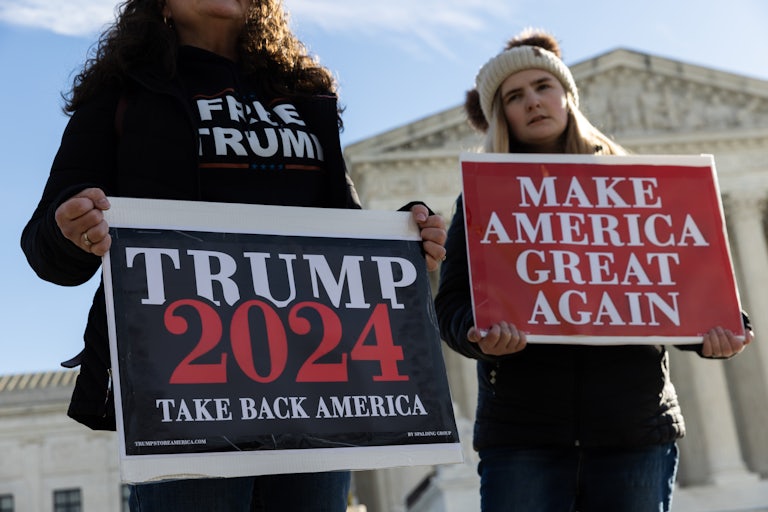
Two women stand outside the Supreme Court holding signs that read "Trump 2024 Take Back America" and "Make America Great Again."
Julia Nikhinson/Getty Images

Steps away from where a Donald Trump–backed mob attempted to thwart the 2020 presidential election results, in Washington, D.C., fans of the former president set up chairs and stood by in anticipation of a U.S. Supreme Court hearing that would decide whether Colorado could ban Trump from appearing on the state’s presidential primary ticket.

Crowds grew from a couple dozen people to more than 100 overnight, with protesters braving frigid temperatures in order to show up, even though Trump himself was not expected to make an appearance.

Some mega pro-Trump fans drove from hundreds of miles away in order to attend, like Aranda Maher and her husband, who “left their children with grandparents and drove about 350 miles to Washington,” reported The New York Times.

“It was kind of spur of the moment,” Maher, 24, told the outlet, dressed in Ugg boots and pajamas.

Others made the trek more deliberately.

“My hope is that the Supreme Court has the courage to read the Constitution as it’s written, and not torture the text in defense of Trump,” Richard Zipper, a retired software engineer from Crofton, Maryland, told Politico.

Counterprotesters also made their mark outside the halls of the country’s highest judiciary, insisting that Trump be held accountable for his role in the January 6 riot.

“We’d like to see the Supreme Court uphold justice and read the law,” Jennifer Hobbs, a lawyer who drove down from New York, told Politico.

Trump, meanwhile, appeared optimistic about the proceedings, in an appearance outside his Florida estate.

“I thought the presentation today was a very good one. I think it was well received—I hope it was well received,” Trump told a gaggle of reporters outside Mar-a-Lago.

In December, Colorado’s Supreme Court issued a historic ruling removing Trump from the ballot on the basis that Trump had been involved in an “insurrection,” thereby violating the U.S. Constitution’s Fourteenth Amendment.

Rudy Giuliani Whines That Trump Still Owes Him Boatload of Money

Rudy Giuliani, who has declared bankruptcy, is complaining that Donald Trump isn’t paying up.

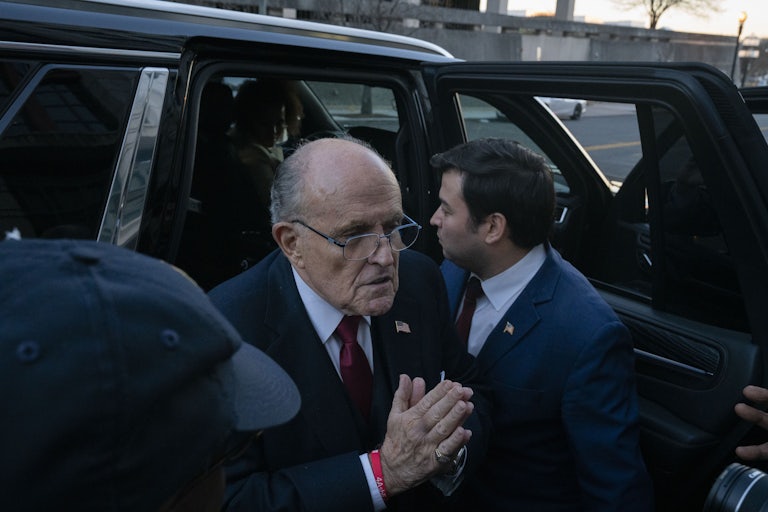
Rudy Giuliani exits a car and places his hands together as if in prayer
Andrew Thomas/NurPhoto/Getty Images

Rudy Giuliani, who is so low on cash he filed for bankruptcy, says that Donald Trump owes him about $2 million in unpaid legal fees for helping try to overturn the 2020 election.

Giuliani filed for bankruptcy in December, faced with insurmountable debt after he was found liable for defaming two Georgia state election workers. During a hearing on Wednesday, Giuliani told a Manhattan federal bankruptcy court that Trump had asked the former mayor to take over his campaign’s legal team in November 2020.

At the time, Trump’s lawyers and Trump-aligned lawyers were working to overturn the presidential election results. Courts across the country threw out every single one of the dozens of cases that Trump’s allies filed.

Giuliani said Wednesday that when he took over the Trump campaign’s legal staff, “it was my understanding that I would be paid by the campaign for my legal work and my expenses to be paid.”

“When we submitted the invoice for payment, they just paid the expenses. Not all but most. They never paid the legal fees,” Giuliani said. He added that he never calculated how much Trump still owes him, but he estimated it was about $2 million.

Giuliani was hurting financially even before the defamation ruling against him. He listed his Manhattan apartment for sale in July and began representing himself in court to save on legal fees. In August, after he was indicted in Georgia, Giuliani asked his social media followers to donate to his defense fund.

He also flew to Mar-a-Lago to beg Trump to pay his legal fees. That didn’t work, but Trump did host a fundraiser dinner for Giuliani in September. Entry cost $100,000 a plate.

When Giuliani declared bankruptcy in December, the filing showed that Giuliani owes as much as $500 million in debt but has only up to $10 million in assets. His biggest debt is to Georgia election workers Ruby Freeman and Shaye Moss. Giuliani owes the pair $148 million in damages for defaming them.

He owes money to Hunter Biden, electronic voting machine companies Smartmatic and Dominion, and an accounting firm. Giuliani is also in debt to his former associate Noelle Dunphy. Dunphy sued Giuliani in May, accusing him of promising to pay her a $1 million annual salary but instead sexually harassing and abusing her over two years.

Ironically, the man once affectionately known as “America’s mayor” owes money to multiple law firms for unpaid legal fees. Several of Giuliani’s former lawyers, including his longtime attorney Robert Costello, have sued Giuliani for failing to pay their legal fees.

Trump’s Lawyer at SCOTUS Today Helped Craft Texas Anti-Abortion Law

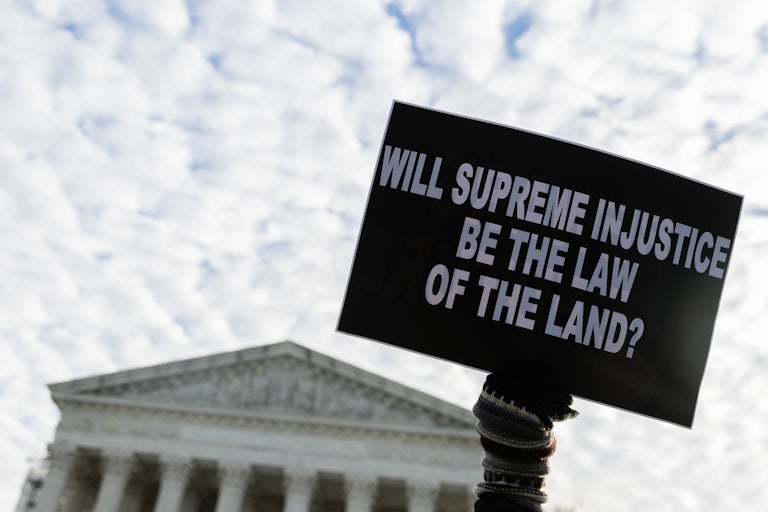
The Supreme Court is considering whether Donald Trump can be removed from the ballot under the Fourteenth Amendment. Here’s the lawyer arguing his case.

Julia Nikhinson/Getty Images

The lawyer representing Donald Trump at the Supreme Court on Thursday is no stranger to controversial legal battles: Jonathan Mitchell is one of the primary architects of Texas’s brutal anti-abortion law.

The Supreme Court is hearing arguments about whether Trump should appear on the Colorado primary ballot—and by extension, any other state’s ballot. Mitchell argued that the former president should not be disqualified.

But before Thursday’s arguments, Mitchell was best known for crafting Texas’s so-called vigilante law, which allows private citizens to sue someone they suspect got an abortion. The law, which was implemented in 2021, bans abortions after six weeks, before most people even know they’re pregnant.

Because it empowered private citizens, instead of state officials, to target people who got an abortion or people who helped someone get an abortion, the law could circumvent the regulations established by Roe v. Wade, which at the time had not yet been overturned. The state couldn’t punish someone for getting an abortion, but an individual could.

Mitchell has said he specializes in strategies for creating legislation that can “withstand a court challenge if one arises.”

One of his former law professors, Richard Epstein at the University of Chicago Law School, told NPR in 2023 that Mitchell is “a kind of a technical magician.”

The Texas law, of course, has had devastating effects on state residents. Women have been unable to get abortions, whether elective or medically necessary. Often, they have been forced to either wait until they suffer life-threatening complications from the pregnancy before they can get an abortion, or they have been forced to give birth to infants that die within hours of birth.

Mitchell told NPR that result “concerns” him because “the statute was never intended to restrict access to medically necessary abortions.” But the reality is that he helped create a culture of fear in Texas, with medical professionals too worried about legal repercussions to advise someone to get an abortion, let alone perform the procedure.

And Mitchell is looking to expand that atmosphere. Since Roe was overturned, he has argued for the enforcement of the Comstock Act, a nearly two-centuries-old anti-obscenity law. The measure bans, among other things, the transport of abortion-related materials across state lines. Mitchell, and many other conservative legal figures, believe the Comstock Act can be used to ban the sale of abortion medication.

Now Mitchell’s helping Trump, the man who helped overturn Roe, remain on the ballot.