Breaking News
Breaking News
from Washington and beyond

Trump Apparently Has a List of Things He Loves About Adolf Hitler

Donald Trump’s former chief of staff, John Kelly, says the former president used to praise lots of things about Hitler.

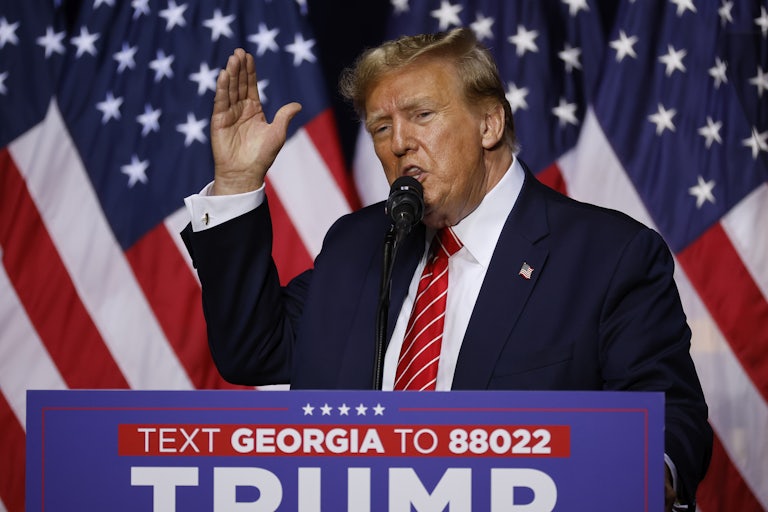
Donald Trump stands before a podium mic, profile shot
Win McNamee/Getty Images

Donald Trump has never been shy about expressing his affection for dictators. And now that stance has become even clearer, with his former chief of staff alleging that Trump once said Adolf Hitler “did some good things.”

In his new book, The Return of Great Powers, which comes out Tuesday, reporter Jim Sciutto interviews several of Trump’s former advisers. All of them stressed that Trump regularly lavished praise on authoritarian leaders around the world, calling Hungarian Prime Minister Viktor Orbán “fantastic,” Chinese President Xi Jinping “brilliant,” and North Korean leader Kim Jong Un an “OK guy.”

Horrifyingly, Trump also said, “Well, but Hitler did some good things,” according to John Kelly, who served as White House chief of staff from 2017 to 2019.

“I said, ‘Well, what?’ And he said, ‘Well, [Hitler] rebuilt the economy.’ But what did he do with that rebuilt economy? He turned it against his own people and against the world. And I said, ‘Sir, you can never say anything good about the guy. Nothing,’” Kelly told Sciutto. “I mean, Mussolini was a great guy in comparison.”

Kelly said that Trump also praised Hitler for achieving complete loyalty from senior Nazi officials—and Trump expected similar fealty from the retired generals he brought onto his Cabinet.

“He would ask about the loyalty issues and about how, when I pointed out to him the German generals as a group were not loyal to him, and in fact tried to assassinate him a few times, and he didn’t know that,” Kelly said. “He truly believed, when he brought us generals in, that we would be loyal—that we would do anything he wanted us to do.”

Kelly suggested that Trump’s infatuation with dictators was due to his perception of himself. “That’s who he is,” Kelly told Sciutto. “He was shocked that he didn’t have dictatorial-type powers to send U.S. forces places or to move money around within the budget. And he looked at Putin and Xi and that nutcase in North Korea as people who were like him in terms of being a tough guy.”

“He’s not a tough guy by any means, but in fact quite the opposite,” Kelly said. “But that’s how he envisions himself.”

If Trump was disappointed he couldn’t be a dictator during his first term in office, he’s clearly setting himself up to change that should he be reelected in November. Although he has joked about only acting like a dictator on “day one” of a potential second term, Trump and his allies are already bragging about their plans should they retake the White House.

As The New Republic’s Matt Ford summarized, “Trumpworld is scheming to install ideological loyalists throughout the federal government, purge the civil service of any dissenters, centralize all power in the executive branch, and unleash the Justice Department on Trump’s perceived political enemies with sham prosecutions.”

Trump has also seemingly embraced the authoritarian label on the campaign trail. He has repeatedly paraphrased Hitler’s rhetoric in campaign speeches, and on Friday, he hosted Orbán at Mar-a-Lago.

“There’s nobody that’s better, smarter, or a better leader than Viktor Orbán,” Trump said. “He’s the boss, and he’s a great leader, fantastic leader. In Europe and around the world, they respect him.”
Trump Is Threatening to Gut Social Security. Take His Word for It.

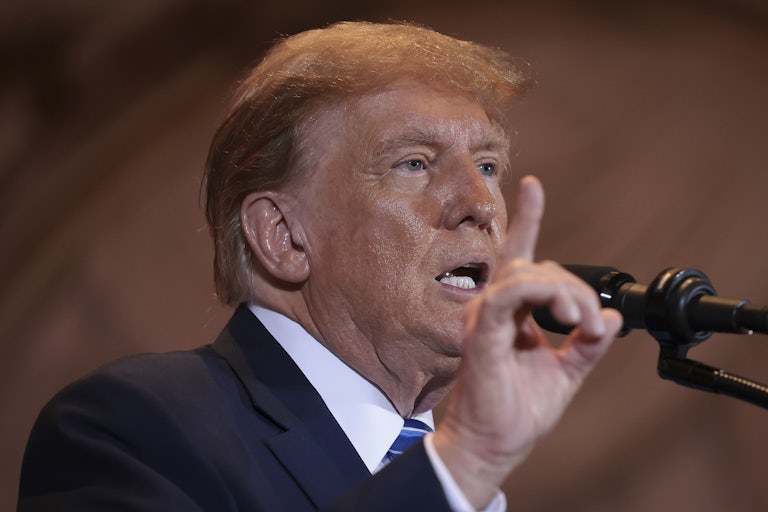
Donald Trump says there are “a lot” of ways to cut Social Security and Medicare.

Win McNamee/Getty Images

Donald Trump has offered a new way to win over older voters: suggesting that the government gut Medicare and Social Security spending.

While calling in to CNBC’s Squawk Box on Monday, the former president brought up the idea of cutting  “entitlements” such as Social Security and Medicaid.

“There is a lot you can do in terms of entitlements, in terms of cutting and in terms of also—the theft and the bad management of entitlements,” Trump said.

“There’s tremendous amounts of things, numbers of things you can do,” he continued, without further elaborating. 

Trump’s mention of the “bad management of entitlements” brings to mind the Project 2025 policy agenda to eliminate and defund social programs. The plan, created by the Heritage Foundation and several other conservative groups to guide a transition to a Trump White House, states firmly that “our deficit problem is a Medicare and Medicaid problem.”

In a statement later Monday, Trump’s campaign spokeswoman Karoline Leavitt desperately tried to walk the statement back and also, classically, blamed Joe Biden and the border. His campaign claimed that “mass invasion of countless millions of illegal aliens will, if they are allowed to stay, cause Social Security and Medicare to buckle and collapse.” 

This certainly isn’t the first time Trump has called for defunding Medicare and Social Security.

Meanwhile, Biden’s spokesman doubled down on the president’s commitments to funding the government programs, saying that “Biden honors his ironclad commitment by firmly opposing benefit cuts to Medicare and Social Security.”

Currently, Social Security funds, which 67 million Americans rely on, risk running out by 2033. The same goes for Medicare in 2031.

Panicked Trump Makes Last-Ditch Effort to Delay First Criminal Trial

Donald Trump is using the Supreme Court immunity case for another delay tactic in his hush-money case.

Joe Raedle/Getty Images

In a move we should all have seen coming, Donald Trump asked Monday to delay his hush-money trial until the Supreme Court rules on whether he has presidential immunity.

Trump is currently set to face trial in New York on March 25 for his role in hush-money payments to porn star Stormy Daniels ahead of the 2016 presidential election. He faces 34 felony charges for business fraud and has pleaded not guilty to all of them.

Although the payments took place before Trump became president, his lawyers argued in court documents Monday that prosecutors intend to introduce evidence at trial that “implicate the concept of official acts” and therefore should be protected by presidential immunity.

Trump’s lawyers argued that the trial should be delayed until the Supreme Court issues its decision, which would in turn determine whether prosecutors in the hush-money trial would be barred from introducing certain evidence.

President Trump respectfully submits that an adjournment of the trial is appropriate to await further guidance from the Supreme Court, which should facilitate the appropriate application of the presidential immunity doctrine in this case to the evidence the People intend to offer at trial,” the court filing said.

Prosecutors are expected to respond later this week. It is unclear if Trump will be successful. His lawyers had requested in February to delay the trial, arguing that Trump was being sued too many times and couldn’t keep up with the workload. Presiding Judge Juan Manuel Merchan denied the motion. 

The Supreme Court handed Trump a major win two weeks ago when it agreed to hear his case on whether he is immune from prosecution over his role in trying to overturn the 2020 election. That trial was supposed to start on March 4 but has now been indefinitely postponed.

Last week, the Supreme Court announced the case’s arguments will begin on April 25. A ruling will not come until several weeks later, potentially as late as June or July. Whether or not the justices rule in favor of Trump, he has essentially already won.

Trump’s main strategy in his myriad legal battles has been to delay them as long as possible. If he is reelected in November, he could instruct the Department of Justice to drop the two federal cases against him, or even try to pardon himself and avoid ever facing accountability for his actions.

This story has been updated.

Cognitive Decline? Trump Goes on Incomprehensible Rant About TikTok

The Republican Party’s front-runner, everyone.

Chip Somodevilla/Getty Images

Donald Trump struggled Monday to give a coherent answer on whether he thought the United States should actually ban TikTok.

The House of Representatives is poised to pass a bill this week that would ban TikTok from U.S. app stores unless ByteDance, the app’s Chinese parent company, sells TikTok to an American company. Trump was one of the original arbiters of anti-TikTok sentiment on Capitol Hill.

But last week, Trump advocated against banning TikTok. His reasoning? He doesn’t want Facebook CEO Mark Zuckerberg to reap any unintended benefits in the fallout.

If you get rid of TikTok, Facebook and Zuckerschmuck will double their business. They are a true Enemy of the People!” Trump warned on TruthSocial.

When asked Monday about his apparent flip on banning TikTok, Trump insisted, “I had it done.”

“And then Congress said, well, they never, they ultimately, usually fail,” he continued on CNBC’s Squawk Box. “They are a gooch—like, extremely political, and they’re extremely subject to people called lobbyists who happen to be very, very talented, very good and very rich.”

“I could have banned TikTok. I had it banned just about, I could have got that done. But I said, ‘You know what? But I’ll leave it up to you.’ I didn’t push them too hard because, you know, let them do their own research and development, and they decided not to do it. But as you know, I was at the point where I could have gotten it done if I wanted to. I sort of said, ‘You guys decide, you make that decision.’ Because it’s a tough decision to make.”

While he was in office, Trump made banning TikTok a pet project. In 2020, he signed an executive order prohibiting any transactions between ByteDance and U.S. citizens, citing national security concerns. The order was eventually blocked in court.

Trump admitted Monday that his main incentive for keeping TikTok around is preventing Facebook from expanding—and he threw in some election fraud conspiracy for good measure.

“I consider Facebook to be an enemy of the people, along with a lot of the media. What Facebah-book did with lock boxes, with a $500 million, Zuckerberg’s, lock boxes that he put in. I mean, I considered illegal,” Trump said, referring to a conspiracy he started that Facebook had paid for “lock boxes” of fraudulent ballots that made up “96 percent” of votes for Joe Biden.

Trump told CNBC that he still believes TikTok poses a threat to national security. “We have to very much go into privacy and make sure that we are protecting the American people’s privacy and data rights,” he said. “But, you know, we also have that problem with other, you have that problem with Facebook and lots of other companies too.”

“I mean, they get the information, they get plenty of information, and they deal with China and they’ll do whatever China wants. You know, if you look at, some of our American companies, when you talk about, highly sophisticated companies that you think are American, they’re not so American. They deal in China, and China, if China wants anything from them, they will give it. So that’s a national security risk also.”

TikTok is one of the few issues that unites Democrats and Republicans on Capitol Hill. A company associated with the Chinese government owns a 1 percent stake in TikTok parent company Bytedance. With both political parties eager to seem tough on China, cracking down on TikTok is an easy move. TikTok CEO Shou Zi Chew has testified twice before Congress and has faced far tougher, and sometimes more racist, grilling than any of his American tech CEO counterparts.

Republicans also regularly use TikTok as a scapegoat because the platform is popular with young people, the majority of whom tend to lean left. Many lawmakers say they want to ban TikTok to protect both national security and children’s privacy and well-being.

Bizarrely, Trump got one thing right during his weird rant: When it comes to security, both national and personal, TikTok is far from the only bad actor.

Google and YouTube have violated children’s privacy. Livestreaming platform Twitch is rife with sexual harassment and child predators. Apple and Google parent Alphabet design their products to be addictive to teenagers.

Facebook parent company Meta knew its products were destroying teens’ mental health, particularly teenage girls’, but made no changes to its platform. Zuckerberg was aware of this but lied to Congress under oath about it.

Meanwhile, the United States has no overarching data security legislation. Instead, data privacy and security is regulated by a patchwork of state laws. Congress has repeatedly failed to pass laws that would actually protect children online. In fact, in the past decade, Congress passed just one narrow children’s online safety law.

Sex Trafficking Survivor Detests Being in Republicans’ SOTU Response

Karla Jacinto Romero isn’t happy about the way Republican Senator Katie Britt used her story for the State of the Union rebuttal.

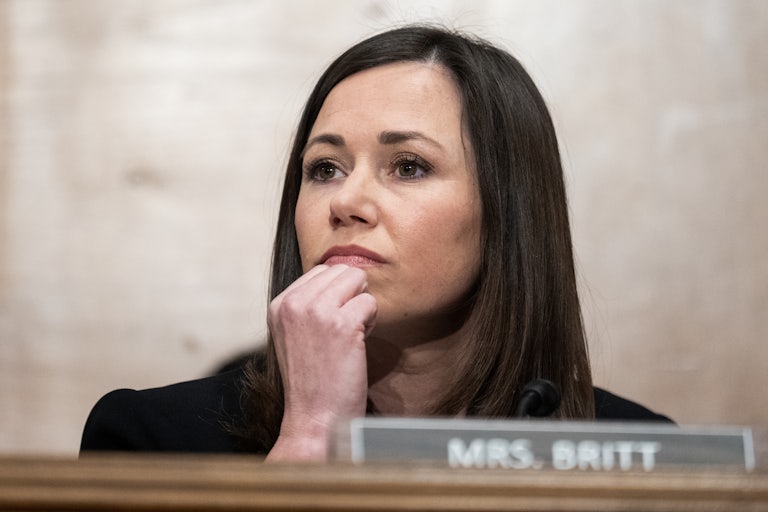
Katie Britt rests her chin on her hand. A nameplate before her reads "Mrs. Britt."
Tom Williams/CQ-Roll Call, Inc/Getty Images

The sex trafficking survivor who was mentioned by Republican Senator Katie Britt in the State of the Union rebuttal says her story was totally warped by the senator as part of an attack on Joe Biden’s immigration policies.

“I hardly ever cooperate with politicians, because it seems to me that they only want an image. They only want a photo—and that to me is not fair,” Karla Jacinto Romero told CNN on Sunday. Jacinto Romero also confirmed that no one from Britt’s team had reached out to her asking to share her story.

In her widely criticized State of the Union response, Britt shared the graphic story of a woman who was raped by human traffickers for years.

“When I first took office, I did something different. I traveled to the Del Rio sector of Texas, where I spoke to a woman who shared her story with me. She had been sex trafficked by the cartels starting at age 12,” Britt said in her speech, seeming to imply that this happened in the United States during Biden’s presidency.

Britt’s communications director has already stated that the woman in the story was Jacinto Romero. And Jacinto Romero, in her interview with CNN, is confirming a viral TikTok that Britt got all the dates—and some other details—wrong.

In reality, Jacinto Romero was kept in captivity in Mexico from 2004 to 2008, when President George W. Bush was president. She was not trafficked in the United States, nor was she trafficked by drug cartels as Britt alleged in her speech, but by a pimp who kidnapped young girls.

Jacinto Romero also disputes Britt’s version of the story, which made it seem like the two women met in a private meeting.

Jacinto Romero told CNN that she actually met Britt at an anti-trafficking event last year at the southern border, with several other government officials in attendance, including Republican Senators Marsha Blackburn of Tennessee and Cindy Hyde-Smith of Mississippi.

As these clarifications have come to light, how has Britt responded? Well, she’s doubling down of course.

When Fox News host Shannon Bream asked Britt Sunday if she meant to imply that this all happened during Biden’s presidency, Britt responded, “No. I very specifically said, ‘This is what President Biden did during his first 100 days.’ He stopped all deportations, he halted construction of the border wall and he said, ‘I’m going to give amnesty to millions.’ Those types of things act as a magnet to help more and more people here.”

She followed up that sentence with the statement, “President Biden’s border crisis is a disgrace. It’s despicable. And it’s almost entirely preventable.”