Newsletter
Power Mad
A weekly review of the rogues and scoundrels of American politics

The Democrats Are Blowing the 2024 Election

Joe Biden’s reelection hopes have been ill served by his complacent colleagues—who are currently getting pummeled by their more vigorous Republican counterparts.

Senate Majority Leader Chuck Schumer
Valerie Plesch/Getty Images
Senate Majority Leader Chuck Schumer

What do Democrats need to do to win in November? The New Republic took up that question this month in a series in which some of the brightest minds offered their best advice to President Biden and his party. But in an essay mapping out the challenges Democrats face, and how to surmount them, editor Michael Tomasky wrote something that has remained lodged in my mind: “It practically goes without saying that the Democrats will do none of the things I suggest.”

I’m pretty sure that Michael didn’t intend that one line to linger the longest. But it’s borne out so far. Here at the precipice of the general election, Biden has important accomplishments to trumpet and significant errors to overcome. But he’s being served poorly by his party, which seems adrift, complacent, and inert. Republicans, by contrast, have been sharper and more savage; at the moment, they are winning.

The recent fallout from the report by special counsel Robert Hur—the Trump-appointed U.S. attorney whom Attorney General Merrick Garland tapped to investigate Biden’s potential mishandling of classified documents—neatly illustrates the differences between the two parties. While absolving Biden of criminal wrongdoing, the report characterized the president at length as someone with worrisome memory lapses.

I don’t know if Hur went about his job with partisan ends in mind, but partisan ends were served nonetheless: The report surfaced derogatory information in a way guaranteed to make news. From there, an exceedingly well-oiled GOP communications machine swung into operation. Democrats have largely responded by complaining about how the media has framed the story. Their complaints may have merits, but what matters is they’re losing.

As The New Republic’s Osita Nwanevu noted, it was a “collision of Democratic pathologies” that put Hur “in the position to shiv Biden” in the first place: “Gerontocratic politics, a culture of hero-worship that gave Garland far more respect and stature than he was ever due, and the commitment to even-handedness” led Garland to believe that the fair thing to do was put a Trump-appointed attorney in charge of the investigation. But the biggest pathology on display here has to do with the way Democrats approach the media and their extreme disinterest in competing on the same playing field as the GOP.

There are always good reasons to complain about the political press—and Republicans do their own share of carping. But Democrats too often operate as if the media they’d prefer to have—temperate and fair, dedicated to substance and nuance, committed to preserving democracy—is the one that actually exists. Republicans don’t believe that the press is a noble institution and they don’t treat its members that way. Instead, they innately understand that the political press is just a ravenous, insensate maw looking for its next hot meal of crassness, chaos, conflict, and controversy—and Republicans always come with a heaping plate.

Once the Hur report became national news, GOP electeds acted quickly and decisively to keep this new shiny ball spinning. As Brian Beutler reported in a recent newsletter, the full-court press is on: “Hur is now negotiating with his fellow Republicans on Capitol Hill over what he can testify to and when he can appear at a hearing. Those same Republicans have insisted that the Justice Department release a transcript of Biden’s interview with Hur, so they can clip and circulate any instance in which Biden’s memory failed him.” Once the GOP gets a scent of some derogatory information, they are prepared to act on it.

The Democrats compare unfavorably to their opponents’ fervent determination and preparedness. In a previous edition of this newsletter, I noted that Representative Jamie Raskin had surfaced evidence that Trump had “pocketed at least $7.8 million in payments from foreign governments during his presidency,” but that the investigation hit an impasse when the GOP took over the House. Democratic senators have a committee where they can pursue open-ended investigations, but they have no interest in advancing Raskin’s case.

And the Hur report, while mainly damaging to Biden, also happens to cast Trump in an unfavorable light regarding his own handling of classified materials. Democrats don’t seem interested in using their own investigatory powers to raise further questions or make a big stink about the matter. Beutler ruefully noted that the media didn’t “swarm to the unflattering contrast between Trump and Biden” because Democrats largely ignored it.

This is malpractice, especially when you consider how swiftly and purposefully the GOP acts on similar shreds of information. But Democrats’ aversion to playing the game in the most effective manner is bone deep. They’re ignoring a myriad of other areas where further unflattering facts can be found. What might be behind Trump’s plan to abandon NATO? What shady arrangement may lurk at the heart of the favorable treatment he’s receiving from his pet judge Aileen Cannon? Democrats don’t seem to want to fill the newshole with these discussions.

Nor do they seem to want to make daily hay of Trump’s many legal woes. They aren’t pouncing on the fact that he recently confused Nikki Haley with Nancy Pelosi. The former president has vowed to repeal and replace Obamacare. Why aren’t Democrats beating him up over that? Republicans’ similar plans to end protections for patients with preexisting conditions were a potent campaign issue for Democrats in 2018. Have they forgotten?

What do the Democrats stand for? Who are their enemies? What fights do they want to pick? Can they even answer these questions? Because while they dither, the public is forming some wild opinions about what should go in the spaces they’re leaving blank. Recent polls indicate that half of Americans think that Biden got favorable treatment from Hur in the document probe. Another recent poll indicates the public blames Biden for killing the border deal, despite the fact that Trump publicly browbeat GOP electeds into nuking it. After the expiration of the expanded child tax credit, voters who had received those benefits swung their support to the GOP, despite the fact that they were the most prominent opponents of the expansion. And majorities of voters still don’t hold Trump responsible for the repeal of Roe’s abortion protections.

Perhaps the press should be doing a better job conveying this information. I certainly harbor little affection for mainstream political reporting; there are definitely patterns of behavior among the elite media that rebound to the detriment of Democrats alone. But at a certain point Democrats simply need to shoulder the responsibility themselves instead of waiting for the media to cure itself of habits that have been entrenched for decades.

Instead, they are getting in their own way, mired in weird pathologies and maladroit tendencies, timidly waiting for nonexistent referees to come and level the playing field on their behalf. There’s no getting around the fact that Joe Biden is old and steadily getting older. It’s up to other Democrats to lend his campaign youth and vigor; instead they are supine and moribund. Watching this party execute its campaign plan—if you can call it that—you’d never suspect that it feels any urgency. But there is much at stake, and Democrats are absolutely blowing it.

This article first appeared in Power Mad, a weekly TNR newsletter authored by deputy editor Jason Linkins. Sign up here.
The Corporate Crooks Who Got Caught Stealing Workers’ Wages

Investigative reporters exposed these bad bosses, and now comes the hammer of the law.

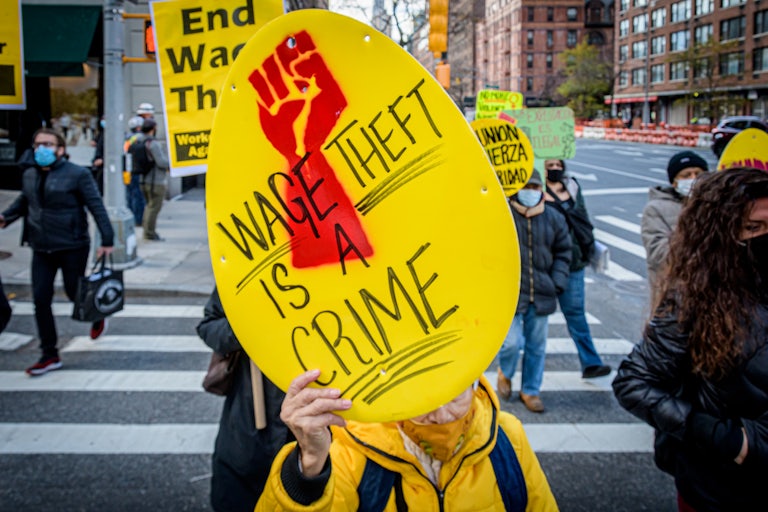
A New York City laundromat worker hold up a yellow sign that says "Wage Theft Is a Crime" during a protest in November 2020.
Erik McGregor/Getty Images
New York City laundromat workers protesting wage theft in November 2020

The first few weeks of this young year have only resurfaced an old problem: the continuing economic havoc that’s roiling the journalism industry. Hundreds of positions have been cut at venerable institutions like the Los Angeles Times and The Wall Street Journal. Start-up concern The Messenger eliminated itself from existence, leaving behind scorched earth and recriminations. This week, TNR’s Ellie Quinlan Houghtaling dove into this rot and found much of it coming from the top, with a plutocratic ownership class that’s driving good businesses into the ground on the backs of poor choices and bad ideas.

Just about everyone in this business has had some brush with the employment grim reaper—or is glancing over their shoulders in fear of the next encounter. But every once in a while, we catch sight of the ways that journalism, with a little bit of stability and good decisions from the top, can still make a huge difference in the lives of ordinary people. And this week, we can celebrate one such example in the state of New York, where some good old shoe-leather reporting has helped lawmakers craft a new bill to crack down on one of the most costly financial crimes we face: organized corporate wage theft.

Back in September, I highlighted a blockbuster report from ProPublica, who, working in a partnership with Documented New York, dug through federal and state databases and uncovered a staggering degree of wage theft: From 2017 to 2021, “more than $203 million in wages had been stolen from about 127,000 workers in New York.” While it is an inexact science to compare one state to another in this regard, ProPublica reported that its “analysis of cases reported to the U.S. Department of Labor and substantiated by federal investigators shows that New York ranked eighth highest in the amount of back wages owed per worker.”

But the best thing about all that reporting is that it’s been put to very good use. As ProPublica reported this week, New York state lawmakers have proposed a battery of bills that will bring the hammer down on wage thieves by allowing state agencies to strip scofflaws of their ability to do business.

One bill, centered on the restaurant industry—where workers in New York had $52 million stolen from them between 2017 and 20201—would allow the “New York State Liquor Authority to suspend liquor licenses for bars and restaurants that the Department of Labor has determined owe more than $1,000 in back wages to their workers.” The second bill “would enable the Department of Labor to place a stop-work order on any business that has a wage theft claim of at least $1,000”; this has been an effective punishment in other cases. Finally, the third bill “allows the New York State Department of Taxation and Finance to suspend a business’s certificate of authority—which allows it to collect sales tax and conduct business—in cases where wage theft exceeds $1,000.”

Anyone who runs afoul of these new laws can get themselves off the hook using one neat trick: Pay up within 15 days! Otherwise, it’s a pretty severe punishment. But it’s one that fits a truly heinous crime, and if the past is any guide, wage thieves have prospered because of the way the law too often doles out mere slaps on the wrist.

A Popular Information report from January explains that this has been what’s missing: While the Department of Labor can penalize wage thieves, it is only empowered to impose civil penalties against repeat offenders or when it finds that the wage theft was “willful.” Consequently, penalties are only “imposed 41 percent of the time.” And when they are imposed, they’re rarely stiff enough to trouble large firms: “The maximum civil penalty is $2,374 for each violation. In contrast, in Australia, the penalty for wage theft is up to $630,000 per violation.” That these new laws have actual teeth is a big improvement.

Back when I first wrote about the scourge of wage theft, I focused on the way the media industry was dropping the ball by elevating shoplifting and organized retail theft to national panic status. This feeding frenzy over penny-ante crime—one estimate put the real cost of the shoplifting wave at “seven cents per 100 dollars in losses”—was often promulgated through too-good-to-check stories that fell apart under the slightest scrutiny. Wage theft, by contrast, is a massive crime: A 2014 study from the Economic Policy Institute found that wage theft “costs American workers as much as $50 billion a year.” It deserves massive attention.

In terms of how the media has treated both issues, this is a Goofus and Gallant–style comparison. All the shoplifting coverage in the world has produced little more than bogus stories and reactionary fearmongering over crime. ProPublica demonstrated how better journalistic choices lead to an informed public and impact in the form of laws that will help solve a truly rampant problem and actually help ordinary people.

It also earned a ringing endorsement from state Senator Jessica Ramos, a co-sponsor of the aforementioned bills: “We knew from our conversations with labor and from our constituent service caseload that wage theft is a chronic problem,” she said. “We did not have the data to understand the scale of the issue in New York state until the ProPublica and Documented series came out last year.” It goes to show that journalism still works when it’s uncoupled from idiot bosses.

This article first appeared in Power Mad, a weekly TNR newsletter authored by deputy editor Jason Linkins. Sign up here.
The CEOs Are Warming to Trump

Remember when corporate America joined the fight to protect American democracy? J.P. Morgan Chase CEO Jamie Dimon doesn’t, apparently.

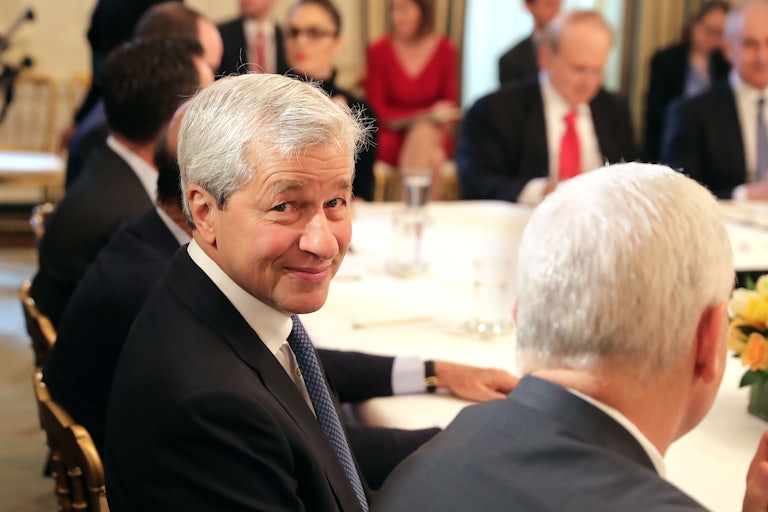
JPMorgan Chase CEO Jamie Dimon
Chip Somodevilla/Getty Images
J.P. Morgan Chase CEO Jamie Dimon at a White House policy forum with President Trump in 2017

Just about three years ago, Time’s Molly Ball dropped an epic piece of reportage on the wild months from Joe Biden’s presidential victory through the terrifying events of January 6, 2021. During this fraught time, an unusual champion emerged in the fight to protect democracy: corporate America. As Ball documented, “the forces of capital” teamed up with “the forces of labor” to rebuff the loser who refused to admit he had lost, with “hundreds of major business leaders, many of whom had backed Trump’s candidacy and supported his policies, [calling] on him to concede.”

It’s hard to know where we’d be today if this unity campaign hadn’t emerged. Sadly, I have grave doubts that Big Business is going to re-up for another campaign to save America, as some CEOs are already making clear that they don’t find Trump so dangerous after all.

Longtime readers will recall that I take a pretty jaundiced view of the idea that corporate America has a vital role to play as a stabilizing force in our democracy. But I’m happy to acknowledge that the most recent vintage of right-wing rhetoric sometimes makes it seem like Republicans and corporate America are headed for some kind of split. Not long after Ball’s reporting, The Wall Street Journal’s Editorial Board published a lengthy screed about the “left turn of many corporate CEOs” and their failure to remain “a reliable friend of capitalism”—just one of the larger rounds expended in the right’s war on “woke corporations.”

TNR’s Osita Nwanevu wasn’t buying it. “It’s preposterous to characterize them as material enemies of the right given that they clearly want to funnel money and resources to Republican lawmakers any way they can without raising hackles from vigilant activists,” he wrote. “They owe their market power and low tax burdens to conservative policies, after all, and for all the right’s moaning and groaning about ‘woke capital,’ Republican rule is still a better deal for them than Democratic governance.”

Faced with the prospect of another four years of Democratic governance—especially under the auspices of a president who has showered more favor on the labor movement than any of his recent Democratic predecessors—corporate America seems to be returning to its old malodorous form. The most telling sign came, naturally, at Davos, where J.P. Morgan Chase head Jamie Dimon began the process of making peace with Trump’s return: “Take a step back. [Trump] was kind of right about NATO, kind of right on immigration. He grew the economy quite well. Tax reform worked. He was right about some of China. He wasn’t wrong about some of these critical issues.”

As Brian Beutler pointed out in his Off Message newsletter, this was worthy of alarm bells: “The question of whether elites, particularly center-right elites, choose to abide fascism is central to the survival of democracy.” In a later post, Beutler dove deeper into Dimon’s rhetoric, and found evidence that whatever ties that might have bound him to the more high-flown ideals of our democracy were fraying:

I’d bet a large sum of money that Dimon knows Donald Trump tried to overturn the 2020 election. I’d bet almost as much that Dimon knows Trump has promised to establish a dictatorship on “day one”; that he has demanded immunity for any crimes he committed from 2017-2020, and any that he might commit from 2025 onward.... And yet to hasten another round of tax cuts and reduced bank regulation, Dimon will tell the world he thinks Trump is a populist everyman who gets a bad rap.

There’s no way to know for sure whether the political media will successfully discern the con of Dimon plumping Trump as a “populist everyman,” especially given the fact that over the course of the Trump era, they have continually conflated “populism” with “boorishness.” Still, this isn’t the worst development from the perspective of those who are running Democratic campaigns this year—it would be ideal to raise the salience of a Wall Street embrace of Trump, especially considering Biden’s vastly superior record on labor. As TNR contributor KJ Boyle documented at length, life for the average worker got vastly worse during Trump’s reign.

Biden’s vital corrections to that grim era may, in fact, be the very reason that Dimon is looking to the orchestrator of the attacks on the U.S. Capitol for relief. It wouldn’t be the first time such an alliance was attempted: Back in 1933, a cabal of financiers attempted to orchestrate what came to be known as “the Business Plot,” a plan to overthrow President Roosevelt’s government via an ersatz uprising of aggrieved veterans. They made the mistake of asking retired Marine Corps Major General Smedley Butler, the famously repentant author of War Is a Racket to lead it, only to learn the hard way what a blunder it was to ask a man of great integrity to lead a campaign against democracy when he instead sold the coup plotters out. Suffice it to say, Donald Trump does not offer similar impediments.

This article first appeared in Power Mad, a weekly TNR newsletter authored by deputy editor Jason Linkins. Sign up here.
Republicans Are Starting to Worry That They Suck at Governing

GOP lawmakers have started to grumble about their lack of legislative accomplishments. They should take a good long look in the mirror.

Matt McClain/Getty Images
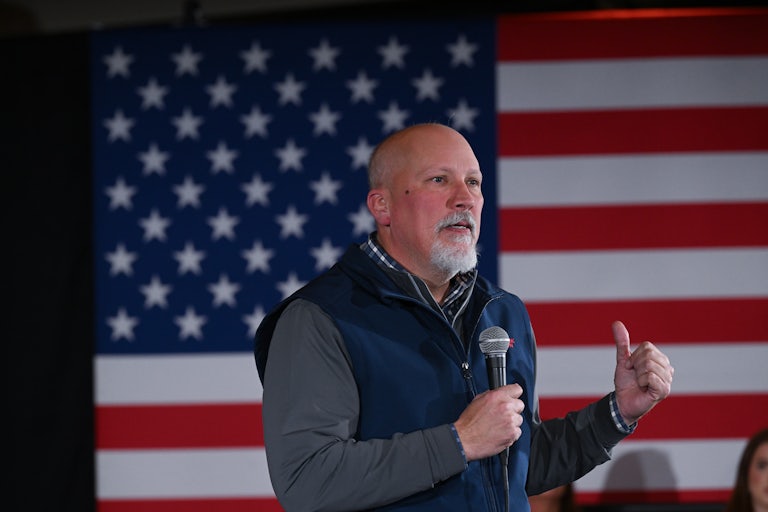
Representative Chip Roy

It appears that we’re all going to pretend to have a GOP primary a little longer. Eight days after his decisive win in the Iowa caucus winnowed the field to two, Donald Trump comfortably beat Nikki Haley in the New Hampshire primary. The former South Carolina governor is soldiering on, apparently on the grounds that hers was but a minor shellacking and not a campaign-killing blowout. But the end will arrive soon enough—perhaps in her home state next month.

With Trump all but officially the nominee, though, Republican politicians are now turning to the question of how he can win over non-MAGA voters—and there is a scent of uneasiness in the air. In something of a plot twist, GOP lawmakers have grown discontented with the way their party’s rickety platform offers few selling points for the party, with some members “very publicly complaining about [its] lack of accomplishments,” according to reports

NBC News’s Sahil Kapur reported that there is a “dynamic that looms over Republican lawmakers,” in which they’ve “passed little substantive legislation since winning the majority” and are struggling with “the basics of governing” and beset by internal “fractiousness and chaos”—all of which is apparently complicated by the fact that Trump’s policy platform is mainly about “retribution” and spreading “fabricated claims that the 2020 election was stolen from him.”

Last November, we got our first inkling of this strange insecurity when Texas Representative Chip Roy went to the floor of the House to have a nervous breakdown about the deficiencies he saw in his own party. “One thing. I want my Republican colleagues to give me one thing. One. That I can go campaign on and say we did,” Roy ranted. “One!” (Apparently taking credit for the infrastructure bill that most of them voted against doesn’t quite cut it.)

This is a lot like a Girl Scout expressing outrage over the organization’s commitment to cookies. Nearly all of Roy’s disgruntlement can be chalked up to the simple fact that he’s a member of the Republican Party, which hasn’t really been  trying to accomplish anything  for a long while. Three years ago, TNR contributor Katelyn Burns took stock of the GOP and found that it had all but abandoned meaningful policymaking in favor of “entrenching itself in the distant patriarchal mythology of America’s past” and waging culture war against liberals. A Republican adviser to former Senator Rob Portman summed it up: “If you want to spend all your time going on Fox and be[ing] an asshole, there’s never been a better time to serve. But if you want to spend all your time being thoughtful and getting shit done, there’s never been a worse time to serve.”

It is deeply funny that Roy has emerged as one of his party’s foremost critics in this regard. In a profile last year, TNR’s Pablo Manríquez described Roy as a “viral bomb thrower” with scant history of bipartisan accomplishment and a tireless critic of the debt ceiling and funding deals that House Speaker Kevin McCarthy had to make to keep things running. While Roy came out against the motion to vacate that began the process of ousting McCarthy, his replacement pick, Jim Jordan, was even less suited to accomplishing anything—unless his quixotic efforts to invent some sort of reality-based foundation for the party’s incessant culture warring counts as a “thing.” 

In his public remarks, Roy seems to understand that the primary impediment to Republican accomplishments is the fact that Democrats control the Senate and Joe Biden occupies the White House, and that getting things done requires Republicans to engage Democrats and forge deals. From what I can discern from his rantings, though, he has no real plans to do this, preferring instead to shout loudly and indiscriminately at the situation while assailing other members of his party for their lack of magical thinking. 

This is where Roy stands out, even among his caucus: He seems to hate some of his Republican peers at least as much as Democrats. At one point during a recent floor speech, Roy professed outrage over the fact that passing a border deal might require Republicans to have to talk to Senator Mitt Romney and other Republican senators to convince them to support the effort. “So what?” he declaimed about his House colleagues’ plans to pass a border security bill out of the House. “Are you going to pass that bill and walk over [to the Senate] and convince that great stalwart of defense of our border, Mitt Romney, that he should vote for it? Are you going to convince any of the 12 who just voted to redefine marriage and stomp all over religious liberty … are you going to convince any one of them to vote for a strong border security bill?”

It’s notable that Romney features here, as Romney is perhaps the last prominent Republican to rise up through the ranks on the back of a famous policy accomplishment. But over the years, the Commonwealth Care health care reform he enacted in Massachusetts has gone from being an acclaimed example of GOP problem-solving to forbidden knowledge of which none must ever speak. 

Romney’s stock within the party has declined in direct proportion to his party’s commitments to policymaking. It’s been an ignominious trajectory—but more so for the country than the GOP. Because for all of Chip Roy’s carping, it’s a simple fact that the modern GOP doesn’t actually need policy accomplishments to win elections. This is a party built to thrive on gerrymandered districts, Senate malapportionment, Electoral College shenanigans, and other well-funded game-rigging and voter-suppression efforts—the better to survive the unpopularity that comes from not ever contributing to the civic fabric or the betterment of the country. 

But Chip Roy should take heart, because Trump’s presumptive nomination suggests that Republicans will have specific things to run on in 2024: another round of tax cuts for rich corporations to fund more stock buybacks, a fresh attack on Obamacare and its protections for patients with preexisting conditions, and, of course, the furtherance of abortion restrictions as dictated by the party’s most sociopathic extremists. I would definitely encourage Republicans to be true to themselves, and run on a promise to accomplish these things.

This article first appeared in Power Mad, a weekly TNR newsletter authored by deputy editor Jason Linkins. Sign up here.

It’s Time for Democrats to Make Some Enemies

With the presidential primary all but over, a yawning void in the news hole just opened up. Biden and his allies should pick some fights—and give the media some fresh material.

Alex Wong/Getty Images
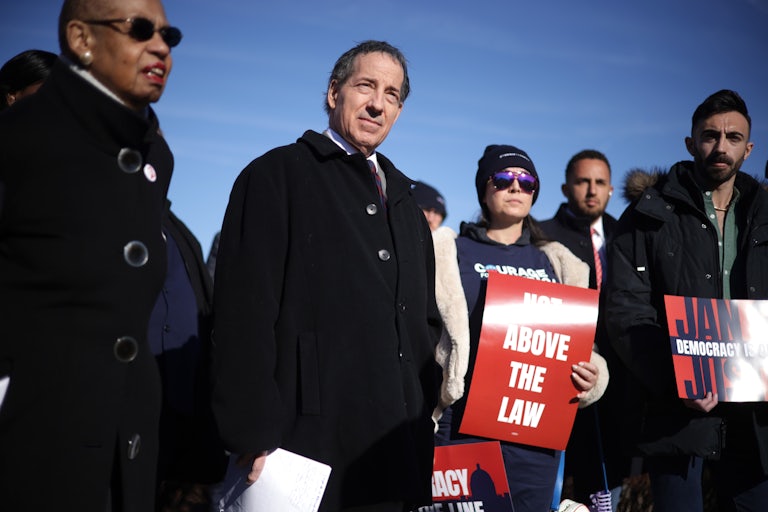
Democratic Representative Jamie Raskin

It’s possible that the 2024 presidential primary will go down as the shortest in American history. This week’s blink-and-you’ll-miss-it Iowa caucus wrapped up about 34 minutes after polls closed, with Donald Trump the winner by a predictably wide margin. The GOP nomination contest will stumble forward, reeking of anticlimax, but with Trump comfortably dominating the GOP field and the Democratic nominee locked and loaded, the competitive portion of the primary is over (if it ever started). Nothing remains but playing out the string.

So what now? While you shouldn’t underestimate the political media’s desperate need to gin up suspense where none exists, at some point soon it’s going to become impossible to conjure the illusion that it’s still a contest. There will be a huge space in the news hole to fill, and Democrats ought to have an unrelenting plan for filling it.

The New Republic’s editor, Michael Tomasky, in setting the table for this campaign season, has repeatedly stressed the need to name some enemies and pick some broad public fights with these foes. Now, as the media fiends for drama amid a lifeless campaign season, is a ripe opportunity for some good old-fashioned naming and shaming. This can’t be the stuff of wonks and white papers—this is about emotions and morality, a gut punch to the bad guys.

President Joe Biden opened this particular book by going long on the threat that Trump poses to democracy. There’s nothing wrong with restating these terms, especially as it was a winning message in the midterms two years ago. But not every voter that Biden needs to reach is going to be fully convinced that such an existential threat is in the offing. So it pays to locate some less esoteric enemies, to whom everyone can relate. Here, a slew of corporate enemies abound: junk-fee crooks; private equity goons; the gangsters of the pharmaceutical industry; banks plucking high overdraft fees out of the pockets of people living paycheck to paycheck; a small universe of price gougers, wage thieves, and consumer predators.

Democrats should be using their bully pulpit to actually bully these miscreants, drawing down on anyone who’s preventing ordinary Americans from claiming their fair share of a robust economy. Another way you can save democracy, after all, is to give people the belief that they can use it to empower people who’ll fight for them. But Democrats have to earn these stripes through political combat—and they need to force Republicans to pick a side, as well. More often than not, the GOP can be put on the defensive. Trump’s plan to team up with the privateers of the health care industry to dismantle protections for patients with preexisting conditions is already giving his fellow Republicans headaches.

That brings us to the other commodity with which Democrats need to fill the space left by the absent primary: derogatory information about Republicans. This is one area where Democrats simply don’t seem to be on the same page. As The New Republic’s Greg Sargent reported this week, Representative Jamie Raskin and his colleagues on the House Oversight Committee have done yeoman’s work, surfacing a tremendous amount of documentation proving that President Trump “pocketed at least $7.8 million in payments from foreign governments during his presidency” and that the cataloging of “far more such foreign booty” was “thwarted when GOP capture of the House deprived them of subpoena power.” The path to furthering this investigation is blocked in the House, but Raskin has, in recent days, “approached Senate Democrats and made the case that they might consider using their subpoena power to continue the investigation into the unconstitutional payments.”

The problem, Sargent says, is that Raskin is hitting a roadblock in the Senate, which is divided on whether to take the next step and jump into the fray—especially given that “to refer any ignored subpoenas for prosecution, the Senate must marshal 60 floor votes to overcome the inevitable GOP filibuster.” But the point of this exercise shouldn’t be to levy a bunch of criminal convictions—it’s to surface newsworthy information that the media might mill into content. The Senate may prefer to be the “cooling saucer” of democracy, but to provide for democracy’s future, it’s going to have to spill some tea.

The fact that the Democrats are of two minds on the matter is emblematic of the asymmetry of America’s political warfare. Republicans can be counted on to speak with one voice, picking topics on a daily basis on which to do a Two Minutes Hate, keeping the right-wing media Wurlitzer filled with fresh sheet music to call the next dance. Democrats can’t match the GOP in terms of propaganda infrastructure, but they can marshal far more relevant and substantive topics of conflict than the Republican Party’s typical culture-war fare. As Brian Beutler noted in his Off Message newsletter, Raskin did successfully break into the media transom—and if Democrats could learn to parcel such damning information in small portions, that slow drip could keep the media fed for days on end.

Again, the point of these conflicts isn’t necessarily to get “wins” in the form of defeated enemies or laws passed in the short term, it’s to take back some measure of control over what we spend the next few months talking about, put Republicans on the back foot, and constantly remind Americans that Democrats are on their team and will crush the people who are cheating them out of the good life they deserve.

And for a reelection campaign that’s been dogged by constant critiques of Biden’s advanced age, Democrats need a shot of vitality, which some good old political knuckle-dusting can bring. They can be an energetic, capacious party, filling this liminal space until the general election with fighting words and a promise to crush crooks. The 2024 campaign is looking more and more like it might be a referendum on whether the Democrats can put up a fight or not. I’d strongly advise them to get in the ring.