Life in a Warming World
A weekly reckoning with our heated planet—and the fight to save it

How to Truly Make a Difference With Your Money This Holiday Season

A lot of nonprofits asked you for donations on Giving Tuesday. But simply moving your money might be more effective.

A christmas tree laden with ornaments stands in front of the ornate, columned building that houses the New York Stock Exchange.
Angela Weiss/Getty Images
A Christmas tree in front of the New York Stock Exchange in December 2023

Giving Tuesday”—the nonprofit answer to Black Friday and Cyber Monday—is supposed to be a reprieve from the crass commercialization of this holiday period, or at least a way to make yourself feel better after spending hundreds or more on Wirecutter-approved deals. But I find it exhausting. Thanksgiving now heralds a multiweek stretch of increasingly frenetic marketing emails from people trying to destroy your budget, and “Giving Tuesday” just means that nonprofits join the fray, each competing against the next to offer the greatest sense of urgency and bang for buck in a world where there are too many crises and needs to count.

Climate and environment groups participate perforce. (How can they not?) “YOUR GIVING TUESDAY GIFT CAN SAVE OUR PLANET,” Al Gore–founded advocacy group Climate Reality Project told its supporters, adding that “ALL GIFTS WILL BE MATCHED.” The Sierra Club replaced its home page with a dedicated Giving Tuesday landing page, announcing: “If we reach our 1,000 donor goal by midnight, we’ll unlock a special $25,000 match for the environment.” The pressure, the pressure!

How do you choose where to give money and in what amounts without going broke? Wearyingly, there are now guides for that, not unlike Wirecutter’s annual “Best Black Friday Deals” tracker. Many of them rely on data and recommendations from nonprofits that now exist to help people navigate nonprofits. Various organizations operating more or less explicitly according to the principles of so-called “effective altruism” (championed by such techbro luminaries as the now-incarcerated Sam Bankman-Fried) promise a “systematic approach to try and determine where the high leverage points are in climate philanthropy—and by high-leverage, I’m thinking most greenhouse gas reductions per dollar,” in the words of Giving Green director Daniel Stein, speaking with Heatmap last week.

Experts could probably haggle over the methodology of such enterprises for years. Rather than get into the finer details of this philosophical debate or a practical one about the rankings that result, I want to point out another option for optimizing your “bang for buck” for the many people of limited means but concerned hearts. It lies in what you don’t give your money to: If you are the sort of person inclined to donate online on Giving Tuesday, you are probably somebody with a bank. And by switching away from a bank that finances fossil fuels, or by simply switching from one of the bigger offenders to a local credit union, you have the ability to extend your “impact” even if you don’t have the means to send large sums to exhaustively researched “evidence-backed” charities.

The Banking On Climate Chaos Report has found that JPMorgan, Bank of America, Wells Fargo, and Citigroup are among the top financers of fossil fuels worldwide. Bank of America recently even walked back its pledge to stop financing new coal projects. Despite the right-wing fantasy that the finance industry is engaged in a discriminatoryconspiracy” against fossil fuels, most financial firms continue to direct a lot of money toward environmentally catastrophic enterprises.

It took me longer than I’d like to admit to begin the process of switching banks; like most people with organizational difficulties, I have developed a well-founded fear of fouling up the fine print or forgetting to change an autopay setting and somehow destroying my life through sheer logistical mismanagement. Pearl Marvell’s piece for Yale Climate Connections last February about how she herself made the switch—along with useful information from experts, tools for determining your bank’s climate-friendliness, and databases of banks to choose from according to your criteria—is what pushed me from dithering into actually doing it.

In case it needs emphasizing, this newsletter does not constitute any kind of financial or investment advice, nor is it intended to singlehandedly address the entanglement of capital with the climate crisis by convincing a few TNR readers to exercise their consumer choice. Switching out all your finances at once can be tricky; people have limited control over employer-sponsored retirement accounts, for example. (And certainly there are banks out there charging exorbitant fees for minor infractions that you’d be wise to avoid—although luckily many databases now allow you to select for banks that don’t do that.)

But this option may be more practical for some people than trying to stretch an already stretched budget and agonizing about where to donate. If we’re really going to go about beating our chests about “optimizing” our do-gooder impulses and extracting maximum “leverage,” then removing a bank’s ability to use the money you have in your accounts year-round to help fund fossil fuel projects is probably going to outweigh donating $25 or even $100 once a year to a carefully selected green effective altruism fund.

Psychologically, switching banks wasn’t as chaotic and disruptive as I’d feared. After keeping the old one open for several extra months to ensure there weren’t any automatic bills I’d forgotten about, I’m closing it later this month. It’s nice to know that money I receive from a day job dealing with the climate crisis isn’t being used to fuel that crisis while I sleep. It doesn’t hurt that the two smaller banks my family has switched to offer better interest rates and are way easier to deal with than the endless bureaucracy of my old bank. So far it’s a lot like switching away from a gas stove—after the initial logistical inconvenience has passed, it’s just a much nicer way of living.

Good News/Bad News

Electrifying and decarbonizing require copper—but high-quality reserves are limited and the extraction process is extremely toxic and emissions-intensive. Grist has an intriguing report on new technologies being developed to make the process less environmentally destructive.

Even if you were already aware of the dangers of formaldehyde pollution—an alarming amount of it coming from basic home furnishings—this ProPublica piece on the extent of the problem, and the Environmental Protection Agency’s failure to tackle it, is going to hit very hard.

Stat of the Week
$334 million

That’s how much money from the EPA’s Environmental Justice Thriving Communities Grantmaking Program has yet to be awarded, leaving it “vulnerable to reversal efforts from Trump officials or Republican lawmakers,” Inside Climate News reports.

What I’m Reading

No, the Fight for the Climate Isn’t “Over”

Historian Kevin Young’s new piece over at Jacobin is an intriguing entry in the emerging genre offering reasons for climate followers to have a degree of hope heading into the second Trump era. Despondent leftists have a distorted view of how the first Trump presidency actually played out, Young suggests. Environmentalists secured a number of crucial victories—and understanding precisely how that happened can help activists identify the most promising paths going forward:

Despite Trump’s best efforts, some of the US climate movement’s most notable recent victories happened on his watch. More coal-fired power plant capacity was retired in the United States from 2017 to 2020 than from 2013 to 2016. That’s right: the coal industry took a bigger hit under a president who campaigned on reviving it than under a president who was supposedly waging war on it. Notice how Trump rarely mentions coal anymore?

The reason is that coal’s fate depends only marginally on national politicians. Since the early 2000s, hundreds of local environmental groups, acting largely independently of the big national organizations, have made it much harder for coal plants to be built or remain in operation. The natural gas boom has also undermined coal, but the market shift has been amplified by the movement.…

Trump suffered many quieter defeats too. His efforts to enact extra subsidies for coal and nuclear energy, to expand offshore oil drilling, to end tax credits for the wind industry, and to force banks to fund drilling in the Arctic National Wildlife Refuge all were blocked.…

It’s important to understand how we played that role. It wasn’t through the unfocused outrage of occasional mass marches nor through lobbying or electing Democrats. We were most powerful when we put sustained, disruptive pressure on capitalists and state elites whose interests diverged from Trump’s.

Read Kevin Young’s full essay at Jacobin.

This article first appeared in Life in a Warming World, a weekly TNR newsletter authored by deputy editor Heather Souvaine Horn. Sign up here.
How to Do Good in a World Gone Bad

Tired of doomscrolling? Tempted to tune out? Here’s a more fruitful way to respond to the gloomy news of late.

People facing away from the camera stand in a line with hands joined.
Boston Globe/Getty Images
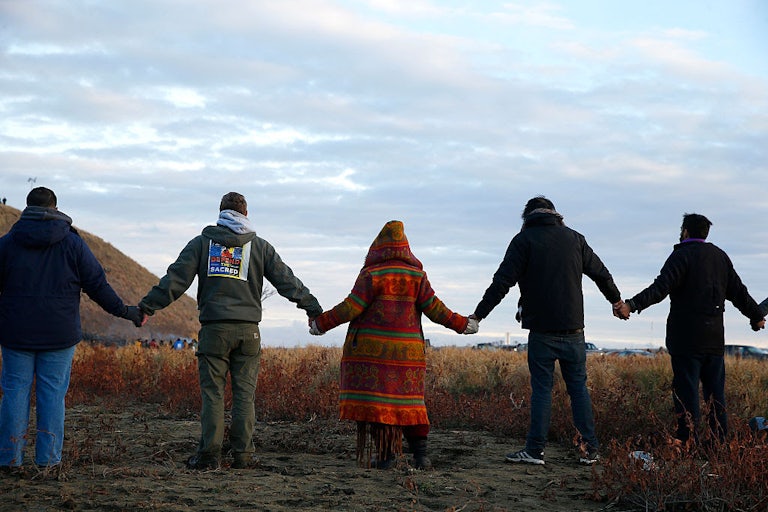
Water protectors protest the Dakota Access Pipeline at Standing Rock on November 24, 2016.

With the election of Donald Trump, it’s reasonable to take a wide lens on what the consequences will be for the climate. His fossil fuel–friendly proposals may soon add an estimated four billion metric tons of CO2 to the country’s emissions, and he’s expected to re-withdraw the United States from the Paris climate agreement. Beyond Trump, the international news is no more reassuring. The COP29 climate talks concluded last week with widespread acknowledgment that the goal of limiting warming to 1.5 degrees Celsius (2.7 degrees Fahrenheit) is dead, and with rich countries having only agreed to $300 billion in aid to developing countries—far less than the $1.3 trillion that is projected to be needed.

Yet perhaps now, as we celebrate a holiday that has become nearly synonymous with returning to one’s hometown, is a good time to think locally. Despite a deficit of community-level coverage and awareness about climate issues, there’s a lot of solid information about what would make local environmental problems better: revoking the permit for a dubious local biomass plant, banning the use of pesticides on lawns in order to reduce toxic runoff, or doubling down on public transit rather than road widening to reduce traffic problems. And it doesn’t take that many people to make a difference. Voter turnout in local elections is often a fraction of voter turnout in national elections—even compared to midterms—and there’s a shortage of candidates as well: In 2022, Civic Pulse estimated that 34 percent of contenders in local contests ran unchallenged. That’s a shame, but also an opportunity.

Many strikingly consequential environmental issues are local ones. As Helen Santoro and Olúfẹ́mi Táíwò wrote at TNR three years ago, local activists are often a crucial bulwark against new fossil fuel installations and can influence city-level climate and sustainability targets. These fights are about both environmental justice and overall emissions, as shown by high-profile showdowns over pipelines. They are about emissions from wood pellet–burning plants or the rapidly developing plans to burn hog waste fumes. Cities were the first places where bans on new gas hookups were passed, and local governments are now leading the charge against gas-powered lawn equipment, which emits stunning quantities of greenhouse gases in addition to fine particulate matter.

Those seeking to block meaningful climate policy know how important these local battles are. It’s why lobbyists are trying to get so many states to pass new laws prohibiting local restrictions on gas hookups in buildings—like the ballot measure that just passed in Washington state, which TNR’s Kate Aronoff wrote about here. It will take local activists and politicians, but also simply more engaged voters, to counter these industry forces.

Those who have dedicated months and years to fighting pipelines can testify that winning these local battles is not easy. But for people currently frustrated at the distance between their mouths and the ears of the party elite, it’s worth a reminder: Meeting local elected officials is entirely doable. (Sometimes you may find yourself dismayed by the result. That, too, is useful information. Right-wing activists in recent years have been strikingly effective at mobilizing in local politics like school board races, and they’ve succeeded in part because a lot of people aren’t paying much attention.)

In the face of relentlessly grim environmental news at the national and international level—biodiversity declines, a new Trump EPA pick, COP29 disappointment—many people are tempted to withdraw. I’ve read half a dozen stories in recent weeks about how those once questionably dubbed the “resistance” are tired and tuning out. That’s a natural impulse. But on the principle of “a change is as good as a rest,” those exhausted from national and international news could also consider refocusing. In holiday downtime this week or while waiting in an airport, consider reading a local paper rather than doomscrolling social media; figure out what neighbors are angry about rather than the influencers in your feed.

As climate disasters loom ever larger and with increasing frequency, there is an inherent utility in investing in the local. These are the people who will be sharing resources when disaster strikes, as we saw in North Carolina recently. If the Trump administration presents an existential threat, the existential saviors could be right next door.

Good News/Bad News

New vehicles have reached a record-low average emissions rate of 319 grams of CO2 per mile and a record-high fuel economy of 27.1 miles per gallon, according to a report the Environmental Protection Agency released this week. A significant part of recent progress on these averages has come from electric vehicles and plug-in hybrids.

The deal agreed to at COP29 is going to do very, very little to help poorer countries tackle climate change.

Stat of the Week
4x

According to a new paper, the cost of trying to reverse damage from climate change quadruples once so-called “tipping points” are reached—when enough of a rainforest has been cut down that the ecosystem starts to collapse and desertification takes over, or when enough polar ice melts that it becomes easier for the rest of it to melt. If so, that’s strong incentive to act sooner rather than later to limit the damage.

What I’m Reading

For the Love of a Little Sea

Lough Hyne, a saltwater lake on the southwest coast of Ireland fed by the Atlantic Ocean via a small channel, is “the birthplace of experimental marine biology,” Olive Heffernan writes at Hakai Magazine. It was also the first area in the country to be protected as a marine nature reserve. But now, its biodiversity appears to be in decline. Starfish and urchins have all but disappeared, and masses of algae suggest to scientists that fertilizer runoff from nearby farms has led to an excess of nutrients and a deficit of oxygen in the lake’s waters. Heffernan and Grant Callegari’s full piece—with gorgeous visuals—is worth your time, showing the challenges of conservation amid dense agriculture and tourism.

The situation at the reserve is part of a trend in Ireland and globally: “paper parks”—whereby governments create protected areas but fall flat on developing regulations or on enforcing them. Worldwide, there are nearly 19,000 marine protected areas; over 30 percent of their total area lacks meaningful rules and regulations. Ireland currently has 254 protected sites that are wholly or partially marine; few have management plans.… “Over the last 20 years … there was a race to designation,” says Nicolas Fournier, campaign director at Oceana Europe. But “most of the marine species and habitats, if you look at their conservation status, it’s still degrading.… We’ve expanded marine protected areas without any management.”

Read Olive Heffernan’s and Grant Callegari’s full piece at Hakai Magazine.

This article first appeared in Life in a Warming World, a weekly TNR newsletter authored by deputy editor Heather Souvaine Horn. Sign up here.
How to Make Your Daily Media Consumption Less Depressing

A guide to postelection “takes” for climate-concerned readers

A newsstand displays headlines from The Sun, The Mirror, Daily Star, The Times, and more reporting Trump's election victory.
Anna Barclay/Getty Images
U.K. newspapers display stories on the reelection of former U.S. President Donald Trump.

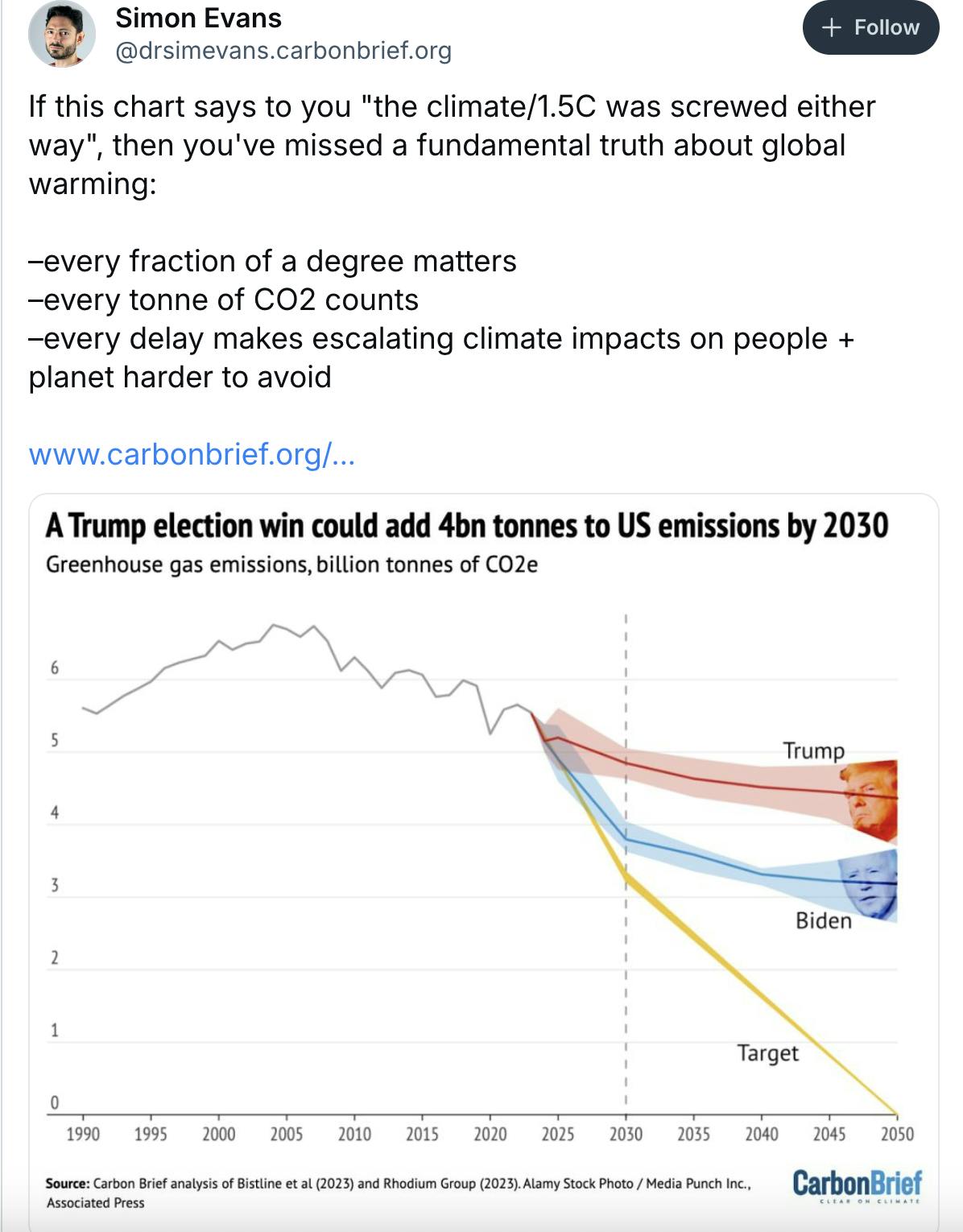
Climate-concerned readers and voters are in a tough spot. They don’t have the postelection coping options—escapism, despair, biding one’s time till the next election—open to some other people. The Biden administration’s climate policies, however historic, weren’t enough to cut emissions to the point that researchers say is needed by 2030, and analysis from U.K.-based climate news site Carbon Brief suggests the Trump administration could now add an extra four billion metric tons of carbon dioxide.

Simply accepting this and waiting for the next election isn’t really an option—either for the climate-concerned or for the many other groups whose immediate safety and well-being are in jeopardy.

This image shows a Bluesky post from Simon Evans, reading: "If this chart says to you "the climate/1.5C was screwed either way", then you've missed a fundamental truth about global warming: –every fraction of a degree matters –every tonne of CO2 counts –every delay makes escalating climate impacts on people + planet harder to avoid." The post includes a chart showing projected emissions under Trump (high), projected emissions with Biden administration policies (somewhat less high), and the target emissions reductions for preventing catastrophic levels of warming (considerably below both of these trend lines).

If this realization feels crushing, it also comes with some advantages. Specifically, it offers a useful tool for sifting through the deluge of postelection “takes” and distinguishing what is helpful from what is unhelpful: If we are truly in an all-hands-on-deck moment (I think that we are), and if, as numerous experts have emphasized, every fraction of a degree of warming matters, then postelection analyses and prescriptions that don’t offer some discernible and actionable kernel of wisdom, lighting (however dimly) one plausible path forward, are pointless, and can be discarded without further ado.

Despair, for example—as numerous climate writers have pointed out over the past few years—just isn’t helpful. I no longer feel guilty just closing the window in which I’m reading a “take” of this variety, even if it’s artful, even if I otherwise enjoy this writer’s work, and moving onto something else.

Postmortems suggesting Democrats tack even further rightward—similarly, I don’t even bother hate-reading them unless I have to for work. As TNR’s Kate Aronoff observed this week, these analyses blaming “interest groups” for dragging Dems left are singularly unpersuasive for 2024, given that Harris ran on a platform that was nearly indistinguishable from that of some 1990s Republicans. And these analyses are particularly absurd from a climate perspective: If the message is that climate groups should sit down and shut up, then where does that leave any of us? On a rapidly heating planet in which even the insufficient Inflation Reduction Act—a product, in no small part, of ceaseless and effective climate advocacy—was never passed?

Identifying effective responses to an election that empowered a corrupt, coup-backing rapist to enact mass deportations that would destroy countless lives and kneecap the national economy and food supply is not an easy task. I haven’t seen anyone lay out anything like a comprehensive plan as of yet—and like many people, I’ve been looking. But here and there you can already see people compiling useful suggestions; filtering out the not so useful ones is an important part of moving that discourse forward. Likewise, the first step in figuring out what ethical escapism and rest might look like, or building a sustainable form of political engagement for the coming months and years, lies in identifying what can easily be discarded. It’s a kind of Modified KonMari rule for political discourse: Ask yourself, “Does this ‘take’ offer any discernible theory of change?” If not, let go of it with gratitude or a murmured expletive, according to your preference. Embrace the upside of urgency. That’s all I’ve got by way of advice for now.

Good News/Bad News

The state of Maryland cut its per-capita carbon emissions by 42 percent, according to a new report—way ahead of the national average.

Some of the nonprofit organizations that mounted successful legal challenges to the first Trump administration’s environmentally rapacious policies say they are struggling with fundraising.

Stat of the Week
40%

That’s how many of the 204 agricultural lobbyists at COP29 in Baku, Azerbaijan, this year, attended as part of official country delegations, “which lent them privileged access to diplomatic negotiations,” reports Rachel Sherrington in a joint analysis by DeSmog and The Guardian.

What I’m Reading

The Fossil Fuel Industry Continues to Exert Undue Influence Over COP29, Activists Say

A U.N. climate change conference held in the petro-state of Azerbaijan days after the United States elected a president fully in the pocket of the oil and gas industry was never going to be a cheery affair. And indeed, there’s more grim news: One estimate now suggests at least 1,773 fossil fuel lobbyists have attended the U.N. climate conference known as COP29. There isn’t a good reason why this pattern is allowed to persist, reports Bob Berwyn:

Most other major international negotiations at the United Nations have conflict-of-interest policies. For example, tobacco company involvement was strictly limited when the World Health Organization developed its Framework Convention on Tobacco Control, with similar limits on pharmaceutical companies during ongoing discussions about a global pandemic treaty.

But in the case of the climate talks, corporate influence isn’t in keeping with those guidelines. The UNFCCC took small steps to increase transparency on who is attending the annual climate talks by requiring disclosures of affiliation during registration, but that does not eliminate conflicts of interest, said [Rachitaa Gupta with the Global Campaign to Demand Climate Justice].

Civil society groups have been pushing the UNFCCC Secretariat for years during regularly scheduled meetings to adopt clear conflict-of-interest rules for the climate talks, but she said the response has always been that it’s something that has to come from the member countries.

Read Bob Berwyn’s full report at Inside Climate News.

This article first appeared in Life in a Warming World, a weekly TNR newsletter authored by deputy editor Heather Souvaine Horn. Sign up here.
How Much Damage Can Lee Zeldin Do at the EPA?

Zeldin is a Trump loyalist, and Trump has already promised to gut any regulations that the oil industry doesn't like.

Trump and Zeldin sit in front of a banner reading "America's Future Tour."
Chip Somodevilla/Getty Images
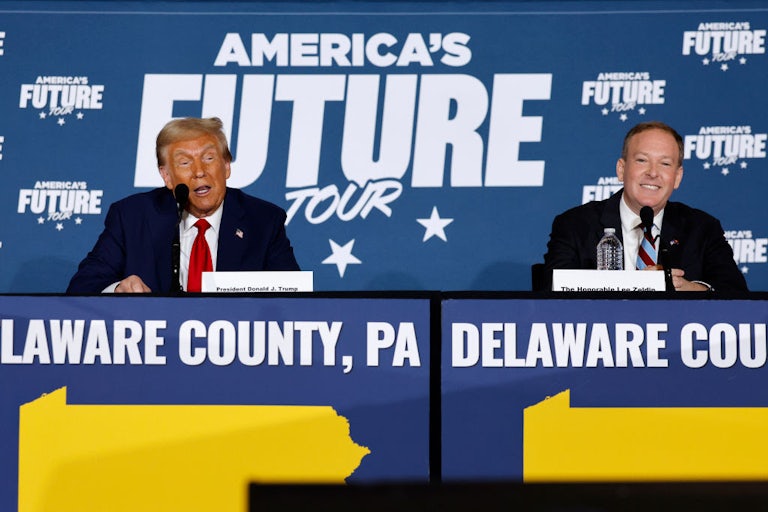
President-elect Donald Trump with former Republican New York Representative Lee Zeldin

Donald Trump has named his pick to run the Environmental Protection Agency: Lee Zeldin, who was the U.S. representative for New York’s 1st congressional district from 2015 to 2023. What does that tell us about what lies ahead? The first thing to know is that Zeldin is about as natural a pick for EPA head as Martha Stewart would be for machinist’s mate on a nuclear submarine.

When Zeldin ran against Kathy Hochul for New York governor in 2022, he campaigned primarily on law and order, along with tax and regulation slashing, “ending all Covid-19 mandates,” and parents’ rights. He also has a long record opposing gay marriage and abortion. His environmental bona fides are mostly limited to having held an annual “Teach a Kid to Fish” day as a state senator and having been a member of minor congressional caucuses such as the Climate Solutions Caucus, the Congressional Estuary Caucus, and the somewhat questionable enterprise known as the Conservative Climate Caucus.

According to one Long Island politics expert I spoke to, Zeldin probably joined these caucuses just to appear responsive to voter concerns, given that Long Island Sound pollution is a big issue in Zeldin’s former district. The memberships did not translate to pro-environmental votes: The League of Conservation Voters gives Zeldin a lifetime score of 14 percent.*

Zeldin is getting this job not because he’s interested in or qualified on environmental issues but because he’s a loyalist: He was one of Trump’s staunchest defenders in the first impeachment probe and one of four New York representatives to vote against certifying the 2020 election. At the Republican National Convention this summer, Zeldin sat in Trump’s own VIP box alongside members of Trump’s family and other cronies, only two seats away from the candidate.

“We will restore US energy dominance, revitalize our auto industry to bring back American jobs, and make the US the global leader of AI,” Zeldin promised on Monday—as if he’d been named energy or commerce secretary instead of EPA administrator. “We will do so while protecting access to clean air and water,” he added.

Unsurprisingly, environmental groups’ reactions to the pick have ranged from skeptical to outraged. On the one hand, it would be hard for Trump to do worse than his first EPA pick, Scott Pruitt, who was hired based on his experience relentlessly suing the EPA as Oklahoma’s attorney general. Pruitt resigned in 2018 amid an avalanche of ethics scandals that overshadowed even his abysmal policy proposals—like blocking the EPA from using public health research to show that pollution hurts people, repealing the Clean Power Plan, loosening fuel emissions standards, and much more. And Andrew Wheeler, who took over after Pruitt’s departure, was a former coal lobbyist.

On the other hand, the installation of a diehard Trump loyalist with little apparent agenda of his own suggests that the EPA is about to do precisely what Trump and his allies have been unusually explicit this time in promising it will do: please oil executives and, in former Interior Secretary David Bernhardt’s words, “rescind every one of Joe Biden’s industry-killing, job-killing, pro-China and anti-American electricity regulations.” (Biden was distinctly anti-China, and the oil industry kind of liked him—to climate activists’ chagrin—but whatever.) That’s in addition to likely decimating EPA staff, which the Biden administration had worked hard to rebuild after the last exodus.

Trump infamously promised oil executives last spring to reverse Biden-era environmental regulations in exchange for $1 billion in campaign contributions. Unsurprisingly, the oil and gas industry has compiled a wish list of regulations it wants axed. The American Exploration and Production Council, or AXPC, composed of oil and gas companies, is eager to repeal “more than a half-dozen executive orders that lie at the center of the Biden administration’s efforts to combat climate change,” The Washington Post reported last month, based on leaked documents. It is apparently fixated on getting rid of a new fee on excess methane released as a by-product of oil and gas production via flaring or leaks—a rule beloved by environmentalists because it reduces emissions of a particularly powerful greenhouse gas without actually requiring people to give up something meaningful. Meanwhile, the American Fuel and Petrochemical Manufacturers, environmental advocates told me, seem to be focusing on the EPA’s car emissions standards.

Zeldin will have the power to act on both of those—and many more. The vehicle standards could take some time, said Carrie Jenks, executive director of Harvard’s Environmental and Energy Law Program. That’s because that rule has already been finalized. “To roll back a final rule,” Jenks explained to me via email, “the Administrative Procedure Act requires an agency to propose a new rule, take public comment, and then finalize that new rule. The agency will have to explain what has changed and why, and the process of proposal, comment, and final rule takes agency resources and time.” That could take two to three years, she said, “and then any litigation starts once the rule is final.”

If the Trump administration haphazardly tries to rush the process, as it did during Trump’s first term, that might help environmental groups’ lawsuits to stop the new rules. The Natural Resources Defense Council has already pledged its readiness to challenge the Trump administration in court. During Trump’s last presidency, chief litigation officer Michael Wall said in a statement last week, “on average, we sued once every ten days for four years, and we won victories in nearly 90% of the resolved cases.”

The methane rule, formally known as the “waste emissions charge,” or WEC, could be reversed more quickly. Because it was only finalized on Tuesday, it’s vulnerable to the Congressional Review Act, which can be used to scrap a rule “finalized within 60 legislative days of the new administration taking office” via a simple congressional majority, Jenks explained. “We saw that used by the Trump administration last time as well as the Biden administration, and I would expect the Trump administration to consider where it can be used again.” Because the methane rule was mandated by the Inflation Reduction Act, “the EPA will continue to have the obligation to implement the WEC (through a different rule) until Congress repeals or alters the methane provisions of the IRA,” Jenks added. But “there are examples of where an agency fails to implement a rule, so that could also be a possible outcome.”

Then there are the rules that have been proposed but not yet finalized. Right now, several important ones fall into that category: proposed rules to limit industries’ ability to pollute the environment with harmful chemicals known as PFAS, for example. Proposed rules can be abandoned immediately. And a new rule for limiting greenhouse gas emissions from existing gas-fired plants, which was postponed while the administration finalized rules for existing coal-fired plants and new gas-fired plants, has not even been formally proposed yet. So that plan could be easily discarded, which is not ideal, given that gas-fired plants generate more electricity than any other type of plant in this country.

It would be a bit ironic if Zeldin were to scrap the PFAS rules—either the proposed ones or the one finalized this spring to reduce PFAS in drinking water. PFAS regulation is one of the very few environmental issues Zeldin repeatedly voted in favor of during his time in Congress: Twice he voted for a bill to require the EPA to set new drinking water standards and limit industrial PFAS discharge; he also voted for an amendment to the National Defense Authorization Act to set new standards for PFAS cleanups by the Department of Defense. But he also hasn’t been entirely consistent on this front, and at the end of the day, the point of appointing a loyalist is that they do what you tell them to. If Trump says to let industrial donors fill the nation’s waters with PFAS, it’s a good bet that Zeldin will do just that.

* This piece originally misstated Zeldin’s position on several congressional votes.

Good News/Bad News


The emerging consensus seems to be that Trump and a Republican Congress probably won’t repeal the Inflation Reduction Act (with its many clean energy incentives) in its entirety, because a lot of the money is going to red states. In other marginal good news, a billionaire’s effort to get rid of Washington state’s landmark climate law was roundly rejected at the ballot box, other states are gearing up to continue climate progress without the federal government, and the U.S. Air Force is walking back its initial claim that it doesn’t have to do anything to clean up the massive PFAS mess it created in Tucson, Arizona.


A different Washington ballot initiative, which aims to make it illegal for any municipality or the state itself ever to do anything that could be seen as discouraging gas energy or gas hookups in new buildings, looks like it’s going to pass. TNR’s Kate Aronoff wrote about the very weird background to that battle here.

Stat of the Week:
30 million tons

That’s how much ice the Greenland Ice Sheet is currently losing per hour, according to a new report.

What I’m Reading:

At Cop29, the Sun Sets on U.S. Leadership

This year’s international climate talks have kicked off amid news both of Donald Trump’s reelection as president of the United States and that 2024 is already a record-hot year for global temperatures. Despair and nihilism won’t help, but neither will sugarcoating the matter. So to that end, here’s Elizabeth Kolbert’s succinct summary:

In his first term, Trump withdrew the U.S. from the Paris Agreement. The day Biden took office, he moved to reënter the agreement. Trump in his second term almost certainly will withdraw from the accord once again. And it’s possible that the new Administration could take the even more radical step of withdrawing from the treaty that underlies the Paris Agreement, the U.N. Framework Convention on Climate Change, which was ratified by the U.S. Senate in 1992. Leaving the U.N.F.C.C.C. would make it virtually impossible for the country to rejoin because the move would require approval by two-thirds of the U.S. Senate.

Just how bad a second Trump Administration will be for domestic climate policy remains, of course, to be seen, but the most likely scenarios are all pretty bleak. During his first term, Trump tried to roll back more than a hundred environmental regulations. And, while the Biden Administration is rushing to try to “Trump-proof” various rules, including a set aimed at limiting oil drilling in the Arctic National Wildlife Refuge, this seems unlikely to deter the incoming President, who, through his own nominees, has produced a U.S. Supreme Court deeply sympathetic to his agenda. According to a recent analysis by the British-based Web site Carbon Brief, were Trump to roll back the Biden Administration’s key climate initiatives, the U.S. could emit an extra four billion tons of CO2 by 2030. This, the analysis noted, “would negate—twice over—all of the savings from deploying wind, solar and other clean technologies around the world over the past five years.”

Read Elizabeth Kolbert’s full piece at The New Yorker.

This article first appeared in Life in a Warming World, a weekly TNR newsletter authored by deputy editor Heather Souvaine Horn. Sign up here.
The Right Way to Deal With Election Stress

Everyone's got a suggestion for how to de-stress. Alternatively, you could stress. This is stressful!

People stand next to a sign reading "Vote Vote Vote."
AFP/Getty Images
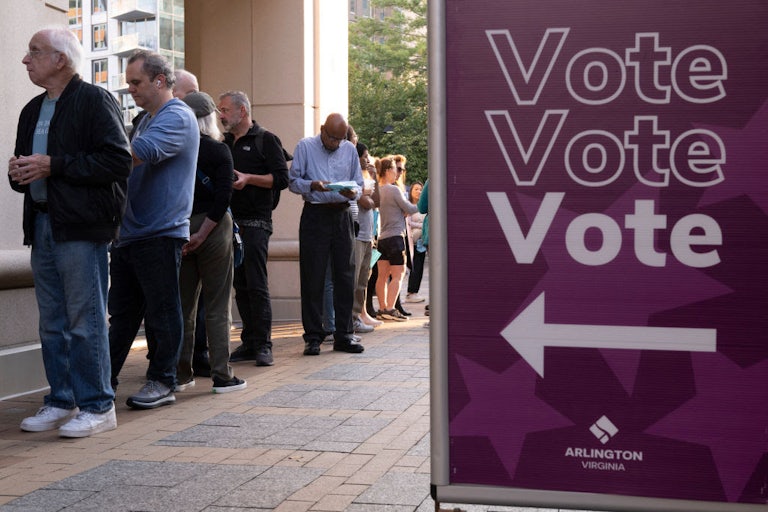
Voters line up for early voting in Arlington, Virginia, on September 20.

We’re in the breathless final stretch of this election—when new poll analyses drop seemingly every five minutes, “closing arguments” that contain no new information receive detailed reviews, homepages transform into liveblogs, opinion pages swing wildly between imagining different scenarios, and almost none of it is useful because there simply isn’t much to do other than wait until Election Day. Or rather Election Week: Chances are that we won’t know for days, or even longer, whether the White House will return to a guy who tried to overturn the last presidential election.

In fact, at this stage of the election cycle, The New York Times’ dining section, with its recommendation of what cookies to bake while watching election night coverage, arguably contains more new and useful information than most politics sections: At least you get some tips about baking with brown butter.

But this year, many outlets have added a new genre of article to the mix: how to handle election stress. Experts interviewed by ABC News suggest that people sleep, limit news and social media consumption, and “focus on concrete tasks that they have control over, like helping get people registered to vote or participating in canvassing.” People interviewed by the ABC affiliate in West Palm Beach, Florida, likewise endorse action—and also prayer. Austin news station KXAN suggests people adopt a “day-by-day approach” and use “I” statements when “setting boundaries” with family and friends regarding political discussions. Psychologists in particular had a lot of advice: how to identify the root of your anxiety, “boost optimism up until the last minute,” relax via “deep breathing, progressive muscle relaxation, aerobic exercise, a warm bath, relaxing music, a walk in nature.” An article from the meditation app Headspace, unsurprisingly, suggested meditation. Washington Post columnist Ruth Marcus said that she knits, “compulsively.”

Your mileage with all these suggestions may vary. Personally, I found even collecting them to be overwhelming. (And that’s not ideal, given that my boss wrote Monday that we have a moral duty not to panic.)

Recently, I’ve been thinking a lot about a pair of essays Mary Annaïse Heglar wrote for TNR four years ago: the first about how mourning climate change prepared her to weather the Covid-19 pandemic, and the second about how being both a “climate person” and “a Black climate person” affected her perspective on the 2020 presidential election. Mary is emphatically not a “doomer”—i.e., someone who sees all the bad news and figures it’s time to give up. But in these essays, she emphasized the importance of fully acknowledging the weight of the moment, rather than trying to ignore it. “This is painful,” she wrote in March 2020 about Covid and the climate crisis. “It’s supposed to be. We are suffering through a collective trauma. We’re watching our world change, and it feels like it’s falling apart. That’s not supposed to feel OK: It’s not OK. As hard as it is, as painful as it is, we have to accept the reality of our crisis. Denial, often a critical step in the grieving process, is not an option.”

Her assessment of the 2020 election was similarly unflinching. Being a climate writer means understanding just how high the stakes are, and that there’s no such thing as putting the crisis on “pause” for four years. Instead, as writer and activist Bill McKibben has repeatedly observed, in his newsletter The Crucial Years, these next years are more vital than ever—and merely failing to act during this time will put us on a very dangerous path.

“This election,” as Mary put it, “is less about whether we should act on climate than how we should act on it. Should we act with compassion or with cruelty? Given that our national commitment to democracy has become debatable, this election is also about whether we even have the ability to act on climate in any meaningful way in the future.” Against all that, her message was simple: “This past weekend, on the first day of early voting in New York City, I stood in line for more than five hours to vote like my life depended on it. Because it does.”

That’s not a warm bath. On the other hand, it is an “I” statement, and I’d argue it does engage with the “root” of election anxiety. It’s also a kind of optimism. As Mary put it, “I’ll take a shot in hell over a shot to the head any day.”

It’s a line worth meditating on.

Good News/Bad News

The Washington Post reports that while climate change may be killing people all over the globe, it’s also allowing British vineyards to produce quality bubbly. I can’t quite bring myself to endorse that grisly juxtaposition as “good news,” though. Instead, here’s a lovely piece from Inside Climate News about how Johns Hopkins researchers and communities across Baltimore are working together to figure out how to make Baltimore and other cities more climate resilient—and more equitable.

Greenhouse gas concentrations in the atmosphere reached record levels last year, according to a new report from the U.N.’s World Meteorological Organization.

Stat of the Week
$3 billion

That’s how much money the Biden administration is disbursing in Inflation Reduction Act–funded grants to green the country’s ports, following an announcement this week.

What I’m Reading

Authoritarianism is on the rise. Is climate change to blame?

“Researchers have long noticed that natural disasters like floods, droughts, and wildfires can help autocratic politicians consolidate power,” writes L.V. Anderson in an unnervingly timely article at Grist. But recent research has helped to narrow down what, exactly, is happening and how people disinclined to give up on democracy can push back:

Until fairly recently, researchers looking at the ties between climate disasters and authoritarianism only had case studies, like Duterte and Trujillo.… But in 2022, economists in the United Kingdom and Australia devised a clever study seeking to prove that storms like hurricanes actually cause a slide toward authoritarianism.… A causal relationship between climate change and authoritarian attitudes has also been demonstrated on a much smaller scale in psychology studies. In 2012, a team of psychologists divided cohorts of German and British university students into two groups and told them they were helping to develop a knowledge test. They informed half of the volunteers about some of the threats associated with climate change—findings about how hazardous heat, wildfires, and glacier loss are projected to worsen in the future. The other half learned “neutral facts” about their respective countries’ weather, forests, and economies, with no mention of climate change. The volunteers who had been told about the perils of climate change expressed more negative opinions of dangerous or marginalized groups—like terrorists, drug addicts, or attack-dog breeders—on a 10-point scale measuring their attitudes toward various demographics.

Read L.V. Anderson’s full report at Grist.

This article first appeared in Life in a Warming World, a weekly TNR newsletter authored by deputy editor Heather Souvaine Horn. Sign up here.