Newsletter
Power Mad
A weekly review of the rogues and scoundrels of American politics

Trump’s Best Allies Are His Biggest Weakness

The same out-of-touch elites the GOP has spent decades vilifying are the company this president keeps. Now it’s the Democrats’ turn to demonize them—if they want it.

Donald Trump speaks at a White House “AI and Crypto” event alongside the billionaire tech-bro set.
Alex Wong/Getty Images
Donald Trump speaks at a White House “AI and Crypto” event alongside the billionaire tech-bro set.

Donald Trump was lustily booed at the U.S. Open in New York, and his excursion to one of D.C.’s despots’ club restaurants was interrupted by chanting protesters. But the opposition to the president extends well beyond the Acela corridor. As CNN’s Harry Enten noted this week, Trump’s approval rating is plummeting and he’s now “underwater on every issue”—including on crime and immigration, his supposed strengths. Across the board, Trump continues to have a “consent of the governed” problem, and it’s gotten so pronounced that former New York Times columnist Paul Krugman is wondering whether “a despised autocrat can consolidate power.”

It’s a question that Krugman ultimately leaves unresolved. “I guess we’re going to find out,” he concludes. But there’s a hint of passivity here, as though the outcome is beyond our control—which could not be further from the truth. There’s a large and growing anti-Trump movement across the United States that is just waiting for powerful allies to join them, and it just so happens that there’s a minority party in Washington that is desperate for ways to exert its power that don’t require controlling the levers of government. It’s a no-brainer for the Democrats, who can keep the public animus toward the president well stoked by turning Trump’s elite enablers and supplicants—not just in the capital but across society, from Silicon Valley to academia—into objects of opprobrium.

We’ve been over this before, but the most important thing to remember about Trumpism is that it doesn’t work as a matter of policy. He doesn’t know how to run the economy anywhere other than into the ground, and with each passing day come fresh harbingers of shocks to those mythical kitchen tables. (According to recent reports, agricultural economists believe prices for a slew of grocery staples could be set to double this winter.)

As Krugman notes, Trump is running the inverse play from the Dictators’ Guide to Consolidating Power: Instead of using his power to shore up a weak economy, Trump is taking a roaring economy and wrecking it. And it hasn’t gone unnoticed: TNR’s Greg Sargent reported on a recent poll that found that “48 percent of overall likely 2026 voters say Trump’s tariffs are hurting their own economic situation, versus only 29 percent who say they’re not having any effect and an abysmal 8 percent who say the tariffs are helping their economic prospects.”

Still, as Krugman writes, Trump is governing like he has “an overwhelming mandate to do whatever he wants,” which raises the question: How is he getting away with it? Part of the answer is that denial has become his administration’s stock-in-trade—like the hilarious claim that the president’s signature does not appear in Jeffrey Epstein’s birthday sex-crime book. But another part of the answer, Krugman continues, “is anticipatory compliance on the part of members of the elite, from corporate CEOs to university presidents to law partners.”

Let’s linger on this a moment: Krugman is correct to note that one of the key forces enabling Trumpism is this grotesque collection of oligarchic weirdos that everybody hates: Big Law goons, Ivy League ivory tower types, corporate predators, and the tech-bro billionaire set. While some of these supplicants are more willing than others, they’re also the only ones receiving—or hoping to receive—some tangible benefit from Trump. Whether it’s Trump’s Silicon Valley dinner party guests or the university president who tried to cut a deal, all of these elites are operating from the same premise: “Maybe if I’m nice enough to Trump, he’ll let me keep the money.”

But the salient point is this: In the not-so-recent past, it would be the GOP endeavoring to paint Democrats as the captive party of America’s economic and cultural nobility. Now Trump has embraced all of these political albatrosses as his boosters. And as fortunes decline for you and me, it’s these already uber-privileged members of society who are staying whole—or getting ahead. The only people for whom Trumpism works, in other words, are the same sort of people who rigged the system in their favor in the first place. The only thing that’s changed is that the new mob boss is demanding a bigger cut.

It may be that the same forces that are enabling Trumpism could enable the opposition to Trumpism, provided that Democrats lose their risk-averse ways and demonize the elites that are now at Trump’s beck and call. And while it’s true that some have bent the knee more readily than others, we must have the stomach to castigate Trump’s allies no matter how willingly they came to his side. For my part, it’s OK with me if Democratic messaging included the line, “While Trump’s Harvard cronies were cutting deals, the cost of your groceries has doubled.”

There are no allies for Democrats to be found in Trump’s teeming hive of enablers. Anyone who might serve the ends of democracy and the rule of law has, by now, explicitly announced themselves as having taken that side. As Jonathan V. Last notes, “Any institution not explicitly anti-Trump will eventually become useful to Trump.” One day, we might need to have a conversation about whether some of these people or institutions should receive a path back to respectability after violating the social compact on behalf of a wannabe fascist strongman. But that’s not the pressing business of the day.

For now, brave Democrats can and should implicate and vilify those who have abetted Trumpian misrule and have, by extension, reaped the fruits of its poisonous economic tree. It may be that one of the keys to denying Trump long-term power is to foment the public’s ire at the company he keeps, paint the whole lot as crooks and brigands who are looting the proceeds of the public trust. The burgeoning anti-Trump movement in the streets will be cheered to hear from some political allies who are promising to name the villains of the Trump era and to crush them in whatever era comes next.

This article first appeared in Power Mad, a weekly TNR newsletter authored by deputy editor Jason Linkins. Sign up here.
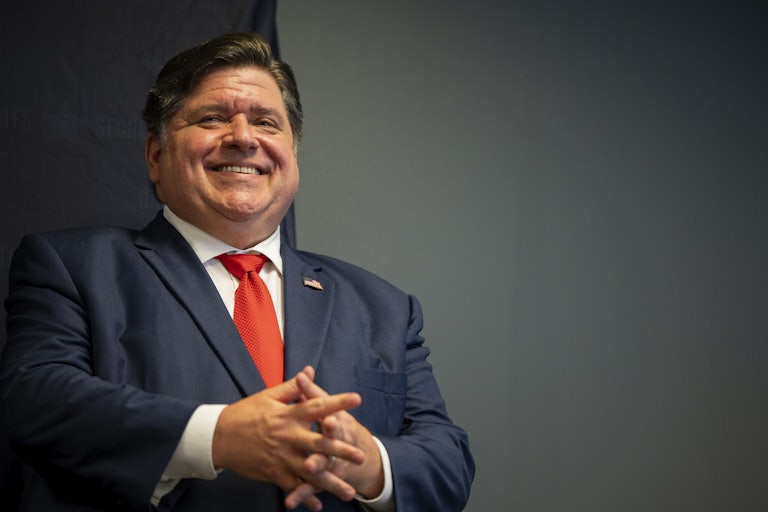

JB Pritzker Just Set Himself Apart From All Other Democrats

This week, the Illinois governor suggested that he’s ready to take the fight against Trump much further than his party colleagues.

Illinois Governor J.B. Pritzker smiles during a 2024 United States Democratic National Convention security briefing.
Vincent Alban/Getty Images
Illinois Governor J.B. Pritzker

As Donald Trump’s goon-squad occupation of the nation’s capital wends its way into its third week, the president is already eyeing the next Democratic stronghold he’d like to strangle with his bruised hands in the name of “fighting crime.” Among the municipalities facing the mad king’s wrath is Chicago, which has loomed in far-right lore as some kind of Third World hellhole. While we wait for many Democratic leaders and media elites to take Trump’s authoritarian spree seriously, TNR editor Michael Tomasky this week urged Illinois officials to steel themselves for what’s to come. “Okay, JB Pritzker,” he wrote, “you’re up.”

It didn’t take long for the reply to come. In a Monday afternoon news conference, Illinois’s Democratic governor joined a slew of state leaders speaking out about Trump’s plan to deploy troops to Chicago. Pritzker has, over the past year, begun to cement his national profile ahead of what many presume to be a presidential run in 2028. He has firmly planted himself in the same “fighter” lane as California Governor Gavin Newsom—the better to distinguish himself from, say, whatever it is that Michigan Governor Gretchen Whitmer thinks she’s been doing lately.

Pritzker ended up being the headline figure of that Monday news conference, thanks to the simplicity and directness of his message. “Mr. President, do not come to Chicago,” he said. “You are neither wanted here nor needed here.” He offered some satisfying digs at the evident decline of Trump’s mental faculties. He hit many of the right notes for someone who wants to establish himself as a leader of a dissident movement. But Pritzker saved his best for last, when he promised to take the fight against Trump a step farther than most Democrats have allowed themselves.

Finally, to the Trump administration officials who are complicit in this scheme, to the public servants who have forsaken their oath to the Constitution to serve the petty whims of an arrogant little man, to any federal official who would come to Chicago and try to incite my people into violence as a pretext for something darker and more dangerous: We are watching and we are taking names.

This is where Pritzker has leveled up over his fellow Democrats, by promising a future of accountability and retribution for the destruction Trump and his minions are doing to the constitutional order and our individual freedoms. As I wrote back in May, the Trump White House and the GOP are no longer a political party by any definition; rather, they are a sort of criminal syndicate with an extensive portfolio of white collar crimes, violent offenses against our civil rights, and an ongoing sort of imposed cultural tyranny that is killing off the well-paying jobs of the future by decimating academia, and literally sparking public health crises at home and abroad through the Lysenkoism of key administration figures like Robert F. Kennedy, Jr.

As I noted at the time, “There is a certain necessary logic to what has to follow corrupt misrule of this kind: tribunals, trials, punishment, prison, and the running to ground and defunding of the entire Trump syndicate.” The only thing we were lacking then was an ambitious political figure who was willing to say that they were ready and willing to make accountability a key plank in their platform. Pritzker has made a timely arrival.

As Discourse Blog’s Rafi Schwartz points out, this isn’t the only uniquely consequential aspect of Pritzker’s speech. The Illinois governor—channeling the feelings of so many who’ve forewarned of what was to come in a second Trump term—told those assembled, “If it sounds to you like I am alarmist, that is because I am ringing an alarm, one that I hope every person listening will heed, both here in Illinois and across the country.”

Pritzker’s willingness to straightforwardly announce the existence of a crisis with “no caveats” and “no conditionals,” Schwartz writes, helps to “[neutralize] the latent anxieties of those worried about coming off as unduly panicked or oversensitive to the political realities around us.” In short, Pritzker allows those so inclined to finally grant themselves the permission to see the fascism that’s on the march, and speak of it out loud.

In the same way, I think that Pritzker has kicked open a door to an alternate future: One in which the restorative work of post-Trump patriots involves accountability for criminals and reparations for the people they’ve harmed. The taking of names and the doling out of punishments: This is now part of the larger political discussion; this is now part of the Democrats’ intraparty debate about What Is To Be Done. By including this as part of his political ambition, and broadly suggesting it may be the major goal of some future Pritzker administration, he allows us to imagine this future and have a hand in creating it.

And it sure sounds like Pritzker wants to put his hands to the task right now. “If you hurt my people,” he said, “nothing will stop me, not time or political circumstance, from making sure that you face justice under our constitutional rule of law.” In a week where Beltway Democrats passed their time pointlessly debating whether or not they were using words like “food insecurity” too much, and congratulating each other for calling the D.C. occupation a “stunt” or a “distraction,” hearing a Democratic politician speak in plain English is pleasingly bracing. These are, indeed, encouraging words to hear after Democrats long implored us to “look forward, not backward” and allowed misrule to go unpunished, thereby paving the road for Trump’s fascist second act.

This article first appeared in Power Mad, a weekly TNR newsletter authored by deputy editor Jason Linkins. Sign up here.
The Useful Idiots in the Media Abetting Trump’s D.C. Takeover

Imagine if the president’s radical claims about reducing crime were actually scrutinized?

National Guard troops from South Carolina stand in Foggy Bottom Metro Station in Washington, D.C.
Andrew Harnik/Getty Images
National Guard troops from South Carolina in Foggy Bottom Metro Station in Washington, D.C.

Less than a fortnight into President Trump’s federal takeover of D.C. by the National Guard and an alphabet soup of federal law enforcement agents, Washingtonians have rendered an unsurprising verdict on the president’s latest display of authoritarian corruption: They hate it, in large numbers. And they’re organizing against it: A “Free D.C.” movement has taken root—and taken to the streets—to resist the president’s latest power grab.

The response from political and media elites to this militarized takeover of our capital, however, has been rather limp. As The New Republic’s Monica Potts reports, Democrats apparently have been caught flat-footed by Trump’s maneuver; to the extent that they’ve said anything about it, they’ve largely dismissed it as a manufactured “distraction” rather than loudly calling it what it is: a fascist occupation—and a prelude to worse.

But Trump is getting plumped by some in the media as well: The Atlantic’s Michael Powell idly handwaves the fact that D.C. brought the violent crime rate to a 30-year low in 2024 to admonish Democrats for “downplaying crime.” (In this case, “downplaying crime” means “marshaling statistics demonstrating that the crime rate is trending in the right direction.”) Charles Fain Lehman, also in The Atlantic, goes to similar lengths to dismiss the actual facts to assert that “the reality is more complicated” and that some “deliberate intervention”—atop the one that brought the crime rate to a 30-year-low, presumably—is warranted.

These authors and others are making a profound error from the jump in assuming that Trump sincerely desires to lower the crime rate in D.C. Trump is actually a “blank, sucking nullity” who wants to see himself on television and has decided that his second term in office will be about self-enrichment and revenge. He is inventing a crisis of crime as a pretext for further consolidating his power; this is authoritarianism 101.

Personally, I think downplaying crime in the nation’s capital is not nearly as irresponsible as downplaying Trump’s authoritarianism. But if we must pretend that Trump’s efforts are sincere, then I’d challenge the proponents of his militarized deployments to approach their work with more rigor, and less vibes. Trump has proposed a thesis: Crime in D.C. will go down if masked paramilitaries flood the city and amble about the streets. The task, then, is to see if his theory stands up to the test—to take this seriously.

Trump’s critics do take this seriously, and they have a thesis of their own backed up by data. The District of Columbia had a miserable year in 2023; as crime rates were dropping across the country, D.C.’s were spiking. The New Republic’s Grace Segers took an in-depth look into the phenomenon and reported that the city’s woes stemmed from an interlocking array of local failures, structural problems, and lack of investment. But city officials got busy in 2024 and reversed the trend, achieving a 35 percent reduction in violent crime and the aforementioned 30-year low in the violent crime rate. (Trump is now contending that the city lied about these results. As always, the safe harbor for journalists is to treat every Trump claim as a probable lie—unless, for example, you relish being the type of dummy who reported that Trump had “disavowed Project 2025.”)

As the city pulled off this feat without unleashing goon platoons into the streets, Trump’s challenge is to somehow demonstrate that his way of doing things is more effective. While it’s early days, I’m not sure that we’re getting much bang for what I’m guessing will be a lot of bucks taken from taxpayers. What statistics the administration has put forth are scant: The White House told Axios that “212 people have been arrested for various [non–immigration related] crimes” between August 8 and August 18, 101 of which were from Wards 7 and 8.

That sounds fine, but there’s a lot I don’t know about these numbers and no one at Axios bothered to do much in the way of scrutinizing Trump’s claim. Which agency is reporting these numbers? Is this a coordinated data dump from multiple agencies? Are these adult arrests, juvenile arrests, or both? Do these figures include the Metropolitan Police Department’s own arrest tallies during that period? Does “212” reflect the number of defendants or the number of arrest charges? Because that’s how the MPD tabulates its own arrest statistics. Speaking of, in the same time period in 2024, the MPD made 596 adult arrests.

Crime statistics can be treacherous waters in which to wade; in my experience the lack of consistency and the eminent cherry-pick-ability of them is fodder for crime fearmongers to beat their drum. Moreover, as my colleague Matt Ford pointed out to me, arrest statistics can be unreliable because they are more reflective of law enforcement priorities than they are of actual criminal activity. But that suggests there is a ripe avenue for curious reporters: Find out from the administration what their priorities are. Make them stake a specific claim about what they want to achieve and then hold them accountable.

By all outward appearances, Trump’s crime crackdown priorities seem odd. As The New York Times reported this week, most of the troops that have been sent to D.C. are aimlessly wandering around “the National Mall, large monuments and other tourist-heavy areas,” as well as “metro stations, most of which are also near tourist and entertainment sites.” These patrols aren’t exactly taking place in the mean streets, folks.

The big accomplishment of this deployment seems to be a big uptick in the number of selfies tourists are taking with troops. The other achievement is public displays of ridiculousness: My former New Republic colleague Prem Thakker spent Wednesday morning at the Columbia Heights metro station witnessing a farce as various troops and cops rode the escalators up and down and back again, only to eventually nab a single alleged fare evader. Those who think Trump is in the right should probably explain how these activities will achieve a lower crime rate than city officials were managing themselves.

But it’s not all so benign. Gangs of vaguely identified pseudo-cops are brazenly beating up people in the street, in a manner that The New Republics Melissa Gira Grant likens to the violent exploits of the Proud Boys. The occupying forces are carrying out a sadistic campaign against the city’s homeless population. And beneath it all, the city is being subjected to the mother of all ICE raids, with unidentifiable agents snatching food deliverers off the street (one GrubHub driver was rammed by a police car while making a delivery on his moped) and swarming local churches, grocery stores, and daycare centers. That’s certainly a lot of activity, but those who’ve criticized the city’s own approach to law and order should explain what’s being achieved.

Proponents of Trump’s intervention should also explain whether or not what D.C. needed was a swift kick to the local hospitality economy. While the Trump administration has recently tried to claim that restaurant reservations are “up 30 percent” since the takeover, this is a lie. As The Washington Post reported this week, “Restaurant reservations have dropped in the city by as much as 31 percent year over year for a single day,” since Trump kicked off his military takeover, and “business owners are concerned that the continued surge in law enforcement could impact their revenue during a vital period of the summer.” For everyone who pooh-poohed the Democrats who wielded actual facts about crime in D.C., please enlighten me: Is this good? Are these the results we wanted?

You can absolutely mark me down as extremely skeptical that Trump’s interventions are going to reduce crime in D.C. As always, I’m prepared to be wrong. Can the same be said of the pundits who’ve criticized anyone who dares use facts to question Trump’s fearmongering on crime?

This article first appeared in Power Mad, a weekly TNR newsletter authored by deputy editor Jason Linkins. Sign up here.
Yes, Dems Should Push to Repeal Trump’s Big Bad Law—but Not Stop There

James Carville had a decent idea, for once. But it’s easily improved upon.

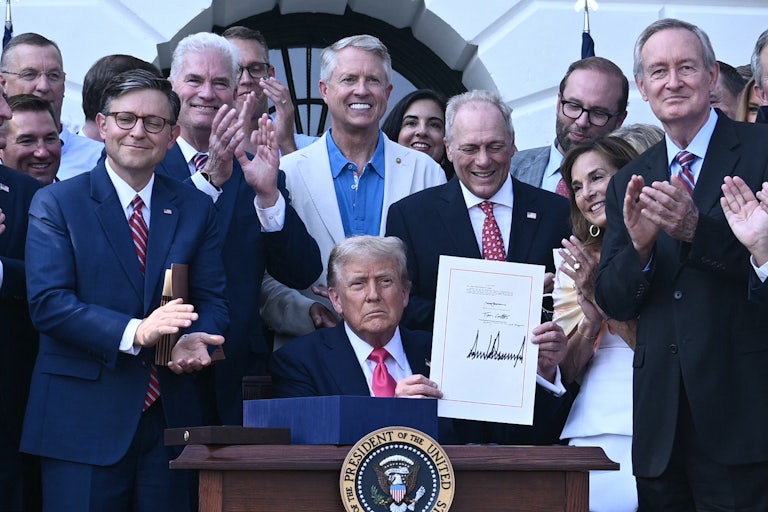
Donald Trump shows his signature on the “Big Beautiful Bill Act” at the White House in Washington, D.C.
Brendan Smialowski/Getty Images
Donald Trump shows his signature on the “Big Beautiful Bill Act” at the White House in Washington, D.C.

Earlier this month, I brought you the good news that Democrats were developing a concept of a plan for their upcoming midterm campaign, having spent the first half of the year on a concentrated strategy of sitting back and letting Republicans screw things up. The precipitating event for the change of heart, according to reports, was the passage of President Donald Trump’s One Big Beautiful Bill Act, which I guess was the trap that Democrats were hoping to spring. Well, as if to confirm that the game is, finally, afoot, James Carville—the chief advocate of his party’s “roll over and play dead” strategy—is calling for a big shift, in a recent op-ed in The New York Times.

To my surprise, there is merit to be found in his proposed line of attack. But it’s sandwiched between a confused read of the political landscape and a rather limp call to action that really fails to contemplate the real harms that Trump’s legislation is about to unleash. For this garden to bear fruit, we need to do some weeding.

As is their wont, the minders of the rubber room in which New York Times opinion pieces are formed did permit Carville to spend several paragraphs throat-clearing about how the Democrats are “constipated” and “leaderless”—which, you know, shouldn’t bother someone who advised them to do nothing for six months, anyway. He also seems weirdly panicked at the fact that Zohran Mamdani won his party’s nomination for the upcoming New York mayoral election, which to Carville represents “an undeniable fissure in our political soul.” To my mind, our political soul would be more gravely imperiled had serial sex pest Andrew Cuomo won the nomination, but it’s always interesting to learn about what elite Democrats and their favorite newspaper editors are prepared to forgive.

After this simultaneously overwrought and underbaked beginning, we finally arrive at Carville’s big idea: Democrats should let Trump “rope-a-dope with MAGA on the Jeffrey Epstein case” without “get[ting] in the way” and instead train their fire on the depredations of Trump’s budget bill.

Now, I come from a controversial school of thought that holds that a political party can, and even should, do two things at once. But I’m willing to concede that the Epstein matter has become something of a perpetual motion machine, with Trump’s own actions being the strongest force keeping this hurdy-gurdy spinning. It is also the precise kind of story—salacious, wicked, and conspiratorial—that our cynical political media doesn’t need outside encouragement to cover. As always, Democrats should take note of what it is the political press wants to spend its time covering and do more to provide low-minded fodder for partisan conflict.

But Carville is very much on point where one vital matter is concerned: This is a phenomenally favorable environment to wage war on Trump’s signature law. Carville cites a July 16 CNN poll that found that a majority of respondents oppose the One Big Beautiful Bill Act, 61–39 percent, and expect it to hurt the economy, 51–29 percent.

What can I say? The public basically has it correct. Taken as a whole, we have strong evidence that there is fertile terrain to wage a maximal battle against Trump on this issue. So it’s puzzling that Carville’s clarion call to action is so oddly muted—and so fundamentally illogical:

Our midterm march starts with a simple phrase every candidate can blast on every screen and stage: We demand a repeal. A repeal of Mr. Trump’s spending law is the one word that should define the midterms. It is clear, forceful and full-throated. It must be slathered across every poster, every ad, every social media post from now until November 2026. That single word is our core message. Every Democrat can run on it, with outrage directed not at the president or a person but at this disastrous bill. And the reasons are countless, each one a venom-tipped political dagger.

I am really struggling to understand how we’ve landed at “We demand a repeal.” In the first place, are Democrats … not planning on winning the midterm elections? I thought the goal here was to take back both houses of Congress, in which case they wouldn’t need to demand a repeal from anyone, they could simply—you know—pass their own bills to repeal things and then demand the president sign them. Which Trump wouldn’t do, of course, but hopefully Democrats understand that the goal here would be to use politics to cross-pressure vulnerable Republicans and construct an anti-GOP electoral majority, not expect Trump to give in to their demands. Republicans spent the Obama years trying to send Obamacare repeals to his desk, not because they thought he’d sign them but because doing so helped reaffirm their commitment with their base.

At any rate, “Demand a repeal” is strained and supine—it suggests that you’re either not planning on using your power to fight or you somehow still intend to attempt bipartisan collaboration once you gain back power. A clearer and more full-throated campaign message would be, “Not only will we repeal this bill, we will pass bills to undo the damage done to the government, we will fight to get the civil service rehired, and we will crush the corrupt thieves who stole your wealth and health care.”

And they shouldn’t stop there. Democrats need to contend with what the One Big Beautiful law will do—and it’s not clear that Carville, at any rate, is prepared to do that. Yes, the law, as Carville suggests, filches wealth from the American people in a thousand different ways, but he fails to connect the all-important dots as to where that money is actually going. Beyond the usual, bog-standard creation of yet another taxpayer-funded slush-fund for oligarchs, Trump’s law is a massive transfer of wealth from the American people to fund a domestic deportation army and construct a nationwide network of concentration camps.

Phenomenal sums of money are already changing hands. The law allocates $8 billion to ICE to go on a massive hiring spree, for which the agency is offering $50,000 signing bonuses. This week, an eye-popping Bloomberg story reported that the Virginia-based Acquisition Logistics Company was awarded a $1.26 billion contract to build another detention facility in Texas. Prior to winning that contract, the firm had collected a mere $29 million in Defense Department contracts. And the fact that the company “doesn’t appear to have any experience with detention” was no impediment to its receiving this windfall.

The law is not merely greedy; it’s not merely cruel. What Trump is doing is nefarious. Needless to say, I’m troubled by Carville’s omission of the way this one law furthers and funds what can only be called the president’s fascistic designs for our country’s future. And I’m troubled by the feeling that Democrats—who are far from great on the issues of immigration and asylum—may try to duck this fight.

Democrats are notoriously conflict-averse, and I worry that they’re still intimidated by Trump’s alleged mastery of the immigration issue. But the biggest reason to take this fight to Trump is that Trump doesn’t think Democrats have the heart for it. As Brian Beutler recently noted, Trump is “betting that grappling with a giant, masked right-wing police force and a multistate immigrant gulag will tear Dems apart if they ever retake power.” Anyone authentically concerned with “undeniable fissures” in the Democrats’ “political soul,” as Carville purports to be, needs to make sure Trump loses this bet.

This article first appeared in Power Mad, a weekly TNR newsletter authored by deputy editor Jason Linkins. Sign up here.

The Democrats Finally Have a Plan to Attack Trump. Sort Of.

They’re organizing a summer-recess attack on the administration’s worst policies—but they’ll be playing catch up against a GOP that’s mastered the media game.

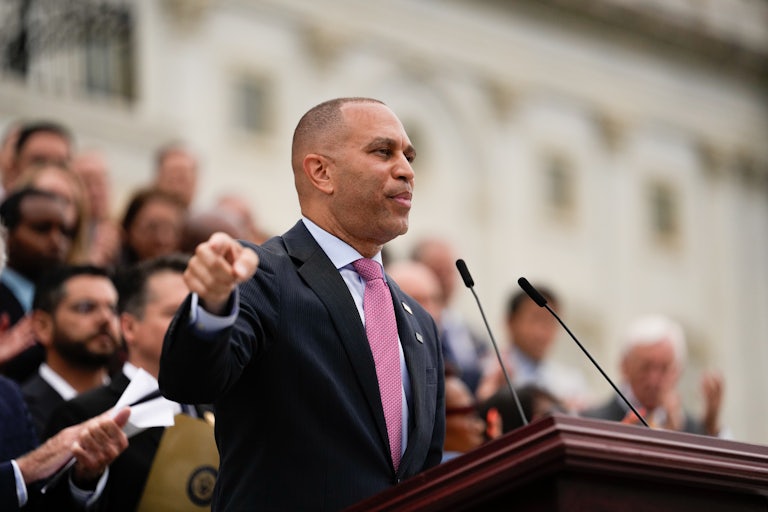
Hakeem Jeffries speaks during a news conference with House Democrats outside the US Capitol in Washington, D.C.
Kent Nishimura/Getty Images
Hakeem Jeffries speaks during a news conference with House Democrats outside the U.S. Capitol in Washington, D.C.

The first six months of Donald Trump’s second presidency have been a master class in what he truly excels at: wanton misrule. With an absence of adult minders and a determination to run roughshod over all of the democratic guardrails that have historically only been propped up by a fealty to norms and the waning spirit of fair play in Washington, Trump has moved fast and broken the government, put the economy into trauma with his constantly shifting tariff demands, perpetrated the deaths of HIV-infected children abroad, and cut the ribbon on a spanking new concentration camp in Florida.

These first six months have also featured a Democratic Party that has done what it does best: kept its stockpile of powder nice and dry. While some Democratic electeds have broken from the herd (often to the disdain of Democratic leadership) to confront Trump and his Republican minions, the party’s age-old theory of how political change happens—wait for the GOP to screw up—has remained in effect. Though now, with the passage of Trump’s big new “kick people off health care and funnel the money into an American Gestapo Act of 2025,” it looks like Democrats finally have their quarry right where they want them.

Or … almost? As it turns out, Democrats are planning to take on the GOP—in a few weeks, anyway. “House Democrats are plotting to turn the August recess into the opening salvo of the midterms, including through town halls and organizing programs,” reports Politico, as the party is experiencing “renewed bravado after months in the political wilderness.” And to think that all it took for Democrats to exit this self-imposed exile was Trump getting everything he wanted.

But come on, feel the bravado, folks. Maine’s centrist weirdo Representative Jared Golden, who is part of a group of Democrats who’ve lately decided that swearing more often makes them look edgy, shows up in the same Politico piece, bragging, “There’s almost nothing about this bill that I’m going [to] have a hard time explaining to the district. This is a giant tax giveaway to wealthy people. Everyone fucking knows it.” Can confirm! The New Republic has been covering this bill rather relentlessly over the past few months, which raises an uncomfortable question: What was stopping Golden from explaining this to his district at any point during the legislative meanderings of this bill? (Perhaps Golden, the most Trump-curious member of the Democratic caucus, was weighing whether to vote with the Republicans, as he has in the past.)

If there’s one thing that Democrats do seem committed to, it’s their August timetable for finally unleashing the spittin’, cussin’, new-look party to officially open the midterm election campaign. Over the past weekend, as Texans faced the now-familiar tragedy of mass casualties from devastating floods, House minority leader and energy vampire Hakeem Jeffries found it premature to go on an attack. Instead, he joined the Sunday morning talk show idiot parade to express his firm hope that Democrats might work productively with the party that’s hell-bent on destroying the government and wiping climate change from our brains: “I think we are going to have to figure out what happened, why did it happen, and how do we prevent this type of tragedy from ever happening again? And so the question of readiness is certainly something that Congress should be able to explore in a bipartisan way, particularly as we head into a summer where we can expect intensifying extreme weather events.”

It’s hard to fathom a Democratic leader speaking these words aloud in July of 2025. In the first place, the hows and whys of this flood should be glitteringly apparent: Trump’s executive branch misrule has led to cuts in the programs and personnel that keep people safe from these disasters, his shell of a disaster-response agency was slowed by Kristi Noem’s penny-pinching and is (as of this writing) “slow-walking the response,” and the federal government’s weather resources are being sold to his cronies. There is also ample evidence of Republican misrule closer to home, from a Republican governor who keeps presiding over these needless disasters to local officials who passed on funding a more robust emergency system so they could score partisan political points. Meanwhile, the GOP’s commitment to the promulgation of deranged conspiracy theories has the MAGA faithful engaging in the sorts of crimes that might cause the next disaster.

Therefore, the question of “How do we stop this tragedy from happening again?” has a pretty clear and obvious answer: Drive Republicans out of office. And that, I’m sorry to say, precludes the possibility of working arm-in-arm with the members of this criminal syndicate to solve the problems of the world. The scores who perished in these Texas floods deserve the finest politicization-of-their-deaths that the Democrats can muster: Take the cheapest shot, force Trump and his lackeys to defend themselves, shred their defense to pieces by demanding more and better, and then reload for the next disaster, which under Trump, as we know, will always be soon in arriving.

I agree with The New Republic’s editor Michael Tomasky that Trump’s murderous new piece of legislation will reveal how cruel and stupid the Republicans have become; how could it not? But the GOP has a distinct advantage over Democrats not just because they, as Tomasky correctly points out, have “a multibillion-dollar propaganda machine that will see to it that [their] vast audience never learns the truth about the impacts of this bill”; they are also vastly better at playing the media game with outlets outside their immediate control, where they are quicker to the punch and more relentless in bringing controversy and conflict to market. It would be a good idea to follow Delaware Representative Sarah McBride’s lead and start referring to the future Medicaid cuts as “Trumpcare.”

Until these widening strategic gaps start to close, I wouldn’t put my faith behind the belief that Trumpism will discredit itself. It’s not enough to simply vote against Trump’s bad ideas—though that is mandatory. You have to engage in full-frontal war with the GOP, relentlessly force them to defend themselves, find a way to blame them for everything that goes wrong, and use your available resources and expertise to help those who will be harmed by the GOP’s policies. This is the time for Democrats to get a lot less civil.

To bide one’s time in the hopes that a more favorable political environment might emerge is malpractice—because while you’re waiting, people are getting crushed economically and snatched off the street by masked paramilitary thugs. And to pretend that you have a productive relationship with the GOP on any level, as Jeffries asserted in the wake of more deaths by Republican hands, is simply brain-dead. I’m pleased as punch to know that in a few weeks’ time, the Democrats will supposedly be firing their powder. I hope to see some real pyrotechnics at last.

This article first appeared in Power Mad, a weekly TNR newsletter authored by deputy editor Jason Linkins. Sign up here.