Trump Wins Another Fake Award—but He Actually Deserves This One
Here are the policies the president is embracing as the “Undisputed Champion of Coal.”

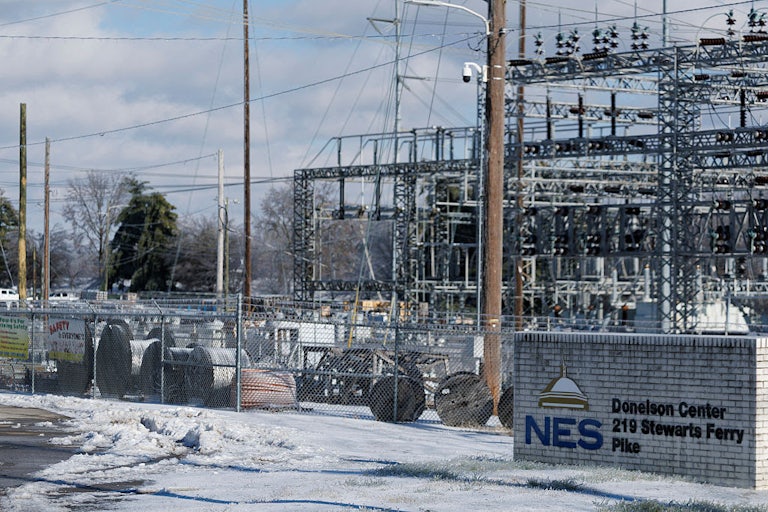
Last month, Energy Secretary Chris Wright convened the National Coal Council for the first time since the organization was disbanded under President Biden. He extolled the administration’s work forcing aging coal plants to stay open, and hinted at further handouts to come. Now we’re starting to get a sense of what those handouts might look like.
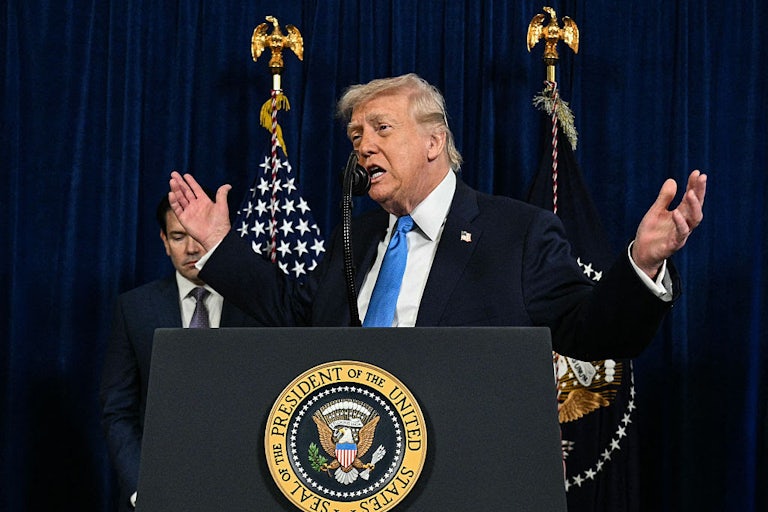
This week, the Trump administration announced that it would, as promised last summer, revoke the so-called “endangerment finding”—a key scientific finding from 2009 on which almost all federal regulation of greenhouse gas emissions is based. It will also order the Defense Department to purchase electricity from coal-fired power plants, and the industry will get a 33-month extension on cleaning up coal-ash dumps containing mercury, arsenic, and other toxins (all of which are expected to seep into groundwater in the meantime). Administration officials speaking to The Wall Street Journal ahead of the Wednesday announcement additionally said the administration would “award funding to five coal plants in West Virginia, Ohio, North Carolina and Kentucky to recommission and upgrade the facilities” and that “Trump will be awarded the inaugural ‘Undisputed Champion of Coal’ award by the Washington Coal Club.”
Trump famously covets fake awards that stroke his ego, but it’s hard to argue that he doesn’t deserve this one.
The revocation of the endangerment finding, which determined that greenhouse gases harm public health, is the biggest news. But propping up coal is societally consequential in its own right, and few think it’s a good idea. It’s economically unsustainable, and aside from warming the planet, coal combustion has been linked to respiratory problems, heart problems, cancer, cognitive impairment and decline, and death. In 2023, a study from George Mason University found that exposure to fine particulate pollution from coal combustion was associated with more than twice the mortality rates linked to fine particulate pollution from other sources.
In fact, pretty much everything that the Trump administration has proposed doing this week polls poorly—and not just with Democrats.
In 2023, Data for Progress found that 65 percent of all likely voters supported proposed Environmental Protection Agency regulations restricting coal- and gas-fired plant pollution—and half of Republicans did too. More recent polling conducted by the Yale Program on Climate Change Communication and the GMU Center for Climate Change Communication found that 66 percent of all registered voters, including a majority of moderate Republicans (57 percent), favor transitioning the economy to 100 percent clean energy by 2050. Shockingly, even 26 percent of conservative Republicans support this. And 74 percent of registered voters want to see carbon dioxide regulated “as a pollutant”—including 76 percent of moderate Republicans and 45 percent of conservative Republicans.
This is the data you should keep in mind when reading New York Times reporters Lisa Friedman and Maxeline Joselow’s meticulous story about the small, behind-the-scenes team that has been working for years to overturn the endangerment finding. While “conservative groups and businesses immediately fought to dismantle” the finding in 2009, they write, most corporations had given up by 2017 “as they lost legal challenges and public concern about global warming began to grow.” Officials in the first Trump administration actually rejected calls to revoke the finding, even during their wild dash to undo as many environmental regulations as possible on their way out the door in January 2021.
But a few key people—specifically Trump allies Russell Vought and Jeffrey Clark, as well as “lesser-known conservative attorneys” Mandy Gunasekara and Jonathan Brightbill—refused to give up, and during the Biden administration they began drafting “a comprehensive strategy for reversing the finding on ‘Day 1’ of the next Republican administration,” working “in secret ‘to prevent media and other conflicted sources from shaming participants and undercutting the work before it is done.’”
Businesses weren’t pressing for it anymore, most mainstream Republicans weren’t pressing for it anymore, and, to hear Joselow and Friedman recount the opinion of one former Trump transition adviser, “the years of work of conservative activists might have gone nowhere if a different Republican had won the presidency.”
Or, to put it another way, almost no one wanted this. Instead, both the polling data and the Times report show that a handful of extremely dedicated ideologues—not even fossil-fuel executives—toiled in secret and found, in Trump, a useful random-number generator who was willing to turn their incredibly unpopular position into policy. Cue the rejoicing from coal companies and the like, who weren’t even aware something this politically implausible was an option.
On the one hand, the fact that no one wants these handouts for coal means that the potential for backlash—as with almost everything else this administration seems to be pursuing—is significant. On the other hand, not all of this damage will be easy to undo.
Stat of the Week
6.4 degrees Fahrenheit
That’s how much February temperatures have risen since the last time Cortina, Italy, hosted the Winter Olympic Games, in 1956. Unsurprisingly, climate change is creating challenges for this year’s games.
What I’m Reading
Why this country declared an ocean current collapse a national security risk
This detailed report on what the collapse of the Atlantic Ocean’s current system could mean for Iceland was published Tuesday, six days after reporter Chico Harlan was told he was being laid off after 17 years at the Post, as part of layoffs that cut almost half of staff at the storied newspaper.
Sometime over the next 100 years, human-driven warming could disrupt a vital ocean current that carries heat northward from the tropics. After this breach, most of the world would keep getting hotter—but northern Europe would cool substantially, with Iceland at the center of a deep freeze. Climate modeling shows Icelandic winter extremes plunging to an unprecedented minus-50 degrees Fahrenheit. Sea ice could surround the country for the first time since it was settled by Vikings.
“At that point, Iceland would be one giant glacier,” said Hildigunnur Thorsteinsson, the director general of the Icelandic Meteorological Office.…
In October, the government classified the AMOC collapse as a national security risk. It amounts to a reckoning with national survival, as the country begins to absorb the idea that climate change won’t necessarily unfold linearly or predictably, and could bring changes beyond the scope of what a nation can cope with.
Read Chico Harlan’s full report at The Washington Post.
This article first appeared in Life in a Warming World, a weekly TNR newsletter authored by deputy editor Heather Souvaine Horn. Sign up here.