Life in a Warming World
A weekly reckoning with our heated planet—and the fight to save it

You Can Pry My Lead Baby Food From My Weedkiller-Covered Hands

Conservatives are hell-bent on defending gas stoves. Why not other poisonous household products?

JOSH EDELSON/AFP/Getty Images

Why do culture wars start, and whose fault is it when they do? You may have noticed how quickly gas stoves became a political fault line this month: One U.S. Consumer Product Safety Commissioner announced his agency was mulling the mounting evidence that gas stoves are poisoning people, and suddenly a slew of Republicans (and, naturally, Democrats’ own coal baron, Joe Manchin) started tweeting that Joe Biden could pry gas stoves from their cold, dead hands. Overcooking steak on a gas range and posting it to Twitter became a thing to “own the libs.”

This all misses the point, as TNR columnist Liza Featherstone wrote this week, since even a ban on gas stoves (which is not actually happening) wouldn’t result in existing devices being ripped from the walls. Regardless, the point of gas stove regulation is to protect people who don’t want to be poisoned in their homes, not to rob people of their right to get asthma and cancer. In other words: This is really a tenants’ rights issue, and it has nothing to do with the affluent homeowners who seem to have taken deep offense that a government official would dare cut through the decades of advertising that have convinced people that gas stoves are the best (they’re not).

But it’s worth noting that there are a lot of poisonous household products that don’t get this kind of crazed treatment. Earlier this month, the Journal of the National Cancer Institute published research from government scientists finding that study participants with high levels of glyphosate—an herbicide found in Roundup weed killer, among many others—in their urine tended to also have signs of oxidative stress, which is an indicator for the possible development of cancer. And this is after the Centers for Disease Control found, last year, that 80 percent of urine samples taken from a representative group of Americans contained measurable amounts of this herbicide. But we have yet to see Tucker Carlson spraying Roundup in his face on live TV to protest hypothetical government overreach. (On Tuesday, the FDA proposed extremely lax limits for the amount of lead companies can include in baby foods. Can we expect some prominent conservative to shovel paint into a toddler’s mouth while screaming, “Take that, AOC!”? I doubt it.)

In seeking to understand why some issues turn into culture wars while others don’t, a lot of people adopt a blame-the-messenger stance; in other words, they blame the activists and politicians trying to alert society to a problem for doing so in an off-putting fashion. This, for example, was the theme of a recent Politico piece suggesting that the United States could pass better climate policy if climate policy weren’t being associated with Democrats, whom voters “view with suspicion.” It was also the thrust of Pamela Paul’s New York Times column seeming to blame vegans for politicizing food.

One problem with this thesis, of course, is that it doesn’t provide much of a model for social change: Asking whistleblowers never to upset people probably isn’t realistic. Moreover, as you’ll read in further coverage at Apocalypse Soon this spring, it’s usually inaccurate to blame activists for these backlashes. When you really look at which issues become culture wars and who benefits, the culprit is rarely, if ever, the moralizing do-gooder caricatured on Fox News every evening.

Good News

Massachusetts legislators are proposing a $300 million Zero Carbon Renovation Fund to help schools, low-income housing, and other municipal buildings swap out fossil fuel–based heating and appliances for electric ones, improve insulation, and more.

Bad News

Norway announced this week that it will offer a record number of fossil fuel exploration blocks (as these delineated territories are called) in the Arctic.

Stat of the Week

A new study in The Lancet finds that implementing the changes to reach net-zero greenhouse gas emissions—reducing air pollution, modifying diets, etc.—in the United Kingdom would reduce premature deaths and increase public health, resulting in over two million extra years of life nationwide. Read the full study here.

Elsewhere in the Ecosystem

Depleted Under Trump, a “Traumatized” E.P.A. Struggles With Its Mission

You may remember reports of the mass exodus that took place from the Environmental Protection Agency under Trump. Unfortunately, the agency hasn’t recovered. And the consequences could be severe, Lisa Friedman reports, when it comes to finalizing regulations needed to carry out the Biden administration’s climate and environmental goals:

The new rules have to be enacted within the next 18 months—lightning speed in the regulatory world—or they could be overturned by a new Congress or administration.

The regulations are already delayed months past E.P.A.’s own self-imposed deadlines, raising concerns from supporters in Congress and environmental groups. “It’s very fair to say we are not where we hoped we’d be,” said Miles Keogh, executive director of the National Association of Clean Air Agencies, which represents most state and local air regulators.

Read Lisa Friedman’s report at The New York Times.

This article first appeared in Apocalypse Soon, a weekly TNR newsletter authored by deputy editor Heather Souvaine Horn. Sign up here.

Davos Still Sucks

How can the World Economic Forum earnestly pretend to address global crises while being funded by the corporations that fuel these crises?

Attendees look toward the right under a World Economic Forum logo.
FABRICE COFFRINI/AFP/Getty Images
The World Economic Forum annual meeting in Davos on January 17, 2023

The annual World Economic Forum meeting in Davos used to be a better party, The Washington Post reports this week. “A decade ago, political power brokers and corporate bigwigs gathered here in the Swiss Alps under an upbeat theme,” Ishaan Tharoor writes. “It was time for ‘resilient dynamism,’ declared the organizers of the 2013 meeting.… Ten years on, there seems to be less optimism.”

Well. I should jolly well hope so. Tharoor notes attendees’ concerns this year: “war, climate catastrophe, energy price chaos, inflation, epidemics of hunger and disease, political instability and widening inequity.”

These are serious issues. They’re also issues that many of the corporations bankrolling the World Economic Forum have contributed to, with abandon. They’re issues they have lobbied governments to keep from addressing rigorously—for fear strong policies will interfere with their business models.

Shell, whose internal emails show it was never particularly serious about reducing emissions, is a WEF partner. So is Chevron—the company that’s dedicated over a decade to persecuting a single lawyer who it blames for making it pay up after its subsidiary Texaco poisoned Indigenous lands in the Ecuadorian Amazon. So are Cargill, Tyson, and JBS—who together control a staggering percentage of U.S. meat production, who did not exactly cover themselves in glory during the pandemic, and whose industry is well known for obstructing climate policy.

This is a bleak game one could play for hours with the WEF’s member and partner lists. The very same day Tharoor’s story published, a new report dropped showing that the biggest banks on the Glasgow Financial Alliance for Net Zero’s “net-zero banking alliance grouping” have in fact continued to finance fossil fuel expansion, to the tune of $270 billion. The list of those banks contains a lot of familiar names.

“One of the biggest banks involved in GFANZ is HSBC,” The Guardian reported on Tuesday, “which announced restrictions on oil and gas financing last month. But it has approved 58 transactions worth $12bn in capital to fossil fuel developers, since joining a GFANZ grouping in April 2021, according to the Reclaim Finance report.” Wouldn’t you know it? HSBC is a WEF partner too.

The list of corporations behind the annual Davos bash is not a tangential issue. While WEF has certainly hosted some serious people over the years, the organization is fundamentally funded by its corporate members and partners, for the purpose of “bring[ing] together decision-makers from across society to work on projects and initiatives that make a real difference,” per the statement on WEF’s website. Bringing together decision-makers is, of course, a polite way of saying that CEOs get to hang out in a Swiss resort with world leaders all week. So while they self-describe as a group that can solve the world’s problems (their stated goal is to have a “positive impact at all levels of society”), it’s not exactly surprising that over the years, the forum has largely spotlighted free-market solutions that corporations like. (As the conservative British magazine The Spectator noted this week, giving top corporations weeklong access to the world’s most powerful policymakers “is the picture-perfect example, not of free market capitalism, but of crony capitalism.”)

So apparently Davos is less fun these days now that attendees feel a sense of “permacrisis” and are no longer so sure that globalization is winning. That gloomy mood is probably for the best: There is no reason these particular people should be feeling good about themselves and their track record running world affairs. And hey, maybe if this party gets depressing enough, it’ll be canceled next year altogether. For all WEF’s talk about Davos being a “carbon neutral” event, the fact remains that private jet emissions quadrupled during Davos 2022 as compared to an average week. That’s one thing you could genuinely say the forum excels at: hot air.

Good News

Finally, finally, the Federal Reserve has directed the nation’s six largest banks to figure out and disclose what sort of effect climate change could have on their portfolios. It’s not much, as Fed action on climate change goes, but it’s a start.

Bad News

Faulty arguments about whale conservation are being deployed against offshore wind installations, instead of an acknowledgment that the main threat to whales comes from boats and climate change, according to this in-depth report from Clare Fieseler at the Post and Courier.

Stat of the Week

That’s the proportion of forest carbon offsets from the world’s leading offset provider, Verra, that turn out to be totally useless, according to a new analysis.

Elsewhere in the Ecosystem

Assessing ExxonMobil’s Global Warming Projections

If you haven’t read at least the top summary of the buzzy new piece out in Science—about how ExxonMobil’s internal predictions about climate change in the 1970s and ’80s were actually extremely accurate—it’s worth your time. (The top, shaded portion is very user-friendly, even if reading scientific papers isn’t usually your jam, and right now it’s not behind a paywall.)

In 2015, investigative journalists discovered internal company memos indicating that Exxon oil company has known since the late 1970s that its fossil fuel products could lead to global warming with “dramatic environmental effects before the year 2050.”… Many of the uncovered fossil fuel industry documents include explicit projections of the amount of warming expected to occur over time in response to rising atmospheric greenhouse gas concentrations. Yet, these numerical and graphical data have received little attention.…

Our results show that in private and academic circles since the late 1970s and early 1980s, ExxonMobil predicted global warming correctly and skillfully. Using established statistical techniques, we find that 63 to 83% of the climate projections reported by ExxonMobil scientists were accurate in predicting subsequent global warming.

Read G. Supran, S. Rahmstorf, and N. Oreskes’s article in Science.

This article first appeared in Apocalypse Soon, a weekly TNR newsletter authored by deputy editor Heather Souvaine Horn. Sign up here.

Meghan and Harry, Welcome to America’s Climate Crisis

Torrential rains, flooding, and mudslides in California are a preview of an alarming future.

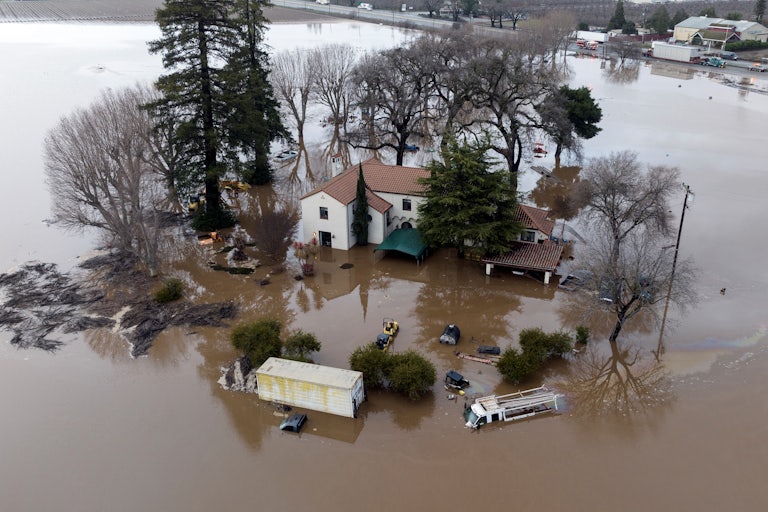
A home, several vehicles, and trees stand flooded with water all around them.
JOSH EDELSON/AFP/Getty Images
Aerial view of a flooded home partially underwater in Gilroy, California, on January 9

If you’ve visited the home page of a major newspaper in the past week, you’ve probably noticed that the intensity of coverage of British royal family dysfunction is vertiginously approaching that of the war in Ukraine or U.S. congressional mayhem. That’s unsettling enough, but it’s been equally jarring to see the state of California pop up continually in stories about Prince Harry and Meghan Markle—without a mention of the fact that it’s currently a disaster zone.

Montecito, where the couple has made their home, came under mandatory evacuation order on Monday due to the ongoing catastrophic rains hitting the state. Harry and Meghan’s representatives did not respond to the Los Angeles Timesrequest for comment as to whether they had complied with the order—a missed opportunity for the couple, arguably, given that climate change is something of a signature issue for them.

Montecito’s disproportionately wealthy residents have had it relatively easy, despite the mudslide warning that went out Monday. Seventeen deaths have been reported across California in the recent rains. Huge portions of Northern California are under flood watch, while hundreds of thousands have experienced power outages and over 135,000 remained without power as of Wednesday morning. A sinkhole opened up under two cars in Los Angeles on Monday, while a 5-year-old child was swept away in floodwaters in San Miguel. The unusual rainfall could continue for the next week, making landslides even more likely.

These kinds of wild weather swings are becoming more frequent as climate change accelerates. Atmospheric rivers (the term for this kind of massive rain band) “are becoming more intense with climate change because they’re holding more moisture,” extreme weather expert Katerina Gonzales told Scientific American this week. And they won’t necessarily reverse the state’s drought problem, she added, given that groundwater takes a long time to be refilled. “We can’t rely on atmospheric rivers to save us. California has wet and dry extremes—that’s our current reality and our future.”

This pattern of fires then floods is basically the worst-case scenario in terms of mudslide conditions, and it’s a scenario a study last April warned of explicitly. Experts are now predicting the California floods could cost several billion dollars once concluded—part of a new trend of billion-dollar disasters striking not an average of three times a year, like in the 1980s, but perhaps over 20 times a year, as happened in 2020.

None of what’s currently happening in California, it’s worth mentioning, begins to approach the scale of the devastation of the floods in Pakistan this summer and early fall. But with news breaking Tuesday that U.S. greenhouse gas emissions rose 1.3 percent in 2022 despite growth in renewable energy, it’s a devastating reminder that we still aren’t doing anywhere near enough.

Good News

The Environmental Protection Agency is moving to tighten regulations on fine-particulate air pollution—a move projected to save tens of thousands of lives a year. (All the usual suspects, Kate Aronoff notes, are lining up to protest this life-saving measure.)

Bad News

The Intercept obtained and published footage this week of the crash caused by a Tesla Model S allegedly under control of the “Full Self-Driving Feature” on the San Francisco Bay Bridge on Thanksgiving Day. The car changes lanes and then abruptly brakes for no apparent reason, causing a multivehicle pileup. It’s pretty nightmarish viewing and doesn’t exactly inspire confidence in Tesla’s recent efforts to stay ahead in an increasingly competitive electric vehicle market.

Stat of the Week

That’s how much extreme weather cost the United States in 2022.

Elsewhere in the Ecosystem

The New Soldiers in Propane’s Fight Against Climate Action: Television Stars

As the U.S. wakes up to the dangers, both climate-wise and health-wise, of using natural gas and propane in home heating and cooking, the industry is fighting back, paying influencers to talk about how propane is beautiful while electric appliances and vehicles suck. The Times’ Hiroko Tabuchi has the goods:

The Propane Education and Research Council, or PERC, which is funded by propane providers across the country, has spent millions of dollars on “provocative anti-electrification messaging” for TV, print and social media, using influencers like Mr. Blashaw, according to the group’s internal documents viewed by The New York Times.

As a federally sanctioned trade association, PERC is allowed to collect fees on propane sales, which helps fund its marketing campaigns. But according to the law that created this system, that money is supposed to be used for things like research and safety.

Read Hiroko Tabuchi’s piece at The New York Times.

This article first appeared in Apocalypse Soon, a weekly TNR newsletter authored by deputy editor Heather Souvaine Horn. Sign up here.

The Most Important New Year’s Resolution for Climate

Changing your personal habits won’t change the world, but there are other benefits to doing so.

Environmental activist Rob Greenfield
ROBYN BECK/AFP/Getty Images
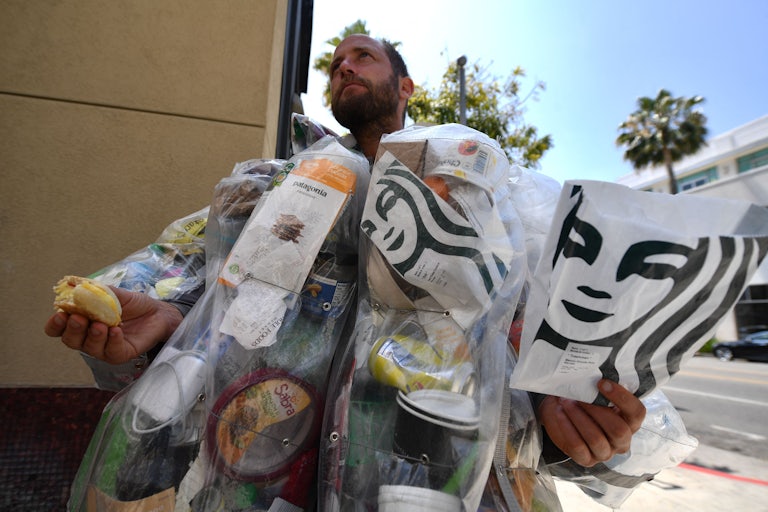
Environmental activist Rob Greenfield last year walked around Beverly Hills, California, wearing a suit filled with every piece of trash he had generated living and consuming like a typical American for one month.

Climate scientist Katharine Hayhoe famously adopts two new climate-friendly habits each year—“not because I think they’re going to change the course of climate change as I know it,” she told Christian Science Monitor in 2021, “but because it enables me to be consistent with my values and it gives me joy.”

One new habit could be reducing meat consumption, given that animal agriculture produces a lot of greenhouse gas emissions and contributes to deforestation and biodiversity loss. Or it could be reducing food waste, which accounts for more emissions nationally than the entire airline industry. You could switch to reusable grocery bags rather than plastic or eliminate plastic packaging from bathroom products (as Hayhoe herself decided to do in 2020). Or cut your energy bill with some combination of LED lights, adding insulation via curtains or door sweeps, turning down the thermostat a few degrees in winter, or even installing a heat pump—hey, there are good tax incentives for that now!

One of the advantages of this approach is that it encourages people to make small, incremental changes rather than getting overwhelmed by guilt about the amount of emissions and consumption baked into everyday life. Bigger, systemic changes like winding down fossil fuel production are vastly more important than an individual’s plastic use (although the fossil fuel industry has poured a lot of money into trying to convince people otherwise, popularizing the term “carbon footprint” to try to convince people that climate change is a matter of personal rather than corporate malfeasance). As Hayhoe frequently reminds audiences and readers, talking about climate change, joining an organization fighting climate change, and advocating for political solutions remain the most important actions an individual can take.

But the idea of adopting two climate-friendly habits is a welcome reminder that there isn’t actually any inherent tension between advocating for those bigger changes and living your values. In fact, living your values while advocating for bigger society-wide changes can help ease your climate anxiety in a productive way.

There’s also a way to fuse those different types of action: for example, deciding to make a small change in how you talk about climate change. I bring this up because, while the last Apocalypse Soon newsletter focused on some of the huge breakthroughs on climate in 2022, the United States is also starting 2023 in the shadow of one of politicians’ big failures of 2022: not including policy to directly wind down fossil fuels in last year’s historic climate package.

In the wake of that bittersweet triumph, Aaron Regunberg wrote about the need for ordinary people to start talking about just how much the fossil fuel industry has done and continues to do to keep the world hooked on planet-killing fuels—despite having known for decades that these fuels are heating the planet.

This isn’t to say that pointing out the bare facts of the fossil fuel industry’s deception is the best way to start a climate conversation with an avowed skeptic. But a lot of people who’d self-identify as being concerned about the climate may still be unaware of how far the industry’s reach extends (into think tanks and academia, for instance—the very institutions producing the papers that politicians then base their decisions on) and how much the industry has influenced our current understanding of what reasonable climate policy looks like. Anyone, for example, who thinks that climate policy is generally a good idea, but also thinks that we need to increase domestic gas production to counter Russia, is unwittingly parroting experts funded in part by ExxonMobil, as Kate Aronoff pointed out last year.

One way to start off 2023 on the right foot, and increase public support for more direct and substantive climate policy, would be, as Aaron wrote, “naming and shaming the agencies and creative professionals that produce fossil fuel propaganda.” Or reminding people in each discussion how our ideas of what’s politically possible are shaped by that propaganda. Or calling out politicians who continue to accept money from this industry. “If we want to save the world,” Aaron wrote, “we need to break the fossil fuel industry’s stranglehold on power.” That may involve turning over a new rhetorical leaf.

Good News

The Biden administration on Friday moved to re-expand the definition of waterways protected under the Clean Water Act to include ephemeral streams and ponds, reversing the Trump administration curtailment in 2019. The move helps limit agricultural, commercial, and industrial runoff; corporations, however, say it’s unfairly expensive to expect them not to poison these waterways.

Bad News

The Biden administration is running out of time to finalize EPA rules if it wants to defend them in court. Unless it moves quickly, a lot of new environmental rules could be reversed by a new president and Congress in 2025. Read Jean Chemnick’s piece on this at Climatewire.

Stat of the Week

That’s the amount of nationwide food waste that comes from households, i.e., not restaurants, stores, or farms. Read Susan Shain’s excellent story about food waste—which contributes to greenhouse gas emissions—and how central Ohio is trying to reduce it, at The New York Times.

Elsewhere in the Ecosystem

Accountability Is the Most Important Climate Solution

As Republicans prepare to take over the House, vital work from the House Oversight Committee’s investigation of the fossil fuel industry’s role funding disinformation about the climate crisis could be stymied. In addition to providing some suggestions for how to avoid that, climate journalist Amy Westervelt this week offered a stirring defense of accountability, writ large, and the need for it in plans to save the planet:

Whenever I talk about accountability a certain type of well-bred elitist tends to bristle. There’s no need to blame, they say, or point fingers. Singling out villains is backwards, archaic, it smacks of eye-for-an-eye approaches to justice and it lets everyone else off the hook. This is a fundamental misunderstanding of accountability and the critical role it plays in formulating effective solutions.

Catastrophic climate change is a symptom of an intertwined web of problems. Untangling that web and the various forces that created it is not just a worthy exercise, it’s absolutely critical to developing solutions that actually work. The focus on technological and policy solutions to climate has put the cart before the horse, and in doing so, created a solutions framework that is hopelessly inadequate. Americans in particular have a tendency to skip right over accountability and straight to “solutions,” but failing to understand how a problem came about in the first place tends to deliver … not solutions, but new problems. And on climate, examples of that abound.

People talk about “the energy transition” as an aspirational, future phase, for example, which ignores the fact that we’ve just spent the past 20 years living through an energy transition, one that required major investments in infrastructure, a new distribution system, all of that. The conversion of U.S. energy sources from coal to natural gas was a massive transition, on par with the transition currently being proposed from fossil fuels to renewables. But we don’t often talk about it that way, which means we miss key lessons from that transition: simply swapping in one energy source for another, focusing on only one greenhouse gas, and allowing the fossil fuel industry to drive and manage that transition were all enormous missteps.

Read Amy Westervelt’s piece in her Drilled newsletter.

This article first appeared in Apocalypse Soon, a weekly TNR newsletter authored by deputy editor Heather Souvaine Horn. Sign up here.

This Year’s Big Breakthroughs on Climate

It wasn’t all doom and gloom in 2022.

Two people in polar bear suits hold hands while dancing.
AHMAD GHARABLI/AFP/Getty Images
Climate activists protest in Sharm El Sheikh, Egypt, during the COP27 climate conference.

It’s been a heck of a year for climate coverage. It started, don’t forget, with fears that any chance of robust climate policy passing Congress might be dead, courtesy of Senator Joe Manchin’s 340th reversal. Now, as 2022 closes, climate advocates can look back on some key victories, from the passage of the Inflation Reduction Act—climate legislation with a politically conciliatory name—to America’s eleventh-hour decision to support climate financing for vulnerable countries at the U.N. climate conference known as COP27.

But the IRA on its own won’t be enough to meet climate targets, and some developments this year were more damaging—like the blockage of climate-conscious monetary policy, the Supreme Court’s ruling against Environmental Protection Agency regulations, or the growing Republican hysteria about Wall Street firms “discriminating” against fossil fuel—and a lot remains up in the air. So how should we think about the past 12 months of whiplash? Here are some of the most prescient and insightful pieces we published on these topics, which may help make sense of the year as it closes.

The first big piece of climate news didn’t seem like climate news: Russia’s invasion of Ukraine. But weaning Europe off Russian gas triggered a wave of climate-relevant consequences, from a new focus on energy efficiency in Germany (good), to the U.S. frenetically green-lighting a bunch of new natural gas exports and even considering new liquid natural gas terminals (bad). New gas infrastructure, Kate Aronoff pointed out in a series of pieces on the crisis in February, won’t come online fast enough to help out this winter, and natural gas leaks an astonishing quantity of methane at every phase of the production and consumption process.

The first quarter of 2022 closed with more bad news: Joe Manchin blocking the nomination of Sarah Bloom Raskin, an advocate for sensible regulations like climate stress tests and emissions disclosures, to the Federal Reserve. Kate reported on a gas conference Manchin attended immediately before announcing his opposition, noting that Manchin slipped up and referred to the assembled fossil fuel execs as “we.” (The pronoun was not entirely inaccurate, given his profits from the coal sector.) Aaron Regunberg later wrote about the many ways the Fed is “neglecting its duty” on climate change.

As the spring ticked onward with Manchin still holding up climate policy, Mary Annaïse Heglar voiced the frustration of many, persuasively arguing that it was time to stop calling climate prevaricators “centrists”:

Centrist is no longer the right moniker for politicians who want to “compromise” with the radical right. Centrist implies reasonable—someone willing to meet in the middle and consider many approaches to reach a goal. But at this stage, if you’re in favor of new fossil fuel infrastructure when all the science says that’s a death sentence, what exactly is your goal?

News that Manchin had finally compromised, allowing climate policy to pass in the form of the Inflation Reduction Act, triggered a wave of celebration in climate circles—but also disappointment, as the bill included support for fossil fuel drilling and hazy notions like climate-smart farming. Aaron Regunberg succinctly summed up the cognitive dissonance. “Though I personally cried tears of joy as I held my 18-month-old son in my arms to watch the IRA’s passage—because I believe this last-minute buzzer-beater of a climate win greatly brightens the previously grim terrain on which we’ll spend our lives fighting for a livable future,” he wrote, “I also think the contradictions of this bitter triumph offer important insights for the work we have ahead of us.” The act contained no direct policy to wind down fossil fuels—a place for activists to focus their efforts in the future.

This year brought two more big surprises on the climate change front. First came the midterms, where the so-called “red wave” failed to materialize, preserving the IRA from rollbacks that a Republican Congress might have enacted. Liza Featherstone wrote about one possible lesson from the November exit polls: Voters care more about climate change than previously thought, and Democrats might want to start capitalizing on that.

Then, at COP27, the United States reversed decades of intransigence and agreed to support a new fund for the damage poorer countries suffer from richer countries’ emissions. Kate Aronoff examined how, exactly, this came to happen, and what remains unknown going forward.

Finally, no recap of 2022’s mixed legacy on science and science policy would be complete without talking about Covid-19. Back in February, TNR regular Melody Schreiber pointed out the increasing radicalism of the anti-mask movement, particularly with regard to children. The politicization of masking has come back to haunt the country this fall and winter, as pediatric wards are overflowing with respiratory syncytial virus, flu, and Covid cases. “Many of the preventative measures proven effective during the Covid-19 pandemic are going broadly unused,” Vox recently reported. In May, Melody reported the troubling implications of rapid Covid reinfection, which meant people recently recovered from Covid could contract it again just a few months later. All of this was ignored when President Biden declared the pandemic “over.” At the time, Melody pointed out that this proclamation was likely to sabotage uptake of the new bivalent boosters. Months later, uptake of these boosters remains low.

We published a lot of terrific pieces that aren’t named here, including powerful personal essays and meditations on the contradictions of media coverage in the era of climate crisis. As always, you can find more pieces at the Apocalypse Soon vertical on The New Republic’s website.

Good News

The breakthrough in nuclear fusion technology announced by the Department of Energy on Tuesday is pretty cool. (Just don’t expect it to save us from the urgent problem of energy transition to limit global warming. Putting this discovery to use will probably take a few decades, and we need to transition off fossil fuels before that.)

Bad News

Solar installations have slowed, despite the incentives in the Inflation Reduction Act.

Stat of the Week

1 in 100

That’s the proportion of heart disease deaths that a new study says can be tied to extreme temperatures. (Read the Axios write-up here.)

Elsewhere in the Ecosystem

Unearthing the Original Mediterranean Diet

This feature from Hakai Magazine is so cool. Journalist Paul Greenberg follows archaeologist Dimitra Mylona, who’s taken to counting fish bones at ancient sites to show that, contrary to popular belief, ancient Mediterranean societies ate a lot of fish. Incidentally, this could also overturn current assumptions about the Mediterranean naturally being low in nutrients. “Because few rivers flow into the Mediterranean,” Greenberg writes, “the sea is considered nutrient-starved and described as containing little phytoplanktonic life—oligotrophic in scientific parlance.” But now not just archaeologists but marine biologists are reconsidering that.

“I don’t accept this idea that the Mediterranean is a poor sea,” [marine biologist Daniel] Pauly tells me. “This is what people always say—few rivers going into the sea to deliver the nutrients. But we know from Roman records that there was probably a significant population of gray whales in the sea. That these whales brought in nutrients from the wider Atlantic, and through their feces fertilized the sea,” Pauly says. What happened to these whales? “The Romans likely killed them all. Everywhere you look, we have evidence of a more abundant sea.” Sharks are not abundant in the Med, but that’s today. “We just did an analysis of film taken by the Austrian cinematographer Hans Hass in 1942. There are sharks everywhere.”

Read Paul Greenberg’s piece at Hakai Magazine.

This article first appeared in Apocalypse Soon, a weekly TNR newsletter authored by deputy editor Heather Souvaine Horn. Sign up here.