Breaking News
Breaking News
from Washington and beyond

Of Course Joe Manchin Is Teaming Up With Ted Cruz To Defend Gas Stoves

No one is coming for your gas stove, Manchin.

Joe Manchin and Ted Cruz stand in a crowded elevator
Tom Williams/CQ-Roll Call, Inc/Getty Images

Senator Joe Manchin plans to introduce a bill Thursday that would prevent the U.S. Consumer Product Safety Commission from banning gas stoves, a very serious debate that has gotten Washington pretty heated.

The bill, which Manchin is co-sponsoring with Ted Cruz, would ban the use of federal funds to regulate or impose new consumer safety rules on gas cooktops.

They are not taking my gas stove out,” Manchin told reporters.

The debate over gas stoves sparked in earnest in mid-December when Richard Trumka, a CPSC commissioner, announced the organization was considering health regulations for and possibly even bans on gas stoves, following a report that they were responsible for almost 13 percent of childhood asthma cases.

The announcement set off Republicans, who took to social media to loudly declare that they would never give up their gas stoves. Here is a list of everyone who wants to take away gas stoves, particularly the one in Manchin’s house:

Trumka has already clarified that the agency will not forcibly take anyone’s gas stove, and is seeking to decrease the associated health hazards through new regulations. But it’s too late: The right wing, and now Manchin, have seized on his initial comments to spin the debate into hysteria.

What should have been a straightforward procedure for public health and safety has become a hot mess.
More on Gas Stoves

House Democrats Introduce Bill Protecting Right To Cross State Lines for Abortion

The Ensuring Women’s Right to Reproductive Freedom Act would protect anyone seeking an abortion out of their home state, and anyone who helps them.

Capitol Building
Anna Moneymaker/Getty Images

House Democrats reintroduced a bill Thursday to protect people’s right to travel out of state for an abortion, as many states clamp down on access to the procedure.

The Ensuring Women’s Right to Reproductive Freedom Act would protect not just anyone seeking an abortion out of their home state but also anyone who helps them, for instance someone who drives them across the border or the health care provider who carries out the procedure. Democrats had introduced the bill last summer, weeks after the Supreme Court overturned Roe v. Wade, but the legislation failed to pass the Senate.

Since the nationwide right to abortion fell, people have rushed to states where the procedure is legal, such as Colorado, where reproductive health centers reported seeing wait times for an abortion double to two weeks, by midsummer, from one earlier in the year. One of the most tragic and infamous cases was a 10-year-old girl from Ohio who had to travel to Indiana for an abortion after she was raped.

As states try to restrict abortion access even further—including Kansas, where the legislature is seeking to overturn a ballot decision to protect abortion rights—one such method is to go after people who travel out of state for an abortion and those who help them when they get there. The Indiana attorney general tried to penalize the doctor who performed the 10-year-old’s abortion.

In March, before the Dobbs draft opinion had even been leaked, Republican state lawmakers in Missouri introduced a bill that would allow individuals to sue anyone who helped a state resident get an abortion, including an out-of-state health care provider or anyone providing transportation across state lines. State House lawmakers blocked the bill a few weeks later.

The Ensuring Women’s Right to Reproductive Freedom Act is unlikely to pass the House of Representatives, where Republicans hold the majority. The GOP has made it clear it opposes reproductive rights, despite losing big-time during the 2022 midterm elections as a result of its stance. The act passed the House when Democrats controlled the chamber last year, but failed to win the requisite 60 votes in the Senate.

The Women’s Health Protection Act, which would have codified the right to abortion, also failed to pass the Senate in May after all Republican senators and Democratic Senator Joe Manchin voted against it.

GOP Proceeds on Shameless Campaign To Oust Ilhan Omar From Foreign Affairs Committee

The Republican-controlled House is preparing for a final vote to remove the Minnesota congresswoman from the committee over her past criticism of Israel.

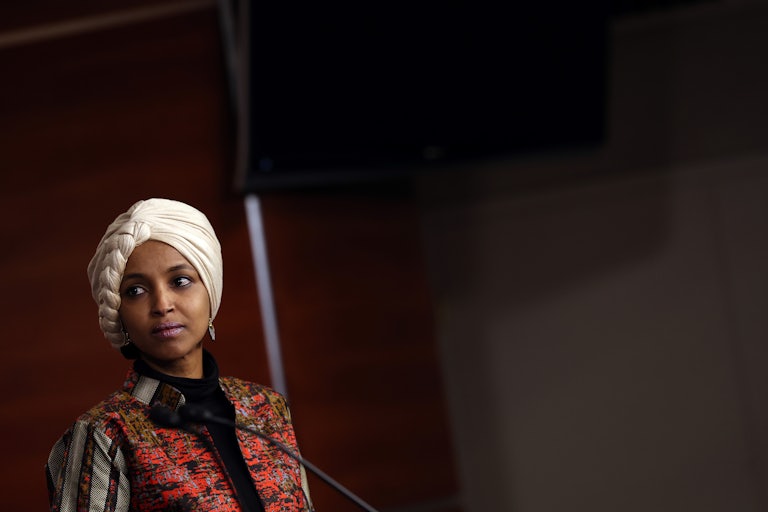
Ilhan Omar stands at a podium and looks to the side
Kevin Dietsch/Getty Images

House Republicans’ shameless campaign against Representative Ilhan Omar continues after the House on Wednesday voted along party lines, 218–209, to advance a resolution on removing the Minnesota congresswoman from the House Foreign Affairs Committee.

The House will have a final vote on Thursday that will determine whether Omar is ejected from the committee she has dutifully served on since she entered Congress—and so far, it looks like Republicans will have enough votes to make it happen.

Republicans have gone after Omar for past comments she has made about Israel, accusing her of antisemitism. Meanwhile, the House speaker also sought vengeance against Representatives Adam Schiff and Eric Swalwell, two members prominent during Trump’s impeachment hearings, by denying them seats on the intelligence committee.

The ejection of the three representatives comes as a payback mission against the Democrats, who removed Representatives Marjorie Taylor Greene and Paul Gosar from committees for inflammatory comments and online posts encouraging violence against other members of Congress.

There were some initial GOP holdouts, including Representatives Nancy Mace, Victoria Spartz, and Ken Buck. All voted in favor of advancing the resolution to boot Omar on Wednesday.

“This is about vengeance. This is about spite. This is about politics,” Representative James McGovern, the top Democrat on the House Rules Committee, told the Associated Press on Tuesday.

Ultimately, Republicans are not getting “payback,” as that would imply some level of equal give and take. Democrats voted to punish members notorious for inciting violence and hate; Republicans have approved of McCarthy’s removal of two members who dared criticize their king president, and are now voting to remove a third who has openly apologized for her past comments.

“It’s motivated by the fact that many of these members don’t believe a Muslim, a refugee, an African should even be in Congress, let alone have the opportunity to serve on the Foreign Affairs Committee,” Omar said on Sunday on CNN.

No less farcical is this vote because of all the rank antisemitism Republicans have allowed to fester, if not promoted themselves, in recent years. Greene, whom McCarthy said he would “never leave” and “always take care of,” has spread theories about “Zionist supremacists” engineering Muslim immigration to Europe, and about Jewish space lasers setting forests on fire in California. Donald Trump, many Republicans’ favorite president—or at least someone they can barely ever say a bad word about—recently wined and dined with antisemites Nick Fuentes and Ye.

And if that wasn’t enough, the Republicans found a way to make this vote even more of a joke. In a country where millions of people struggle to find affordable health care, housing, or even education—ailments born from relentless capitalism—Republicans attached the resolution to another denouncing “the horrors of socialism.”

Federal Reserve Hikes Interest Rates Up 0.25 Percent, Smallest Increase in Almost a Year

Here’s what exactly the Fed Reserve rate hike means for you.

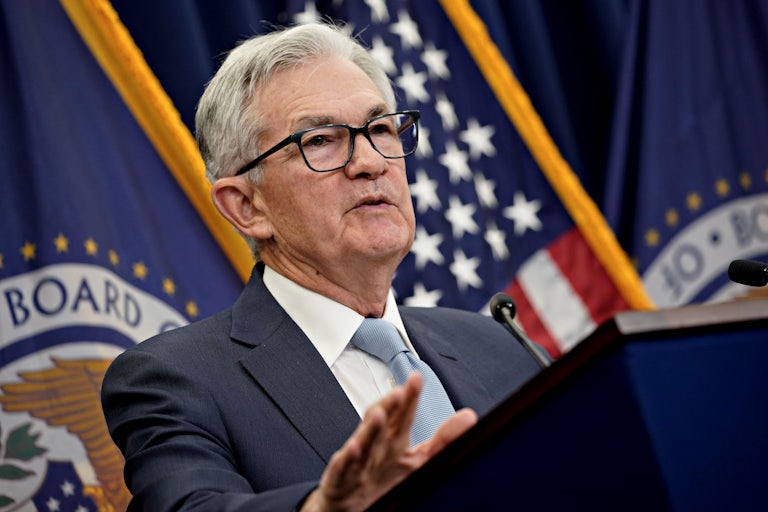
Jeremy Powell speaks at a podium
Al Drago/Bloomberg/Getty Images

The Federal Reserve announced an interest rate hike of 0.25 percent Wednesday, the smallest increase since it began ramping rates up in March.

Inflation has fallen slowly but steadily over the past six months, particularly from October to December. The Fed has been on a tear to get interest rates high enough to discourage people from spending money, slowing the economy down in turn. The central bank only began easing its rate hikes in December. The risk is that growth will slow while prices and borrowing rates stay high, sending the economy into a recession.

“Shifting to a slower pace will better allow the committee to assess the economy’s progress toward our goals as we determine the extent of future increases that will be required to attain a sufficiently restrictive stance,” Fed Chair Jerome Powell told a press conference. “While recent developments are encouraging, we will need substantially more evidence to be confident that inflation is on a sustained downward path.”

Goods prices are generally falling, and the unemployment rate in December was 3.468, the lowest in 50 years—all indicators that the Fed’s previous rate hikes are working as intended. Ian Shepherdson, the chief economist at Pantheon Economics, warned Tuesday that the central bank shouldn’t raise interest rates anymore lest they go too far.

Dean Baker, senior economist at the Center for Economic Policy and Research, answered five questions about what the latest rate hike means going forward.

1. What has changed in recent months that gives the Fed enough confidence to hike rates by the smallest amount in almost a year?

“The economy and inflation have both slowed sharply,” Baker told The New Republic, describing the initial 0.75 percent rate hikes as a “bit of a panic.”

Indicators such as the consumer price index have decreased in recent months, a sign that the economy is slowing and inflation is finally easing up a bit. Baker suggested that Wednesday’s small rate hike is more to “demonstrate [the Fed’s] commitment to fighting inflation.”

2. What can consumers expect from a 0.25 percent rate increase?

Since the rate increase is so small, it’s unlikely to have much effect on the economy, according to Baker. “Since it was widely anticipated, the impact has already been incorporated into the rate structure.”

Now many economists are hopeful the Fed will take a step back and be more reactive with future rate increases, instead of proactive.

3. What can we expect from the Fed going forward?

In a statement, the central bank predicted that “ongoing increases … will be appropriate in order to attain a stance of monetary policy that is sufficiently restrictive to return inflation to 2 percent.”

Monetary tightening measures often have delayed effects, which the policy-setting Federal Open Market Committee said it would take into account when deciding on whether to increase rate hikes in the future.

Looking at current data, the Fed “should be looking to claim victory in the war on inflation, and back off from further rate hikes,” said Baker. He noted that Powell is probably hesitant to do so, but “he should do it soon” if trends continue as they have.

4. Is it possible for the Fed to go too far with rate increases?

There’s a chance that the Fed will go too far with rate increases and tip the economy into a recession, but Baker doesn’t see that on the horizon right now.

“I don’t think that is likely to happen with the rate hikes to date, but if they were to go much further, I would be very worried,” said Baker.

The current economy looks fairly strong, he added, even in some of the sectors most sensitive to changes in interest rates, such as housing, trade, and cars. Housing construction has stayed high due to a backlog of unfinished homes resulting from supply chain disruptions. Car sales have also held up as the supply chain untangles and the industry is finally able to meet demand.

Meanwhile, consumption has shifted from goods to services, so imports are down, meaning the U.S. import and export levels are balancing out.

5. What are the current chances of a recession?

There is some good news: It looks like a soft landing is possible, after all.

A soft landing is a decrease in inflation without a major increase in unemployment, and “it looks like we are seeing that,” said Baker. “The surge in inflation was due to one-time factors associated with the pandemic. Now that those are largely behind us, it looks like the inflation they caused is behind us as well.”

Baker put the chances of a recession at about 20 percent, fairly low. That would increase if the Fed goes too far with rate hikes, but Baker doesn’t think Powell will get too zealous. Another risk would be an escalation of the war in Ukraine, but that is hard to predict.

This post has been updated.

MrBeast’s Gift of Vision Is Nice! But One Guy Shouldn’t Have To Do It

The popular YouTuber released a new video giving 1,000 blind people cataract surgery to restore their vision. Access to life-changing procedures like this shouldn’t be dependent on the goodwill of others.

Dave Kotinsky/Getty Images for MrBeast Burger

It’s really great when people’s lives are made better, but mass uplift should not be subject to the goodwill or charity of a few. This is the major takeaway of a new viral video of MrBeast’s latest charitable act.

On Saturday, MrBeast, the YouTuber with a whopping 236 million subscribers, posted a video titled, “1,000 Blind People See For The First Time.”

Jimmy Donaldson, a.k.a MrBeast, begins the video by saying that 200 million people worldwide suffer from impaired vision. “They can’t see. But we have all the technology to fix it.” Ophthalmologist Jeffrey Levenson, who joined Donaldson, says that half of all cases of blindness in the world consists of people who need a 10-minute operation, a cataract surgery that vacuums out a cloudy lens in an eye and replaces it with an artificial one. With this context, Donaldson provides the quick operation to 1,000 individuals across the world, even giving some patients additional sums of money or cars as goodwill gifts.

As far as content creation goes, this is simply just a nice thing to do; MrBeast has accumulated inordinate amounts of wealth from his massive platform and is using it to help other people. There’s a discussion to be had about so-called “poverty porn,” in which forms of media exploit one’s poor conditions in order to generate attention. On a larger scheme, out of all the malicious ways people use and exploit others’ emotions online, this video perhaps isn’t too reproachable, particularly given MrBeast, at this point, has no issue garnering viewers. He is the fourth–most subscribed account on YouTube and the most popular individual account.

But the on-the-surface heartwarming story also reveals how dependent we are as a society on charity to improve people’s material conditions.

Not only does cataract surgery take a matter of minutes, as MrBeast’s video points out, but the life-changing operation also can cost as little as $25. Yet still, people are left paying hundreds, and more often thousands of dollars for such surgeries, especially for those who are uninsured.

MrBeast himself, not known by any means as a crusading socialist, understands this:

Though he also frames the contradiction, perhaps sincerely or perhaps to appease his broader audience in terms of market logic, MrBeast still communicated to his many fans what we all know to be true: such conditions are incomprehensible.

And so, it would be worthwhile to avoid any overscrupulous analysis of what MrBeast’s latest act of charity represents: the good nature of people, and why we should seek to embrace and imbue that nature into our systems, rather than restrict it to only existing in individuals.