Breaking News
Breaking News
from Washington and beyond

San Francisco Board Open to Paying Black Residents $5 Million in Reparations

The city’s board of supervisors moved forward a draft plan with suggestions on how to compensate Black residents for centuries of slavery and systemic racism.

Shamann Walton seated with a mic before him
Santiago Mejia/San Francisco Chronicle/Getty Images
Supervisor Shamann Walton

The San Francisco Board of Supervisors unanimously accepted a draft plan with suggestions on how to pay millions in reparations to the city’s Black residents, in an effort to atone for centuries of slavery and systemic racism.

The case for reparations has been made many times in recent years, particularly after the murder of George Floyd in 2020. California was the first state to establish a task force to determine how to compensate for the legacy of slavery and racist policies made after the practice of enslaving people was abolished, both of which have crippled Black people’s economic mobility.

San Francisco is the first major city to propose a reparations plan, and its draft, put forward in December, is “unmatched nationwide in its specificity and breadth,” as described by the Associated Press. Under the plan, suggestions include giving every eligible Black adult a lump payment of $5 million. Personal debt and tax burdens could be eliminated, annual incomes of at least $97,000 for 250 years could be guaranteed, and families in San Francisco could get a home for just $1. More than 100 recommendations are included in the draft proposal, though no specific plan has been formally accepted yet.

“Those of my constituents who lost their minds about this proposal, it’s not something we’re doing or we would do for other people,” San Francisco Supervisor Rafael Mandelman said during the five-hour hearing Tuesday night. “It’s something we would do for our future, for everybody’s collective future.”

The plan does not say how much the proposed payments would cost the city, nor is it clear how many San Franciscans would be eligible. Critics argue that it’s unreasonable to pay reparations in a city or state that never enslaved Black people. But advocates of the plan note that the majority of data and historical evidence shows that after slavery ended in 1865, policies and practices across the nation helped curb the rights of Black Americans.

The African American Reparations Advisory Committee, which proposed the plan, has until June to put forward a final report on reparations. Until then, the board of supervisors can approve, change, or reject any or all of the plan’s points.

The California state reparations committee is due to give a final report in July.

Other cities are toying with reparations too. The Chicago suburb of Evanston became the first city to pay for reparations, offering eligible residents funding for home repairs, down payments, and interest or late penalties for property. Experts say Evanston’s approach is a good start but has a ways to go in terms of achieving actual justice.

Leaders in Asheville, North Carolina, have also promised reparations through funding housing, business, and career programs for Black city residents. The City Council in Boston approved a reparations study task force in December.

Texas Representative Sheila Jackson Lee introduced a bill in 2021 to develop a reparations study task force. President Joe Biden has expressed support for studying reparations, but he has yet to back Lee’s bill, and the issue has yet to be seriously discussed at the federal level.

Oklahoma Republicans Stop Bill That Would’ve Banned Hitting Disabled Kids at School

Republican lawmakers read Bible verses and talked about the need for physical discipline, before voting against the bill.

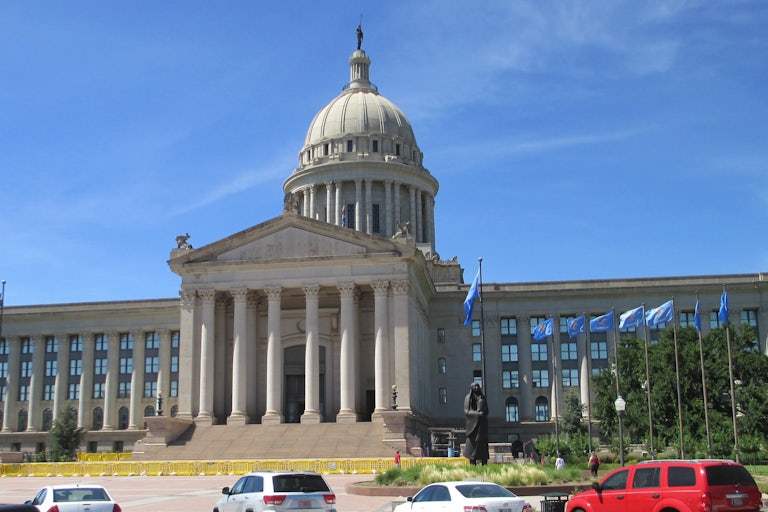
Oklahoma State Capitol building
Getty Images
Oklahoma State Capitol building

A just society would not allow teachers to hit disabled kids at school. Sounds reasonable enough, right? Well, Oklahoma Republicans disagree.

On Tuesday, the Oklahoma House, in which Republicans have a supermajority, voted against House Bill 1028, which would have outlawed school district personnel from “using corporal punishment on any student identified with a disability in accordance with the Individuals with Disabilities Education Act.”

After lawmakers read Bible verses and talked about the need for physical discipline, the measure failed to proceed by a vote of 45–43 (though a narrow majority, the bill needed 51 votes to pass).

Current Oklahoma law only prohibits “deliberate infliction of physical pain” to discipline students with “the most significant cognitive disabilities.” Even then, schools can obtain permission from parents or guardians to supersede the ban.

“The rod and reproof give wisdom. But a child left to himself bringeth his mother to shame,” said Republican Representative Jim Olsen. “So that would seem to endorse the use of corporal punishment. So, how would you reconcile this bill with scripture’s counsel on this matter?” he asked Representative John Talley, a proponent for the bill.

Olsen then asked, “On what basis would we automatically conclude a special needs child should not get corporal punishment?” as if there’s some dangerous risk in allowing children not to be hit by their teachers.

Olsen proceeded to nonblushingly cite a constituent call he apparently received from someone who said their “special needs” child “did not respond to positive motivation but that she responded very well to corporal punishment.”

According to his biography, Olsen himself serves as a Sunday school teacher.

Another Republican representative, Randy Randleman, actually wanted to get into the minutiae of the bill to make sure parents could still freely hit their kids.

“A child could have dyslexia, and then you couldn’t spank him, correct?” he said. “I would never spank an emotional problem, I would never spank a neurological problem,” he continued, in curious syntactical manner. “But if a parent has the choice, and they know that it can stop a misbehavior for behavioral problem, is this bill stopping that?”

Again, the bill’s bare-minimum ambition was just to outlaw school staff (not even all people) from being able to hit disabled children (not even all children).

“‘You can’t touch me.’ I hear that over and over. I don’t want to hear that in school,” Randleman said.

Randleman (supposedly a certified teacher, counselor, principal, psychometrist, school psychologist, and superintendent) has “a passion for children—his children, your children, Oklahoma’s children,” according to his biography.

“We need to help teachers understand how to discipline difficult children while keeping consistency in all classrooms,” he says in his bio.

Environmental Groups Sue Biden Administration to Stop the Invasive Willow Oil Drilling Project

“It’s clear that we can’t count on Biden to keep his word on confronting climate change and halting drilling on public lands.”

Protesters demand President Biden stop the Willow Project by unfurling a banner outside the White House on December 2, 2022.
Paul Morigi/Getty Images for This is Zero Hour

The people are not letting the government off the hook for breaking promises. Numerous conservation, environmental, local, and Indigenous advocacy groups have filed lawsuits against the government to stop Willow, a massive oil drilling project in Alaska set to pillage up to 600 million barrels of crude oil over 30 years.

A lawsuit filed Wednesday, led by environmental law organization Earthjustice, accuses the Biden administration of failing to consider alternatives that could have reduced greenhouse gas emissions and environmental impacts. The gargantuan oil drilling operation is projected to emit the equivalent of roughly two million cars’ worth of carbon pollution every year.

Biden’s approval of the Willow project comes after he repeatedly promised “no more drilling.”

“Now we have to step up and fight for these priceless wild places and the people and animals that depend on them. It’s clear that we can’t count on Biden to keep his word on confronting climate change and halting drilling on public lands,” said Kristen Monsell, a senior attorney at the Center for Biological Diversity.

The lawsuit also charges the administration did not assess the full climate impact of the project, neglecting to consider additional pollution from future development once the project’s infrastructure is in place. Earthjustice cites ConocoPhillips’s description of the project to investors as the “next great Alaska hub,” and that as much as three billion barrels’ worth of oil may lie nearby for them to further plunder from inside the earth.

The lawsuit also charges the Bureau of Land Management, the United States Fish and Wildlife Service, and the National Marine Fisheries Service with failing to consider how the project directly violates their mandates of protecting surface resources and endangered species.

“Permitting Willow to go forward is green-lighting a carbon bomb. It would set back the climate fight and embolden an industry hell-bent on destroying the planet,” said Christy Goldfuss, chief policy impact officer for the Natural Resources Defense Council.

The Wednesday lawsuit follows one filed the day before by another six groups, led by Trustees for Alaska, which leveled similar charges against the government. The lawsuits note that the now-approved project violates similar laws that led a court to void previous approval for the project signed off on by Trump.

“ConocoPhillips has made record profits year after year and hopes to continue to do so at the cost of our communities and future generations,” said Siqiñiq Maupin, executive director of Sovereign Inupiat for a Living Arctic. “The true cost of Willow is a future where we lose our traditional practices and diet because of the pollution and destruction to land, water, and climate caused by the fossil fuel industry’s unending greed.”

Lindsey Graham Suggests Shooting Down Russian Fighter Jets After U.S. Drone Downed

“What would Ronald Reagan do right now?” the Republican senator asked on Fox News.

Senator Lindsey Graham
Kevin Dietsch/Getty Images

Senator Lindsey Graham thinks the best response to a Russian plane allegedly colliding with an American drone is to go on the offensive, despite the West trying for more than a year to avoid outright conflict with Moscow.

“We should hold [Russia] accountable and say that if you ever get near another U.S. asset flying in international waters, your airplane would be shot down,” Graham told Fox News host Sean Hannity Tuesday night.

Tensions rose Tuesday after a Russian jet was accused of clipping an unmanned U.S. drone over the Black Sea. Washington accused Moscow of being reckless and unprofessional. Russia has denied that its plane was involved and demanded the United States cease flights near its borders.

Graham has been unwavering about the need to oppose Russia and help Ukraine fend off Moscow’s invasion—often calling for greater escalation. Last year, Graham suggested that Russian President Vladimir Putin should be assassinated in order to end the conflict.

Earlier Tuesday, Graham insisted on Twitter that aiding Kyiv should be an American “priority” and compared Russian President Vladimir Putin’s attempt to seize Ukraine to Hitler’s rise to power.

The South Carolina lawmaker was also one of just three senators (and the only Republican in the group) who visited Ukraine in January, when the South Carolina lawmaker urged the U.S. to send tanks to Kyiv.

But throughout the entirety of Russia’s war in Ukraine, which has now gone on for more than a year, Western countries have been clear that they want to avoid direct conflict with Moscow. Part of the reason why the U.S. was so hesitant to send Kyiv tanks in the first place was because Russia has repeatedly warned that providing tanks to Ukraine would be seen as a major provocation.

Putin also warned in September he would use nuclear weapons in retaliation if “the territorial integrity of our country is threatened.”

Tennessee Is Willing to Give Up Nearly $1.3 Billion in Funding for This Anti-Trans Bill

The Republican legislature’s commitment to knocking down trans rights is astonishing.

Drone view of Tennessee state Capitol
Joe Sohm/Visions of America/Universal Images Group/Getty Images

Tennessee Republicans are continuing the assault on trans people’s rights, this time by arguing they shouldn’t be able to have their driver’s licenses reflect who they are.

On Monday, Tennessee state Senate Republicans passed a bill that would define “sex” in the state code as one’s gender assigned at birth.

Senate Bill 1440 bill defines evidence of a person’s biological sex as included, but not limited to, “a government-issued identification document that accurately reflects a person’s sex listed on the person’s original birth certificate.” Consequently, people would not be able to stray away from that original documentation; trans people would not be able to modify their driver’s licenses or other government-issued IDs to match their identity.

Beyond being another hateful iteration of the conservative assault on trans people’s rights, the bill could have the state of Tennessee losing buckets of money as the legislation would contradict federal guidelines. If it passes the bill, Tennessee could lose $1.2 billion worth of federal education funding, and another $750,000 of federal grants dedicated towards supporting women and children. Other state and local government entities could be impacted as well.

Even with that potentially astronomical loss of funding, the bill passed the Senate 27-6, exhibiting the relentless urge Republicans have to target trans people at any cost.

“This is their latest cruel attempt to stigmatize, marginalize, and erase the LGBTQ+ community, particularly transgender Tennesseans,” said Human Rights Campaign Legal Director Sarah Warbelow. “Let’s be clear: the goal of this bill is to exclude the LGBTQ+ community from nondiscrimination protections in the state of Tennessee and to perpetuate a false narrative of who transgender people are.”

Having a driver’s license or birth certificate match one’s identity would naturally be significant personally to transgender people—but it would also affirm their identity in a legal sense, and shield them from further discrimination and harassment.

Since 2015, Tennessee has enacted 14 anti-LGBTQ laws, according to the Human Rights Coalition—including a bill signed this month by Governor Bill Lee that prevents transgender youth from accessing affirming medical care.

The proposed Tennessee legislation is part of a broader assault that has led to over 100 anti-trans health care bills being introduced throughout the country.