Newsletter
Power Mad
A weekly review of the rogues and scoundrels of American politics

The Viral Stupidity of Politicians’ TikTok Bans

Lawmakers across the country are looking to kill off the social media platform for many of the same sins that Big Tech commits regularly.

Jonathan Raa/Getty Images

What are the biggest problems that the people of Rapid City, South Dakota, have to face? I’d argue that its citizens should be most concerned that the sole reason the state seems to exist is to provide a haven for oligarchs and tax cheats. But not everyone agrees—and in what is becoming a pitched mayoral race in the state’s second-most-populous city, it’s a matter of hot debate. If you listen to city Councilwoman Laura Armstrong, who has already announced her intention to run, she’ll tell you the biggest issues are crime and meth. But a potential rival, her council colleague Jason Salamun, has identified a different villain: TikTok.

Over the past few months, TikTok—the social media platform that Gen Z has taken to in droves and which their aunts don’t quite understand—has earned the opprobrium of lawmakers near and far. The Wall Street Journal, which reported on these Rapid City goings-on, asserts that concerns over the platform have gone “from Washington to Main Street”—and with a bipartisan sheen to boot. It’s hardly the first time a tech company has drawn the critical eye of policymakers. But what critics of TikTok claim is a matter of national security looks, upon closer inspection, to be a familiar concern about privacy that could just as easily be levied—and should be levied—against a whole array of U.S.-based tech companies.

The political war on TikTok has been brewing for some time, but it ramped up in mid-December when bipartisan legislation was introduced in both the House and Senate that would ban TikTok outright in the United States. That this measure suddenly arrived on the scene with such broad approval was, to me, a red flag. Bipartisan legislation typically falls into three categories: the naming of post offices, the funding of unwinnable wars, and stupid pieces of stunt legislation. My suspicions were confirmed when I saw the name of the bill: Averting the National Threat of Internet Surveillance, Oppressive Censorship and Influence, and Algorithmic Learning by the Chinese Communist Party Act, or ANTI-SOCIAL CCP Act. As my colleague Matt Ford has written, acronym bills are typically the work of the unhinged or the unserious.

Nevertheless, it does seem as though this bipartisan and bicameral desire to limit TikTok’s ability to, say, briefly cement Louis Theroux’s status as a hip-hop icon, was born of bona fide real-world concerns. As NBC News’s Rebecca Shabad reported, lawmakers took the step after receiving “warnings from the FBI director and cybersecurity experts who have said China could use the social media platform for spying”; Buzzfeed reported in June that China-based employees of TikTok’s parent company had accessed the nonpublic data of U.S. users despite assurances to the contrary. The ANTI-SOCIAL CCP Act, put forth in the Senate by Marco Rubio, sought “to protect Americans from foreign adversaries who might use certain social media to surveil Americans, learn sensitive data about them, and spread influence campaigns or propaganda.”

But TechDirt’s Karl Bode took a dim view of Rubio’s proposal, and with good reason. “For several years,” he wrote, “we’ve noted how most of the calls to ban TikTok are bad faith bullshit made by a rotating crop of characters that not only couldn’t care less about consumer privacy, but are directly responsible for the privacy oversight vacuum TikTok (and everybody else) exploits.” Bode noted the dubious legal underpinnings of the measure but found a larger fault at the core of the proposal: “For decades the GOP (and more than a few Democrats) have worked tirelessly to erode [Federal Trade Commission] privacy enforcement authority and funding, while fighting tooth and nail against absolutely any meaningful privacy legislation for the Internet era.”

This door has been open for tech companies of all stripes to abuse in similar fashion. “If you actually care about national security,” wrote Bode, “holding all companies and data brokers accountable for privacy abuses should be your priority. A basic, helpful, well-written privacy law should be your priority. A working, staffed, properly funded FTC should be your priority.”

We have some idea what a more rigorous regulatory regime looks like. European authorities this week dropped hundreds of millions of dollars’ worth of fines on Mark Zuckerberg as part of the EU’s larger effort to bring Meta into compliance with the privacy regulations of its member nations. That we don’t have this level of enforcement in America is down to the fact that firms like Meta spend a lot of time and money influencing our lawmakers to retain a status quo in which they have broad latitude to do the very things TikTok stands accused of doing: surveilling Americans, acquiring sensitive data about them, and subjecting them to influence campaigns and propaganda.

What’s likely to happen once all the shouting is over? As Bode notes, a stateside TikTok ban is not going to prevent China’s exploits in the field of data acquisition: “You could ban TikTok immediately and the Chinese government could simply buy this (and more) data from a rotating crop of dodgy data brokers and assorted middlemen.” Meanwhile, the tech industry’s surveillance-capitalism panopticon will continue its work. Lawmakers could take bigger and more effective efforts to secure our privacy, but until then we’ll get a few brief and repetitive seconds of feckless and ineffectual parliamentary song-and-dance from lawmakers across the land. How very TikTokian.

The Next Step in the Fight for the Good Life

How Democrats can heed the lessons of 2022 in the year to come

Drew Angerer/Getty Images

This week, The New Republic will be devoting some of our time to looking back at the villains, ghouls, and do-gooders who shaped the past year in politics. A new Scoundrel of the Year will take their place alongside such luminaries as Mark Zuckerberg and Ron DeSantis, and the entire TNR staff will be making contributions to the cause. In looking back on the work TNR has published in 2022, I keep coming back to one big idea that I’ve tried to nurture on these pages: the necessary fight for the Good Life.

Longtime readers may remember how I tried to elucidate the borrowed-from-Keynes concept of the Good Life as a means of offering a then-wayward Democratic Party a way to get its messaging unstuck. To my mind, the elements of the Good Life boiled down to this: “More shared prosperity to reduce economic inequality; more widely distributed political power so that people have more control over their own lives; more political stability to keep upheaval at bay; and, most important of all, more time with the people we love.”

These are simple ideas that can inform a broad compact with America—one that would recover wealth that was stolen from us and provide a more just and equitable future. Democrats, of course, didn’t end up taking the beating many expected in the midterms, in part because they told a good story about democracy, the fountain from which the Good Life flows. They’ll have an opportunity to keep advancing this vision. Some of my favorite pieces from the past year might help light the way.

Democrats should stop panicking about elections, Walter Shapiro argued: The election “reminds Democrats … that it is time to go back to trusting the American people.” A good place to begin—but there is work to be done. As Joe Lowndes and Daniel Martinez HoSang documented at length, the GOP has made inroads with candidates of color, and Democrats have to take that threat seriously. I’ve urged Democrats to be more proactive, rather than waiting to benefit from GOP wreckage.

But when Republicans do wreck things, it’s good to go on offense. Meredith Shiner’s clarion call for Democratic action after Roe was gutted is a good reminder that time is of the essence in an emergency. One Democrat who spoke the loudest about countering the threats of far-right extremists—and one of the few who seemed to step out in support of the increasingly threatened LGBTQ community—was Michigan’s Mallory McMorrow, who did one of my favorite interviews with our editor, Michael Tomasky.

You can’t have the Good Life without a thriving economy, and while Democrats may not get any of their economic ideas to Joe Biden’s desk in 2023, they need to keep pushing for them, even if ultimately they’re getting voted down by the GOP House (which has its own benefits). One big policy to push: a revived and extended child tax credit, which, as Grace Segers has relentlessly documented, provided massive gains in the war against poverty. The Biden administration has, for the most part, helped to build a labor economy that favors workers and boosts the democratizing influence of unions. The president backed the wrong horse in the recent rail strike fiasco, but Steven Greenhouse provided a blueprint for his administration to get back on the right track.

As TNR editor Michael Tomasky noted, Democrats actually have a pretty good economic tale to tell—but they “need to tell a sharper economic story that identifies enemies of working people’s economic interests by name.” The coming year should be a boom time for shaming the worst of the worst, from the private equity firms sucking the American dream dry to the corporate interests that are keeping ordinary people down, as Sarah Miller wrote so eloquently.

Naturally, the biggest enemy of the Good Life continues to be the GOP and a conservative movement that, as Graham Gallagher illuminated at length, is only getting stranger, more off-putting, and more un-American by the day. We’ve worked hard to chronicle this transformation: from Laura Jedeed and Ana Marie Cox’s on-the-ground coverage of a truly cracked CPAC to Melissa Gira Grant’s constant chronicling of the way the QAnon movement keeps burrowing itself deeper into the halls of power.

Perhaps the most important story that defenders of the Good Life will need to tell over the next year is that Trump’s electoral defeat in 2020 and his weakened profile at the end of this year’s midterm cycle don’t point to the return of a normal, credible, democracy-minded Republican Party. Osita Nwanevu wrote:

The Republican Party understands the climate its rhetoric and strategies have created kills people and will continue to do so; it remains important to Republican politicians that the men being provoked to murder have the right tools at their disposal. It’s of some comfort that many Americans have come to see the right’s degeneracy for what it is and that Republicans continue to pay an electoral penalty for it. But given the mounting structural advantages the GOP enjoys within the federal system, this election barely qualifies as a setback.

We’re not out of the woods yet, but the world only spins forward. On to a new year: a new chance to cut, a new chance to cure.

This article first appeared in Power Mad, a weekly TNR newsletter authored by deputy editor Jason Linkins. Sign up here.

Hit Corporate America Where It Hertz

The rental car agency is getting away with subjecting its customers to false arrests and imprisonment. How bad do things have to get before there are real consequences for bad behavior?

Cindy Ord/Getty Images

What kind of criminal activity must a corporation commit to face real consequences—for the justice system to compel the company into nonexistence or jail its executives? In recent weeks, there has been some cheerful news on that front: Sunny Balwani, the president of Theranos, will join his former flame and company founder Elizabeth Holmes in a lengthy prison sentence—a deserved punishment for their outlandish lies about their fraudulent blood-extraction machine.

But for every Theranos, there’s a Wells Fargo, who readers might remember as the ne plus ultra example of a bad bank, its executives seemingly bent on finding newer and more innovative ways to scam its customers. Wells Fargo has been given permission to constantly apologize for its wrongdoing and immediately return to it, with no one facing real consequences. The truth is, instances like Theranos, where clear-cut corporate criminals face clear-cut punishments, are considerably rare. All of which brings us to Hertz, which this week joined the ranks of those who’ve gotten away with egregious malfeasance.

Hertz, a car rental firm that’s joined at the balance sheet with several other well-known brands (Thrifty, Dollar), made some blink-and-you’ll-miss-it news: It was forced to “pay about $168 million to settle disputes with hundreds of customers,” reported The New York Times. “Disputes” puts it too politely. Over the course of many years, the company sicced the police on its own customers, who were wrongly accused of having stolen vehicles. This was all due to Hertz’s error: The company mistakenly misclassified cars as stolen or failed to account for customers making payments to extend their rentals.

As CBS News reported a year ago, dozens of customers were wrongly subjected to terrifying encounters with police. But some customers were subjected to even worse. According to the Times, one woman who was arrested, despite having paid her rental extension, was jailed for 37 days—during which time she was “separated from her fiancé and two children, missed her nursing school graduation and discovered she was pregnant.” Another renter, after learning there “was a warrant for his arrest on charges that he stole a Hertz car, had actually paid for and returned the vehicle.” But after he missed a hearing date, he was “arrested again, and jailed for six and a half months.”

Now a $168 million fine might seem like a lot, but it pales in comparison to the company’s $7.3 billion in revenue and $19.7 billion in assets at the end of 2021. Additionally, no company executives have been punished for what amounts to a wholly fraudulent exploitation of the criminal justice system.

Hertz was a troubled firm beyond the crimes it committed; the company filed for bankruptcy during the pandemic, and its employees are thus familiar with their jobs being at risk. But this episode still provides an illuminating example of why our labor politics needs a big rethink. Firms do things all the time that put jobs at risk. Sometimes they commit crimes. Sometimes an idiot just acquires a company and starts firing everyone who won’t join his inane ego trip. An economy in which employers have to compete for labor allows workers to be more mobile and more capable of leaving bad jobs behind, which can help soften the blow whenever the justice system lowers the boom on bad corporate actors. Moreover, this episode is simply the latest and greatest example of why it pays to have a unionized workforce.

But an even better solution would be to promote and enact policies granting workers larger ownership stakes in companies like Hertz. This would give workforces that are already too vulnerable to the errant whims of overpaid executives more transparency into the decisions cascading from the company boardroom as well as a better opportunity to prevent bad, costly actions that put workers’ jobs at risk. Democrats have, in the recent past, proposed such ideas; as The New Republic’s Osita Nwanevu noted in May 2020, polling from YouGov indicated that there was broad support for them among voters, including for “policies incentivizing the voluntary transfer of ownership stakes to employees, and even making companies with more than 250 employees grant those employees half of their stock over time.”

Without the emergence of a course-altering remedy, we will be stuck with a status quo in which we have to hope that slap-on-the-wrist financial penalties will be enough to steer our corporate masters onto more just and prudent paths. The New York Times’ reporting offered some insight into how that will play out at Hertz: “On Monday, Hertz said it believed it would recover a ‘meaningful portion’ of the settlement amount from its insurance carriers and that the $168 million would be paid by the end of this year.” The system works, just not for you.

This article first appeared in Power Mad, a weekly TNR newsletter authored by deputy editor Jason Linkins. Sign up here.

The GOP’s “New Direction”: More Extremism

If you think that Republicans have learned any lessons from their disappointing midterm election showing, think again.

William Edward/Getty Images
Far-right white nationalist Nick Fuentes recently made news after dining with former President Donald Trump at Mar-a-Lago.

During the Trump era, one of the best running jokes was the media’s near-desperate search for signs that the president was shedding his obstreperous tendencies and settling into a new, earnestly presidential tone. Every moment when Trump managed not to opt for the maximally rancid reaction was one in which, perhaps, the “new tone” was taking hold, thanks to some phantasmal moderating influence that was sure to carry the day.

Alas, this dream never materialized, but that’s not to say evolution didn’t occur: Trump swiftly adopted to life as a bog-standard Beltway Republican. And his party grew more comfortable with its standard-bearer’s political aesthetics—all the better to please its base.

But now that the GOP’s big midterm ambitions have fallen apart, political touts are once again trying to conjure a “new tone” narrative into existence; one in which the Republican Party has learned the error of its ways. Some conservative luminaries, after all, have demonstrated a reluctance to fully jump back into Trump’s arms. Former Pence aide Marc Short suggested on CNN over the weekend that something new is afoot: “Since the election in 2020, [Trump] has descended deeper into the heart of darkness. It’s another reason why I think Republicans are looking in a different direction in 2024.”

There’s little doubt that Pence, who is allegedly running for president, would indeed require Republicans to look in a different direction, considering most of them think of Pence as either someone who did too much to enable Trump’s worst tendencies or someone who did too little to keep him in power. But outside of the wishful thinking of Pence and others, there is scant evidence that conservatives truly are ready to change their ways. Has everyone forgotten that Republicans and their donors went to elaborate lengths over the past two years to enact voter suppression laws and boost the political ambitions of election deniers? Because the voters sure didn’t.

More to the point, let’s recall that the context for this past weekend’s expressions of agita over Trump was his decision to break bread with two flamboyant bigots: rapper Kanye West and far-right media gadfly Nick Fuentes. Here was a golden opportunity for this change in direction: Trump’s presidential rivals were gifted the chance to jump into an “at least I’m not a rabid antisemite” lane ahead of the shadow primary.

Sadly, that lane remains unoccupied by any would-be 2024 aspirants. At least one Republican whose 2022 electoral fate remains hanging in the balance, Herschel Walker, is still mum on the matter of whether it was a good idea for Trump to dine with these reprobates. And it took the rest of the Republican Party a number of days to finally register some mealy-mouthed condemnations of Trump’s antics. This is hardly a surprise: An October 6 tweet from the GOP’s House Judiciary account—reading “Kanye. Elon. Trump”—gave proof through the midterms that Republicans were excited to get in on the ground floor of Kanye West’s antisemitism. (That tweet was finally taken down on Thursday shortly after West expressed an affection for Adolf Hitler during a lengthy interview on Alex Jones’ Infowars.)

Fuentes and West may never become keynote speakers at CPAC, but they’re in a decaying orbit around a party that already countenances no end of grotesqueries, from Viktor Orbán’s stoking of authoritarianism to the now regular evocations of the racist “great replacement theory” on Fox News’ prime time. And the person thought to be the heir to Trumpism, Ron DeSantis, has, if anything, grabbed Trump’s baton and sprinted off in the same direction. As Jonathan Chait recently noted in New York magazine, DeSantis “would reify [the GOP’s] Trump-era transformation” by “preserving” Trump’s extreme coalition of “QAnon supporters and insurrectionists.” DeSantis’s constant anti-LGBTQ rhetoric is central to his appeal; he has already emerged as the “Pizzagate in every city” candidate.

We needn’t wait for DeSantis, though. As The Washington Post’s Karen Tumulty notes, the Republican rot is deep in Washington already: “Come January, there will be fewer Republicans left in Congress willing to speak out when Trump does what he keeps doing.… And those who have followed Trump’s example in associating themselves with extremists and their ideas will have more clout within the institution.” And if you’re looking to see exactly how concerned the Republican Party is about its poor midterm showing, the good news is that the RNC is empaneling a team to examine what went wrong. The bad news is that Blake Masters, a 2020 election denier who spent a large part of his Senate campaign cosplaying as a serial killer, is one of those tasked with divining what went wrong. Yep, folks, they’re all just trying to find the guy that did this.

There is a nonzero chance that Trump’s bid to reclaim the throne will come to naught. But let’s be real: Republicans aren’t clamoring for a moderate to take this party in a new direction. “Never Trumpers” are still verboten in the GOP, and no one within that clan seems to actually have any plan to recapture the party’s institutions, aside from heaving op-eds at it. The Republicans coming to Washington plan to stage mock trials of Hunter Biden and use the debt ceiling as a weapon to try to enact radical cuts to Social Security.

As TNR contributor Graham Gallagher recently explained, the educated elites in this party have become decadent and off-putting weirdos, in thrall to bizarre and un-American ideas that seem custom-designed to turn the stomachs of normal people. Meanwhile, the conservative movement’s media propaganda organ is regularly bleating out the same kind of rhetoric as embarrassment du jour Nick Fuentes. So are Republicans really looking for something new? The only direction this party is headed is toward the gutter; the only question is who in the media, expecting a “new tone” or a “change in direction,” will get dragged there with them.

Guess What, It’s Abolish-the-Debt-Ceiling O’Clock (Again)

If the Democrats don’t use the lame-duck session to take this economic doomsday device out of the incoming GOP’s hands, God help us all.

Paul J. Richards/Getty Images
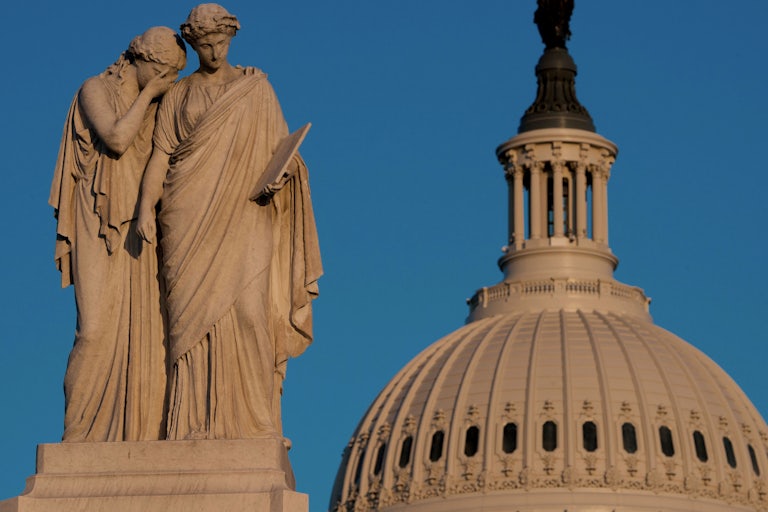
Statues depicting Grief and History stand watch over the Capitol, ruing its denizens’ error-plagued reign.

It’s said that the conventional definition of insanity is doing something over and over again and expecting different results. But what do you call someone who spends their time writing about insane people bent on repeating their insane mistakes, even though that person knows full well that they’ve failed in each and every one of their previous attempts to persuade the aforementioned twonks to stop the madness? Well, for now, you can call that person “me,” because here I am once again, red flags aloft and klaxons screaming, to warn about the potential disaster if Congress fails to raise, or preferably abolish, the debt ceiling. Abolishing the debt ceiling is a thing that lawmakers should have done a long time ago. They will have another chance to fix this in the upcoming lame-duck session. And they almost certainly won’t.

The midterm elections may have broken for Democrats in surprising ways, but they’re ending on very bad terms for those of us who’d prefer to avoid the apocalyptic results of a debt ceiling breach. The GOP will soon be in control of the House and will have to furnish the requisite number of votes to form a majority (presumably with all available Democrats) to stave off debt ceiling doomsday. The tight margins may yield enough votes, but this isn’t a particularly great era for “reasonable Republicans,” and so the worst-case scenario remains on the table. Unless, of course, Congress acts fast and does the deed during the upcoming lame-duck session.

But as The New Republic’s Grace Segers explained this week, the lame duck is already going to be action-packed. There are already a ton of legislative tasks that lawmakers want to try to speed through before the next Congress is sworn in, and different lawmakers attach different levels of priority to each item on their to-do list. I hate to get in the way of everyone’s particular hopes and dreams, but I must: The big thing Democrats need to do in the next few weeks is solve this looming crisis—again, preferably by abolishing the debt ceiling.

TNR readers are probably already familiar with the vagaries of the debt ceiling, but journalistic convention demands that I now furnish an “explainer,” so feel free to skip this if you are not one of the clowns currently sitting in Congress. Congress’s job is to spend taxpayer money. It does this by passing laws and allocating funds. And then, because we’re ridiculous, the legislative branch must, from time to time, affirm that it’ll honor those commitments that get laid on the nation’s balance sheet. This activity is called “raising the debt ceiling.”

Despite what you may have heard, it doesn’t add to or create any new debt. It’s just a promise to pay the bills. And it’s an important promise because if we fail to raise the debt ceiling, it could cause a default of our sovereign credit, and because a lot of the world’s economy is tethered to our own, a default could send a destructive shock wave throughout the global financial system.

It seems nuts that someone gave our ridiculous Congress an “ECONOMY GO BOOM” button, but for years everything went off without a hitch. Whenever the debt ceiling came up, lawmakers would give grandstanding speeches about the other party’s spending priorities, and a few would cast symbolic votes against raising it, knowing all the while that the votes to raise it were secure. What went wrong? Well, when President Barack Obama entered his Grand Bargain era, he raised the notion of using the debt ceiling to negotiate over bigger things. But he forgot that the Republicans were lycanthropic weirdos obsessed with lying about his birthplace and bent on making him a one-term president. So rather than enter into reasonable talks with the White House, the GOP instead enshrined debt ceiling brinkmanship as part of its party’s platform. The Republican Party has increasingly become a home to absolute nitwits with extremely kooky ideas about what might happen if the debt ceiling is breached.

Frankly, it’s nigh on deranged that Democrats didn’t abolish the debt ceiling during these past two years when they had full control of Congress and a mandate to govern. But much like how there aren’t enough Democrats willing to get rid of the filibuster, there haven’t been enough who agree that bringing a loaded gun into the chamber and debating whether it should be fired straight into the face of the global economy is a bad idea.

President Joe Biden, however, had a front-row seat to the debt ceiling chaos of the Obama administration, and he has wisely called for—wait, hold on, what the absolute fuck: It says here that Biden apparently “opposes eliminating the debt limit altogether as a means of averting future confrontations,” on the grounds that doing so would be “irresponsible.” Terrific, Biden has it precisely backward.

Action must be taken now, in the lame-duck session, to put an end to this, because the witching hour is nigh and the GOP will have strong incentives to try to tank the economy. Taking their ability to hold the debt ceiling hostage away from them is a no-brainer. And solutions, from the sublime to the ridiculous, abound: Reinstitute the Gephardt rule; take the advice of The New Republic’s Matt Ford and raise the debt ceiling to one googolplex dollars; mint a trillion-dollar platinum coin and stash it at the Treasury. We could also abolish it outright; we’re just about the only nation with a “debt ceiling,” and no one else on earth has used theirs to create a recurring Saw sequel with the global economy. Or we can do none of those things and Republicans can blow up the economy. Either way, I won’t have to write this again, so at least I have that going for me.

This article first appeared in Power Mad, a weekly TNR newsletter authored by deputy editor Jason Linkins. Sign up here.