What Offshore Wind and the Kennedy Center Have in Common
The Trump administration tends to respond to defeats by getting even more aggressive.

On Monday, the Trump administration suffered its fifth consecutive courtroom defeat in its war on offshore wind. All of these cases stem from an order in December in which the Interior Department claimed that a classified Defense Department report had deemed offshore wind a “national security threat” and Interior was therefore “pausing” the leases on five already-under-construction offshore wind projects on the East Coast, “effective immediately.”
How, you may wonder, did offshore wind pose a national security threat? That’s unclear. The Interior order mentioned previous findings of radar interference but seemed to be suggesting that the information in the “Department of War” reports contained something beyond that.
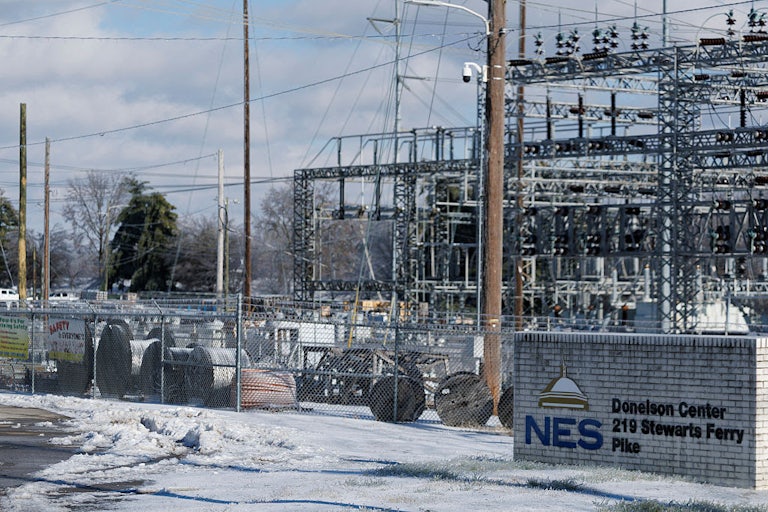
Judge Royce Lamberth, a Reagan appointee, apparently reviewed the new classified report and didn’t buy it. So Sunrise Wind in New York, like the other four wind projects (including Vineyard Wind in Massachusetts, which is already sending power to the grid and was particularly useful during the recent winter storm), is free to proceed as the appeals process continues. “The administration is now 0-5 in its effort to stop wind farms under construction along the East Coast,” The New York Times’ Maxine Joselow noted.
This is not the only embarrassing result of the administration’s odd flurry of late-December energy orders. The administration has long claimed that coal plants have been unfairly demonized by environmentalists, that the country urgently needs fossil fuels, while—in Trump’s words at the World Economic Forum recently—“windmills” are “losers.” But two utilities are now petitioning the administration to, pretty please, let them close their coal plants as planned.
Craig Generating Station’s Unit 1 is one of several coal plants targeted by the administration’s unusual “emergency orders” to remain open past their scheduled retirement. Obviously, environmental groups aren’t thrilled: Previous research has found that some 460,000 deaths in the United States were attributable to coal plant pollution between 1999 and 2020. But reviving coal was always a pretty foolish economic proposition, as well. “Reopening closed coal plants makes no economic sense,” two analysts at the Institute for Energy Economics and Financial Analysis wrote last summer. The reason is simple: “As coal plants age, maintenance costs rise, pushing up their generation costs, making them uncompetitive.”
This is now precisely what two power utilities are saying in their petition. Tri-State Generation and Transmission Association and Platte River Power Authority, two co-operative utilities that run Craig Unit 1, along with three co-owners, weren’t just planning to close the plant to meet Colorado’s goal of phasing out coal by 2030. They were planning to close it because it’s extremely expensive to run, reports Canary Media’s Jeff St. John. One estimate suggests keeping the plant open merely 90 days could cost $20 million. The utilities are arguing, St. John writes, that “forcing them to operate it past December will require their members to bear unnecessary costs, which constitutes an ‘uncompensated taking’ of their property in violation of the Constitution.”
It’s one thing for environmentalists to point out that propping up fossil fuels makes no sense. It’s another thing for utilities themselves to say it.
Between this and being defeated five-nil on offshore wind, another administration might be feeling embarrassed right now (although not as embarrassed as it should have been for arguing that wind turbines pose a secret national security threat to begin with). And that’s typically the subtext when Bluesky liberals share these news stories—smugly or wryly noting further evidence of the administration’s consistent incompetence.
But this is a bit like Trump’s face-plant over the Kennedy Center—“an implicit admission of defeat,” in the words of The Atlantic’s David Graham. Trump now plans to close the storied D.C. arts institution for a complete reconstruction because, after a year with him at the helm promising to make the arts great again, droves of high-profile artists have canceled their performances and ticket sales have plummeted. It’s not working.
While it’s standard for political opponents to cheer when their adversaries are shown up repeatedly, there’s always a dark undercurrent to these stories when it comes to the Trump administration. The Kennedy Center has been a vital institution, and not just for Western high culture for well-dressed attendees, as originally intended, but through loads of free performances at its smaller stages, making arts from around the world accessible to residents in a way they wouldn’t otherwise have been and giving artists work and exposure they wouldn’t otherwise have had. Shutting it down will be a serious blow to the region’s arts.
This president doesn’t withdraw when humiliated. He just gets more vindictive and aggressive. And it’s worth emphasizing what that means on energy policy. As stupid and damaging as it is, the president’s attempt to revive coal is, to some extent, working. Coal plants aren’t just delaying retirement—they’re polluting more too, thanks to the administration’s environmental rollbacks. The toll of these policies will be measured in extra consumer costs, in health damage, as well as in lives and livelihoods lost in climate disasters.
Wind projects, likewise, may be free to proceed thanks to the courts but will suffer the effects of these delays. Wind investments are complicated. Delays are extremely expensive and have helped sink wind projects before. And it’s foolish to think that the administration will take the five-nil defeat and make its peace with renewables. Trump will just charge forward again like an enraged Don Quixote.
Stat of the Week
565,744 kids
That’s how many live “within 3 miles of a power plant or other corporate polluter that has received a two-year free pass from President Trump to avoid complying with toxic air pollution limits,” according to a new report from the Center for American Progress.
What I’m Reading
EPA set to reapprove dicamba, an herbicide previously banned by courts
The bizarre contradictions in the Make America Healthy Again agenda continue to accumulate. The Washington Post recently reviewed an “unreleased statement” showing the Environmental Protection Agency plans to reapprove dicamba, an herbicide so prone to drifting (even more than a mile) from its area of application that it’s been known to kill loads of crops it was never intended to kill.
The statement also mentioned that the EPA’s review of dicamba found no risk to human health.
Still, the decision could cause tension between the Trump administration and Make America Healthy Again activists who have advocated for more limits on herbicides and pesticides.
“The use of this pesticide has been economically devastating and socially divisive, which is why the courts ruled for its removal,” said Kelly Ryerson, known as “Glyphosate Girl” on social media.
Read Amudalat Ajasa’s full report at The Washington Post.
This article first appeared in Life in a Warming World, a weekly TNR newsletter authored by deputy editor Heather Souvaine Horn. Sign up here.