Breaking News
Breaking News
from Washington and beyond

Washington Man Arrested for Threatening To Kill Members of Congress in Hundreds of Voicemails

The man allegedly left hundreds of threatening voicemails over the course of two years and continued despite warnings from law enforcement.

Anna Moneymaker/Getty Images

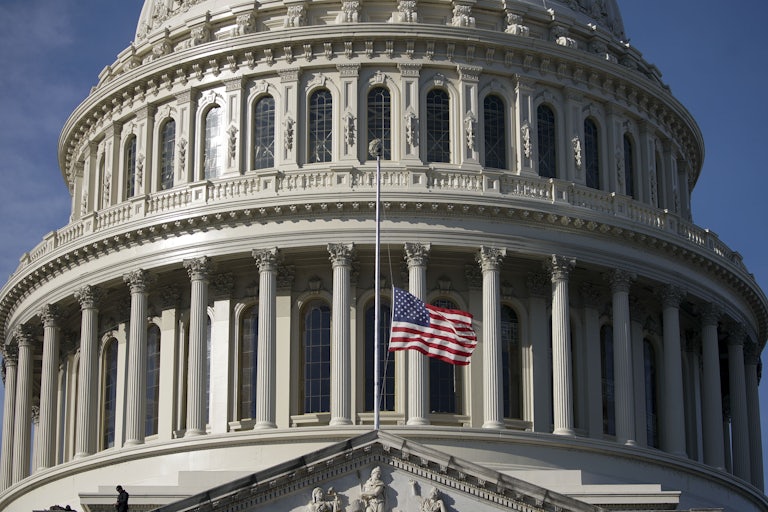
A 48-year-old Washington state man has been arrested and charged after he allegedly made threats against multiple members of Congress.

Mark Leonetti had allegedly threatened several Senate and House members, leaving hundreds of menacing, racist, antisemitic voicemails over the course of two years. He was charged with seven counts of making interstate threats, the Justice Department announced Wednesday.

Leonetti’s relentless threats follow a national trend of heightened threats against members of Congress. According to the United States Capitol Police, cases involving “concerning statements and threats” spiked from 3,939 in 2017 to 9,625 in 2021.

“In this instance, Mr. Leonetti refused to stop his conduct despite contact with law enforcement and mental health personnel,” said U.S. Attorney Brown.  “We acted now because it has become clear it is the only way to safeguard the community and those serving it.”

One of Leonetti’s first threatening calls came in March 2021. “Am I here to kill [U.S. Senator 3] because I’m clinical. No, I’m not clinical. If [U.S. Senator 3] is delusional I’m still here to kill him, I’m not clinical,” the legal complaint’s transcription of one of Leonetti’s voicemails read.

The call prompted Capitol Police to investigate and subsequently work with the FBI to probe further. Investigators found that Leonetti had been previously visited by country mental health workers, and that the team stated Leonetti is paranoid schizophrenic.

Investigators made initial contact with Leonetti; there, he allegedly said he would try harming or killing “U.S. Senator 3” “only if justified.” In the rest of 2021 alone, Leonetti allegedly left over 400 voicemails to members of Congress of both parties.

As time went on, the voicemails only grew darker. “We’re going to barbecue your ass. We’re going to peel your ass inside out,” a September 2022 voicemail transcript reads. “I’m gonna murder you. It is justified,” read another from later that month.

Voicemails Leonetti left in October were even more vile, as he described particularly gruesome manners of inflicting violence on these members, and spewed vicious antisemitic threats—all of which will not be repeated here.

Leonetti left calls as recent as December 5, which again involved “murder” and “kill[ing].”
Don’t Listen to Any of the 2024 Polls on Trump

After weeks of warnings that Trump isn’t popular anymore, a new poll found that he’ll win a crowded Republican primary.

Joe Raedle/Getty Images

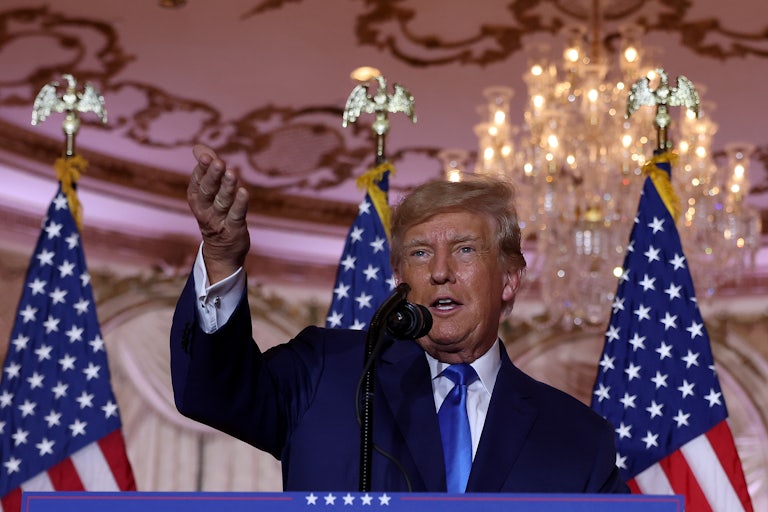
Donald Trump would be the preferred Republican presidential nominee in a multicandidate race, a poll published Thursday by NPR found, a sobering revelation after weeks of predictions that Trump isn’t popular enough to win the next election.

The NPR/PBS NewsHour/Marist poll found that 45 percent of Republicans and Republican-leaning independents prefer Trump for the party’s nominee. Thirty-three percent favored Ron DeSantis, a mere 8 percent said they liked former Vice President Mike Pence, and 11 percent said they wanted someone else entirely.

But several polls published in the past few weeks reflected a different outcome.

A Wall Street Journal poll published Wednesday found that in a race between the two, DeSantis would win 52 percent of votes to Trump’s 38 percent among Republican primary voters. A Quinnipiac University poll released Wednesday found that Trump’s approval rating among voters had hit its lowest point in seven years.

Only 31 percent of all registered voters viewed him favorably, although 70 percent of Republicans still like him.

Several YouGov surveys conducted in November had DeSantis leading Trump in a hypothetical primary. A poll released on December 1 showed DeSantis had dropped behind Trump, but only by six percentage points.

The results of these polls may seem contradictory, but here’s the thing: Political polls aren’t really good representations of what the entire country is thinking.

Such surveys tend to overrepresent people who are more active politically or in their community, according to the Pew Research Center. Polls also seek to capture how all adults in the country feel, while election results generally reflect only about 40 percent of public opinion for regular elections and 60 percent for presidential ones.

Polls massively missed the mark about the results of the 2016 and 2020 elections. For the recent midterm elections, polls consistently predicted there would be an overwhelming “red wave” that would see Republicans easily sweep control of Congress.

Instead, Democrats kept control of the Senate—even flipping a seat—and Republicans took control of the House of Representatives by just a few seats.

Which is all to say, it ain’t over til it’s over.

The College Student Tracking Elon’s Jet Had All His Twitter Accounts Suspended

Jack Sweeney had more than 30 Twitter accounts tracking rich people’s private jets. They’re all suspended, and so is his personal Twitter account.

Elon Musk laughing and holding a mic
CARINA JOHANSEN/NTB/AFP/Getty Images

The Twitter account tracking Elon Musk’s private jet may have been suspended Wednesday, but that won’t stop the person running it.

Jack Sweeney ran the account called @ElonJet, which tracked the location of the billionaire’s private plane. This information is publicly available on websites such as FlightAware.

But on Wednesday, the account was suspended, a month after Musk had promised not to do so in the name of “free speech.”

A few hours later, Sweeney’s personal account was also suspended, as were the more than 30 other accounts he runs that track the private jets of celebrities, including Mark Zuckerberg, Donald Trump, and Kim Kardashian.

And now Sweeney is ready for war.

The 20-year-old university student told Insider that he intends to keep tracking Musk’s jet on other platforms.

I mean, fuck this guy,” Sweeney said, referring to Musk, about the suspensions. “This is ridiculous.”

Before the additional suspensions, Sweeney had already confirmed to press that he is working on a website version of the tracker.

“It’s important to hold people accountable, no matter what side they’re on,” he told BuzzFeed News.

“Now I’m going to keep going forever,” he continued. “I guess I can’t let him win now.”

Sweeney said over the weekend that his account had already been “shadowbanned,” meaning its visibility had been restricted. In a series of tweets that went viral, he claimed that Twitter was suppressing his posts.

This is not the first time that one of Musk’s Twitter beefs has resulted in an account suspension.

Several comedians and actors were suspended for mocking the Tesla founder, while a few prominent liberal accounts were blocked (and ultimately reinstated) for no apparent reason.

Meanwhile, hate speech and abuse have flourished on the platform since Musk took over in late October.

Just Thousands of Votes Stopped Democrats From Keeping the House

A new report shows just how narrow Republicans’ margin of victory in the House really was.

Al Drago/Pool/Getty Images

While Democrats navigate a newly insecure 51–49 Senate, with Arizona Senator Kyrsten Sinema’s recent switch to independent, it’s worth revisiting how close they were to maintaining a majority in the House.

A new report from Inside Elections details how, in the five closest GOP House wins, the Republicans won by a combined measly 6,652 votes. Republicans’ gain of any seats at all came from just 22,370 votes, the combined margin of their nine closest victories.

The most razor-thin victory was Colorado Representative Lauren Boebert’s closing win over Democrat Adam Frisch. The far-right candidate, expected to win 97 times out of 100 in FiveThirtyEight’s election simulator, had won the district previously by six points. This November, she won by 546 votes—a 0.16 percent margin that triggered an automatic recount. (The Inside Elections report did not take into account Boebert’s even lower margin of victory after the recount, and we’ve updated the numbers in this piece accordingly.)

Elsewhere, in New York, the state Democrats allowed a disastrous string of losses, with two races being lost by less than one percent, including the chair of the Democratic Congressional Campaign Committee, Sean Patrick Maloney.

A combination of state party mismanagement, a lack of strong top-of-ticket campaigning from reelected Governor Kathy Hochul, and a disadvantageous redistricting spurred by former Governor Andrew Cuomo’s appointed judges all contributed to New York Democrats’ disastrous results.

In total, New York Democrats lost six races in redistricted sections that voted for Biden in 2020. Next year, the balance of power in the House will be 222–213, with a Republican majority. Six seats the other way, not even counting any other close race Democrats lost, would have made it 216–219, letting Democrats keep their hold of the House.

Of course, Democrats won narrow races too. And these wins came not just from coasting off attacking MAGA candidates as such but actually doing the work of campaigning.

As Slate’s Alex Sammon points out, one of Democrats’ major upsets—Marie Glusenkamp Perez’s House win in rural Washington—benefited from a massive organic ground game. The operation came despite lackluster financial support from the DCCC (losing-candidate Maloney’s committee), which dismissed the race as a “reach.”

The balance is nevertheless tight. Kevin McCarthy still hasn’t corralled together 218 votes to claim the speakership. Maybe Democrats could compensate for their losses and, instead of constantly leveraging the left, pressure McCarthy—or another potential Republican speaker—for some favors in exchange for the gavel.

Federal Reserve Hikes Interest Rates up 0.5 Percent, Slowing Pace of Increases

More on what exactly the increase in the interest rate means

U.S. Federal Reserve Chair Jerome Powell speaks at a podium
Liu Jie/Xinhua/Getty Images
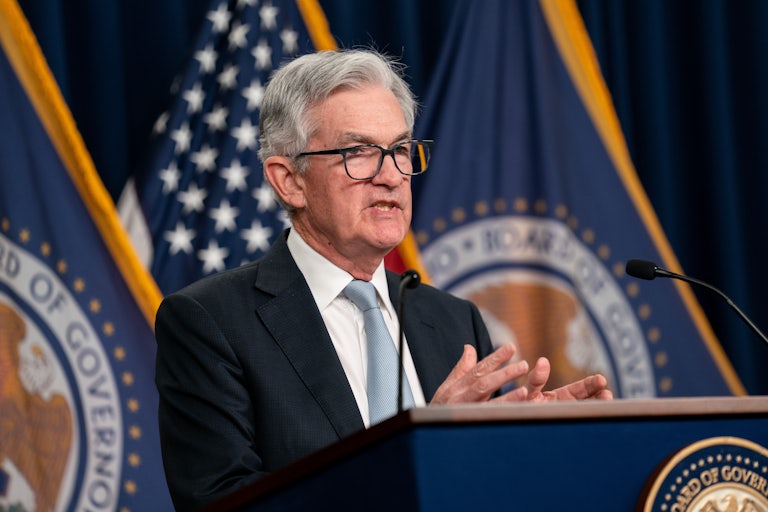
U.S. Federal Reserve Chair Jerome Powell

The Federal Reserve on Wednesday announced an interest rate hike of 0.5 percent, easing up a bit after a series of much higher increases.

With inflation at a record high, the Fed has been scrambling to get interest rates high enough to discourage people from spending money, slowing the economy down in turn. The last four rate hikes have been 0.75 percent.

The risk is that growth will slow while prices and borrowing rates stay high, sending the economy into a recession. Fortunately, there have been some signs that inflation is finally starting to ease a bit. But Fed Chair Jerome Powell warned that while “it’s good to see progress … we have a long ways to go to get back to price stability.”

In a statement, the Fed pointed to supply chain issues and high food and energy prices due to Covid-19 and the war in Ukraine as main factors for inflation continuing to stay high.

But also, “recent indicators point to modest growth in spending and production. Job gains have been robust in recent months, and the unemployment rate has remained low,” the statement said.

Dean Baker, senior economist at the Center for Economic Policy and Research, answered five questions about what this means going forward.

1. What does the 0.5 percent interest rate increase mean for consumers?

The interest rate hike means that rates for credit card debt, mortgages, and car loans will likely go up, Baker said—albeit less than after the Fed’s last policy meeting in November.

Over the past year, the rate hikes have also slowed down the housing market. However, Baker noted, “the number of construction workers has not fallen” due to a backlog in unfinished construction projects.

Jobs numbers have stayed high, which is positive for consumers but has caused concern for some experts that the economy has not slowed sufficiently to avoid a downturn.

Baker also warned that the higher interest rates push up the value of the dollar too, “which makes our goods less competitive internationally.”

2. What has changed in the past month that gives the Fed enough confidence to start slowing rate hikes?

But it’s not all bad news: “Inflation is clearly slowing in many areas,” Baker said. The October and November consumer price index, or CPI, a key government measure of inflation, indicate that inflation finally seems to be slowing a bit.

Baker attributes this to supply chain issues getting resolved. Costs for appliances and used cars, as well as shipping, have fallen.

3. Now that the Fed has been hammering away at inflation, what changes can people expect to start seeing?

The Fed indicated in its statement that it will continue to reevaluate the economic situation to determine what moves are necessary to get and keep inflation under control.

“The Committee anticipates that ongoing increases in the target range will be appropriate,” the statement said.

Powell told reporters that “it’s our judgment today that we’re not at a sufficiently restrictive policy stance yet, which is why we say that we would expect that ongoing hikes will be appropriate.”

But Baker said he hopes Powell “will indicate that he is prepared to adopt a wait and see attitude and hold off on further rate hikes.”

“This should mean further declines in mortgage and other interest rates,” he said.

4. Can a soft landing still be achieved?

The Fed has been clear its goal is to achieve a so-called soft landing, or a decrease in inflation without tipping the economy into a recession. And fortunately, the chances of a soft landing “look very good right now,” Baker said.

Inflation has slowed, but employment levels have remained high. It may take a while to reach the central bank’s target of 2 percent inflation, “but the direction of change is clearly downward,” according to Baker.

5. What are the current chances of a recession?

As the likelihood of a soft landing goes up, the likelihood of a recession goes down. In Baker’s opinion, the chances of a recession are “well under 50 percent at this point.”

The U.S. economy will probably take a hit from weaker markets abroad, as Europe struggles with direct effects from the Ukraine war and China battles a massive spike in Covid-19. But Baker is optimistic that won’t be sufficient to tip the U.S. into a recession.

“The biggest risks are from another wave of Covid or a big flare-up in the war in Ukraine,” the said.

This article has been updated.