Life in a Warming World
A weekly reckoning with our heated planet—and the fight to save it

Finally, a Gas Stove Proposal That Cares About Poor People

The District of Columbia City Council is considering a bill that will allow low- and moderate-income households to switch out their gas stoves—if they so choose—for free.

Charles Allen gesticulates while speaking at a podium.
Matt McClain/The Washington Post/Getty Images
D.C. Councilmember Charles Allen speaks during a swearing-in ceremony on January 2.

Last Friday, District of Columbia Councilmember Charles Allen led five colleagues in introducing a bill to address the health dangers of gas stoves in the home. You might think, given all the coverage of the gas stove wars in the past month, that this legislation was just the latest salvo in the growing contest between Democratic policymakers who want to regulate gas stoves and Republican policymakers who want to outlaw any law that outlaws gas stoves.

The D.C. bill differs significantly, however, from how the cities of Berkeley, San Francisco, and New York—as well as Montgomery County, Maryland—have approached gas stove policy. Whereas those places have banned gas hookups in new buildings, Allen’s bill aims to make stove-switching affordable in existing moderate- and low-income homes. The idea, per a release on Allen’s website, is to use federal funds made available by the Inflation Reduction Act to help households earning less than $80,000 switch out their old gas stoves for free, allowing them to buy and install an electric or induction stove with “no out-of-pocket costs.” It also proposes incentives for others to switch: a fee for installing “new fossil fuel-burning appliances during major renovations,” for example, and a prohibition on installing these devices in public housing. But the legislation’s main goal is enabling low-income households to choose what kind of device they want in their home—and, if desired, get rid of polluting stoves that may have been installed before people were widely aware of the health risks.

Allen’s bill, which was originally submitted late last year before the gas stove issue exploded into public consciousness, is an important policy innovation. And it points toward a way to avoid the whole bogus culture war that ignited last month when the U.S. Consumer Product Safety commissioner gave a quote to Bloomberg that suggested his agency was open to banning gas stoves to protect consumers.

While the American right immediately jumped on this quote as a consumer rights issue—the government is coming to steal your stove!—the people who really get screwed by gas stoves, as TNR columnist Liza Featherstone recently pointed out, are those who don’t have much choice about their appliances to begin with. In other words: renters, low-income households, etc. The bottom line is that regardless of your opinion of gas stoves as a cooking device, no one should be stuck living with an appliance that is poisoning them.

The Berkeley, San Francisco, and New York City bans on new gas hookups didn’t focus on this, and that may be because the rationale offered at the time for those bans was climate change: specifically, gas stoves’ copious emissions of methane, a potent greenhouse gas. The bans on new gas hookups were presented as a way to help each city meet its emissions targets going forward.

But as researchers have been stressing for decades, methane emissions aren’t the only problem with gas stoves. Since the late 1970s, studies have been showing a link between gas stoves and respiratory illnesses, particularly in children. And research in the past year has highlighted that the stoves are also leaking benzene, a known carcinogen with no safe exposure limit. In other words, gas stoves aren’t just a collective risk when it comes to the climate—there’s ample evidence that they’re poisoning people in their homes.

Bans on new gas hookups are probably a good idea from a climate perspective. But they don’t help people currently stuck with gas stoves in their homes. What the D.C. bill gets right is that giving people the means to remove a toxic appliance from their homes ought to be a clear ethical priority for policy going forward. In addition, reframing the debate over gas stoves as a matter of tenants’ rights—of giving people the ability to choose not to be poisoned—may be a smart political strategy to avoid the nonsensical culture wars that have become a sad feature of modern American life.

Good News

The Inflation Reduction Act is, as intended, stimulating green job creation. More than 100,000 clean energy jobs have been announced since last August, according to a new report.

Bad News

Thirty-four percent of plants and 40 percent of animals in the United States are at risk of extinction, and 41 percent of U.S. ecosystems are at risk of collapsing, according to a report released Monday by conservation research group NatureServe. The biggest threats to terrestrial species are from invasive species or disease and agriculture, with climate change close behind, while freshwater animals are particularly threatened by pollution and human water management practices. (Read Prem Thakker’s piece about how biodiversity fell off the Biden administration’s agenda in the past year.)

Stat of the Week

That’s how much energy could be generated simply by putting solar panels on the roofs and parking lots of every Walmart in the U.S., engineering professor Joshua Pearce told The Washington Post. (That’s as much as, or more than, the amount expected to be generated by a new and unprecedentedly ambitious parking-lot plan in France.)

Snidely Whiplash Award:

The National Oilheat Research Alliance and the Propane Education and Research Council have been funding and disseminating misinformation to dissuade homeowners from switching to heat pumps, the Post reports. Heat pumps can dramatically reduce a household’s energy bill and are eligible for federal tax credits due to provisions in the Inflation Reduction Act. The propane trade association “has put out training material coaching installers how to dissuade customers from switching to electrical appliances.” The heating oil trade association, meanwhile, has been paying for campaigns telling Maine residents—many of whom are looking to switch from ultra-expensive oil-based heat—that heat pumps won’t work in their climate.

Elsewhere in the Ecosystem

Cars are rewiring our brains to ignore all the bad stuff about driving

A new study by a team in Wales suggests people suspend a lot of their values when it comes to defending car culture. The way they tried to measure this is fascinating, comparing subjects’ opinions on a given car situation with another analogous ethical situation not involving cars to identify unconscious biases:

For example, people were asked to agree or disagree with the following statement: “People shouldn’t smoke in highly populated areas where other people have to breathe in the cigarette fumes.” Then they were asked to respond to a parallel statement about driving: “People shouldn’t drive in highly populated areas where other people have to breathe in the car fumes.”

While three-fourths of respondents agreed with the first statement (“People shouldn’t smoke...”), only 17 percent agreed with the second (“People shouldn’t drive...”).

Another statement addressed values around theft of personal property. Respondents were asked whether they agreed or disagreed with the statement, “If somebody leaves their belongings in the street and they get stolen, it’s their own fault for leaving them there and the police shouldn’t be expected to act,” as well as the parallel statement, “If somebody leaves their car in the street and it gets stolen, it’s their own fault for leaving it there and the police shouldn’t be expected to act.”

Only 8 percent of people disagreed with the first statement, while 55 percent of people disagreed with the second one.

Read Andrew J. Hawkins’s piece on this at The Verge.

This article first appeared in Apocalypse Soon, a weekly TNR newsletter authored by deputy editor Heather Souvaine Horn. Sign up here.

Rich People Are Boiling the Planet

What’s one thing wealthy people of all nationalities have in common? Far higher emissions than the poorer people in their country.

The Woolsey Fire approaches homes in Malibu, California
David McNew/Getty Images
The Woolsey fire approaches homes in Malibu, California, on November 9, 2018.

You may have heard that U.S. emissions per capita are the highest in the world, in part because the United States is by far the world’s largest economy. But a new report highlights that wealth inequality within countries is as important as inequality between countries when it comes to per capita emissions. Put simply: The global rich are disproportionately driving this climate catastrophe.

The 2023 “Climate Inequality Report” from the World Inequality Database, authored by economists from the Paris School of Economics and Iddri Sciences Po, is the latest study to emphasize that income is one of the best predictors of emissions—not just at the national level but also at the individual level. North America as a continent—led by the United States—still produces over four times the emissions of the entirety of Latin America and almost 10 times the emissions of South and Southeast Asia. But “at the same time,” the authors note, “comparing country-level averages can mask the underlying contributions of different population groups.” The poor in the U.S. aren’t emitting anywhere near as much as the rich.

To get a sense of what this report and similar findings ought to mean for policy going forward, I called Peter Newell, professor of international relations at the University of Sussex and co-founder of the Rapid Transition Alliance, whose previous research has focused on inequality and behavior change in the climate crisis.

Heather Souvaine Horn: The big finding from this report is that the emissions gap between rich and poor is bigger within countries than it is between countries. Does that finding surprise you at all?

Peter Newell: Not hugely. There’s been quite a few studies recently—Oxfam did some work earlier on this, and to some extent it was confirmed by some of the things we found in this report we did, the Cambridge Sustainability Commission on Scaling Behaviour Change, about this “polluter elite” being quite crucial to action on climate change, how to target that action in more effective ways. I think what’s also important to highlight is some of the different dimensions of that power.

People often think about it just in terms of the behavior change—about the richest in rich and poor countries, around their lifestyles: the SUVs, the big houses, the private jets, the yachts. Those things are hugely important. But what this report points to is that it’s also the financial and political power of that elite.

HSH: How are the superrich managing to blow the carbon budget this badly? Where is it going?

P.N.: Well, that goes back to what I was saying about there being different dimensions. One is around those high-consuming behaviors: Almost by default they have larger houses that then have to be heated. Having larger vehicles, driving them longer distances, flying more frequently. So if you look at all the hot spots in terms of where emissions are growing fastest, it’s areas like energy and transport and food, and across all those areas emissions are quite correlated with income; the more disposable income you have, the more people will be out buying luxury goods, the more their energy consumption is likely to be higher.

But then combined with that is also the financial and political power. If you’re also running a company that’s investing in fossil fuels, or buying shares in lots of companies involved in mining activities or cement production or any super-carbon-intensive sectors, that’s going to start to magnify again the footprint you have.

It’s also a relational thing: It’s about the crushing levels of poverty that still exist around the world. The elite look particularly bad because there are so many people that are in such a marginalized position.

HSH: There’s a common refrain from climate obstructionists that acting on climate change, taking it seriously, means that poor countries won’t be allowed to develop. It sounds like the finding here is that that’s not true—it’s just that we can’t all consume like the superelite.

P.N.: Exactly, I think they make that point very clear. How can we possibly say to countries—India and elsewhere—that they can’t increase their emissions? They can. It’s really about reining in the overconsumption of carbon in richer parts of the world.

But there’s this inter-societal dimension as well. Elites in India and parts of Africa often have as high a carbon footprint as people in the United States, in Canada, or the U.K. It’s wealth that is crucial to this. In a way that’s a useful entry point, because it gets beyond the naming and shaming of individual countries as always being good guys and bad guys: There are plenty of people in the States that are very very poor and not overconsuming carbon budgets. It’s about overconsumption of carbon by elite actors who have the cultural, political, economic power to do so.

So that’s an important finding: Respecting carbon budgets isn’t about restricting emissions growth from poorer countries that clearly need to move up to a certain level to meet their basic needs. It’s about freeing up the carbon space for them to do that by constraining elites’ overconsumption.

HSH: So how do we do that? If you could wave a magic wand and make certain policies politically feasible, what would actually make a dent in this?

P.N.: On the lifestyle side, things like a levy on aviation that would then be used to fund climate adaptation, for example—the Maldives have proposed this before. A straight polluter-pays tax, if you like: Those generating more of the emissions have to pay for more of the adaptation for those who have caused the problem least.

In behavior-change debates people often talk about “choice-editing” as well. It’s a lot harder to stop people using SUVs or larger vehicles once they’ve got them. It’s far easier to have proper regulations in place to stop carbon-intensive and highly polluting things coming to market in the first place. So, could you imagine restrictions on private jets, for example, or about engine size, or tougher building regulations so you make sure new homes are way more energy efficient?

You have to have a two-pronged approach. For the rich, there may also have to be redistributive measures of some sort. For most of society, it’s about enabling behavior shifts in terms of provision of more public transport or insulating homes—the sort of thing that’s going on with the Inflation Reduction Act in the States or the Green New Deal in Europe. But for those who are overconsuming, there will have to be some taxation and some penalties, frankly, to encourage more social rather than anti-social behaviors.

Then, on the financial side, I think there has to be disclosure of assets in highly polluting activities, regulation of those. And on the political side, greater transparency around things like party contributions and cleaning up the lobbying process—the level of access that corporations and wealthy individuals have to the policy process and their ability to frustrate and stall climate action, which is happening routinely all over the world.

In this report they go further and talk about progressive taxation and straight wealth taxes—i.e., not targeting particular behaviors. I think the key thing, if you’re going to pull off something like that, is that it has to be very clear what it’s going to be used for in order for it to be socially acceptable.

HSH: Is there anything else that you’re dying to say about this topic?

P.N.: We’re just seeing more and more reports like this say very similar things. The conversation now has to move on to what are the politically palatable ways of having these very difficult conversations. What would be the concrete demand?

The authors of this report talk about a “1.5 percent wealth tax for 1.5 degrees.” [A tax to keep levels of warming to 1.5 degrees Celsius, or 2.7 degrees Fahrenheit, which is one of the preferred thresholds mentioned in the Paris Agreement.] Something like that might have some traction because it’s potentially understandable—but it’s still quite complicated for a lot of people. There’s a big communications job to do around “What does 1.5 degrees mean, anyway?” If you’re going to have a conversation about it on the school playground: Is it important because we want to keep warming below preindustrial levels? There, you’ve already lost someone. So there needs to be clear framing around the purpose of tools and interventions being proposed.

So I welcome this report, but we’ve accumulated enough evidence now. Who’s going to run with this? What’s going to be the concrete demand? Who’s going to own it? That’s what we need to think about now.

This conservation has been edited for length and clarity.

Good News

For the first time, wind and solar produced more power than so-called “natural” gas in the European Union last year.

Bad News

ExxonMobil and Chevron made more money in 2022 than ever before—munch on that every time you’re tempted to think the climate policies in the Inflation Reduction Act might suffice to curb global warming.

Stat of the Week

That’s when the world is likely to cross the threshold of 1.5 degrees Celsius (2.7 degrees Fahrenheit) of warming, according to a new study. The study also predicts we now have only a 50 percent chance of avoiding an even more catastrophic two degrees of warming.

Elsewhere in the Ecosystem

These homes replaced their gas stoves—and saw a huge drop in indoor pollution

Coverage of the health risks of gas stoves has exploded in the past month. The Guardian this week reports on the results of a 96-unit public housing study in the Bronx, where 20 low-income households were given induction stoves to compare indoor air pollution against those with gas.

Researchers performed a controlled cooking test and found that the baseline level of nitrogen oxide (NO2)—which forms in the air from burning fossil fuels—in homes with gas stoves was 18 parts per billion (ppb).

It rose to an average of 197ppb during cooking. That is almost twice the Environmental Protection Agency’s (EPA) threshold for outdoor exposure deemed unhealthy for sensitive groups, such as people with respiratory illnesses, seniors and young children.…

(The EPA does not have standards for indoor air pollution, even though Americans on average spend 90% of their time indoors.)

In the homes with induction stoves, by comparison, the background NO2 level of 11ppb saw a negligible change to 14ppb during cooking.

Read Aliya Uteuova’s report at The Guardian.

This article first appeared in Apocalypse Soon, a weekly TNR newsletter authored by deputy editor Heather Souvaine Horn. Sign up here.

You Can Pry My Lead Baby Food From My Weedkiller-Covered Hands

Conservatives are hell-bent on defending gas stoves. Why not other poisonous household products?

JOSH EDELSON/AFP/Getty Images

Why do culture wars start, and whose fault is it when they do? You may have noticed how quickly gas stoves became a political fault line this month: One U.S. Consumer Product Safety Commissioner announced his agency was mulling the mounting evidence that gas stoves are poisoning people, and suddenly a slew of Republicans (and, naturally, Democrats’ own coal baron, Joe Manchin) started tweeting that Joe Biden could pry gas stoves from their cold, dead hands. Overcooking steak on a gas range and posting it to Twitter became a thing to “own the libs.”

This all misses the point, as TNR columnist Liza Featherstone wrote this week, since even a ban on gas stoves (which is not actually happening) wouldn’t result in existing devices being ripped from the walls. Regardless, the point of gas stove regulation is to protect people who don’t want to be poisoned in their homes, not to rob people of their right to get asthma and cancer. In other words: This is really a tenants’ rights issue, and it has nothing to do with the affluent homeowners who seem to have taken deep offense that a government official would dare cut through the decades of advertising that have convinced people that gas stoves are the best (they’re not).

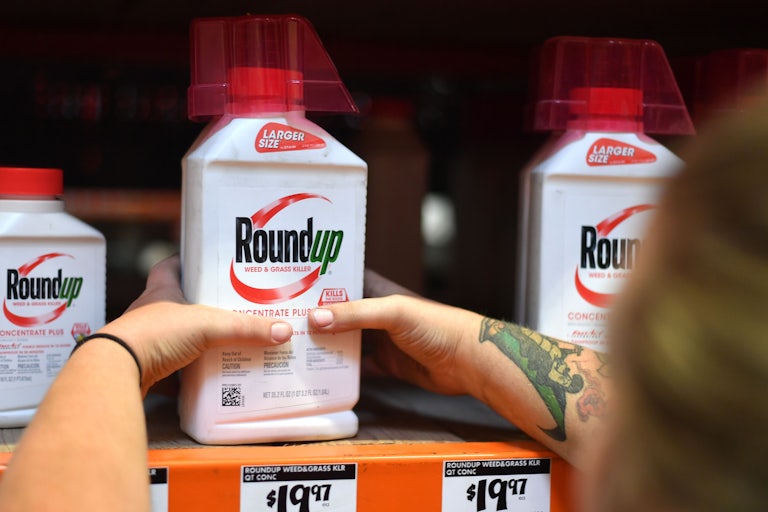
But it’s worth noting that there are a lot of poisonous household products that don’t get this kind of crazed treatment. Earlier this month, the Journal of the National Cancer Institute published research from government scientists finding that study participants with high levels of glyphosate—an herbicide found in Roundup weed killer, among many others—in their urine tended to also have signs of oxidative stress, which is an indicator for the possible development of cancer. And this is after the Centers for Disease Control found, last year, that 80 percent of urine samples taken from a representative group of Americans contained measurable amounts of this herbicide. But we have yet to see Tucker Carlson spraying Roundup in his face on live TV to protest hypothetical government overreach. (On Tuesday, the FDA proposed extremely lax limits for the amount of lead companies can include in baby foods. Can we expect some prominent conservative to shovel paint into a toddler’s mouth while screaming, “Take that, AOC!”? I doubt it.)

In seeking to understand why some issues turn into culture wars while others don’t, a lot of people adopt a blame-the-messenger stance; in other words, they blame the activists and politicians trying to alert society to a problem for doing so in an off-putting fashion. This, for example, was the theme of a recent Politico piece suggesting that the United States could pass better climate policy if climate policy weren’t being associated with Democrats, whom voters “view with suspicion.” It was also the thrust of Pamela Paul’s New York Times column seeming to blame vegans for politicizing food.

One problem with this thesis, of course, is that it doesn’t provide much of a model for social change: Asking whistleblowers never to upset people probably isn’t realistic. Moreover, as you’ll read in further coverage at Apocalypse Soon this spring, it’s usually inaccurate to blame activists for these backlashes. When you really look at which issues become culture wars and who benefits, the culprit is rarely, if ever, the moralizing do-gooder caricatured on Fox News every evening.

Good News

Massachusetts legislators are proposing a $300 million Zero Carbon Renovation Fund to help schools, low-income housing, and other municipal buildings swap out fossil fuel–based heating and appliances for electric ones, improve insulation, and more.

Bad News

Norway announced this week that it will offer a record number of fossil fuel exploration blocks (as these delineated territories are called) in the Arctic.

Stat of the Week

A new study in The Lancet finds that implementing the changes to reach net-zero greenhouse gas emissions—reducing air pollution, modifying diets, etc.—in the United Kingdom would reduce premature deaths and increase public health, resulting in over two million extra years of life nationwide. Read the full study here.

Elsewhere in the Ecosystem

Depleted Under Trump, a “Traumatized” E.P.A. Struggles With Its Mission

You may remember reports of the mass exodus that took place from the Environmental Protection Agency under Trump. Unfortunately, the agency hasn’t recovered. And the consequences could be severe, Lisa Friedman reports, when it comes to finalizing regulations needed to carry out the Biden administration’s climate and environmental goals:

The new rules have to be enacted within the next 18 months—lightning speed in the regulatory world—or they could be overturned by a new Congress or administration.

The regulations are already delayed months past E.P.A.’s own self-imposed deadlines, raising concerns from supporters in Congress and environmental groups. “It’s very fair to say we are not where we hoped we’d be,” said Miles Keogh, executive director of the National Association of Clean Air Agencies, which represents most state and local air regulators.

Read Lisa Friedman’s report at The New York Times.

This article first appeared in Apocalypse Soon, a weekly TNR newsletter authored by deputy editor Heather Souvaine Horn. Sign up here.

Davos Still Sucks

How can the World Economic Forum earnestly pretend to address global crises while being funded by the corporations that fuel these crises?

Attendees look toward the right under a World Economic Forum logo.
FABRICE COFFRINI/AFP/Getty Images
The World Economic Forum annual meeting in Davos on January 17, 2023

The annual World Economic Forum meeting in Davos used to be a better party, The Washington Post reports this week. “A decade ago, political power brokers and corporate bigwigs gathered here in the Swiss Alps under an upbeat theme,” Ishaan Tharoor writes. “It was time for ‘resilient dynamism,’ declared the organizers of the 2013 meeting.… Ten years on, there seems to be less optimism.”

Well. I should jolly well hope so. Tharoor notes attendees’ concerns this year: “war, climate catastrophe, energy price chaos, inflation, epidemics of hunger and disease, political instability and widening inequity.”

These are serious issues. They’re also issues that many of the corporations bankrolling the World Economic Forum have contributed to, with abandon. They’re issues they have lobbied governments to keep from addressing rigorously—for fear strong policies will interfere with their business models.

Shell, whose internal emails show it was never particularly serious about reducing emissions, is a WEF partner. So is Chevron—the company that’s dedicated over a decade to persecuting a single lawyer who it blames for making it pay up after its subsidiary Texaco poisoned Indigenous lands in the Ecuadorian Amazon. So are Cargill, Tyson, and JBS—who together control a staggering percentage of U.S. meat production, who did not exactly cover themselves in glory during the pandemic, and whose industry is well known for obstructing climate policy.

This is a bleak game one could play for hours with the WEF’s member and partner lists. The very same day Tharoor’s story published, a new report dropped showing that the biggest banks on the Glasgow Financial Alliance for Net Zero’s “net-zero banking alliance grouping” have in fact continued to finance fossil fuel expansion, to the tune of $270 billion. The list of those banks contains a lot of familiar names.

“One of the biggest banks involved in GFANZ is HSBC,” The Guardian reported on Tuesday, “which announced restrictions on oil and gas financing last month. But it has approved 58 transactions worth $12bn in capital to fossil fuel developers, since joining a GFANZ grouping in April 2021, according to the Reclaim Finance report.” Wouldn’t you know it? HSBC is a WEF partner too.

The list of corporations behind the annual Davos bash is not a tangential issue. While WEF has certainly hosted some serious people over the years, the organization is fundamentally funded by its corporate members and partners, for the purpose of “bring[ing] together decision-makers from across society to work on projects and initiatives that make a real difference,” per the statement on WEF’s website. Bringing together decision-makers is, of course, a polite way of saying that CEOs get to hang out in a Swiss resort with world leaders all week. So while they self-describe as a group that can solve the world’s problems (their stated goal is to have a “positive impact at all levels of society”), it’s not exactly surprising that over the years, the forum has largely spotlighted free-market solutions that corporations like. (As the conservative British magazine The Spectator noted this week, giving top corporations weeklong access to the world’s most powerful policymakers “is the picture-perfect example, not of free market capitalism, but of crony capitalism.”)

So apparently Davos is less fun these days now that attendees feel a sense of “permacrisis” and are no longer so sure that globalization is winning. That gloomy mood is probably for the best: There is no reason these particular people should be feeling good about themselves and their track record running world affairs. And hey, maybe if this party gets depressing enough, it’ll be canceled next year altogether. For all WEF’s talk about Davos being a “carbon neutral” event, the fact remains that private jet emissions quadrupled during Davos 2022 as compared to an average week. That’s one thing you could genuinely say the forum excels at: hot air.

Good News

Finally, finally, the Federal Reserve has directed the nation’s six largest banks to figure out and disclose what sort of effect climate change could have on their portfolios. It’s not much, as Fed action on climate change goes, but it’s a start.

Bad News

Faulty arguments about whale conservation are being deployed against offshore wind installations, instead of an acknowledgment that the main threat to whales comes from boats and climate change, according to this in-depth report from Clare Fieseler at the Post and Courier.

Stat of the Week

That’s the proportion of forest carbon offsets from the world’s leading offset provider, Verra, that turn out to be totally useless, according to a new analysis.

Elsewhere in the Ecosystem

Assessing ExxonMobil’s Global Warming Projections

If you haven’t read at least the top summary of the buzzy new piece out in Science—about how ExxonMobil’s internal predictions about climate change in the 1970s and ’80s were actually extremely accurate—it’s worth your time. (The top, shaded portion is very user-friendly, even if reading scientific papers isn’t usually your jam, and right now it’s not behind a paywall.)

In 2015, investigative journalists discovered internal company memos indicating that Exxon oil company has known since the late 1970s that its fossil fuel products could lead to global warming with “dramatic environmental effects before the year 2050.”… Many of the uncovered fossil fuel industry documents include explicit projections of the amount of warming expected to occur over time in response to rising atmospheric greenhouse gas concentrations. Yet, these numerical and graphical data have received little attention.…

Our results show that in private and academic circles since the late 1970s and early 1980s, ExxonMobil predicted global warming correctly and skillfully. Using established statistical techniques, we find that 63 to 83% of the climate projections reported by ExxonMobil scientists were accurate in predicting subsequent global warming.

Read G. Supran, S. Rahmstorf, and N. Oreskes’s article in Science.

This article first appeared in Apocalypse Soon, a weekly TNR newsletter authored by deputy editor Heather Souvaine Horn. Sign up here.

Meghan and Harry, Welcome to America’s Climate Crisis

Torrential rains, flooding, and mudslides in California are a preview of an alarming future.

A home, several vehicles, and trees stand flooded with water all around them.
JOSH EDELSON/AFP/Getty Images
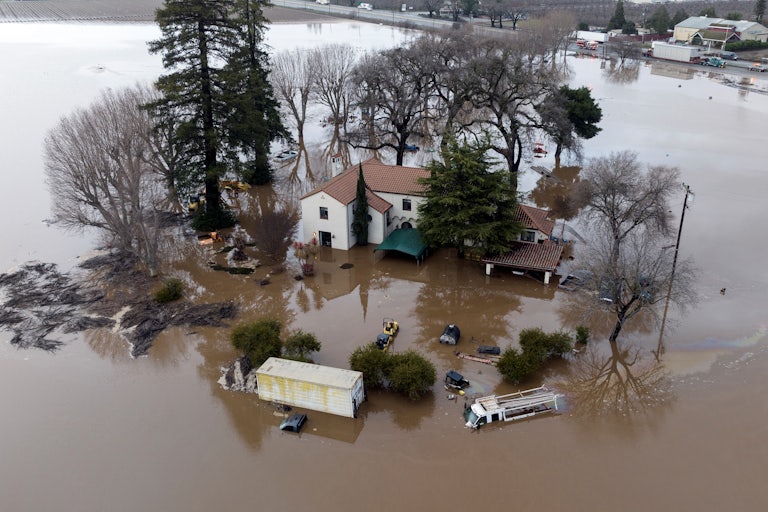
Aerial view of a flooded home partially underwater in Gilroy, California, on January 9

If you’ve visited the home page of a major newspaper in the past week, you’ve probably noticed that the intensity of coverage of British royal family dysfunction is vertiginously approaching that of the war in Ukraine or U.S. congressional mayhem. That’s unsettling enough, but it’s been equally jarring to see the state of California pop up continually in stories about Prince Harry and Meghan Markle—without a mention of the fact that it’s currently a disaster zone.

Montecito, where the couple has made their home, came under mandatory evacuation order on Monday due to the ongoing catastrophic rains hitting the state. Harry and Meghan’s representatives did not respond to the Los Angeles Timesrequest for comment as to whether they had complied with the order—a missed opportunity for the couple, arguably, given that climate change is something of a signature issue for them.

Montecito’s disproportionately wealthy residents have had it relatively easy, despite the mudslide warning that went out Monday. Seventeen deaths have been reported across California in the recent rains. Huge portions of Northern California are under flood watch, while hundreds of thousands have experienced power outages and over 135,000 remained without power as of Wednesday morning. A sinkhole opened up under two cars in Los Angeles on Monday, while a 5-year-old child was swept away in floodwaters in San Miguel. The unusual rainfall could continue for the next week, making landslides even more likely.

These kinds of wild weather swings are becoming more frequent as climate change accelerates. Atmospheric rivers (the term for this kind of massive rain band) “are becoming more intense with climate change because they’re holding more moisture,” extreme weather expert Katerina Gonzales told Scientific American this week. And they won’t necessarily reverse the state’s drought problem, she added, given that groundwater takes a long time to be refilled. “We can’t rely on atmospheric rivers to save us. California has wet and dry extremes—that’s our current reality and our future.”

This pattern of fires then floods is basically the worst-case scenario in terms of mudslide conditions, and it’s a scenario a study last April warned of explicitly. Experts are now predicting the California floods could cost several billion dollars once concluded—part of a new trend of billion-dollar disasters striking not an average of three times a year, like in the 1980s, but perhaps over 20 times a year, as happened in 2020.

None of what’s currently happening in California, it’s worth mentioning, begins to approach the scale of the devastation of the floods in Pakistan this summer and early fall. But with news breaking Tuesday that U.S. greenhouse gas emissions rose 1.3 percent in 2022 despite growth in renewable energy, it’s a devastating reminder that we still aren’t doing anywhere near enough.

Good News

The Environmental Protection Agency is moving to tighten regulations on fine-particulate air pollution—a move projected to save tens of thousands of lives a year. (All the usual suspects, Kate Aronoff notes, are lining up to protest this life-saving measure.)

Bad News

The Intercept obtained and published footage this week of the crash caused by a Tesla Model S allegedly under control of the “Full Self-Driving Feature” on the San Francisco Bay Bridge on Thanksgiving Day. The car changes lanes and then abruptly brakes for no apparent reason, causing a multivehicle pileup. It’s pretty nightmarish viewing and doesn’t exactly inspire confidence in Tesla’s recent efforts to stay ahead in an increasingly competitive electric vehicle market.

Stat of the Week

That’s how much extreme weather cost the United States in 2022.

Elsewhere in the Ecosystem

The New Soldiers in Propane’s Fight Against Climate Action: Television Stars

As the U.S. wakes up to the dangers, both climate-wise and health-wise, of using natural gas and propane in home heating and cooking, the industry is fighting back, paying influencers to talk about how propane is beautiful while electric appliances and vehicles suck. The Times’ Hiroko Tabuchi has the goods:

The Propane Education and Research Council, or PERC, which is funded by propane providers across the country, has spent millions of dollars on “provocative anti-electrification messaging” for TV, print and social media, using influencers like Mr. Blashaw, according to the group’s internal documents viewed by The New York Times.

As a federally sanctioned trade association, PERC is allowed to collect fees on propane sales, which helps fund its marketing campaigns. But according to the law that created this system, that money is supposed to be used for things like research and safety.

Read Hiroko Tabuchi’s piece at The New York Times.

This article first appeared in Apocalypse Soon, a weekly TNR newsletter authored by deputy editor Heather Souvaine Horn. Sign up here.