Life in a Warming World
A weekly reckoning with our heated planet—and the fight to save it

How to Make Your Daily Media Consumption Less Depressing

A guide to postelection “takes” for climate-concerned readers

A newsstand displays headlines from The Sun, The Mirror, Daily Star, The Times, and more reporting Trump's election victory.
Anna Barclay/Getty Images
U.K. newspapers display stories on the reelection of former U.S. President Donald Trump.

Climate-concerned readers and voters are in a tough spot. They don’t have the postelection coping options—escapism, despair, biding one’s time till the next election—open to some other people. The Biden administration’s climate policies, however historic, weren’t enough to cut emissions to the point that researchers say is needed by 2030, and analysis from U.K.-based climate news site Carbon Brief suggests the Trump administration could now add an extra four billion metric tons of carbon dioxide.

Simply accepting this and waiting for the next election isn’t really an option—either for the climate-concerned or for the many other groups whose immediate safety and well-being are in jeopardy.
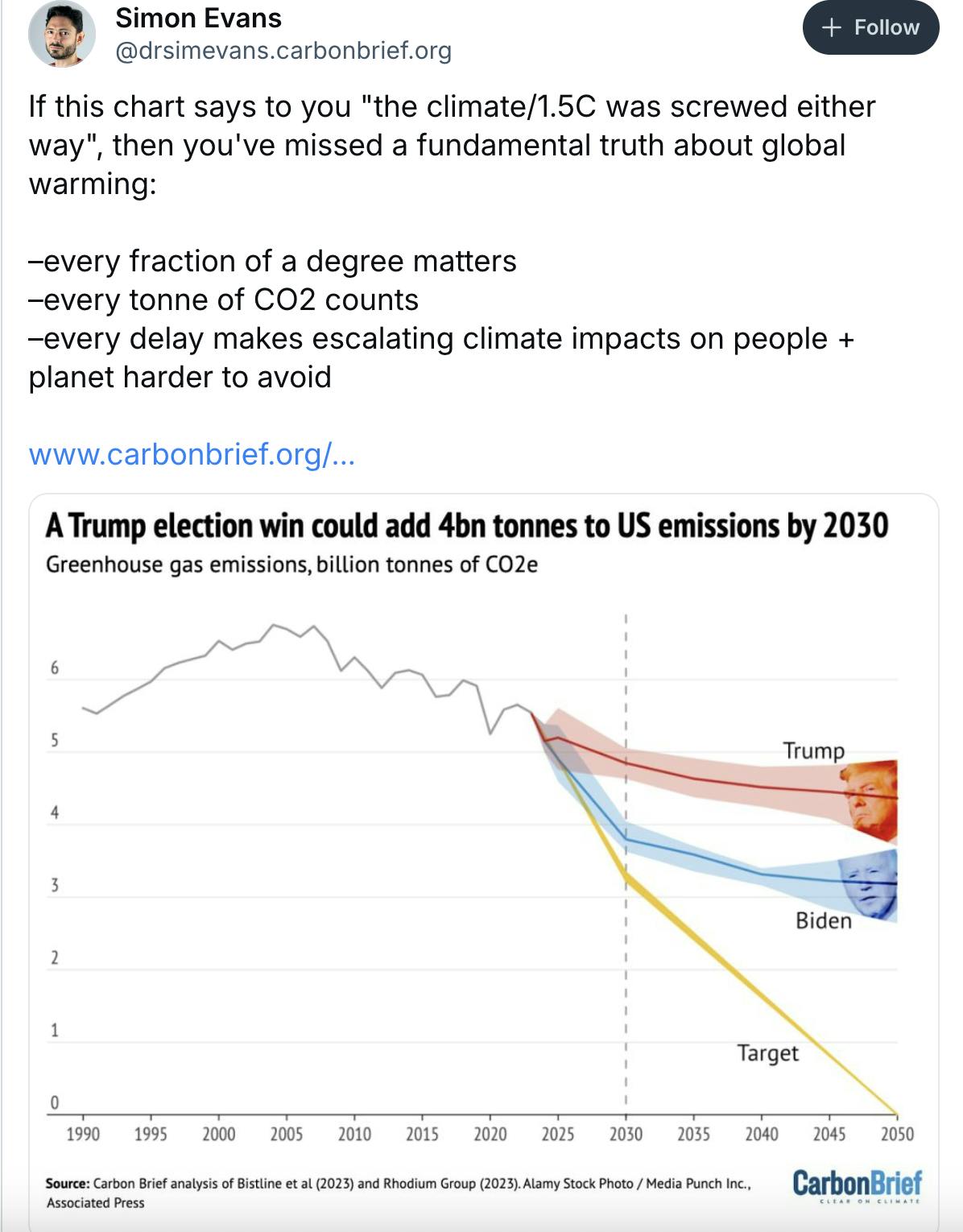
This image shows a Bluesky post from Simon Evans, reading: "If this chart says to you "the climate/1.5C was screwed either way", then you've missed a fundamental truth about global warming: –every fraction of a degree matters –every tonne of CO2 counts –every delay makes escalating climate impacts on people + planet harder to avoid." The post includes a chart showing projected emissions under Trump (high), projected emissions with Biden administration policies (somewhat less high), and the target emissions reductions for preventing catastrophic levels of warming (considerably below both of these trend lines).

If this realization feels crushing, it also comes with some advantages. Specifically, it offers a useful tool for sifting through the deluge of postelection “takes” and distinguishing what is helpful from what is unhelpful: If we are truly in an all-hands-on-deck moment (I think that we are), and if, as numerous experts have emphasized, every fraction of a degree of warming matters, then postelection analyses and prescriptions that don’t offer some discernible and actionable kernel of wisdom, lighting (however dimly) one plausible path forward, are pointless, and can be discarded without further ado.

Despair, for example—as numerous climate writers have pointed out over the past few years—just isn’t helpful. I no longer feel guilty just closing the window in which I’m reading a “take” of this variety, even if it’s artful, even if I otherwise enjoy this writer’s work, and moving onto something else.

Postmortems suggesting Democrats tack even further rightward—similarly, I don’t even bother hate-reading them unless I have to for work. As TNR’s Kate Aronoff observed this week, these analyses blaming “interest groups” for dragging Dems left are singularly unpersuasive for 2024, given that Harris ran on a platform that was nearly indistinguishable from that of some 1990s Republicans. And these analyses are particularly absurd from a climate perspective: If the message is that climate groups should sit down and shut up, then where does that leave any of us? On a rapidly heating planet in which even the insufficient Inflation Reduction Act—a product, in no small part, of ceaseless and effective climate advocacy—was never passed?

Identifying effective responses to an election that empowered a corrupt, coup-backing rapist to enact mass deportations that would destroy countless lives and kneecap the national economy and food supply is not an easy task. I haven’t seen anyone lay out anything like a comprehensive plan as of yet—and like many people, I’ve been looking. But here and there you can already see people compiling useful suggestions; filtering out the not so useful ones is an important part of moving that discourse forward. Likewise, the first step in figuring out what ethical escapism and rest might look like, or building a sustainable form of political engagement for the coming months and years, lies in identifying what can easily be discarded. It’s a kind of Modified KonMari rule for political discourse: Ask yourself, “Does this ‘take’ offer any discernible theory of change?” If not, let go of it with gratitude or a murmured expletive, according to your preference. Embrace the upside of urgency. That’s all I’ve got by way of advice for now.

Good News/Bad News

The state of Maryland cut its per-capita carbon emissions by 42 percent, according to a new report—way ahead of the national average.

Some of the nonprofit organizations that mounted successful legal challenges to the first Trump administration’s environmentally rapacious policies say they are struggling with fundraising.

Stat of the Week
40%

That’s how many of the 204 agricultural lobbyists at COP29 in Baku, Azerbaijan, this year, attended as part of official country delegations, “which lent them privileged access to diplomatic negotiations,” reports Rachel Sherrington in a joint analysis by DeSmog and The Guardian.

What I’m Reading

The Fossil Fuel Industry Continues to Exert Undue Influence Over COP29, Activists Say

A U.N. climate change conference held in the petro-state of Azerbaijan days after the United States elected a president fully in the pocket of the oil and gas industry was never going to be a cheery affair. And indeed, there’s more grim news: One estimate now suggests at least 1,773 fossil fuel lobbyists have attended the U.N. climate conference known as COP29. There isn’t a good reason why this pattern is allowed to persist, reports Bob Berwyn:

Most other major international negotiations at the United Nations have conflict-of-interest policies. For example, tobacco company involvement was strictly limited when the World Health Organization developed its Framework Convention on Tobacco Control, with similar limits on pharmaceutical companies during ongoing discussions about a global pandemic treaty.

But in the case of the climate talks, corporate influence isn’t in keeping with those guidelines. The UNFCCC took small steps to increase transparency on who is attending the annual climate talks by requiring disclosures of affiliation during registration, but that does not eliminate conflicts of interest, said [Rachitaa Gupta with the Global Campaign to Demand Climate Justice].

Civil society groups have been pushing the UNFCCC Secretariat for years during regularly scheduled meetings to adopt clear conflict-of-interest rules for the climate talks, but she said the response has always been that it’s something that has to come from the member countries.

Read Bob Berwyn’s full report at Inside Climate News.

This article first appeared in Life in a Warming World, a weekly TNR newsletter authored by deputy editor Heather Souvaine Horn. Sign up here.
How Much Damage Can Lee Zeldin Do at the EPA?

Zeldin is a Trump loyalist, and Trump has already promised to gut any regulations that the oil industry doesn't like.

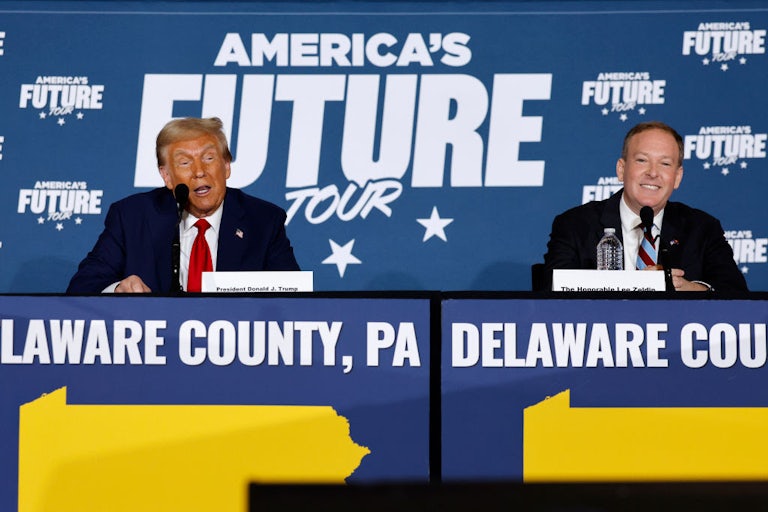
Trump and Zeldin sit in front of a banner reading "America's Future Tour."
Chip Somodevilla/Getty Images
President-elect Donald Trump with former Republican New York Representative Lee Zeldin

Donald Trump has named his pick to run the Environmental Protection Agency: Lee Zeldin, who was the U.S. representative for New York’s 1st congressional district from 2015 to 2023. What does that tell us about what lies ahead? The first thing to know is that Zeldin is about as natural a pick for EPA head as Martha Stewart would be for machinist’s mate on a nuclear submarine.

When Zeldin ran against Kathy Hochul for New York governor in 2022, he campaigned primarily on law and order, along with tax and regulation slashing, “ending all Covid-19 mandates,” and parents’ rights. He also has a long record opposing gay marriage and abortion. His environmental bona fides are mostly limited to having held an annual “Teach a Kid to Fish” day as a state senator and having been a member of minor congressional caucuses such as the Climate Solutions Caucus, the Congressional Estuary Caucus, and the somewhat questionable enterprise known as the Conservative Climate Caucus.

According to one Long Island politics expert I spoke to, Zeldin probably joined these caucuses just to appear responsive to voter concerns, given that Long Island Sound pollution is a big issue in Zeldin’s former district. The memberships did not translate to pro-environmental votes: The League of Conservation Voters gives Zeldin a lifetime score of 14 percent.*

Zeldin is getting this job not because he’s interested in or qualified on environmental issues but because he’s a loyalist: He was one of Trump’s staunchest defenders in the first impeachment probe and one of four New York representatives to vote against certifying the 2020 election. At the Republican National Convention this summer, Zeldin sat in Trump’s own VIP box alongside members of Trump’s family and other cronies, only two seats away from the candidate.

“We will restore US energy dominance, revitalize our auto industry to bring back American jobs, and make the US the global leader of AI,” Zeldin promised on Monday—as if he’d been named energy or commerce secretary instead of EPA administrator. “We will do so while protecting access to clean air and water,” he added.

Unsurprisingly, environmental groups’ reactions to the pick have ranged from skeptical to outraged. On the one hand, it would be hard for Trump to do worse than his first EPA pick, Scott Pruitt, who was hired based on his experience relentlessly suing the EPA as Oklahoma’s attorney general. Pruitt resigned in 2018 amid an avalanche of ethics scandals that overshadowed even his abysmal policy proposals—like blocking the EPA from using public health research to show that pollution hurts people, repealing the Clean Power Plan, loosening fuel emissions standards, and much more. And Andrew Wheeler, who took over after Pruitt’s departure, was a former coal lobbyist.

On the other hand, the installation of a diehard Trump loyalist with little apparent agenda of his own suggests that the EPA is about to do precisely what Trump and his allies have been unusually explicit this time in promising it will do: please oil executives and, in former Interior Secretary David Bernhardt’s words, “rescind every one of Joe Biden’s industry-killing, job-killing, pro-China and anti-American electricity regulations.” (Biden was distinctly anti-China, and the oil industry kind of liked him—to climate activists’ chagrin—but whatever.) That’s in addition to likely decimating EPA staff, which the Biden administration had worked hard to rebuild after the last exodus.

Trump infamously promised oil executives last spring to reverse Biden-era environmental regulations in exchange for $1 billion in campaign contributions. Unsurprisingly, the oil and gas industry has compiled a wish list of regulations it wants axed. The American Exploration and Production Council, or AXPC, composed of oil and gas companies, is eager to repeal “more than a half-dozen executive orders that lie at the center of the Biden administration’s efforts to combat climate change,” The Washington Post reported last month, based on leaked documents. It is apparently fixated on getting rid of a new fee on excess methane released as a by-product of oil and gas production via flaring or leaks—a rule beloved by environmentalists because it reduces emissions of a particularly powerful greenhouse gas without actually requiring people to give up something meaningful. Meanwhile, the American Fuel and Petrochemical Manufacturers, environmental advocates told me, seem to be focusing on the EPA’s car emissions standards.

Zeldin will have the power to act on both of those—and many more. The vehicle standards could take some time, said Carrie Jenks, executive director of Harvard’s Environmental and Energy Law Program. That’s because that rule has already been finalized. “To roll back a final rule,” Jenks explained to me via email, “the Administrative Procedure Act requires an agency to propose a new rule, take public comment, and then finalize that new rule. The agency will have to explain what has changed and why, and the process of proposal, comment, and final rule takes agency resources and time.” That could take two to three years, she said, “and then any litigation starts once the rule is final.”

If the Trump administration haphazardly tries to rush the process, as it did during Trump’s first term, that might help environmental groups’ lawsuits to stop the new rules. The Natural Resources Defense Council has already pledged its readiness to challenge the Trump administration in court. During Trump’s last presidency, chief litigation officer Michael Wall said in a statement last week, “on average, we sued once every ten days for four years, and we won victories in nearly 90% of the resolved cases.”

The methane rule, formally known as the “waste emissions charge,” or WEC, could be reversed more quickly. Because it was only finalized on Tuesday, it’s vulnerable to the Congressional Review Act, which can be used to scrap a rule “finalized within 60 legislative days of the new administration taking office” via a simple congressional majority, Jenks explained. “We saw that used by the Trump administration last time as well as the Biden administration, and I would expect the Trump administration to consider where it can be used again.” Because the methane rule was mandated by the Inflation Reduction Act, “the EPA will continue to have the obligation to implement the WEC (through a different rule) until Congress repeals or alters the methane provisions of the IRA,” Jenks added. But “there are examples of where an agency fails to implement a rule, so that could also be a possible outcome.”

Then there are the rules that have been proposed but not yet finalized. Right now, several important ones fall into that category: proposed rules to limit industries’ ability to pollute the environment with harmful chemicals known as PFAS, for example. Proposed rules can be abandoned immediately. And a new rule for limiting greenhouse gas emissions from existing gas-fired plants, which was postponed while the administration finalized rules for existing coal-fired plants and new gas-fired plants, has not even been formally proposed yet. So that plan could be easily discarded, which is not ideal, given that gas-fired plants generate more electricity than any other type of plant in this country.

It would be a bit ironic if Zeldin were to scrap the PFAS rules—either the proposed ones or the one finalized this spring to reduce PFAS in drinking water. PFAS regulation is one of the very few environmental issues Zeldin repeatedly voted in favor of during his time in Congress: Twice he voted for a bill to require the EPA to set new drinking water standards and limit industrial PFAS discharge; he also voted for an amendment to the National Defense Authorization Act to set new standards for PFAS cleanups by the Department of Defense. But he also hasn’t been entirely consistent on this front, and at the end of the day, the point of appointing a loyalist is that they do what you tell them to. If Trump says to let industrial donors fill the nation’s waters with PFAS, it’s a good bet that Zeldin will do just that.

* This piece originally misstated Zeldin’s position on several congressional votes.

Good News/Bad News


The emerging consensus seems to be that Trump and a Republican Congress probably won’t repeal the Inflation Reduction Act (with its many clean energy incentives) in its entirety, because a lot of the money is going to red states. In other marginal good news, a billionaire’s effort to get rid of Washington state’s landmark climate law was roundly rejected at the ballot box, other states are gearing up to continue climate progress without the federal government, and the U.S. Air Force is walking back its initial claim that it doesn’t have to do anything to clean up the massive PFAS mess it created in Tucson, Arizona.


A different Washington ballot initiative, which aims to make it illegal for any municipality or the state itself ever to do anything that could be seen as discouraging gas energy or gas hookups in new buildings, looks like it’s going to pass. TNR’s Kate Aronoff wrote about the very weird background to that battle here.

Stat of the Week:
30 million tons

That’s how much ice the Greenland Ice Sheet is currently losing per hour, according to a new report.

What I’m Reading:

At Cop29, the Sun Sets on U.S. Leadership

This year’s international climate talks have kicked off amid news both of Donald Trump’s reelection as president of the United States and that 2024 is already a record-hot year for global temperatures. Despair and nihilism won’t help, but neither will sugarcoating the matter. So to that end, here’s Elizabeth Kolbert’s succinct summary:

In his first term, Trump withdrew the U.S. from the Paris Agreement. The day Biden took office, he moved to reënter the agreement. Trump in his second term almost certainly will withdraw from the accord once again. And it’s possible that the new Administration could take the even more radical step of withdrawing from the treaty that underlies the Paris Agreement, the U.N. Framework Convention on Climate Change, which was ratified by the U.S. Senate in 1992. Leaving the U.N.F.C.C.C. would make it virtually impossible for the country to rejoin because the move would require approval by two-thirds of the U.S. Senate.

Just how bad a second Trump Administration will be for domestic climate policy remains, of course, to be seen, but the most likely scenarios are all pretty bleak. During his first term, Trump tried to roll back more than a hundred environmental regulations. And, while the Biden Administration is rushing to try to “Trump-proof” various rules, including a set aimed at limiting oil drilling in the Arctic National Wildlife Refuge, this seems unlikely to deter the incoming President, who, through his own nominees, has produced a U.S. Supreme Court deeply sympathetic to his agenda. According to a recent analysis by the British-based Web site Carbon Brief, were Trump to roll back the Biden Administration’s key climate initiatives, the U.S. could emit an extra four billion tons of CO2 by 2030. This, the analysis noted, “would negate—twice over—all of the savings from deploying wind, solar and other clean technologies around the world over the past five years.”

Read Elizabeth Kolbert’s full piece at The New Yorker.

This article first appeared in Life in a Warming World, a weekly TNR newsletter authored by deputy editor Heather Souvaine Horn. Sign up here.
The Right Way to Deal With Election Stress

Everyone's got a suggestion for how to de-stress. Alternatively, you could stress. This is stressful!

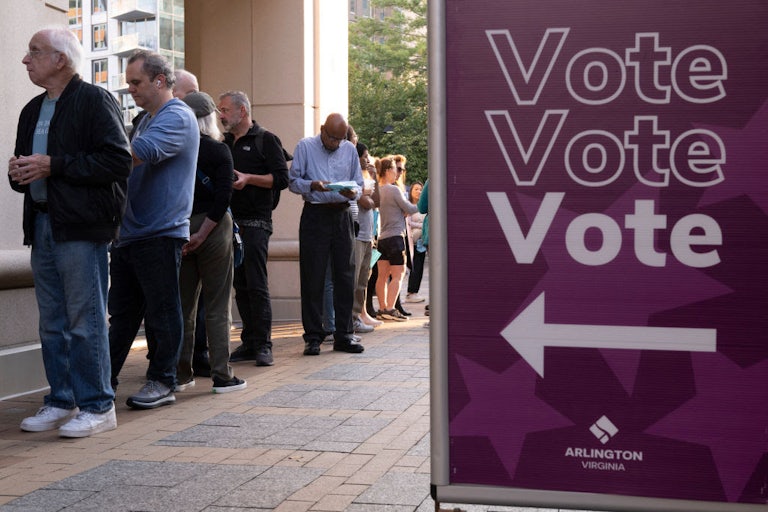
People stand next to a sign reading "Vote Vote Vote."
AFP/Getty Images
Voters line up for early voting in Arlington, Virginia, on September 20.

We’re in the breathless final stretch of this election—when new poll analyses drop seemingly every five minutes, “closing arguments” that contain no new information receive detailed reviews, homepages transform into liveblogs, opinion pages swing wildly between imagining different scenarios, and almost none of it is useful because there simply isn’t much to do other than wait until Election Day. Or rather Election Week: Chances are that we won’t know for days, or even longer, whether the White House will return to a guy who tried to overturn the last presidential election.

In fact, at this stage of the election cycle, The New York Times’ dining section, with its recommendation of what cookies to bake while watching election night coverage, arguably contains more new and useful information than most politics sections: At least you get some tips about baking with brown butter.

But this year, many outlets have added a new genre of article to the mix: how to handle election stress. Experts interviewed by ABC News suggest that people sleep, limit news and social media consumption, and “focus on concrete tasks that they have control over, like helping get people registered to vote or participating in canvassing.” People interviewed by the ABC affiliate in West Palm Beach, Florida, likewise endorse action—and also prayer. Austin news station KXAN suggests people adopt a “day-by-day approach” and use “I” statements when “setting boundaries” with family and friends regarding political discussions. Psychologists in particular had a lot of advice: how to identify the root of your anxiety, “boost optimism up until the last minute,” relax via “deep breathing, progressive muscle relaxation, aerobic exercise, a warm bath, relaxing music, a walk in nature.” An article from the meditation app Headspace, unsurprisingly, suggested meditation. Washington Post columnist Ruth Marcus said that she knits, “compulsively.”

Your mileage with all these suggestions may vary. Personally, I found even collecting them to be overwhelming. (And that’s not ideal, given that my boss wrote Monday that we have a moral duty not to panic.)

Recently, I’ve been thinking a lot about a pair of essays Mary Annaïse Heglar wrote for TNR four years ago: the first about how mourning climate change prepared her to weather the Covid-19 pandemic, and the second about how being both a “climate person” and “a Black climate person” affected her perspective on the 2020 presidential election. Mary is emphatically not a “doomer”—i.e., someone who sees all the bad news and figures it’s time to give up. But in these essays, she emphasized the importance of fully acknowledging the weight of the moment, rather than trying to ignore it. “This is painful,” she wrote in March 2020 about Covid and the climate crisis. “It’s supposed to be. We are suffering through a collective trauma. We’re watching our world change, and it feels like it’s falling apart. That’s not supposed to feel OK: It’s not OK. As hard as it is, as painful as it is, we have to accept the reality of our crisis. Denial, often a critical step in the grieving process, is not an option.”

Her assessment of the 2020 election was similarly unflinching. Being a climate writer means understanding just how high the stakes are, and that there’s no such thing as putting the crisis on “pause” for four years. Instead, as writer and activist Bill McKibben has repeatedly observed, in his newsletter The Crucial Years, these next years are more vital than ever—and merely failing to act during this time will put us on a very dangerous path.

“This election,” as Mary put it, “is less about whether we should act on climate than how we should act on it. Should we act with compassion or with cruelty? Given that our national commitment to democracy has become debatable, this election is also about whether we even have the ability to act on climate in any meaningful way in the future.” Against all that, her message was simple: “This past weekend, on the first day of early voting in New York City, I stood in line for more than five hours to vote like my life depended on it. Because it does.”

That’s not a warm bath. On the other hand, it is an “I” statement, and I’d argue it does engage with the “root” of election anxiety. It’s also a kind of optimism. As Mary put it, “I’ll take a shot in hell over a shot to the head any day.”

It’s a line worth meditating on.

Good News/Bad News

The Washington Post reports that while climate change may be killing people all over the globe, it’s also allowing British vineyards to produce quality bubbly. I can’t quite bring myself to endorse that grisly juxtaposition as “good news,” though. Instead, here’s a lovely piece from Inside Climate News about how Johns Hopkins researchers and communities across Baltimore are working together to figure out how to make Baltimore and other cities more climate resilient—and more equitable.

Greenhouse gas concentrations in the atmosphere reached record levels last year, according to a new report from the U.N.’s World Meteorological Organization.

Stat of the Week
$3 billion

That’s how much money the Biden administration is disbursing in Inflation Reduction Act–funded grants to green the country’s ports, following an announcement this week.

What I’m Reading

Authoritarianism is on the rise. Is climate change to blame?

“Researchers have long noticed that natural disasters like floods, droughts, and wildfires can help autocratic politicians consolidate power,” writes L.V. Anderson in an unnervingly timely article at Grist. But recent research has helped to narrow down what, exactly, is happening and how people disinclined to give up on democracy can push back:

Until fairly recently, researchers looking at the ties between climate disasters and authoritarianism only had case studies, like Duterte and Trujillo.… But in 2022, economists in the United Kingdom and Australia devised a clever study seeking to prove that storms like hurricanes actually cause a slide toward authoritarianism.… A causal relationship between climate change and authoritarian attitudes has also been demonstrated on a much smaller scale in psychology studies. In 2012, a team of psychologists divided cohorts of German and British university students into two groups and told them they were helping to develop a knowledge test. They informed half of the volunteers about some of the threats associated with climate change—findings about how hazardous heat, wildfires, and glacier loss are projected to worsen in the future. The other half learned “neutral facts” about their respective countries’ weather, forests, and economies, with no mention of climate change. The volunteers who had been told about the perils of climate change expressed more negative opinions of dangerous or marginalized groups—like terrorists, drug addicts, or attack-dog breeders—on a 10-point scale measuring their attitudes toward various demographics.

Read L.V. Anderson’s full report at Grist.

This article first appeared in Life in a Warming World, a weekly TNR newsletter authored by deputy editor Heather Souvaine Horn. Sign up here.

The Dirty Secret to a Sustainable Halloween

Finding good, cheap low-waste candy is hard. U.N. negotiations taking place next month could make it easier.

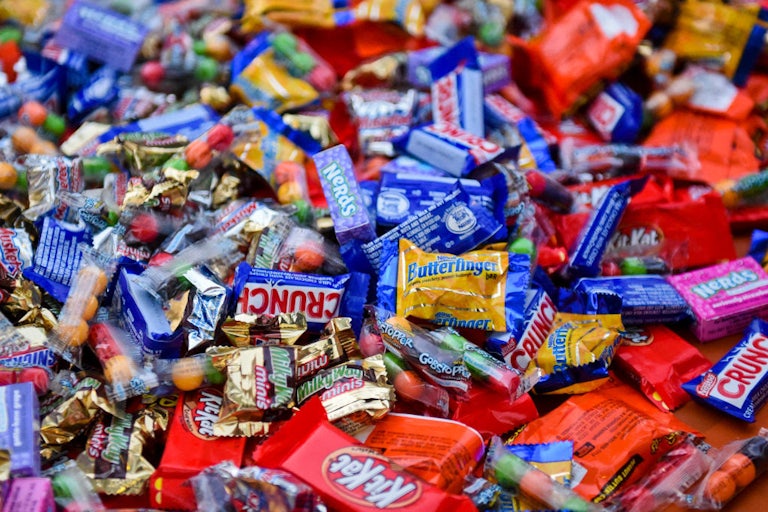
This image shows lots of different pieces of candy.
MediaNews Group/Reading Eagle/Getty Images

I’m not sure what I expected when I typed “low-waste Halloween candy” into a search box a few days ago. I know that trying to celebrate a holiday sustainably can get overwhelming—I’ve written before about the proliferation of bonkers advice when it comes to sustainable Christmas trees. But hey, I like Halloween, I’m told my new neighborhood gets a lot of trick-or-treaters, and if I’m going to bulk-order candy I’d rather it not be packaged in layers of petroleum products.

Alas, I learned that this is much easier said than done.

Let’s review some of the top options: First, I came across blog posts suggesting mini-boxes of Junior Mints or Milk Duds or Nerds, which are some of the few candies available in cardboard packaging. I was intrigued until I realized how hard it was to find a one-stop place for these brands. Some stores were sold out, some didn’t carry them at all, some only carried them in strangely high or low quantities, or their prices were ridiculous, and some online retailers couldn’t ship in time. Also, no one in my household or friend circle really likes these candies (the responses in the group chat, when I checked, were vicious), so I’ve no idea what we’d do if the number of trick-or-treaters was lower than anticipated and I suddenly found myself with 60 Nerds boxes to dispose of. Food waste isn’t sustainable, either.

Then there are the eco-friendly brand suggestions: various fair-trade chocolates in paper or foil wrappers; gummies and lollipops in plastic wrappers that made it into sustainable recommendations lists because they’re organic. I did, in the end, buy some of the more cost-effective of the chocolates, since they had good packaging and I’m pretty confident that the excess will be consumed. Many of these options, though, are quite pricey—particularly when compared to getting a plain-old variety bag at CVS or Walmart. If you’re talking about a high-traffic trick-or-treating neighborhood, stocking up solely on fair-trade paper-wrapped chocolates could easily cost you $150 or more.

Then there’s the ubiquitous suggestion to buy from one of those bins at a bulk store “and then portion out sweets like gummy bears or candy corn into paper or cloth bags,” as phrased by The New York Times in its climate advice column on Monday. This is a lot of work, and if we’re talking about candy that’s completely bare, then putting waxed paper around it at home seems unlikely to reassure parents raised on urban myths about contaminated or poisoned treats. Bulk bins of foil-wrapped candy might be another story. But I’ve also no idea where to find these, let alone cheaply; the only store I can instantly name that had a bunch of these bins lies in my hometown, 400 miles away, and it closed nine years ago.

The point isn’t that finding low- or no-waste candy to hand out is impossible. The problem is that it’s hard: It’s likely to be expensive or time-consuming or both.

What makes this situation especially maddening is that there are ways to make this easier for consumers. It shouldn’t be this hard to avoid an explosion of plastic every October. The real answer to the question of how to have a greener Halloween (and everyday life in general) lies not in specialty chocolate but in a wonky meeting being held next month that many of the people searching for sustainable candy recs probably haven’t heard about: the fifth meeting of the UN’s Intergovernmental Negotiating Committee tasked with drafting “an internationally legally binding instrument on plastic pollution.”

Taking place in Busan, Republic of Korea, this meeting is supposed to be the last negotiation session before the treaty is signed early next year. That timeline may wind up being revised. “We are not where we would have liked to be in the process,” Rachel Radvany, an environmental health campaigner with the Center for International Environmental Law, told me. “We haven’t honestly gotten into a true negotiation,” she said, “except on a few of the more specific provisions.”

The fundamental problem is that a lot of states with significant oil wealth don’t want a treaty that reduces plastics production. Instead, they’d prefer to focus on recycling—which, as numerous TNR writers have noted, has never been a serious solution, as it’s not feasible for many types of plastic, releases more microplastics and toxic chemicals in the process, and doesn’t reduce the overall quantity of plastic. Leaked documents have recently shown that the petrochemical industry deliberately spread the false idea that most plastics would be recycled in order to keep producing plastic.

There are lots of policies, however, that governments could enact to reduce our overall reliance on plastic. It’s not just about bans on plastic bags or water bottles—many countries have banned single-use plastics, “and we’re still seeing the problem getting worse,” Radvany said. “You have to have policies that prioritize reuse systems and reuse services and give funding for that to build that out.” Ideally, reusable materials should be nonplastic ones to begin with, she added, given that even reusable plastics contain a lot of toxic chemicals. Policymakers could also ban those chemicals. Figuring out which ones to ban “could be assessed by a scientific body within the treaty to determine if they’re carcinogenic or things like that. And then those chemicals would be phased out.” Alternatives to plastics already exist, and more could be developed at scale if the treaty were to include funding for that.

Getting any of these policies enacted would be hard. But it’s also arguably easier than asking millions of consumers to de-plastic their lives in a global economy that’s suffused with plastic. “Once it’s produced in the market, you as a consumer can’t control what you’re being exposed to,” Radvany said. “They’re finding microplastics in everything, every part of our bodies,” and researchers are only beginning to understand how this is affecting human health.

“You can put in a lot of effort to have a green Halloween, to buy less plastics, to feed your kids food that’s not packaged in plastic, but there’s only so much you as a consumer can do,” she said. “It’s exhausting and impossible to stop exposing yourself to these things.”

Think she’s exaggerating? Go ahead, run around town trying to get a decent deal on hundreds of pieces of candy in sustainable packaging. Then do it for the costumes and decorations. Did I mention that Christmas is right around the corner?

Good News/Bad News


Researchers are studying ancient Roman concrete for clues about how to make modern concrete manufacturing—a massive greenhouse gas emitter—more sustainable, The New York Times’ Amos Zeeberg reports.


Heat pumps were supposed to be the easy switch, the win-win proposition that saved people money and cut emissions without too much massive infrastructure investment needed. But “heat pump investment in the United States has dropped by 4 percent in the past two years, even as sales of EVs have almost doubled,” The Washington Post

reports. The experts the Post interviews seem divided: This trend could be because of inflation and interest rates, but it could also be because contractors lack training and there’s a lot of misinformation circulating.

Stat of the Week
2 weeks

That’s how long it took after a widely publicized “radical” nonviolent environmental protest for surveys to show an increase in support for more moderate environmental groups, in a recent study. Instead of turning people off environmentalism, the researchers suggest, so-called radicals (and their disruptive but nonviolent protests) might play a role “in driving change.”

What I’m Reading

One issue will decide Arizona’s future. Nobody’s campaigning on it.

Amid the deluge of political ads in the swing state of Arizona right now, reporter Jake Bittle notices one thing missing: the Western water crisis that’s getting worse and worse, while negotiations over how to manage it sputter and stall.

Arizona voters know that they’re deciding the country’s future—the state is one of just a half-dozen likely to determine the next president—but it’s unclear if they know that they’re voting on an existential threat in their own backyards.… During a week reporting in the state, I saw exactly one ad that focused on the issue. It was a billboard in Tucson announcing that Kirsten Engel, the Democratic candidate for a pivotal congressional seat, supports “Protecting Arizona from Drought”—not exactly the most substantive engagement with the issue.

The reason for this avoidance is simple, according to Nick Ponder, a vice president of government affairs at HighGround, a leading Arizona political strategy firm. He said that while many voters in the state rank water among their top three or four issues, most don’t have a detailed understanding of water policy—meaning it’s unlikely that they’ll vote based on how candidates say they’ll handle water issues.

Read Jake Bittle’s full report at Grist.

This article first appeared in Life in a Warming World, a weekly TNR newsletter authored by deputy editor Heather Souvaine Horn. Sign up here.

How Trump Could Sabotage America’s Food Supply

From deporting agricultural workers to cutting back SNAP and free school meals, the policies Trump or his advisers have espoused could wreak havoc on households’ food budgets.

A stack of tomatoes sits next to a stack of avocados
Roberto Machado Noa/Getty Images

Mass deportations, using a 151-year-old law as a national abortion ban, privatizing the National Weather Service, sending the military after the “radical left”: These are some of the policies, proposed by Trump or his supporters, that have made headlines in recent months. But in the past week, reporters have increasingly been looking into the ways that Trump-proposed policies could have far-reaching effects on another big part of the country: its food supply.

Trump’s anti-immigration policy is the most obvious example. “The role of immigrants in the American food system is difficult to overstate,” Frida Garza and Ayurella Horn-Muller write for Grist and El País. “Every year, hundreds of thousands of people, the vast majority of them coming from Mexico, legally obtain H-2A visas that allow them to enter the U.S. as seasonal agricultural workers and then return home when the harvest is done.” Another estimated 1.7 million undocumented workers are also employed “in some part of the U.S. food supply chain.”

What would happen if all those workers suddenly disappeared? Replacing them, Garza and Horn-Muller report, wouldn’t be easy, since U.S. workers often don’t find these jobs appealing. The shock to the system would likely drive a spike in food prices. And even if mass deportation policies didn’t survive legal challenges, the “chilling effect” of the threat could still disrupt the industry—and harm a lot of people.

Tariffs could also send food prices skyrocketing. While both parties have proposed strikingly high tariffs in recent years, the ones Trump has proposed recently are much broader than the Biden administration’s (already pretty extreme) 100 percent tariff on Chinese electric vehicles. Trump, The Washington Post’s Jeff Stein and David J. Lynch note, has “floated ‘automatic’ tariffs of 10 percent to 20 percent on every U.S. trading partner, 60 percent levies on goods from China, and rates as high as 100, 200 or even 1,000 percent in other circumstances.” Even if these were “only partially implemented,” Stein and Lynch write, “the consequences would be far-reaching: Americans would be hit by higher prices for grocery staples from abroad, such as fruit, vegetables and coffee.” If you’re looking for specifics, the reporters point to one estimate that 90 percent of tomatoes sold in the U.S. are imported.

The policies in Project 2025—a playbook for the next Republican president written by conservative thinkers and former Trump administration officials, which Trump has tried (unsuccessfully) to distance himself from—go further still. It proposes getting rid of dietary guidelines, which “form the basis for all federal food policies, from school meals to SNAP, WIC and other programs,” Cecilia Nowell reports for The Guardian this week. Project 2025 also proposes changes to the Supplemental Nutrition Assistance Program and the additional program for Women, Infants and Children that would likely reduce such assistance, by reinstituting work requirements and restricting eligibility. With regard to WIC, Project 2025 suggests changing the bidding and contracting process for baby formula and having the president “re-evaluate excessive regulation” of baby formula, which Project 2025 blames for formula shortages. (In 2022, contaminated baby formula led to widespread recalls and multiple infant deaths.)

The evidence behind these proposals is weak. Republicans push work requirements in the belief that receiving SNAP benefits reduces the incentive to work, but as University of Washington researcher Pia Chaparro told Civil Eats reporter Grey Moran, “research shows that SNAP participation reduces food insecurity but does not act as a disincentive to work. Moreover, research shows that the work requirements don’t lead to increased employment.”

As for the proposals to change WIC and the state contracts for baby formula, removing the competitive bidding process could easily “result in a funding shortfall, jeopardize access to WIC for millions of parents, infants, and young children, and result in higher formula prices for all consumers,” expert Katie Bergh told Civil Eats.

This isn’t an exhaustive list of all the ways Project 2025 proposals would affect the food system. Nor does it cover all the ways other policies publicly proposed by Trump himself could affect food in this country. (After all, inaction on climate change is already wreaking havoc on agriculture and harvests.) As news outlets continue probing the concrete ramifications of culture-war-inspired policies, however, it’s a useful reminder of a basic truth: Culture-war policies don’t stay in the realm of culture. And they often have ramifications far beyond what might immediately be apparent.

Good News/Bad News

E.V. charging stations are a hard sell because they’re not very profitable. But The Washington Post explores the idea that charging stations could “borrow the business model that has made gas stations ubiquitous: Sell fuel at a loss as a way to get people to buy snacks, drinks and other items.”

Two years after countries agreed to fight biodiversity collapse by protecting 30 percent of the planet for wild ecosystems, The Guardian reports, only 25 countries have actually followed through and submitted their plans, while 170 have missed the deadline. “The world,” reporters Patrick Greenfield and Daisy Dunne write, “has never yet met a single target in the history of UN biodiversity agreements, and there had been a major push to make sure this decade was different.”

Stat of the Week
52%

That’s how many Floridians say they would prefer a political candidate who wants to tackle climate change, according to a new survey. Unsurprisingly, there is a large partisan split.

What I’m Reading

Biobanking Corals: One Woman’s Mission to Save Coral Genetics in Turks and Caicos to Rebuild Reefs of the Future

So many people are hungry for “good news” stories about climate change. But as Teresa Tomassoni’s profile of Turks and Caicos Reef Fund executive director Alizee Zimmerman shows, sometimes the “good news” stories aren’t “good news” in the sense of the environment doing better than expected. Sometimes, they’re about people facing forces they can’t stop, trying to find small ways to preserve future options. Tomassoni writes about the effort to create a “Noah’s ark” for Caribbean corals as mass bleaching events decimate the global coral population:

Scientists first removed corals from the water on a large scale to hold them in captivity for the long-term so they wouldn’t go extinct in 2018, in response to Stony Coral Tissue Loss Disease. The Florida Fish and Wildlife Conservation Commission and NOAA partnered with the Association of Zoos and Aquariums and other facilities to collect and hold some of Florida’s most vulnerable corals on land with the goal of propagating them in the future. It was the largest coral rescue effort in history.

Zimmermann wanted to learn how she could do the same, albeit on a much smaller scale in Turks and Caicos.… The Turks and Caicos government had granted permission for Zimmermann to retrieve corals from the ocean, with the caveat that they should be “corals of opportunity,” she said. Whenever possible, she said, they wanted her to collect corals that likely would have been destroyed if they weren’t rescued from a coastal development project. She knew just the right ones.

A few months earlier, she’d gotten word that an old dock on the eastern end of Providenciales was slated to be ripped up for renovations. She’d heard there were corals growing on its underwater structure and went snorkeling to see for herself.… Zimmermann recruited around 30 volunteers to help her rescue the animals, which would have otherwise been killed during the dock renovations. She divided them into two teams. Half of the people entered the water with snorkel gear and hammers and chisels they used to carefully break off live corals from the dock and place them in shopping baskets they kept underwater. When they were full, the snorkelers brought them to the surface and handed them over to other volunteers on deck who transported them on a boat to an old abandoned conch farm. The group rescued more than 400 corals.

Read Teresa Tomassoni’s full report at Inside Climate News.

This article first appeared in Life in a Warming World, a weekly TNR newsletter authored by deputy editor Heather Souvaine Horn. Sign up here.