Breaking News
Breaking News
from Washington and beyond

Rail Workers in 11 States and D.C. Rally After Forced Labor Deal With No Sick Days

The workers are calling on Biden to take executive action on paid sick leave for the rail industry.

Fatih Aktas/Anadolu Agency via Getty Images
Union activists and workers’ rights groups protest to demand sick pay and union rights for rail workers, at Grand Central Terminal in New York on December 7.

Masses of rail workers across the country are rallying Tuesday in efforts to draw the public attention toward their demands, including giving rail workers paid sick days, after President Joe Biden signed legislation imposing a labor deal on workers.

Rallies are taking place in Colorado, Illinois, Iowa, Massachusetts, Michigan, Minnesota, Nevada, New Mexico, Ohio, Utah, Wyoming, and Washington, D.C.

“We demand that Biden sign an Executive Order that he apparently has the capacity to do and allow for 7 days sick time for RR workers like other Government contractors. Done, end of story,” a spokesperson for the Railroad Workers United labor caucus said in a statement to The New Republic. “Why not? And if he refuses, he owes us an explanation for sure.”

Workers are also asking for two-person crews on all trains and eliminating what’s known as “precision-scheduled railroading.”

Precision-scheduled railroading, or, as workers sometimes dub it, “positive shareholder reaction,” manages freight movement by the individual car level, as opposed to the whole train—ensuring train cars are constantly on the move. In practice, this has cut jobs, consolidated dispatch centers, and made trains less safe, as fewer workers have less time to conduct checks on even more train cars.

The rallies come after 72 members of Congress, led by Senator Bernie Sanders and Representatives Jamaal Bowman, Alexandria Ocasio-Cortez, and Rashida Tlaib, published a letter outlining how Biden could “guarantee rail workers the seven sick days that they desperately need through executive action.”

The letter followed Biden’s decision to impose a labor contract on workers, in an ostensible effort to avoid a national rail strike.

Despite Biden’s cave to railroad companies, these 72 members of Congress are not relenting.

“We are going to continue to fight. We are going to continue to organize. And we’re going to continue to make sure that labor—the workers who create the wealth for these companies—get their fair share of that wealth,” Bowman bellowed at the Washington, D.C., rally.

“We have corporations making record profits,” Bowman continued. “We allow them as many stock buybacks as they want. But we continue to give workers and labor the short end of the stick.… That’s bullshit.”

Three Things to Know About the Inflation Report

Inflation cooled in November, according to a new report released by the Labor Department. Let’s put that in context.

FREDERIC J. BROWN/AFP/Getty Images
People shop for bread at a supermarket in Monterey Park, California, on October 19. In the year through November, grocery prices rose 12 percent, according to data released by the U.S. government.

The consumer price index, or CPI, a key government measure of inflation, indicates that inflation finally seems to be slowing a bit, according to a report released Tuesday by the Bureau of Labor Statistics.

The index measures the monthly change in prices paid by U.S. consumers for specific goods.

Here are three things to know about the inflation report, and what it might mean looking forward.

1. It has some of the the lowest increases in almost a year.

Prices rose 7.1 percent in November compared to a year earlier. This is a big slowdown from October, which saw a 7.7 percent increase compared to the previous year, and the smallest yearlong increase since December 2021.

It may seem counterintuitive to celebrate a 7.1 percent increase, but overall, prices in November rose just 0.1 percent from the previous month.

Removing the price increases for food and energy, which are always volatile, even before the Covid-19 pandemic and the war in Ukraine, prices rose 0.2 percent in November. This is the smallest monthly increase since August 2021.

2. But inflation remains high in key areas.

A big contributing factor in the low price increases was energy. Prices for gasoline, natural gas, and electricity fell 1.6 percent from October.

But prices for food and shelter increased. In fact, they went up the most of any sector. Costs for groceries and eating out went up 0.5 percent, and housing costs rose 0.6 percent.

3. Will it affect the Federal Reserve’s decision on Wednesday?

The Federal Reserve begins its policy-setting meeting Tuesday and is expected to announce a 0.5 percent increase in interest rates. The new CPI report is unlikely to affect that decision any further, according to Dean Baker, the senior economist at the Center for Economic Policy and Research.

“The Fed is always worried about pulling surprises,” he explained.

The U.S. central bank is scrambling to achieve a so-called soft landing, or a decrease in inflation without tipping the economy into a recession. The labor market has remained strong overall, causing concerns that the economy has not slowed sufficiently to avoid a downturn. But Baker says a soft landing is “definitely” still possible.

“It is now indisputable that inflation has slowed sharply, without a big rise in unemployment,” he said. “It is not clear yet that it is at a rate that the Fed considers acceptable, but the rate clearly is much lower than it was earlier in 2022.”

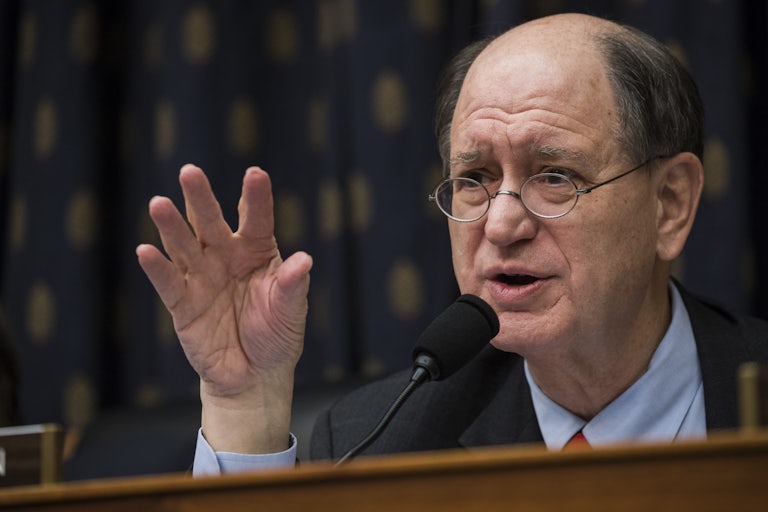
Brad Sherman Tears Into FTX, Calls Cryptocurrency a “Garden of Snakes”

Representative Sherman said the problem isn’t just FTX and Sam Bankman-Fried. The problem is all of crypto.

Samuel Corum/Anadolu Agency/Getty Images
Representative Brad Sherman

During the long-awaited congressional hearings on FTX’s collapse on Tuesday, Democratic Representative Brad Sherman wasted no time making his stance clear on the crypto industry, nor on Sam Bankman-Fried’s role within it.

“My fear is that we will view Sam Bankman-Fried as just one big snake in a crypto Garden of Eden. The fact is, crypto is a garden of snakes,” said Sherman, the only House member to receive an “F” from crypto advocacy group Crypto Action Network.

“Is there a big advantage that crypto has over the U.S. dollar if it actually became a currency, which it’s not yet?” Sherman posed. “Well, there are drug dealers, human traffickers, sanctions evaders who will find that to be a good feature. And as Sam Bankman-Fried would tell you, there’s a hell of a market for bankruptcy court evasion. But the big market is tax evasion. And I know there are some on the other side who cheer every time a billionaire escapes taxes.”

Moving from broader critiques of the industry, Sherman then focused on Bankman-Fried. “Now, Sam Bankman-Fried, or should I say inmate 14372, had one purpose in all of his efforts here in Congress … to keep the SEC out of crypto. To provide a patina of regulation, baby regulation, from the CFTC,” Sherman continued, before addressing his colleagues.

“I have one comment for my colleagues: Don’t trash Sam Bankman-Fried and then pass his bill,” he added, referring to bipartisan-backed legislation pushing for the Commodity Futures Trading Commission to become the primary regulator overseeing crypto, rather than the Securities Exchange Commission. The former would oversee crypto with less scrutiny than the latter.

“I fear that could happen, because Sam was not the only crypto bro with PACs and lobbyists—and there is no PAC or lobbyist here to work for efficient tax enforcement, or sanctions enforcement.”

Sherman closed with a focus on Republicans, citing a letter signed by 19 Republican members that was “attacking the SEC for paying attention to, and I quote, the purported risks of digital assets,” and comments from eight members “that were designed to attack the SEC as being a Luddite and anti innovation for their efforts.”

While Republicans—and some Democrats—will assert that Bankman-Fried and company were simply bad apples, Sherman continues earning his F from crypto advocacy groups, bashing all who try to defend it and its proven potential for massive fraud.

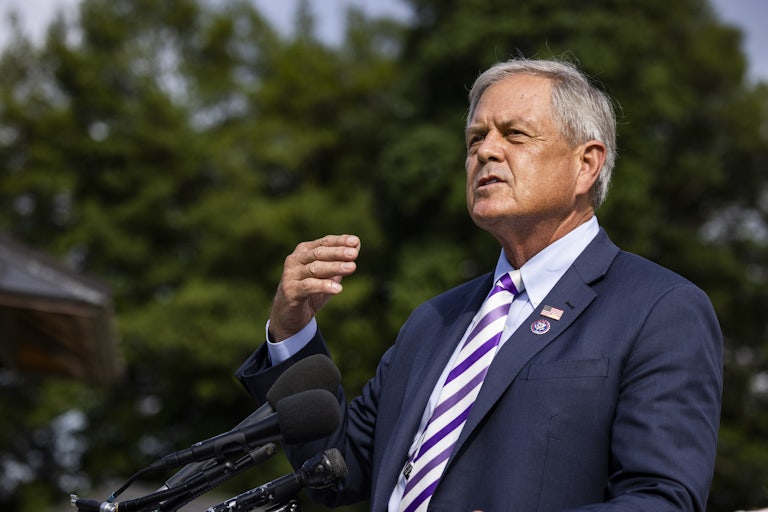
Who Is Ralph Norman? More on the Congressman Who Wanted Trump to Invoke “Marshall Law”

After Donald Trump lost the 2020 election, the South Carolina representative texted then–White House chief of staff Mark Meadows about efforts to overturn the results.

Brian Babin
Samuel Corum/Bloomberg/Getty Images

On Monday, Talking Points Memo reported on at least 34 Republican members of Congress who exchanged text messages with White House chief of staff Mark Meadows in efforts to overturn the 2020 election results.

One message in particular stuck out for its illustration of how blatant these efforts were and, perhaps too, how dumb they were.

On January 17, 2021, Representative Ralph Norman of South Carolina texted Meadows:

“Mark, in seeing what’s happening so quickly, and reading about the Dominion law suits attempting to stop any meaningful investigation we are at a point of � no return � in saving our Republic!! Our LAST HOPE is invoking Marshall Law!! PLEASE URGE TO PRESIDENT TO DO SO.”

Beyond appearing to be a seditionist, Norman seems to think “martial law” is spelled like “Marshall”—similar to messages released previously between Representative Marjorie Taylor Greene and Meadows, in which she wrote: “In our private chat with only Members, several are saying the only way to save our Republic is for Trump to call for Marshall law.” Perhaps Norman just copied and pasted the spelling from the world’s worst possible group chat.

But who is Ralph Norman?

In 2018, while meeting with members from Moms Demand Action for Gun Sense in America, Norman placed his loaded handgun on a table during the conversation to prove “guns don’t shoot people; people shoot guns,” making the activists feel unsafe.

At an election debate in 2018, Norman joked about the sexual assault allegations against then–Supreme Court nominee Brett Kavanaugh. “Did y’all hear this latest late-breaking news on the Kavanaugh hearings? Ruth Bader Ginsburg came out saying she was groped by Abraham Lincoln.”

In 2019, Norman led the charge to try reinstating Representative Steve King to his committee assignments, after King had made one of his career’s many racist comments and asked when “white nationalist” and “white supremacist” became offensive language.

Norman was also one of 126 House Republicans who signed onto a lawsuit contesting the 2020 election results.

In February 2021, Norman and 12 other Republican House members skipped votes, citing Covid-19; instead, they were all happily attending the Conservative Political Action Conference. Norman, the agent of the personal responsibility party that he is, blamed House Speaker Nancy Pelosi for apparently changing “the voting to interfere with CPAC.”

In June 2021, Norman was one of 21 House Republicans who voted against giving honors to officers who defended the Capitol on January 6. That same month, he was one of 14 House Republicans who voted against establishing Juneteenth as a federal holiday. And in July 2021, he was one of just five Republicans who voted against appropriations for granting visas to Afghan allies and enhancing Capitol security.

Norman has repeatedly criticized President Biden for forgiving student loan debtors; Norman himself—with a net worth of over $20 million—had at least $306,520 of PPP loans forgiven.

Based on his history, Norman is the perfect example of someone who’d throw whatever integrity he did have on the line for an individual like Donald Trump.

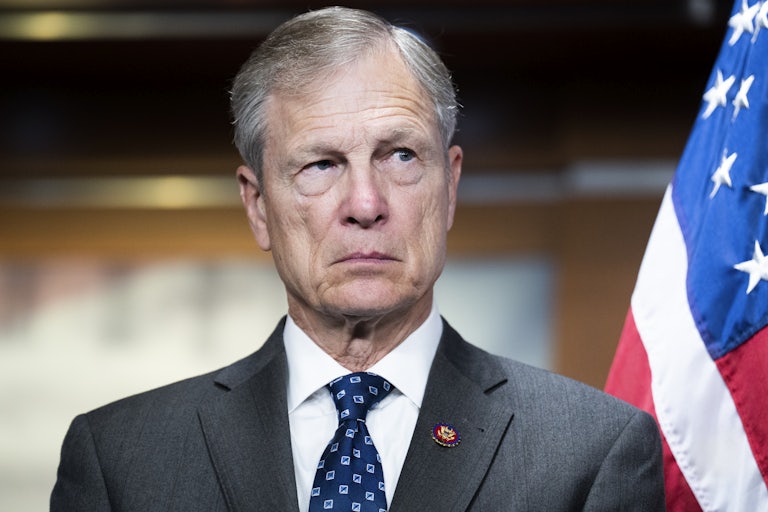
Who Is Brian Babin? More on the Congressman Who Texted Meadows About Overturning the 2020 Election

The Texas representative texted Donald Trump’s then chief of staff 21 times, warning about a Biden victory and the threats of a “corrupt Marxist dictatorship.”

Tom Williams/CQ-Roll Call, Inc/Getty Images

Representative Brian Babin was among at least 34 Republican members of Congress who texted former White House chief of staff Mark Meadows about attempts to overturn the 2020 election.

The chilling messages, first reported on by Talking Points Memo, include some notable names, but the rest read like a veritable “who’s that?” of election deniers in Congress.

Texas Representative Babin texted Meadows at least 21 times, starting before the election, but TPM was only able to verify a paltry four responses. He also signs his texts, which is not an indication of culpability but is weird.

Babin urged Meadows to “fight like hell” to win, warning that a Joe Biden victory would usher in a “corrupt Marxist dictatorship.”

He also expressed concerns that other members of Congress would try to do the right thing and stop him and his cohort from overturning the election. He asked Meadows to reach out to then–Vice President Mike Pence to help them.

Throughout his texts, Babin repeated baseless claims that the election had been stolen. He described the vote as a “theft” and, in late December, sent Meadows an article describing claims from Pennsylvania Republicans that the votes didn’t “add up.”

Pennsylvania’s Department of State had thoroughly debunked the article and roundly rebuked the state representative pushing the so-called “analysis,” but Meadows replied to Babin that he had forwarded the piece to the Department of Justice.

A former dentist, Babin has been a Trump supporter and apologist since the former president took office. In September 2020, he insisted Trump took every possible preventive measure to stop the spread of the coronavirus. He defended Trump against accusations that he had downplayed Covid-19’s deadly nature, and even compared him to Franklin Delano Roosevelt after Pearl Harbor.

In 2021, Babin voted against multiple major bills, including Build Back Better, the American Rescue Plan, the Women’s Health Protection Act, and the Covid-19 Hate Crimes Act. Last week, he also voted against the Respect for Marriage Act, which protects same-sex and interracial marriage.